

You most likely have heard how the radio industry in America is trying to get Congress to pass a law requiring that all cars sold must have an AM radio installed in them. Radio folks say this is necessary so emergency information will be available to the general public in times of a crisis.
The AM Radio for Every Vehicle Act is bipartisan legislation aimed at ensuring AM radio remains accessible in all new vehicles sold in the United States. It would require automakers to include AM broadcast radio as a standard feature, without any additional cost to consumers. The bill also addresses transparency by requiring automakers to disclose if a vehicle lacks AM radio access before the rule takes effect.
But is this really necessary, if we’re being honest with one another?
When Sue and I are on one of our many road trips, and a weather emergency or some other crisis occurs in the area that we are traveling in, our iPhones go crazy with that critical information.
Redundancy
Today, we live in a world with a lot of redundancy when it comes to communication. It’s not like a hundred years ago where radio provided the only means of immediate information to the public. In addition to broadcast radio/TV, we have computers, tablets, and smartphones filling the role of delivering emergency information quickly.
I won’t ever forget the day a tornado alert was issued for Bowling Green, Kentucky, including the campus of Western Kentucky University; every electronic device my students carried with them went off with the tornado warning.
The sound was deafening.
Obviously, as I was teaching a class at the time, no one was listening to a radio or watching TV but we all immediately knew of the imminent danger and sought protective cover.
AM Radio
From my earliest years as a listener, it was AM radio that caused me to want to pursue a career in the radio industry.
The first ten years of my radio career were spent on-air, in programming and operations. The next thirty years would see me move in to radio sales, sales management, general management and finally as a market manager of radio station clusters.
Over that period of time I watched as AM radio listenership grew older and declined, while FM radio amassed a large audience and the lion’s share of the advertising revenue.
The point I’m trying to make is, that AM radio was always available in cars and trucks, but people had moved on; to FM radio, satellite radio and portable music playing devices.
Reach people where they are, not where you want them to be.
Where Did All Radios Go?
Pete Seeger wrote a song that is applicable to the radio issue today, “Where Have All the Flowers Gone?” This song could be radio’s battle cry, by changing “flowers” to “radios.”
If you go into any retailer today, you’ll feel like Harrison Ford in Raiders of the Lost Arc trying to find a radio receiver.
Recently, Sue and I road tripped to Gainesville, Florida for another one of our grandchildren graduating from high school. During our two weeks of travel, every hotel we stayed in no longer had a radio in our room. Instead they had a large screen TV (up to 85 inches) and by our bed a charging block for plugging in our smartphones, tablets and computers.

So, should the radio industry be adding to the “AM Radio for Every Vehicle Act” as well as hotel rooms too? I think not! Have you ever tried to listen to AM radio on one of those cheap radio’s that hotels used to put into their rooms?
The Francis Marion Hotel
On our way home from Florida, we stayed a couple of nights in Charleston, South Carolina at The Francis Marion Hotel. The hotel was named after a revolutionary war hero and built in 1924. The Francis Marion hotel was early to include an AM radio in every room and even housed the city’s first radio station on an upper floor of the hotel.
The 1920s was the Golden Age of railroads, radio and grand hotels, and the Charleston Renaissance was in full bloom.
That was then, this is now.
Today, our room at The Francis Marion featured one of those clock charging cubes by our bedside, two flat screen TVs and excellent WiFi. Oh, and there is no longer a radio station broadcasting from the hotel; that’s been gone for years.
Radio Today
James Cridland reported in his latest newsletter that he read in Radio Today that the UK’s first commercial radio station is switching off two of its FM frequencies. The owners claim that DAB (Digital Audio Broadcasting) and online streaming serves its audience well enough. Cridland believes they won’t be the last either.
The Future is here, NOW!
What Do We Listen To When We Road Trip?
Everything we want to hear when we’re on-the-road comes from our smartphones. They automatically connect to our Honda’s audio system via Apple CarPlay. For music we can choose from my own music library, RadioTunes or Pandora. If we want to hear any radio station, we can listen to it via TuneIn Radio, StreamS, myTuner Radio, or Simple Radio. Plus, any time I want a quick check of the latest news, I click on my Hourly News app which streams the latest news from NPR, CBC, AP, ABC, CBS, FOX, and the BBC in succession. By the time I’ve finished listening, I not only have a good sense of what’s going on in the world, but how each news service ranks each story’s importance to its listeners.
The amazing thing about all of this is, the streaming of audio content we’ve found, is stable; with no dropouts, static or disruption of any kind. Unlike satellite radio which drops out under bridges, streaming audio does not.
In fact, my blog of January 9, 2022 titled “Why I Stream ALL of My Radio Listening,” goes into detail about how and why I started doing this. https://dicktaylorblog.com/2022/01/09/why-i-stream-all-my-radio-listening/ While we still own the 2009 Honda Accord talked about in that article, we recently upgraded to a 2018 Honda Accord for our road trips, which makes everything even easier. Mind you, this vehicle is seven years old and has an AM radio in it; somewhere, I just haven’t spent any time looking for it. The touch screen does have a button at the top that says FM Radio, even when I’m in Apple CarPlay mode, which is ALWAYS.
The Bottomline
Today we live in an ON DEMAND world. People want what they want, when they want it, and where they want it. The focus of today’s radio owner/operators should be on that reality, not on trying to keep a 20th Century technology alive by forcing it on people.
Five years ago, the Radio Advertising Bureau’s Senior Vice President Jeff Schmidt was telling radio sales people,
“If you’re selling the way you were five years ago,
you’re in trouble because the world is changing
and we need to change with it.”
And he’s right, but not just about radio sales, about the entire radio industry. It can’t try and hold back the massive change that is occurring in the world of communications. That’s the message.
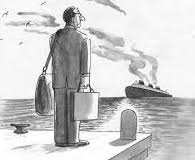
Radio needs to get on board
or
miss the boat.
 If you’re in sales, this is probably the question that haunts you most: Why do people do the things they do?
 Then Houston was hit by Hurricane Harvey and KTRH zoomed to #3, but soon after the impact of the storm began to fade and life in Houston began its long road back to “normal,” KTRH sank back to #15.
 DickTaylorBlog