

You most likely have heard how the radio industry in America is trying to get Congress to pass a law requiring that all cars sold must have an AM radio installed in them. Radio folks say this is necessary so emergency information will be available to the general public in times of a crisis.
The AM Radio for Every Vehicle Act is bipartisan legislation aimed at ensuring AM radio remains accessible in all new vehicles sold in the United States. It would require automakers to include AM broadcast radio as a standard feature, without any additional cost to consumers. The bill also addresses transparency by requiring automakers to disclose if a vehicle lacks AM radio access before the rule takes effect.
But is this really necessary, if we’re being honest with one another?
When Sue and I are on one of our many road trips, and a weather emergency or some other crisis occurs in the area that we are traveling in, our iPhones go crazy with that critical information.
Redundancy
Today, we live in a world with a lot of redundancy when it comes to communication. It’s not like a hundred years ago where radio provided the only means of immediate information to the public. In addition to broadcast radio/TV, we have computers, tablets, and smartphones filling the role of delivering emergency information quickly.
I won’t ever forget the day a tornado alert was issued for Bowling Green, Kentucky, including the campus of Western Kentucky University; every electronic device my students carried with them went off with the tornado warning.
The sound was deafening.
Obviously, as I was teaching a class at the time, no one was listening to a radio or watching TV but we all immediately knew of the imminent danger and sought protective cover.
AM Radio
From my earliest years as a listener, it was AM radio that caused me to want to pursue a career in the radio industry.
The first ten years of my radio career were spent on-air, in programming and operations. The next thirty years would see me move in to radio sales, sales management, general management and finally as a market manager of radio station clusters.
Over that period of time I watched as AM radio listenership grew older and declined, while FM radio amassed a large audience and the lion’s share of the advertising revenue.
The point I’m trying to make is, that AM radio was always available in cars and trucks, but people had moved on; to FM radio, satellite radio and portable music playing devices.
Reach people where they are, not where you want them to be.
Where Did All Radios Go?
Pete Seeger wrote a song that is applicable to the radio issue today, “Where Have All the Flowers Gone?” This song could be radio’s battle cry, by changing “flowers” to “radios.”
If you go into any retailer today, you’ll feel like Harrison Ford in Raiders of the Lost Arc trying to find a radio receiver.
Recently, Sue and I road tripped to Gainesville, Florida for another one of our grandchildren graduating from high school. During our two weeks of travel, every hotel we stayed in no longer had a radio in our room. Instead they had a large screen TV (up to 85 inches) and by our bed a charging block for plugging in our smartphones, tablets and computers.

So, should the radio industry be adding to the “AM Radio for Every Vehicle Act” as well as hotel rooms too? I think not! Have you ever tried to listen to AM radio on one of those cheap radio’s that hotels used to put into their rooms?
The Francis Marion Hotel
On our way home from Florida, we stayed a couple of nights in Charleston, South Carolina at The Francis Marion Hotel. The hotel was named after a revolutionary war hero and built in 1924. The Francis Marion hotel was early to include an AM radio in every room and even housed the city’s first radio station on an upper floor of the hotel.
The 1920s was the Golden Age of railroads, radio and grand hotels, and the Charleston Renaissance was in full bloom.
That was then, this is now.
Today, our room at The Francis Marion featured one of those clock charging cubes by our bedside, two flat screen TVs and excellent WiFi. Oh, and there is no longer a radio station broadcasting from the hotel; that’s been gone for years.
Radio Today
James Cridland reported in his latest newsletter that he read in Radio Today that the UK’s first commercial radio station is switching off two of its FM frequencies. The owners claim that DAB (Digital Audio Broadcasting) and online streaming serves its audience well enough. Cridland believes they won’t be the last either.
The Future is here, NOW!
What Do We Listen To When We Road Trip?
Everything we want to hear when we’re on-the-road comes from our smartphones. They automatically connect to our Honda’s audio system via Apple CarPlay. For music we can choose from my own music library, RadioTunes or Pandora. If we want to hear any radio station, we can listen to it via TuneIn Radio, StreamS, myTuner Radio, or Simple Radio. Plus, any time I want a quick check of the latest news, I click on my Hourly News app which streams the latest news from NPR, CBC, AP, ABC, CBS, FOX, and the BBC in succession. By the time I’ve finished listening, I not only have a good sense of what’s going on in the world, but how each news service ranks each story’s importance to its listeners.
The amazing thing about all of this is, the streaming of audio content we’ve found, is stable; with no dropouts, static or disruption of any kind. Unlike satellite radio which drops out under bridges, streaming audio does not.
In fact, my blog of January 9, 2022 titled “Why I Stream ALL of My Radio Listening,” goes into detail about how and why I started doing this. https://dicktaylorblog.com/2022/01/09/why-i-stream-all-my-radio-listening/ While we still own the 2009 Honda Accord talked about in that article, we recently upgraded to a 2018 Honda Accord for our road trips, which makes everything even easier. Mind you, this vehicle is seven years old and has an AM radio in it; somewhere, I just haven’t spent any time looking for it. The touch screen does have a button at the top that says FM Radio, even when I’m in Apple CarPlay mode, which is ALWAYS.
The Bottomline
Today we live in an ON DEMAND world. People want what they want, when they want it, and where they want it. The focus of today’s radio owner/operators should be on that reality, not on trying to keep a 20th Century technology alive by forcing it on people.
Five years ago, the Radio Advertising Bureau’s Senior Vice President Jeff Schmidt was telling radio sales people,
“If you’re selling the way you were five years ago,
you’re in trouble because the world is changing
and we need to change with it.”
And he’s right, but not just about radio sales, about the entire radio industry. It can’t try and hold back the massive change that is occurring in the world of communications. That’s the message.
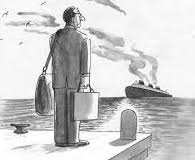
Radio needs to get on board
or
miss the boat.
 DickTaylorBlog
Dick,
The comic strip character Pogo said “We have met the enemy and he is us.” That’s radio. Radio has aided to its own downfall as much as any competitive factor. You can’t ignore change and hope things will remain the same. The digital age smacked radio in the face and radio was slow to react. This AM in every car bill comes at a time when the majority of broadcasters ignore their AM stations and treat them as throwaways. Have you listened to AM lately? It’s pitiful. Little if any local programming. Syndicated or infomercials. Lots of dead air or multi elements running over top of each other. Local information? Weather emergencies? Nope. It’s clear that many of the AM’s have no one paying attention to what’s airing. And how about the horrible technical quality. A good friend and a career radio engineer told me recently he won’t take on AM stations any longer because most owners won’t even spend the dollars necessary to keep their stations in compliance. Yes there are still a handful of great AM stations…..WLW, WABC, WGN to name 3 and there are many others. Religious and ethnic formats use AM successfully. But for every successful AM station there are hundreds that aren’t. How many small towns have a local station doing any news of local community events? How can congress take the AM in every car bill seriously when most broadcasters don’t. Radio has a lot of problems and for most operators AM is far down on their list.
LikeLiked by 1 person
I couldn’t agree with you more, Mike.
That’s my point. The radio industry needs to focus on its FM service and digital service, OR it will become what AM is to listeners of audio content.
I don’t think we’ve crossed the tipping point yet, but it gets closer with every day.
The rest of the world is moving on and so must American radio.
-DT
LikeLike
Dick,
Maybe it’s time for a total reset in radio leadership. New faces. New ideas unburdened by the past. Leaders focused only on the future who never experienced radio in the pre digital era. What’s going on now is not working. Like you, I started on air in my teens eventually moving into sales, sales management, general manager, market manager and COO of a small company of 25 stations. I loved it. 50 years went by in a flash. I am saddened by the struggles radio faces today.
LikeLiked by 1 person
The few AMs that I know which are paying expenses and sometimes makes a profit, are AMs that rely on their FM translators. All are known as FM stations (like ABE 93.7). Instead of worrying about AM the FCC should up all 100 watt non-commercial stations to 250 watts (the current FM translator power), and allow FM translators to dump their AM licenses and up power to at least 1,000 watts. It’s a weak argument to keep AM on the air is based on using commercially licensed stations to maintain the national alert system. It’s not because AM provides any value in programming around the year.
LikeLiked by 1 person
Paul,
I agree with the idea of letting many AM radio stations to cease broadcasting on the AM band and letting their FM translator become the main delivery channel for their programming. This should be done from the get-go and we would have seen an orderly transition to the FM band.
In small markets, where the local AM station is either a daytimer or greatly reduces AM power after sunset, their FM translator provides a much better local service 24/7. However, I doubt many of those local stations are staffed that way.
Thank You for sharing your thoughts on this topic.
-DT
LikeLike
100% agree with you and for having the guts to write this.
Now about your NAB membership…….âºï¸
Hope youâre doing well.
JS
John Shomby
Owner/CEO
Country’s Radio Coach, Inc.
jshomby@countrysradiocoach.comjshomby@countrysradiocoach.com
757-323-1460
https://countrysradiocoach.com
Talent Consultant, Coach and Executive Producer
Backstage Country
[cid:B1D6B285-C6CF-483A-8CAB-63F462D6A8FA@attlocal.net]
LikeLiked by 1 person
Thank You, John.
You might be surprised (or not) that many industry leaders have told me how much they appreciate my speaking out on issues they feel they cannot. I appreciate you “going public” with that kind of support.
I’m NOT sour grapes about this topic, but feel if we keep trying to keep “buggy whips” in every vehicle, we will miss the BIG PICTURE of keeping broadcast radio in every vehicle.
That’s the whole ballgame, in my opinion. That’s where our energy needs to be applied.
-DT
LikeLike
And last I saw, you can also stream AM Radio!
LikeLiked by 1 person
Yes, John, you can stream AM radio.
When I travel to Boston, I often find streaming WBZ – 1030AM allows me to listen to this heritage station long before I’m in range of their 50,000 watt signal.
Likewise, streaming 650AM – WSM out of Nashville, lets you hear them in STEREO. When I made a guest DJ appearance on WSM, eleven years ago, I found they had more listeners listening to them almost anywhere in the world, than they had via their 50,000 watt heritage AM broadcast signal.
The world of communications is changing VERY FAST.
-DT
LikeLike
Dick,
After 44 years of working at some very notable 50,000 watt NYC AM Radio stations (WHN, WOR, & WABC), I have to say, even if there was great programming to listen to, the amount of electronic crap in the air, has made AM radio virtually unlistenable! This ain’t the late 60s when I was able to listen to Cousin Brucie on my Dad’s new 66 Ford’s AM radio while on vacation in Miami Beach!! Before I retired from WABC almost 10 years ago, getting off the Long Island Rail Road at Mineola, I was unable to hear WABC before I pulled out of the garage. We’re currently on our 3rd Honda CRV lease and I don’t believe I’ve set AM presets on any of them! The world has changed…get over it!
Frank
LikeLiked by 1 person
Hi Frank,
YES, you are so right about how the AM broadcast band has been allowed to be so degraded by…just about every electrical thing! No one seems to verbalize that reality, but then it’s probably because the people don’t actually listen to AM radio for the most part. Most AM stations are available on an FM frequency, as well as via streaming.
Set AM pre-sets? Nope, neither have I. I actually haven’t even looked to see where the AM band is located on my 2018 Honda Accord touch screen.
Thank You for sharing your perspective, Frank.
-DT
LikeLike
Totally agree. The government should allow auto makers to make their own decisions and use their own judgment when making business decisions.
LikeLiked by 1 person
Thank You Steven for stopping by the blog and adding your opinion.
-DT
LikeLike
Training a sales person? Who does that, anymore? Mentoring? Forget about it. One person in the office doing telemarketing for current upcoming events? Gas is too expensive, don’t drive 15 miles to meet with that new car dealer, or the bank President. I’ve seen this in my county. Can only imagine what the rest of the country sees.
LikeLiked by 1 person
You make a valid point. The personal touch, that radio did so well (both on-the-air and on-the-street) is gone.
Thank You Mark for making that point.
-DT
LikeLike
Mr. Taylor I am with you on this. The Bill to mandate AM radio was introduced by Ted Cruz, and not for warnings about weather etc, it was for conservative talk radio,and he said so. People today do not want to listen to a mono signal for music. They blew it by not developing AM stereo in the 80’s better. I have spent 52 years in media, mostly in radio,and streaming stations. I have not listened to a terrestrial station in 15 years due to a never ending tsunami of commercials, short playlists that play a song every 90 min be it classic hits to contemporary. Like you, my phone receives warning alerts, directions to a destination, that also alerts me to speed traps or accidents. I can tune into news as well with cable news network aps,or other news services. I have 6 of my own playlists, where each lasts around 29 hours without a repeat. I have Sirius-XM streaming customized to my tastes. I have aps to several streaming sites like Super WCFL, Famous 57 Philadelphia with all the old jingles and great classic hits, plus olideradio.us that has top of the hour network news, local weather, retro commercials, and jock drops. There is no reason for me to listen to radio, unless I want to hear hate talk radio, religion where each proclaims to be better than the others, sports and spanish. So to mandate AM radio in cars is 100 years too late.
LikeLiked by 1 person
Much as Congress people seem to never actually read the bills the vote to pass, I sense they never actually listen to the radio any more either. They are simply out-of-touch on a lot of things they are supposed to be representing their constituents on.
A hundred years ago, no one had to mandate auto makers put a radio inside their vehicles, people demanded it. That demand, like so many other things from the 20th Century are now in the past.
Thank you for taking the time to share your thoughts on this issues.
-DT
LikeLike
I agree generally with your reply. But Ted Cruz did this for one person…Sean Hannity…whose talk show has begun to wane. Yes, I work for a Hannity affiliate. One that interrupts his show every day to do a local talk show with one rule: no politics. And it is succeeding.
You see, I remember when talk radio was NOT a “political” thing.
You spoke of local issues, local topics like: How to cook a good steak, what constitutes a fine wine, and jokes were told. A lot.
And, oddly enough, we have a staff of 20 or so people working for 4 stations. And we turn a profit.
LikeLiked by 1 person
Hi, Dick:
You’ve probably seen this already, but it’s good to see a station that can somehow make “the old way” work (and an AM station, no less!). Certainly can’t happen everywhere.
https://radioink.com/2025/07/14/it-takes-a-village-how-wvlg-built-a-beacon-for-the-50-plus-crowd/?vgo_ee=nPF6zCaK6UcYBW6PzQoSzGdKAzHEJGIvO5C7LPbgfMEWxKdEaaW9EW4EXMry6g%3D%3D%3A8yUbWVwEHvjOzFbyiOuvX%2BrkQJMeFbCi
This goes more to an earlier column you wrote regarding AM, saying in essence that AM must give listeners a reason to keep it in cars, not legislate it….
Roy W. Nilsen
Chief Engineer
Townsquare Media – Atlantic City
950 Tilton Road, Suite 200
Northfield, NJ 08225
609-915-2111 (M)
LikeLiked by 1 person
It’s good to see this station embrace the future as WVLG-AM (known as “The Villages Soundtrack”) also broadcasts its primary channel from 2 FM translators (102.7 and 104.5) which is probably where the majority of their audience listens. In most parts of the USA a station operating on AM with less than 1,000 watts would not have much of a chance to be heard because of the electric signs and other interference along the roads. Possibly, reception is better in the flat lands of Florida. Plus they stream online – https://player.amperwave.net/7041 I gave them a listen, a good station for sure.
LikeLiked by 1 person
Hi Roy,
Thanks for checking in and sharing that story about WVLG – 640AM. That AM radio station is also broadcasting on two FM translators (102.7 and 104.5) which give the station a larger coverage area and allows listeners to hear the station in STEREO. I’m betting most people listen to the FM channels.
But, what I found most interesting in the article (written by one of my former broadcast students, Cameron Coats) is that the program director has authority over the commercials the station accepts for broadcasting and also the way those commercials are produced for air.
Back in the day when I was general manager of WFPG AM/FM, we exercised that same authority over both the types of ads we’d accept and also the way they were produced. Sadly, today’s radio stations mostly will play anything for a buck and never take into consideration its negative impact on the radio listener.
There was a time when WZXL first came on-the-air in Wildwood, NJ that it only allowed commercials that it produced to be heard on its classic rock format. I remember being at a party and when the ad break came on, everyone got quite to listen to it. YES, the ads they wrote and produced were that good.
Radio has abandoned so many of the elements that made it enjoyable to listen to.
Sounds like WVLG understands this and it’s having a positive affect on attracting a loyal listening audience.
-DT
LikeLike
Hi, Dick. I’ve been waiting to comment on this post for a little while.
The answer for radio boils down to two words: local and investment.
You have to invest in a community to make radio work. And you have to invest in your people.
We don’t have to be 24-7 anymore, but we have to be local.
LikeLiked by 1 person
That’s the kind of radio you’ve always done, Kevin. And you’ve got the awards to prove it.
-DT
LikeLike