Category Archives: Mentor

Get Out of Your Comfort Zone

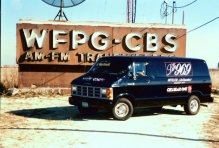
WFPG Transmitter SiteFor thirteen years I was the general manager of WFPG AM/FM in Atlantic City, New Jersey. The stations were successful. I was active in Rotary, the local chambers of commerce, community social programs in addition to running the radio stations.

We did the state’s first LMA (Local Marketing Agreement) adding a third radio station to our operation.

We had a print division that did zoned coupon mailers and produced an annual calendar for local advertisers.

I was in the zone, my comfort zone.

Success Is a Poor Teacher

When new ownership took over the radio stations in my 13th year of managing them, one of the owners was to be the “managing partner.” He didn’t have the equity stake to invest, so his contribution was to move to Atlantic City and manage the stations for the group. That meant that everyone in the radio stations were needed but me.

As I set out to find a new radio general manager position, I would be faced with something new that the broadcasting industry had never had to deal with before, consolidation. Consolidation was like a game of musical chairs, only in this game when the music stopped, you were out-of-a-job.

I thought that my long period of success would be a plus in finding my next position but kept hearing “you’ve been at the same place for over a decade?” I would soon learn that this wasn’t perceived as a positive.

My Road Trip

Eventually, I would land my next GM position and move to a new state. That would lead to a series of moves every two to three years after that as consolidation kept changing the landscape of the radio industry as we knew it.

Delaware, Maryland, Iowa, Pennsylvania and back to New Jersey a couple of more times would be my life over the next decade.

While I never would have chosen this path, what I would realize was that I learned more over this period of time than being in the same place for the previous decade. That being successful and in your comfort zone is a poor teacher.

College Professor

Seven years ago, I made a career change. I went from market manager of a cluster of radio stations for Clear Channel to broadcast professor at Western Kentucky University. I was moving out of my comfort zone BIG TIME.

That first year was a lot of heavy lifting as I created every course, every lesson, every test for each of my classes.

Eventually, I grew to a new comfort zone at the university. I was on university senate and several committees. I graduated from the university’s master advising certification program and advised around 100 students each semester. I graduated from the university’s police academy and my office was a campus “safe space” for students, faculty and staff. And I was active in state broadcast associations along with founding and directing a radio talent institute on campus.

Why Comfort Zones Are Bad for You

Staying in a comfort zone feels peaceful and relaxing. Comfort zones are not challenging. They become limiting and confining. They can produce a sense of boredom.

I know I certainly had that feeling of “Is That All There Is?” during my long tenure in Atlantic City.

Change is the only constant you can depend on in the world. Nothing stays the same. If you’re not growing then you’ve “gone to seed.”

WWJD

What Would Jobs Do?

My fiancé shared with me the last words of Steve Jobs and it’s illuminating.

Jobs said that in the eyes of others his life had been the symbol of success. However, Jobs found that apart from his work, his life held little joy.

Steve had stayed in his comfort zone.

Once you’ve accumulated enough money for the rest of your life, you need to change your focus to pursuing objectives that are not related to wealth.

It is why I started this media mentorship blog in January 2015.

Happy New Year 2018

The new year is traditionally a time when we all look in the mirror of our lives and contemplate where we want to go next.

If you want to grow in 2018, decide to get out of your comfort zone.

Remembering that you are going to die is the best way I know to avoid the trap of thinking you have something to lose. You are already naked. There is no reason not to follow your heart.”

– –Steve Jobs

16 Comments

Filed under Education, Mentor, Radio

Best of the Blog 2017

73On this last Sunday of 2017, it’s a good time to look back at the year just past and share with you The Top 5 Most Read and shared blog articles from 2017. Maybe you missed them or perhaps you’d like to read them again.

To date I’ve published 180 articles that have been viewed around the world over 115,800 times.

My Most Read Article in 2017

My most read/shared article of this past year was “Coal Ain’t Coming Back & Neither is AM Radio”. It was published on August 20, 2017. It told the story of how the fate of the coal industry in America was akin to that of AM radio stations. America’s broadcast industry was built on AM radio beginning with the first commercial radio license issued in 1920. This article received the most comments of any I published this year and was widely shared.

Second Most Read Article of 2017

In April, I wrote an article based on a blog reader question titled “The Question Radio Itself Has Yet to Answer.” That big question was, “what can radio do that other media can’t.” I opened the issue to readers to share with me their thoughts before sharing mine. It stimulated lots of emails, sharing and discussion.

Third Most Read Article of 2017

My third most read article would be the follow-up article to the one above, “What Can Radio Do That Other Media Can’t.” It was in this article I shared some of the over fifteen pages of reader comments, as well as my own thoughts. In my summary, I boiled it down to 5 key things: Live, Local, Community, Companionship and Relevant.

Fourth Most Read Article of 2017

In October, after the FCC voted 3 to 2 to eliminate the Main Studio Rule, I wrote “Live & Local?” It posed the question about maintaining the first of the five key things radio can do that other media can’t I wrote about back in April.

In this article, I shared the observations of Maynard Meyer, a local radio manager and owner from Madison, Minnesota who concluded in his statement to the FCC in 2004, “From what I’ve seen through my personal experience, as soon as a hometown studio is closed and relocated, the local service is relocated as well.”

After the article published, Mr. Meyer emailed me and said he still felt the same in 2017 as he did back when he testified before the Federal Communications Commission 13-years earlier.

Fifth Most Read Article of 2017

And finally, the fifth most read blog article I wrote and saw lots of people sharing, was “Radio’s Best Feature.” In it, I wrote about the speed of change in our world today and how to expect it to keep accelerating going forward.

Radio needs to understand its role in humankind. Technology doesn’t transform our human nature.

Our need for love, touch, companionship and community will always be a part of our humanity no matter what technology brings.

Most Read Articles, Period

Two articles I’ve written continue to see lots of traffic and continue to be far and away the two most read on my blog.

They are “SiriusXM Radio is Now FREE” and “The Day the “Dumbest Idea” Invaded the Radio Industry.” Both articles have now been read over 7,000 times.

The first article I wrote for my blog was “Clear Channel Media & Entertainment becomes iHeartMedia” and it was read a total of five times.

Why I Blog

I blog for broadcasters, educators and students.

I blog to provide media mentorship and to pay-it-forward to the broadcasting industry that I have been a part of for 50-years.

I’m grateful for the more than 88,000 people from all over the world who have visited to read an article that caught their interest.

FREE SUBSCRIPTIONS

You can subscribe to this blog for FREE and get a copy of each week’s article delivered to your email IN BOX every Sunday morning. To subscribe, simply go to the bottom right-hand corner of your screen and click on the FOLLOW button. (If you’re accessing this blog via a mobile phone or tablet, that button may not be visible, so be sure to do this on a computer or laptop.)

Next week I will begin my fourth year of blogging with all new articles.

Thank You for reading.

Feel free to contribute your thoughts to the discussion in the comments. Together we can all learn by sharing our experiences, knowledge and wisdom.

Happy New Year!

5 Comments

Filed under Education, Mentor, Radio, Sales

Radio’s Serenity Prayer

Serenity Stained Glass Window


In everyone’s life, there are trials and tribulations.

During a particularly trying moment in my life, I found comfort in Reinhold Niebuhr’s Serenity Prayer.


Niebuhr’s Serenity Prayer

God grant me the serenity to accept the things, I cannot change; courage to change the things I can; and wisdom to know the difference.

The prayer is actually made of three parts: 1) accepting things that can’t be changed, 2) courage to change the things that can be changed, and 3) wisdom to know the difference.

So how does that apply to those of us in radio broadcasting?

Somethings Never Change

I’m sure, like me, you’ve been reading a lot about the future of radio and all the changes it faces on the horizon of 2018 and beyond.

It can be overwhelming.

But I fear that too many in radio are too focused on changing the things that are beyond our control or are working hard to change the things we believe we can change, and are missing the bigger opportunity, the things that won’t change.

In my long radio career, I’ve seen the consistency of radio’s power to make a difference in a community.

I’ve also seen the number of radio stations on-the-air multiply like bunnies, and the number of radio pre-sets on a car radio expand to 30, but the number of favorite radio stations a person has remains at about three. And one of those three favorite radio stations will dominate with over 80% of the time spent listening to radio.

Nielsen confirms this is still the case.

“I very frequently get the question: ‘What’s going to change in the next 10 years?’ And that is a very interesting question; it’s a very common one. I almost never get the question: ‘What’s not going to change in the next 10 years?’ And I submit to you that that second question is actually the more important of the two — because you can build a business strategy around the things that are stable in time.”

– Jeff Bezos, Amazon CEO

Radio’s Constants

Great radio will always be about the listener.

Great radio personalities will be great entertainers and a friend to the listener.

Great radio will not only serve listener needs but also their wants and desires.

Great radio will be dependable, in good times and bad.

Great radio will always be about community and companionship.

Great radio will always be surprising and unpredictable.

Great radio will attract listeners who don’t want to miss out.

Great radio adds value to everyone it comes in contact with.

Invest in the Future

Jeff Bezos is a very rich man.

Jeff began Amazon in his garage in Seattle twenty years ago.

Jeff bought the Washington Post with his pocket change and infused it with a new spirit by focusing on a newspapers’ constants.

Bezos says the way to invest in the future, is to identify the constants of people who use your product or service and build on them with relentless focus.

For Amazon it’s lower prices, and speedier delivery for example. Do you see either of those going in the opposite direction, with respect to consumer expectations, in the years ahead?

And so, it is with radio.

The very constants that made radio great for nearly one hundred years will continue into the next century. The secret is not to take your eye off the ball.

“When you have something that you know is true,

even over the long term,

you can afford to put a lot of energy into it.”

-Jeff Bezos

Radio needs to live one day at a time, enjoying the special place it holds in people’s lives.

Radio needs to accept the hardships, knowing they will lead to a better place.

Trust that if you focus on the radio constants, the future will be alright.

Or as Bezos put it in Forbes, “Successful businesses are those that continue to find ways to best fulfill core needs. Does our business fulfill one or more core human needs? Are we meeting that need in the most effective and efficient way possible given the changes in technology and people’s expectations?”

(Hat Tip to John Frost’s Frost Advisory #390 for the inspiration)


12 Comments

Filed under Education, Mentor, Radio, Sales

Radio Grows Comunication Skills

Orson WellsHaving been in higher education for the past 7 years, I heard a lot about the need for students to be fluent in the STEM skills (Science, Technology, Engineering and Math).
A recent study from CSIRO found that STEM skills were indeed important during the period of 2009-2016, but that in the future occupations requiring communication skills will grow the fastest. As our world becomes more technologically enabled, what will keep humans from being replaced by robots will be their ability to connect, communicate, understand and build relationships.

Google It

We live in a world where skills change quickly and facts can be Googled from one’s smartphone.  In order to be successful in the 21st Century, everyone must be able to work collaboratively and learn to be emotionally intelligent.

Those who possess the skills such as active listening, empathy and teamwork will grow in demand across all work sectors.

While we will still need people with STEM skills going forward, the numbers needed will decline as the work of programming will be done through artificial intelligence by the very machines that need it done.

Jobs requiring a high level of interpersonal and/or problem-solving skills are the ones that can’t be automated.

Radio’s Role in Developing Key Communication Skills

I was working in commercial radio when I was in the 10th grade in high school. What it taught me that school didn’t, was verbal communication skills. Being a radio personality means having to develop public speaking skills and being able to speak extemporaneously.

In radio, you learn how to serve a listener – both over the air, on the phone and on remote broadcasts.

Working in radio brought be closer to the community I lived in. I covered elections, breaking news, births & deaths, and was active in local charities.

Over my high school and college years, my radio work would see me hosting talk shows, buy-sell shows, gathering-writing-&-reporting news, playing Top 40 music, beautiful music, Irish music, Polish music, country music and middle-of-the-road music.

Each radio assignment required different communication skills.

Radio & Education

A quick check of the number of high school radio stations in the United States on Wikipedia shows about 250 currently on the air.

Students who are exposed to radio work as part of their high school education will not only find it to be a fun and exciting experience, they will also be acquiring the very critical communication skills that will help grow personally and professionally.

People who can create exciting, engaging, stimulating and fun radio have what it takes to be successful in life.

Ronald Reagan

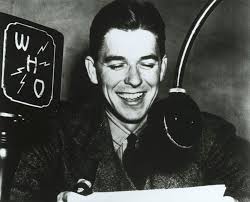
Ronald Reagan WHO.jpegOur 40th President of the United States, Ronald Reagan, was called “the great communicator.” President Reagan learned those critical communications skills as a radio broadcaster. First at WOC-AM1420 in Davenport, Iowa.

When WOC consolidated (yes, that kind of thing was happening back in the 1930s too) with WHO, Reagan would go on to recreate Chicago Cubs baseball games.

While doing one of these recreations in 1934, the wire service feeding the play-by-play descriptions of the game went dead. Reagan, knowing that other stations were also broadcasting this game, knew he had to hold his radio audience and would improvise saying hitters on both teams were hitting foul balls off of pitches until the wire was restored.

Radio builds your character in moments like that.

Orson Welles

The Mercury Radio Production on CBS, “War of the Worlds,” brought Orson Welles to the attention of Hollywood. One of the aspects Welles brought to the movie industry was his extensive radio experience. In his greatest film masterpiece, “Citizen Kane,” Welles used a combination of live sound with recorded sound to create an almost three-dimensional audio illusion for Charles Foster Kane.

Radio is what inspired Orson Welles to push the aural possibilities of the film medium.

Theater of the Mind

Radio has the ability to take a listener anywhere.

Radio also has the ability to provide the foundation to take the radio performer anywhere as well.

No matter what you want to do with your life, radio will give you the communication skillset to get you there.


8 Comments

Filed under Education, Mentor, Radio, Sales

How Will You Measure Success?

Carpet Baggers (Music Man)That seems like a simple question.

But in reality, it’s really complex.

Worse, most people have never asked themselves this question, let alone answered it.

Advertising Strategy

Let me state for the record that I’m a BIG Wizard of Ads disciple. Roy H. Williams is the person known as “The Wizard of Ads.” I have the Wizard’s bestselling book trilogy, taught the Wizard’s methods in my sales class at the university and am a member of the Wizard Class known as the “Fearless Flyers.” (Ask me why, if you want to know why my class was named that.)

A key question to ask any advertiser at the outset of doing business is, “How will YOU measure success.”

Simply saying, to make a lot of money is not the answer.

If money is the goal, then how much money and in what period of time, needs to be asked. It is important that both the advertiser and the seller of advertising are on the same page. Both parties must agree before you can move forward.

12 Core Questions

I recently shared a graphic from fellow Wizard Craig Arthur that listed 12 core questions an advertiser needed to answer when developing an advertising strategy. Let me explore those questions in a little more detail here:

  1. WHAT are you trying to make happen? What’s the destination you are trying to reach with your advertising?
  2. HOW will you measure progress? What will be the method employed to keep track of how things are going? How will things be tweaked to insure progress is being made?
  3. HOW big is the pie? In other words, how big is the market for what you’re trying to accomplish? It’s no use winning if the market potential is so small you still starve.
  4. HOW good are your competitors? In the musical, The Music Man, the carpet baggers (picture above) would constantly say “But you gotta know the territory.” You need to know who the people, businesses, systems, etc. are, that you will be up against.
  5. HOW good are you? This is a tough one. You need to be able to look yourself in the mirror and honestly address your own skills and abilities. Can you provide an outstanding customer experience?
  6. WHO to talk to? Who are the customers you’re attempting to attract? You need to be specific and target.
  7. WHAT to say? Roy says there are no wrong media to use to tell your story, only bad stories. In other words, is your story relevant? If it is, it will reach your target by word of mouth a.k.a. sharing on social media.
  8. HOW to say it? Most radio stations no longer employ dedicated copywriters and production people. Everyone is multitasking. Crafting the message is most critical. Just like in the movies or on TV, the script makes the difference between a hit and a miss.
  9. WHAT will it sound/look like? Having a well written message will sink like the Titanic if it’s produced poorly. Dick Orkin’s Radio Ranch not only produces great copy but employs professional voice actors to deliver the goods.
  10. HOW much to spend? When crafting an ad budget you should keep in mind that you want to hit the target every week. When the data isn’t available, say in an unrated radio market for example, the rule of thumb is 21 ads per week (3/day), 52 weeks a year.  If the ad budget is small, then spend it on only one station and possibly on only one daypart until the business grows to support more.
  11. HOW to schedule it? In all advertising, repetition is key to gaining top of mind awareness in your customer. Radio is best because of its affordability to allow virtually any advertiser to purchase a three frequency with the listener on a weekly basis. To achieve this minimum level of frequency is usually unaffordable in other mediums.
  12. WHERE to say it? Again, Roy believes there are really no wrong radio stations, only wrong messages. Obviously, there are some businesses/products that are an obvious non-fit with a particular radio station format, but in general, any radio station with a cume of 30,000 people or more has the audience size to get an advertiser good R.O.I. (Return On Investment).

As Craig Arthur points out, most advertisers skip questions 1 to 11 and only focus on question 12.

That’s why most advertising fails.

4 Comments

Filed under Education, Mentor, Radio, Sales

Why do people buy what they buy?

120If you’re in sales, this is probably the question that haunts you most: Why do people do the things they do?

Daniel Pink recently wrote a book “To Sell is Human” and in the book, he tells us, we are all in sales today. In fact, we may not even be aware that we are selling all the time. Daniel told the Harvard Business Review:

“I’m obviously selling books because that’s a part of my business. But if you go beyond that, I (also spent my) time trying to convince an editor to abandon a stupid idea for a story. I tried to get an airline gate agent to switch his seat. I’ve got kids. So, I’m trying to persuade my kids to do things. I have various people I do business with. And I’m trying to get them to see it my way, rather than their way, to go my direction, rather than their direction.”

“And when you actually tease it all out, I’m spending an enormous amount of time selling.”

We’re All in Sales

Looking at this from a broadcaster point of view, we too are all in sales, NOT just the people in the sales department.

Programmers are selling their ideas to management and if management gives them enough rope, they then have to sell those ideas to their air staff who then has to sell the concept to the listeners.

Events Change Our World in a Heartbeat

Sometimes events change the dynamics of what people want, need and do. The recent hurricanes have certainly had that effect on broadcasting.

In Houston, KTRH was ranked #11. 122Then Houston was hit by Hurricane Harvey and KTRH zoomed to #3, but soon after the impact of the storm began to fade and life in Houston began its long road back to “normal,” KTRH sank back to #15.
I ran a news-talk-information AM radio station back in the 90s in Atlantic City and in spite of our big commitment to local news and information, research showed that people would rather spend their day with one of the many FM music stations. However, they knew in times of coastal storms or other emergencies, our AM radio station was the one to turn to.

Radio cannot live waiting for the next emergency.

iPhones vs Androids

We all know that iPhones have not activated the FM chip to receive OTA FM radio broadcasts in their older iPhones. Plus Apple’s newest iPhones (7, 8 & X) don’t even have an FM chip in them to activate. So, if having an FM chip in their smartphone was important to Apple’s customers, why do people keeping buying iPhones? Maybe it is because they use them for other things.

In the USA Google’s Android and Apple’s iOS mobile operating systems are sharing the market about evenly says John Koetsier writing in Forbes. However what we’ve seen over the last couple of years is that what they don’t share equally is commerce. iOS is used to make more online purchases than Android. If you’re selling stuff, that’s an important distinction and its why Apps are usually first developed for the Apple Store and then later for Android devices.

Digital Cameras

I recently read an article that said if digital cameras were to stay relevant, they should connect to the internet. Guess what, they now can. Here are seven of the best WiFi cameras on the market according to Lifewire.

Should they also be able to make & receive calls, texts? Contain an FM chip?

As everything becomes connected to the internet should they also be able to receive OTA broadcast?

Electric Cars

BMW was the first car company I was aware of, that when it introduced its all electric car said it would not contain an AM radio. BMW said they couldn’t isolate the noise interference it would cause to the AM signals.

Funny, but I remember when cars used to have only an AM radio and that isolating an alternator was often necessary to not get horrific noise through the speakers. Is this really that much of a problem or has BMW carefully defined its customer’s wants, needs and desires?

Tesla in introducing their new Model 3 also said AM radio would not be part of the center stack options.

Do you think this will give people pause in buying an electric vehicle?

Go with the Flow

None of these things really represent a change in why people do the things they do. Roy H. Williams, the Wizard of Ads, has been writing about these things for decades.

In his book “Secret Formulas of the Wizard of Ads” in Chapter 70 “Better Jewelry, Better Jeweler,” Roy poses this question: “If you had to choose between selling what you wanted to sell, or what the majority of people wanted to buy, which would you choose?” Your future success is determined largely by your answer to that very question says Roy.

Bringing this back to broadcasting, AM, FM, digital, TV, cable, streaming is really nothing more than a display case in a jewelry store. It’s what you put into that display case that matters.

Your success comes down to serving your viewer or listener in the very way they want to be served.

If you’re in sync with the people of your broadcast property’s service area, then you will enjoy their business and they will demand you be easily accessible on the latest device.

The curve ball today is connecting your programming to the internet. The internet is a global community. You can’t be all things to all people. If you try, you will fail.

Define your market, know what they want, then serve it up to them. It’s OK to put it on the internet as long as you stay true to the people’s wants and needs that you aim to serve.

5 Comments

Filed under Education, Mentor, Radio, Sales

Managing Others

Dick Taylor PresentingFor most of my life I was a radio manager. Then I had the opportunity to be a university professor. What those two professions had most in common was the training of others, employees in the work place and students in higher education.

Be the Change

As a parent, I quickly learned that my children didn’t learn as much from what I told them but in observing how I, myself, acted. I credit my mother and father for this form of parenting because that’s how they raised their three boys.

Mahatma Gandhi put it this way:

“You must be the change you want to see in the world.”

I swear, I didn’t

My oldest son never uttered a single swear word until he went to school. One day when he was helping me work in the yard, he let out a loud curse.

It was then that I said to him, “you may have noticed that your mother and father don’t use those words. Neither do your aunts, uncles and grandparents. Now if you want to talk that way around your friends, that’s your decision, but around your family, please don’t.” He never used that kind of language again – at least around me.

Swearing, Part 2

Years later I would be a radio Market Manager in Iowa with a lot of employees in my stations. Not too long after I had taken over the property, my Operations Manager came into my office and closed the door. (When people close your door behind them, it’s usually not a good sign.)

I said, you look like something’s serious is on your mind. What’s up?

He said, “you’ve made a big impact on the employees of these radio stations. Everyone is afraid to swear around you because you don’t ever swear.”

I laughed.

Then told him that it wasn’t because I didn’t know those words but because I personally chose not to use them, but it didn’t bother me if others did.

He sighed a big sigh of relief and said he would spread the word.

But here’s the interesting result: people continued to very rarely swear at those radio stations.

Starting on Time

In my university classes I set certain standards by my actions. I told students on the first day of class that I would always start my classes on time. That I would be setting up to deliver my lectures about 15-minutes before the start of class and that when it was time to start I would close the classroom door. That closed door was to keep hallway noise out but never students and if for some reason they were running late, they could always enter the classroom, just be courteous of other students. Virtually every student was in class before the start.

Teaching punctuality came by being punctual myself.

Another lesson in punctuality came with turning in assignments by the day and time they were due. I made it very clear that late assignments would not be accepted. Period.

That’s because in the workplace, in life, everything has a deadline.

Picking Up Trash

One time when I was walking through an airport to my plane’s gate, I picked up some paper that was on the floor near a trash receptacle and placed in the can. The person behind me said, “You either own a business or manage one.” To which I smiled and replied, “Guilty.”

Everyone is watching you. Noticing how you act.

Always do the right thing. Always.

Managing Others Begins with You

To be an effective manager of other people, to train them to do things the way you wish to see them done, you must first exhibit those behaviors in the way you live your life.

Nothing is more powerful than being the change you want to see in others.

6 Comments

Filed under Education, Mentor, Radio, Sales

The Largest Financial Decision in Your Lifetime

122I was just reading an article about car buying and it said that buying a car is one of the largest financial decisions most consumers will make in their lifetime.  Really? I thought that was buying a house.

After being a university professor for seven years, I left with a feeling that getting a college education might be the largest financial decision. Today, student loan debt tops $1.3 trillion. The number of Americans with student loan debt is a record 44.2 million.

A record 107 million Americans now have auto loan debt. Worse, 6 million of them are behind on their auto loan payments.

Homeowners are doing little better with only one in four having more equity in their home than debt. Unfortunately, 5.4 million homeowners are seriously upside down – meaning they owe more on their mortgage than they can sell their home for. The rest of the homeowners are somewhere in the middle.

Then again, maybe it’s the cost of health insurance or putting away money for retirement.

Finding a Purpose in Life

Have you found yours yet?

I was lucky, I learned at a very young age what I wanted to do with my life.

It was to be a disc jockey on the radio.

Until one day, after being a DJ for ten years, I changed my mind. Now I wanted to be the radio station general manager.

That lasted over three decades until I changed my mind again. Now I wanted to be a university professor. I did that for seven years before deciding there was something more to life than just focusing on a career.

Business writer and editor Theodore Kinni says that “you can still build a rewarding career, even if you don’t heed the purpose ‘siren call.’ Start with what you’re good at and go from there – quit early and often until you’ve found work that works for you.”


“A sense of purpose is like an appendix. If you’ve got one, good for you.

 If you don’t, you’re not missing anything important.”

-Theodore Kinni

Luck & Success

I’m not discounting the need for hard work to be a success in life, but I know a lot of people who worked very hard and still had a hard time getting ahead while others seemed to have a much easier time.

Recently, a report in Inside Radio spoke to the fact that some radio markets were enjoying phenomenal growth while other markets were very challenged.

If you’ve ever worked in a large radio group, I’m sure your property was often compared to others who were making their numbers while yours struggled. No one seemed to care or found it important to understand the local market dynamics and how another’s “Best Practices” were not in your best interests to employ.

Radio Stations & Colleges

Turns out colleges have similar geographic problems as radio stations. Colleges are married to their location in much the same way that radio station licenses anchor broadcast properties.

Have you ever heard of the DCI?

DCI is the Distressed Communities Index and it shows that the U.S. economy is very diverse and fragmented when it comes to economic well-being. The 2017 DCI shows 52.3 million Americans today live in communities characterized as “economically distressed.”

For colleges that operate in these areas, their prospects for recruiting students to fill the seats is very challenging. Not all that different from radio stations trying to produce cash register rings.

Another area that both radio and colleges are being challenged, is the internet and the mobile economy. Whether it’s listening, shopping or getting an education, more and more people are doing it online.

When listening, shopping or education moves online, it no longer competes with the entities, but the best merchants, radio stations and the best colleges in the world.

Internet Dollars or Dimes

For too long, I heard traditional broadcast media complain that going online was trading OTA advertising dollars for internet dimes. And that was certainly true. It’s because we tried to apply the same business model to the internet that we applied to our broadcast business model. Colleges did it too. It was wrong. Internet economics is an entirely different business model.

Look at the top 50 internet websites and you will see they don’t make money the way that traditional media companies or colleges made money. The top 5 didn’t exist before there was an internet.

I’m sure if you dig deeper you will find that the digital dimes are being made by the traditional media companies and colleges, while the digital dollars are being made by those digital startups. In fact, INCOME did just that and compiled a list of the top 20 companies making the most money on the internet.

The real eye-opener is when you scan this list of companies and see how much money they vacuum in every second (Amazon $1084 per second is #1).

Very quickly you realize that internet commerce is made up of a few haves and a zillion have nots.

Once upon a time America had strong antitrust laws. Antitrust laws are really anti-competition laws that were put in place by the U.S. Government to protect you and me from predatory business practices by ensuring that fair competition existed and we live in an open-market economy.

Fast vs. Slow

The beauty of our government is that nothing happens fast. It takes time and a lot of political capital to bring about change.

Fortunately, that slow pace of government wasn’t that much slower than the rate of commerce over the last 225 years. It all worked. Until it didn’t.

Welcome to the 21st Century

Computers are fast. Computers connected to the internet are even faster. Collaboration adds even more to the speed of innovation.

Government hasn’t been able to adjust to this new high-speed world the internet created.

Colleges and radio stations are also trying to play catch-up.

Life is a balancing act.

Things are moving very fast.

No one can ever tell you what’s right for you. And no one knows where all this is going.

And so, I’ll leave you with some great career advice from Dr. Seuss:

“You have brains in your head. You have feet in your shoes.
You can steer yourself any direction you choose.
You’re on your own. And you know what you know.
And YOU are the guy who’ll decide where to go.”

3 Comments

Filed under Education, Mentor, Radio, Sales

Luck, Signal & Being Unique

123Back before the turn of the century, radio station owners often did market research to find viable programming “holes” in a market. Often it didn’t even take research, just an experienced radio nerd with a sense of what was to be popular. Once identified, the task was simply to put it altogether and hit the air.
Beautiful Music to Lite AC

I was in Atlantic City doing one of Bonneville’s beautiful music formats and Jerry Lee was in Philadelphia doing Bonneville’s Matched-Flow beautiful music format on WEAZ (EZ 101-FM).

Jerry Lee has always been a leader in the radio industry and with the research of Bill Moyes, they moved WEAZ from beautiful music to Lite AC and re-branded the station B101 (with new WBEB call letters too). It was a very gutsy move!

Jerry’s success with the new format saw me take WFPG-FM from beautiful music to Lite AC and re-brand as Lite 96.9 a few years later.

Timing is Everything

The year was 1989. The country would soon be headed into a recession. The format switch at WFPG-FM saw us go from #2 in the 12+ Arbitron Ratings to #1. Even better, we took the #1 positions in all the key buying demos.

As the economic conditions tightened in the early 90s, the number of stations deep being bought in Atlantic City regionally/nationally would go from five to three to one. And WFPG-FM was the one.

We delivered our first million-dollar bottom-line year in 1991. We repeated that performance in 1993. Meanwhile, the other radio stations in the market were just about making ends meet.

Signal, Signal, Signal

In real estate, the key to having a winning property is all location, location, location.

In radio, the key to having a winning property is signal, signal, signal.

WFPG-FM had one of the market’s only 50,000-watt non-directional signals at that time. Two other 3,000-watt radio stations were already programming a light adult contemporary format, but when we put that format on our huge signal, they both bailed, one changing to classical music and the other to classic rock. It left WFPG-FM as the market’s only Lite AC radio station and with the most popular music format at that moment in time.

Me Too

What I’m seeing is too many “me too” stations on the air today.

Me too is not a viable strategy.

The future for any venture in a 21st Century world is to zag when others are all zigging.

Look at any successful enterprise and you will see two things:

1) not everyone loves what they do and

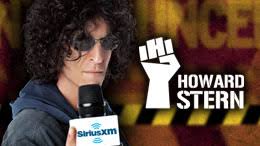
2) they’re famous for what they do. (Think Howard Stern)

Howard would make Sirius Satellite Radio something special and unique. 124It’s why they forked over hundreds of millions of dollars to have Howard join their team.
What happened to the OTA radio station’s when Howard left for Satellite Radio?

They had an Excedrin headache for quite a few years.

17 Comments

Filed under Education, Mentor, Radio, Sales

Live & Local ?

Stuck in a Time WarpI’ve been attending a lot of radio meetings these past years and one refrain I’ve heard over and over and over and over is that the power of radio is it’s “live & local.”

This week, the FCC voted along party lines 3 to 2 to eliminate the Main Studio Rule.

1934 Congress Establishes the FCC

The first regulatory body to oversee radio was the Federal Radio Commission (FRC) that was established by the Radio Act of 1927. The FRC was created to, among other things, insure that the public airwaves of America were used in the “public interest, convenience and/or necessity.” The FRC was given regulatory powers for licensing all radio stations and insuring the airwaves were assigned to broadcasters capable of providing quality broadcasts. The amateurs were assigned to another piece of the broadcast spectrum which today is known as Amateur Radio Service or Ham Operators.

Amateur Radio like AM/FM radio is regulated by the Federal Communications Commission which was established by Congress with the Communications Act of 1934.

Main Studio Rule

So, this week when the FCC voted to end the Main Studio Rule, what did that mean according to the FCC’s regulations that have been in place in 1934 (and per Gregg Skall) updated in 1988 to make them clearer? FCC attorney Skall wrote back in 1991 in his “Main Studio Rule and Staffing” memo:

The main studio rule as clarified in 1988 requires a station to maintain a main studio within its principal community contour “which has the capability adequately to meet its function…of serving the needs and interests of the residents of the station’s community of license.” That rule has now been further revised to allow a main studio to be located either within 25 miles from its community of license reference coordinates, or within the principal community contours of any station, of any service, licensed to its community of license. (See memo, Revised Main Studio and Public File Rules). Jones Eastern requires the station to maintain a “meaningful management and staff presence” at the main studio on a full-time basis during regular business hours.

You can read the full memo here.

LIVE RADIO

Since the introduction of automation systems, syndication, satellite delivery and computer voice tracking, the LIVE aspect of radio has been on the wane. Even in the #1 radio market in America, New York City, stations may or may not have a live operator behind the microphone when you’re tuned in.

When I was starting out in radio, we used to have to announce whether a program was live or pre-recorded so the listeners wouldn’t be deceived about the broadcast. In the early days of radio, virtually all radio was live and so it was the exception for something to have been recorded.

Today, it’s more likely what you are listening to is not live but syndicated, voice-tracked and pre-recorded.

LOCAL RADIO

With the Main Studio Rule, the goal was at least there would be a live person at the station and the studio would be in the community the licensee was licensed to serve.

Lance Venta writing on RadioInsight wrote “But what will it (elimination of the Main Studio Rule) mean in the short term? Probably not a lot. In the long term, be prepared for a much leaner broadcast facility.” You can read Lance’s entire article “The Radio Station of the Future…Today!” here.

The National Association of Broadcasters has been lobbying for the elimination of the Main Studio Rule, and its executive VP of communications Dennis Wharton said “We’re confident that cost savings realized from ending the main studio rule will be reinvested by broadcasters in better programming and modernized equipment to better serve our local communities.”

Brick & Mortar Presence

FCC attorney Scott R. Flick said that the Main Studio Rule was really a government mandate for radio to have a brick-and-mortar presence in an internet age. “Its existence hindered stations from evolving and adapting to the rapidly changing business strategies of their many non-broadcast competitors.”

It’s ironic that the biggest online retailer, Amazon, is now in the process of acquiring a brick-and-mortar presence as the radio industry appears to be moving in the opposite direction.

Public Safety

When a broadcaster doesn’t have a studio in the local community it serves, it delivers its programming through the internet, satellites, microwaves or wired lines. Broadcasters have been quick to point out how these forms of communication are first to go down in natural disasters.

What seems to be missing in this conversation, is a Black Swan event. Will radio be ready for a Black Swan?

Today’s Big Regulatory Difference

The big difference I see today for radio versus its toddler years is how it is regulated. The Radio Act of 1927 provided the foundation for all broadcast regulation right up until today. While more Acts were passed and made law over the years, the basics remain much the same as when they were first made law.

Some of the key provisions in the original Act that we’ve deviated from today are:

  • Limiting the number of broadcasters to foster higher quality radio broadcasts versus having more stations of poor or mediocre qualities
  • Radio broadcasters would operate in the “public interest, convenience and necessity”
  • Radio would be a regulated medium to assure high quality and operating in the public interest
  • Radio would be commercial and privately owned (a condition that made radio broadcasting in the USA different from every other country in the world)

Those who complain that radio isn’t like it used to be only need look at how broadcast regulations have been changed over the past century; the biggest change being the Telcom Act of 1996.

Make Radio LiVE & LOCAL Again

On May 24, 2004, the Federal Communications Commission (FCC) held a “Broadcast Localism Hearing” in Rapid City, South Dakota.  The president, general manager and co-owner of KLQP-FM licensed to Madison, Minnesota (population 1,767) Maynard Meyer addressed the commission.  He told them (I’ve edited his comments. The full text can be found here. )

“Localism in radio is not dead, but it is in dire need of resuscitation in many areas.  I have been involved in the radio business in announcing, sales, engineering and management for about 36 years, all of my experience is in communities of 5,000 people or less.  We personally live in the communities we serve so we know the ‘issues,’ we work to address them in our programming and have been doing so for the past 21 years.“

“A few years ago, many stations operated this way, but much of that has changed for a variety of reasons.  I think the beginning of the end of local broadcast service started in the 1980s when the Federal Communications Commission approved Docket 80-90.”

Mr. Meyer went on to explain to the FCC how many communities that “on paper” had a local radio station actually found that the transmitter was being fed from another location tens of miles away.  Mr. Meyer went on to say:

“I don’t think this is the best way to promote local radio service.  From what I have seen through my personal experience, as soon as a hometown studio is closed and relocated, the local service is relocated as well.”

What do you think?


23 Comments

Filed under Education, Mentor, Radio, Sales