Should We Sell the FCC License?

1Last week I wrote about how Radio is Relationships and what I was talking about was the relationship between the air personality and the listener. However, relationships are also important inside a radio station.

My hometown newspaper recently wrote an article about the local high school radio station in Pittsfield, Massachusetts – WTBR – that might go dark. This FM radio station that operates out of one of the city’s two public high schools has been on-the-air for over 40 years. It was recently fined $7,000 by the Federal Communications Commission (FCC) for violating the commission’s regulations at the time of its license renewal.

The body that holds the license for WTBR is the Pittsfield School Committee and the school committee appealed the amount of the fine. The FCC reduced the fine from $7,000 to $5,600 “based on Pittsfield’s history of compliance” the local paper reported.

Now to put this fine in perspective, WTBR operates on an annual budget of only $6,000.

How it’s able to operate on such a small budget is due to the fact that everyone who works at the station is an adult volunteer from the community or a high school student. The annual budget goes to pay for equipment maintenance, fees and other miscellaneous expenses.

So what changed? A long time advisor to the school FM radio station retired. With his departure, student interest in the radio station also diminished, to just five students.   Without this inside champion, the radio station is staring at a seven day a week, three hundred sixty-five day operating schedule with no people.

The school superintendent in addressing the school committee at a recent meeting outline three alternatives: invest in the program to develop a more professional broadcast curriculum, partner with a local media company that would be charged with overseeing the station’s operations or selling the FCC license.

The superintendent said with around five students interested in the operation, it didn’t appear that the investing option made much sense. Consolidation of the commercial radio industry in the area didn’t seem very plausible either. The last option could bring in $100,000 he thought.

The irony here is that WTBR is usually the only radio station in the city that is doing LIVE & LOCAL programming when I return home to visit family and friends during holidays. The local commercial radio stations usually are running either voice-tracking, syndicated or network programming.

The difference to me as a listener is the passion and one-on-one nature of WTBR. It’s the kind of radio that still attracts me as a listener. But without a visionary inside this radio station who’s building relationships with both students and the local community to run the station and be responsible for its operation and not getting it in trouble with the FCC, it may nearing its final days.

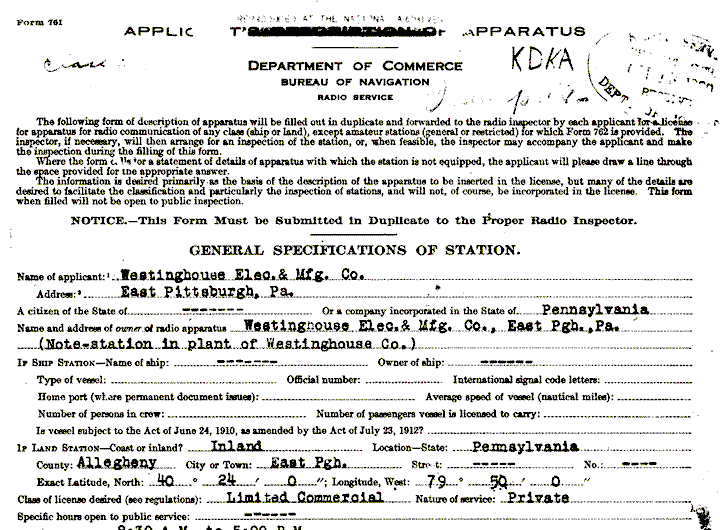
(Note: The first commercial radio station license was issued to Westinghouse for KDKA in Pittsburgh, PA in October 1920. In October 2020, radio will mark its 100th Anniversary. That original license for KDKA is pictured above.)

2 Comments

Filed under Education, Radio

Radio is Relationships

1
Radio, from the very beginning, has been about relationships. The first radio stations were amateur experimental stations. Dr. Frank Conrad, a Westinghouse engineer, was a ham radio operator. On October 17, 1919 he broadcast a recording over his station and that precipitated requests for more musical broadcasts. Conrad obliged by programming two hours of recorded music on Wednesday and Sunday evenings. Conrad even took requests.

It was from these early beginnings that a Westinghouse VP decided that Westinghouse should build a radio station and encourage people to listen and acquire the habit of listening to the radio. Westinghouse would benefit, because it was in the business of building radio receivers.

Westinghouse would file an application with the Department of Commerce on October 16, 1920 and receive its license for radio station KDKA eleven days later.

Radio gave people at that point in time a new way to connect and build relationships.

When radio pretends that what can’t be easily measured doesn’t exist, it’s on the path to extinction. Radio is relationships. No one ever had a relationship with automation.

Throughout radio’s history, savvy operators have known that being different can be a competitive advantage. Howard Stern, Rush Limbaugh, Ryan Seacrest, Casey Kasem, Arthur Godfrey among many others all knew how to distinguish themselves from the pack and build a relationship with the radio audience.

The competitive advantage that Pandora has is through its ability to be like your iPod, with an element of surprise. Each person creates his or her own personalized radio station.

But I seriously doubt anyone would say they have a “relationship” with Pandora. It serves a need in much the same way a low price retailer serves a need. Once someone comes along with a little bit better “mouse trap” the people quickly move on. That certainly was the case with Blockbuster when Netflix came along.

America’s radio stations that have a relationship with their audience will not have to live in fear. Relationships can transcend technology. Just ask Howard Stern’s listeners.

What concerns me is when audience relationships that took years to build are so quickly dismissed with automation in one of its various forms. Do you think radio would have grown to be the industry it is had it started out with automation?

-0-

This post was previously published in RBR-TVBR’s “Thought Leaders” on October 3, 2014 and in the New Jersey Broadcasters Association’s “QuickNews” on October 10, 2014.

Leave a comment

Filed under Education, Radio

Your Reception Rights

1

This week Marriott agreed to pay $600,000 to resolve a Wi-Fi blocking investigation that was being conducted by the Federal Communications Commission (FCC). The issue with the FCC revolved around an investigation into whether Marriott intentionally interfered with and even disabled Wi-Fi networks that its customers had established in Marriott’s conference facilities at their Gaylord Opryland Hotel and Conference Center located in Nashville, Tennessee. The FCC in their news release said their enforcement bureau investigation revealed that Marriott employees had used containment features of a Wi-Fi monitoring system at the property to prevent individuals from connecting to the Internet via their own personal Wi-Fi networks. This allowed Marriott to charge those same customers, small businesses and exhibitors as much as $1,000 per device to access Marriott’s Wi-Fi network.

I’ve always been amazed that when you stay at some of the biggest and best resorts that you have to pay for Wi-Fi access, whereas when you stay at a Hampton Inn, it’s not only FREE Wi-Fi but they also include a really wonderful breakfast too.

According to the FCC, “Consumers who purchase cellular data plans should be able to use them without fear that their personal Internet connection will be blocked by their hotel or conference center.” Enforcement Bureau Chief Travis LeBlanc added, “It is unacceptable for any hotel to intentionally disable personal hotspots while also charging consumers and small businesses high fees to use the hotel’s own Wi-Fi network. This practice puts consumers in the untenable position of either paying twice for the same service or forgoing Internet access altogether.”

And it’s not just your right to receive a personal hotspot on your smart phone, tablet or laptop but also those same rights extends to TV antennas and satellite dishes.

In 1999, the FCC amended its rules so that even renters could erect a satellite dish in “exclusive use areas” such as a balcony or patio. Then in 2000, the FCC added that it also applied to “customer-end antennas that receive and transmit fixed wireless signals.”

You have a right to receive over-the-air signals.

The $600,000 education and three-year compliance plan that Marriott just got from the FCC hopefully will have other hotel chains and conference centers sitting up and taking notice that you don’t need to be a federally licensed broadcaster to receive a monetary slap on the wrist from the Federal Communications Commission.

You might want to make a note of this case in case you ever find your service is being blocked. Here’s a link to the FCC’s press release: http://www.fcc.gov/document/marriott-pay-600k-resolve-wifi-blocking-investigation

Leave a comment

Filed under Radio

I Heart New York

1

Do you think if the State of New York had to do it all over again, they would have gone with “I Heart New York” instead of “I Love New York”? Neither do I. So what always puzzled me was why Clear Channel launched their new streaming application and called it “iHeartRadio.” I mean the logo design for the App was cool, but to me it said “iLoveRadio,” because everyone knows the heart is the graphic symbol for love. Or maybe everyone didn’t know that.

I Love Radio. There, I said it. I’ve loved radio since my earliest days on planet Earth. And so having an App that says that I love radio would have been a pretty cool thing to have on my smart phone. But that’s not what happened. This makes one wonder if the techies who did the design weren’t all that cool.

So you can imagine my amazement when Clear Channel Media & Entertainment (which had already dropped the word “radio” from their name) changed their name less than two years after the last name change to iHeartMedia.

In the meantime, I note that pure play streaming companies are all putting “radio” into their name. Pandora Radio, TuneIn Radio, Spotify Radio and the streamer I’ve enjoyed Sky.FM recently just did a name change of their own. They now call their streaming service “Radio Tunes.”

I think it might be a case of “The Other Man’s Grass Is Always Greener” (cue Petula Clark to start singing). Those that ARE radio companies are trying to erase it from their name as fast as they can and those companies that don’t have an FCC broadcast license are adding to their name.

Maybe adding the small “i” to your name or taking “radio” out is the radio industry’s “mid life crisis.” It’s radio getting seduced by the new.

Instead of trying to be something you’re not, why not work harder at being the best at what you are. Radio has an incredible legacy. Radio was the #2 greatest invention of all time on The History Channel’s list of the world’s greatest inventions. (#1 was the smart phone, to which most people today listen to their favorite radio station or stream)

It’s time for us to say it loud and proud. I LOVE RADIO.

Leave a comment

Filed under Radio

Do What You Love and the Money Will Follow

Kritin CantrellWhat do you need to do to be successful in life? Adopt these simple nine words as your mantra. “Do what you love and the money will follow.”

I had the opportunity to interview Kristin Cantrell, owner and operator of four radio stations in Frankfort, Kentucky about the radio industry. Kristin said these are exciting times to be in radio, because radio is so well positioned to pull from all the various media platforms and put it together to solve problems for local businesses.

Radio is a “high touch emotion” medium and as long as it continues to deliver all that it’s capable of delivering to the listener, it will always be relevant.

Cantrell will be the first to admit that she has no idea what radio will look like in the future. Maybe we will just say the word “radio” and it will start playing in our ears. Maybe we won’t even have to say anything, just think it and it will start up, like Stephen Hawking can make his computer talk using his thoughts. But what she does know is that wherever radio is going, her radio stations will be there.

Cantrell also knows that radio is better when it reduces clutter. She said when she took over the radio stations in Frankfort; she immediately reduced the commercial inventory per hour on all four of her radio stations. Today she airs ten minutes of commercial messages per hour with a couple of the drive hours running no more than twelve minutes.

If you’re a student who’s thinking of being in the radio industry, Cantrell advises that you be well read, passionate and genuine. People who have these qualities will succeed.

It all comes down to just nine simple words: “Do what you love and the money will follow.”

If you’d like to see my interview with Kristin, you can view it here: http://kbawku.nationalradiotalentsystem.com/index.php/guest-faculty/23-faculty/111-kristincantrell

Kristin really must love what she’s doing as she just recently announced the purchase of seven more radio stations in Pennsylvania.

Leave a comment

Filed under Education, Radio

“Do The Bartman”

1I do most of my radio listening these days via Internet and radio station streams. Two of my favorite radio stations that get a lot of my listening time are WCBS-FM in New York City and KRTH in Los Angeles.

I’ve been listening to K-Earth 101 (KRTH) for quite some time via the Internet. Unfortunately the sonic quality of the stream was anemic at best. This point was really driven home when I took a college spring break to drive the Pacific Coast Highway.

My drive began at LAX. Just as soon as I was handed the keys to my rental convertible, I turned on the radio and cranked up K-Earth 101 and one of my favorite radio personalities, Shotgun Tom Kelly. (Kelly just marked his 17th anniversary of holding down the PM drive slot, a position previously held by fellow Hollywood Walk of Fame Star, The Real Don Steele.) Man, did that station explode from my car’s dashboard; big and bold with a sound that begged for a driver to put the pedal to the metal on the 405.

When I got back home to Kentucky, I put the K-Earth stream on and was disappointed by the lack of audio gusto. That is, until recently. K-Earth now sounds as good on their stream as they do over-the-air. And that’s not surprising as a lot of stations are really paying attention to the audio quality of their streams. But that, unfortunately, is all they are apparently paying attention to.

Which brings me to “Do The Bartman.” That was a song that Michael Jackson (yes, that MJ) wrote for Bart of The Simpsons. Michael was a big Simpsons fan and he called the show’s producers and volunteered to write a hit song for Bart. (He did and it was.) How do I know this? K-Earth and WCBS-FM told me. Again, and again, and again, and again, and again, and again, and again, and again….well you get the idea. They told me this factoid a lot. And I’m not talking over a course of days, try in the same break. Sometimes this factoid ran back to back in that break.

OK, I realize that someone thought it would be a good idea when the stream didn’t have the same amount of commercials sold that the over-the-air programming had, to fill that extra time up with something cute. And it was cute, the first ten times I heard it. But cute goes bad quickly. And cute can really begin to annoy the listener with a very high burnout rate.

It doesn’t seem to matter whether I listen to WCBS-FM with Scott Shannon in the morning (Scott’s doing some of his best radio work ever by the way) or drive home with Shotgun Tom Kelly on K-Earth 101, I will be subjected to the “Do The Bartman” factoid quite a few more times before a new factoid is researched, written and replaces it.

You don’t hear this lack of attention to detail on pure play streams. And that’s where pure plays have the advantage over broadcast radio stations that stream.

Brian Boyer of NPR nails it when he says “Our biggest rule is that if it doesn’t work on mobile, it doesn’t work,” adding, “Mobile-first design is a great mind hack.”

Today’s broadcasters now understand that the sonic quality of their streams is as important as their over-the-air signal, but they still haven’t got the programming of the breaks right yet. It’s really more than just the length of the breaks by broadcasters vs. pure plays, but that’s a big deal too. Broadcasters need to listen to their streams and ask themselves, “Am I happy with the way this sounds?” My bet is they would not be happy.

Oh no, here comes “Do The Bartman” for the umpteenth time.

4 Comments

Filed under Radio

Clear Channel Media & Entertainment becomes iHeartMedia

Tom Taylor wrote this morning in his NOW digital publication “A rose by any other name, would smell as sweet.” What interesting about that old Bill Shakespeare line from Romeo & Juliet is that researchers have actually found that would not be true. Turns out a name can affect how we perceive a lot of things – smell, attractiveness etc. Teaching the next generations at the university I can pretty confidently say that iHeartMediathey have no clue what “clear channel” means when it comes to either class of AM radio station or to the behemoth media company (The exception being those who take my History of American Broadcasting class). Since the Clear Channel name is posted on tons of billboards across our land, they most likely equate the name with that form of media. (And iHeartMedia is not changing the name of the billboard division). However, ask my students about iHeartRadio and not only do they have an opinion, but the App on their smartphone. To the radio diehards it may feel like the tail is wagging the dog, but the reality is digital is now the dog and broadcasting is the tail. But what a mighty tail it is and radio has an incredible advantage if it puts that tail to work for it’s future in digital.

2 Comments

Filed under Radio