Tag Archives: FOMO

If I Was a Teenager Today, Would I Dream of a Radio Career?

I became addicted to radio by listening to great nighttime radio personalities. But those hours are now filled by anything but inspiring, innovative personalities and that makes me sad.

Great Radio Delivered

Great radio stations delivered personality, stationality, promotions, jingles, and FOMO (Fear Of Missing Out). Today, the difference between one radio station and another is about as different as one fast food restaurant from another. Not all that much.

On-Air radio production was exciting when I was growing up. Radio stations were tight and focused. Every programming element that was allowed to hit the air was overseen by a program director that was obsessed with maintaining his/her radio station’s mission.

Those days are history.

SiriusXM

The other day, one of my daughters was complaining that SiriusXM was tripling her current rate of $5/month. She said she called to complain and was told there was nothing that could be done, so she cancelled the satellite service.

That’s not the shocking part of this story however.

What she said next was sad. She said that the local radio stations “sucked,” and that there was nothing on her car radio worth listening to.

The following week, SiriusXM sent her a $5/month for a year offer in her snail mail. She quickly returned to the satellite service.

We’re Creatures of Habit

There are so many things we do in our daily lives without thinking. We’re creatures of habit, and our habits are like being on autopilot; we do them without giving them any thought.

For example, you might be able to remember the last time you showered, but do you know which hand you always grab the shampoo with? Which armpit do you wash first? Which foot do you always put your socks on first? These are just a few examples of the many things we do every day without giving them any conscious thought.

Radio Listening Is A Habit, or It Isn’t

What my daughter learned, without thinking about it, was, listening to SiriusXM had become a habit. A habit that she had become addicted to. Only when forced to listen to today’s broadcast radio did she realize that it had changed from the days when she was growing up. Sadly, broadcast radio no longer served her listening needs.

Spotify, Pandora, RadioTunes etc.

My wife’s favorite music listening habit is Pandora’s “Secret Garden Radio.” In my case, RadioTunes serves up the best music mix of instrumental Smooth Jazz music.

What streamers offer the listener is the ability to match the genre of music to their mood of the moment. A broadcast radio station is a one flavor option, while streamers offer a myriad of flavors like Ben & Jerry’s.

CES2026

The other day I sat in on the first of many CES2026 (Consumer Electronics Show) recaps. What struck me was that the potential of AI (Artificial Intelligence) to sense our mood and serve up a stream of music that matches our mood.

Even more concerning for commercial broadcasters, AI may also be able to sense when a commercial break starts and switch a listener’s audio source to continue the genre of music they are listening to, avoiding the commercials.

Broadcast radio depends on its commercials as the primary source of its revenue.

That’s scary!

Yet, it is something I don’t hear any commercial radio broadcasters being concerned about. Instead, they are focused on keeping a century old radio service (AM radio) in the dashboard of every vehicle. (And like coal, it ain’t coming back, as I wrote in August 2017. You can read that blog article here: https://dicktaylorblog.com/2017/08/20/coal-aint-coming-back-neither-is-am-radio/ )

Is this really the best place for commercial broadcasters to be focusing their time and money lobbying Congress?

19 Comments

Filed under Education, Mentor, Radio, Sales

First Things, First

covid-19If someone had asked you, “Where do you see yourself in 5-years?” I seriously doubt anyone could have imagined they would be smack dab in the middle of a global pandemic. But that’s where we find ourselves at this moment in time.
No matter what you may think will return us to the life we had before COVID-19, nothing even begins to change until we have two things: therapeutics to cope with this novel coronavirus and a better understanding of how this dastardly disease can be squashed like a bug. In the meantime, everything else we try is merely a Band-Aid on the problem.

TRUST

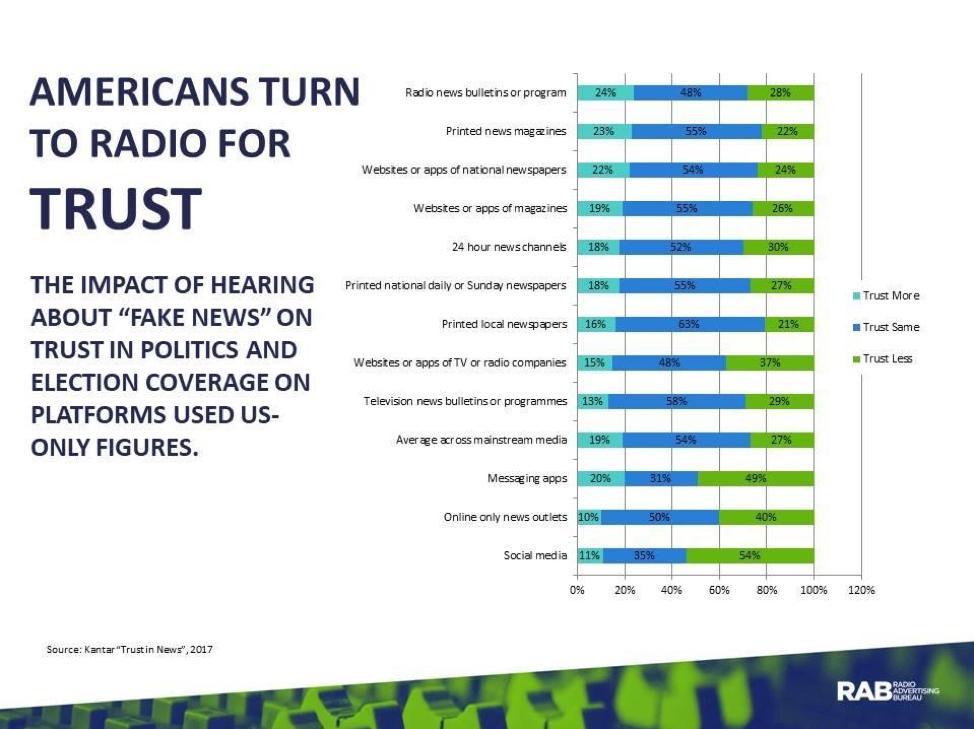
A good radio friend posted on LinkedIn a graphic from the Radio Advertising Bureau (source: Kantar 2017)  “Trust in News” purporting radio to be the medium, Americans turn to for trust.

Radio & Trust

Well, we are now half-way through 2020, and I wonder what relevance that this research conducted in 2016 and published in 2017 has in a COVID-19 world. Probably, slim and none.

In fact, the NRRC (Network Radio Research Council) is recommending that all network/national buying and selling be based on the Fall 2019 Nationwide survey, and not those surveys conducted since the start of COVID-19, saying “the impact of the COVID-19 pandemic has caused unprecedented divergence of traditional patterns of media consumption, including AM/FM listening and the streaming of audio.”

If we can take to the bank anything from the world we are living in now, it’s that anything pre-COVID-19 is now FUBAR*.

How COVID-19 Has Changed Our Media Consumption

Since the onset of this global pandemic, the home broadband bundle has significantly been changed. Most consumers are adopting a stand-alone broadband service and not bundling it with Pay-TV or home phone or even their mobile phone. Why is this happening? Researchers say with another recession looming, people are watching all of their pennies.

With people working from home (WFH) and driving less, Out-Of-Home (OOH) media has been clobbered. Revenue projections for the Billboard industry show it will be down over 19% in 2020, compared to radio (down 13.7%) and local television (down 12.4%), according to MAGNA. Before COVID-19 hit, OOH was one of the fastest-growing and most stable linear media channels. Zenith thinks that OOH revenue will be down even more, predicting it to be down 25% in 2020.

Nieman Lab writes “Radio listening has plummeted. NPR is reaching a bigger audience than ever. What gives?” And the answer is, 2020 is the year that NPR will make more money from underwriting on its podcasts than it will from its radio programs.

Follow the Money

Local radio is very dependent on Main Street, but Main Street is in the cross-hairs for defaults, bankruptcies and evictions due to COVID-19.

Much like NPR is experiencing with its online products, retailing is becoming an online activity with American consumers. Economists knew that many cities had a retail footprint that was too big for the local consumer economy to support. COVID-19 merely accelerated things.

In fact, COVID-19 has created a quantum leap for e-commerce in 2020. What was projected to take place over years, has been compressed into a few months.

The United States Census Bureau reports that in the second quarter of 2020, e-commerces retail sales in America rose 31.8% from the first quarter and were 44.5% above the same period in 2019. The Census Bureau says that compared to the share of total retail sales, e-commerce sales grew as much in three months as it had over the past five years.

We are living a period of rapid technological change. Columbia Business School economist Laura Veldkamp says, “We are changing the way business is getting done, we’re changing the way we’re shopping and the way we’re eating – we’re changing the way we’re having meetings.” She points out that:

“the pandemic, like the Depression and World Wars I and II, is fundamentally altering people’s tastes. Some businesses will be left behind, as consumers get accustomed to videoconferencing instead of commuting, and buying groceries and other goods online instead of braving stores, malls and restaurants.”

Unemployment Tsunami Ahead

Economists are worried what’s ahead when it comes to unemployment in America. They see exponential growth in claims for the Pandemic Emergency Unemployment Compensation (PEUC) program and a weakening U.S. labor market. The PEUC has grown from 27,000 people on April 11, 2020 to 1.3 million as of August 1, 2020. Worse, the number of PEUC recipients has stayed at over 1 million people for four straight weeks and has actually been increasing each week.

“The real tsunami is coming,” says Mark Zandi, chief economist at Moody’s Analytics. “My guess is at this point hiring in the industries that have been hit hard is going to abate.” Plus we know that United Airlines plans to furlough 3,900 pilots, Delta 2,000 pilots and American Airlines are alerting their employees to furloughs of 19,000 companywide.

The Conference Board Consumer Confidence Index declined in August for the second consecutive month hitting a new pandemic low. Consumer optimism, along with their financial prospects also declined. Both are continuing on a downward path.

The Long Road Back

Economists see a long road back for the United States economy. A National Association for Business Economies (NABE) survey of 235 members July 30-August 10, 2020 showed that 60% predict that it will not be until the second quarter of 2022 (or later) that our economy may finally rebound to where it was in 2019, pre-COVID-19.

Economy Rebound

The Party’s Over

When you’re having a good time, it’s hard to call it a night and leave a party. Sometimes it’s due to FOMO (Fear Of Missing Out) and other times, it’s because no one likes to see good times come to an end.

The Oracle of Omaha – Warren Buffett, puts it this way:

‘They know that overstaying the festivities — that is, continuing to speculate in companies that have gigantic valuations relative to the cash they are likely to generate in the future — will eventually bring on pumpkins and mice. But they nevertheless hate to miss a single minute of what is one helluva party. Therefore, the giddy participants all plan to leave just seconds before midnight. There’s a problem, though: They are dancing in a room in which the clocks have no hands.’

Commercial broadcasters, by and large, have enjoyed the radio broadcasting party of the 60s a little too long. So many of the programming models haven’t really changed since the days when I was still a disc jockey, yet the world has changed, and changed exponentially.

Radio broadcasters, like NPR, that have embraced a vision of where media consumption is headed, are seeing their investments paying off.

Those that haven’t changed, are finding today’s environment extremely challenging.

Local radio’s fortunes have always been tied to Main Street, not Wall Street.

COVID-19 has disrupted Main Street’s business model.

The old rules don’t apply any longer, but, we don’t really know yet if this is another giant bubble or the future of our world.

Realizing that the time horizon for answers could be two years out, one wonders, will you be able to survive till we have the answers?


*A military term defined as F’d Up Beyond All Recognizability

1 Comment

Filed under Education, Mentor, Radio, Sales