Tag Archives: Steve Harvey

Pilot of the Airwaves

Forty-six years ago, Charlie Dore wrote and recorded the song “Pilot of the Airwaves,” a song about a girl who stays up late every night to listen to her favorite radio air personality. She requests that he play a record for her, either the one she suggested or a record of his choice, and adds “I’ve been listening to your show on the radio and you seem like a friend to me.”

Companionship

Radio’s most important strength has always been its ability to provide companionship to the radio listener, and the radio air personality becomes a trusted friend, like a member of the family.

Freddie Mercury

Forty-one years ago (1984) Queen released “Radio Ga Ga,” a song that reflected on the changing popularity of radio and television with the advent of MTV and music videos. In the song, Freddie Mercury belts out “Radio, someone still loves you!”

Which begs the question, if in 1984, Queen felt it necessary to reaffirm the power of radio – before there was the internet and streaming – what must it be like today, 41-years later? Who’s showing the love now, and why?

I Watched It All On My Radio

Thirty-Five years ago, Lionel B. Cartwright released a song that spoke to how radio is “the theater of the mind” in a song called “I Watched It All On My Radio.” It’s a song about a young boy’s remembrances of listening to his transistor radio growing up. This song brought to mind how Charles Osgood (CBS Radio Commentator) would sign-off his radio broadcasts saying “I’ll see you on the radio.” Ah, the good old days.

Video Killed The Radio Star

MTV signed on in 1981, playing music videos that were introduced by Video Jockeys (VJs). The first song played on MTV on August 1st of that year was by The Buggles, “Video Killed The Radio Star.” A key line in that song was “In my mind and in my car, we can’t rewind we’ve gone too far.” The original VJs were all gone before the end of the decade and while MTV still exists, it’s less focused on music videos having  migrated into reality shows for teenagers.

So, video didn’t kill the radio star, but consolidation of radio ownership certainly has.

Radio Listeners Miss Hearing Their Favorite DJs

CRS ‘25 (Country Radio Seminar) just ended in Nashville. Listener research done by NuVoodoo’s Carolyn Gilbert and Leigh Jacobs found that listeners are noticing their favorite personalities are getting downsized, telling the audience that “thirty-six percent agreed that many of the hosts and DJs they had enjoyed hearing on the radio [have] lost their jobs. They’re aware.”

Techsurvey 2024

A year ago, Fred Jacobs released his company’s 20th annual Techsurvey on the habits of radio listeners. One of the major findings of Techsurvey 2024 was how a majority of listeners enjoy the local feel and connection with personalities.

Yet, radio companies continue to de-emphasize experienced local talent – in other words, fire them.

Expiring Skills & Permanent Skills

Morgan Housel, a partner at The Collaborative Fund and an expert on behavioral finance and history, says that every field has two kinds of skills:

  • Expiring skills, which are vital at a given time but prone to diminishing as technology improves and a field evolves.
  • Permanent skills, which were as essential 100 years ago as they are today, and will still be 100 years from now.

Is Being a DJ an Expiring Skill?

  • Seems like everyone’s been talking about what artificial intelligence (A.I.), means for the future of air personalities. Radio owners seem to be excited about A.I. but radio personalities view this new technology with trepidation.
  • You might be wondering if being an air personality is something that will no longer be relevant and can be replaced by a robot.
  • If we’re talking about replacing mindless voice tracking, maybe A.I. is an improvement, but if we’re talking about making a human connection, I think not.
  • Most permanent skills are human-centric, meaning that they are not something a chatbot can duplicate. Sharing of human experiences can only be done by another human. Permanent skills require emotional intelligence which compound over time.
  • People who spend a lifetime perfecting one skill whose importance never wanes, will be the ones in demand.

AI (Artificial Intelligence) Is Not The Answer

The popular TV game show, Family Feud, began airing on ABC in 1976. It would be the personal charm and witty banter of host Richard Dawson that would make the Feud hugely popular with television audiences.

The show continued on after Dawson left, hosted by Ray Combs, Louie Anderson, Richard Karn and John O’Hurley, but it wasn’t until radio star Steve Harvey took over in 2010 that Family Feud saw renewed success. Ratings for the program increased by as much as 40%, and has become the fifth most popular show in syndication being renewed once again through the 2025-2026 season.

By the way, Steve Harvey hosts the #1 syndicated morning radio show in America too.

Personalities like Steve Harvey are not worried about being replaced by artificial intelligence because they have developed a useful and permanent skill in a world that is constantly changing.

Yes, this is both a national example, as well as one about television, but great local radio stations embrace the importance of having strong personalities, like a Steve Harvey, filling their rosters of air talent.

Humans connect with other humans that engage them.

Being human is something artificial intelligence will never be.

10 Comments

Filed under Uncategorized

Expiring versus Permanent

A hundred years ago, radio was the new form entertainment that captivated the world. The radio receiver occupied prime real estate in American living rooms and families would make sure that dinner was over and the dishes cleaned before the evening’s entertainment was broadcast to their radio. This was the first Golden Age of Radio.

Television

When TV came along, the radio would lose its place of prominence in the American living room. Radio, due to the advent of the transistor would find a new home in the bedrooms of teenagers and in the dashboard of automobiles. Radio’s original stars would move to the medium of television and radio would give birth to a new type of performer, the Disc Jockey aka the DJ.

It would be a position that didn’t exist before records or radio. It required a new kind of communication skill, one filled with personality and imagination.

Expiring Skills versus Permanent Skills

One of the most popular instructors at West Point was Robert Walter Weir. Weir taught painting and drawing offering this class not to broaden a cadet’s perspective on the world, but because in the 19th century, military officers were expected to draw maps of the battlefields they fought on, and be able to record their topography quickly.

One of Weir’s best students would be Union General Ulysses S. Grant, who defeated Confederate General Robert E. Lee during the Civil War.

Drawing, it turns out, was an expiring skill, as today’s West Point offers classes in mapping software and technology, but no longer in painting and drawing.

Morgan Housel, a partner at The Collaborative Fund and an expert on behavioral finance and history, says that every field has two kinds of skills:

  • Expiring skills, which are vital at a given time but prone to diminishing as technology improves and a field evolves.
  • Permanent skills, which were as essential 100 years ago as they are today, and will still be 100 years from now.

Is Being a DJ an Expiring Skill?

Over the past month, everyone’s been talking about what artificial intelligence (A.I.), like Futuri’s RadioGPT means for the future of air personalities. Radio owners seem to be excited about A.I. but radio personalities view this new technology with trepidation.

You might be wondering if being an air personality is something that will no longer be relevant and can be replaced by a robot.

If we’re talking about replacing mindless voice tracking, maybe A.I. is an improvement, but if we’re talking about making a human connection, I think not.

Most permanent skills are human-centric, meaning that they are not something a chatbot can duplicate. Sharing of human experiences can only be done by another human. Permanent skills require emotional intelligence which compound over time.

People who spend a lifetime perfecting one skill whose importance never wanes, will be ones in demand.

The Lesson of Family Feud

The popular TV game show, Family Feud, began airing on ABC in 1976. It would be the personal charm and witty banter of host Richard Dawson that would make the Feud hugely popular with television audiences.

The show continued on after Dawson left, hosted by Ray Combs, Louie Anderson, Richard Karn and John O’Hurley, but it wasn’t until radio star Steve Harvey took over in 2010 that Family Feud saw renewed success. Ratings for the program increased by as much as 40%, and has become the fifth most popular show in syndication being renewed once again through the 2025-2026 season.

By the way, Steve Harvey hosts the #1 syndicated morning radio show in America too.

Personalities like Steve Harvey are not worried about being replaced by artificial intelligence because they have developed a useful and permanent skill in a world that is constantly changing.

Being human is something artificial intelligence will never be.

9 Comments

Filed under Education, Mentor, Radio

P E R S O N A L I T Y

In 1959*, Lloyd Price released the song “Personality.”

It was about a girl and what made her special.

Here’s a sample:

            ‘Cause you got personality

            Walk, with personality

            Talk, with personality

            Smile, with personality

            Charm, with personality

            Love, with personality

With the exception of a daypart or two, it’s what most radio lacks today – PERSONALITY.

Rewound Radio

Every Saturday, Rewound Radio, a streaming-only radio station features its “DJ Hall of Fame.” They are air checks of some of America’s best radio personalities, like Dan Ingram, Ron Lundy, Robert W. Morgan, Charlie Tuna, The Real Don Steele and so many more. While everyone of the personalities I just mentioned are now in radio heaven, their recorded radio shows sound as vibrant and exciting as ever. That’s why people from all over the globe dial in to hear them, and not just radio people, radio listeners who grew up with them.

People like me.

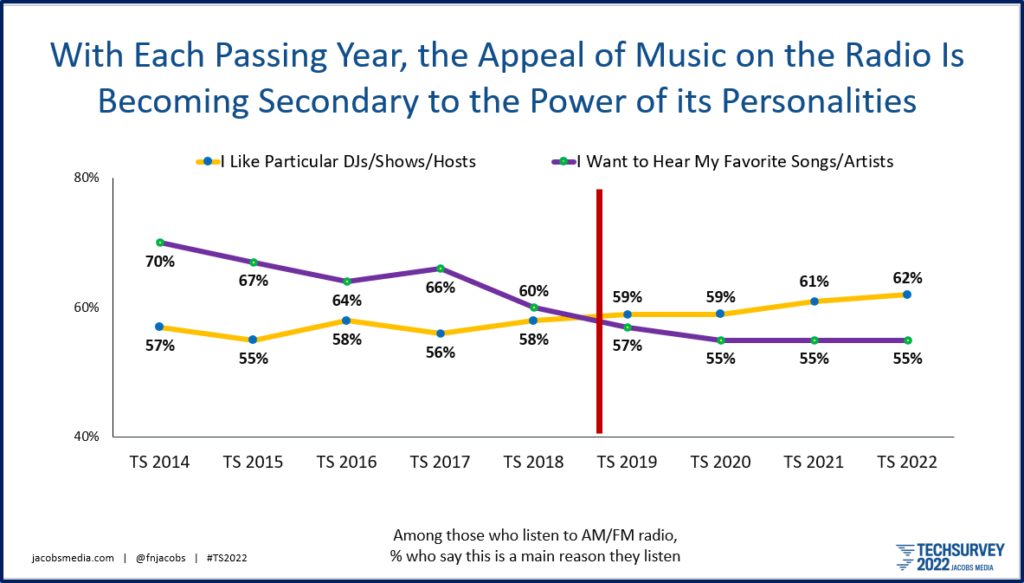
Techsurvey 2022

So, it wasn’t really a surprise when Fred Jacobs gave us a sneak preview of his latest research on why people listen to over-the-air (OTA) radio.

People today listen to OTA radio for the very same reason that they always have, to hear their favorite radio personality. The unfortunate thing is, the radio industry talks the talk, but doesn’t really walk the talk.

Radio’s ultimate strength as a medium is dependent

on the power and popularity of its personalities.

-Fred Jacobs

Club DJs

When I walk the boardwalks in New Jersey, Delaware or Maryland in the summertime, you can’t help but be very aware of how important it is for each club to have a popular DJ. Club DJs get people dancing, having fun and spending their money in that particular club for hours.

The longer club patrons stay, the more money club owners make.

The reality is the role of a Club DJ could be easily automated and the music would be non-stop, but it is the special magic a live personality delivers that makes all the difference. Great performers make people feel things. They deliver an emotional experience that can’t be duplicated by automation.

“People are always neglecting something they can do

in trying to do something they can’t do.”

-Edgar Watson Howe

Living in a VUCA World

The world today is volatile, uncertain, complex and ambiguous; it’s a VUCA existence. Many businesses are told they must innovate or die.

In radio’s race to stay relevant, it tries to compete with streaming audio services, where at best it can only be second best when it plays on their terms. What OTA radio should be heavily investing in is the development and promotion of outstanding, compelling, relatable radio talent.

“Treat talent with respect.

They are the reason radio remains so important.”

-Lori Lewis

Family Feud

Sue & I love watching Family Feud with Steve Harvey. This TV game show debuted on ABC on July 12, 1976 with host Richard Dawson. It would be broadcast for nine years before the network pulled the plug,  but would continue to air periodically over the following decades. The show has had six hosts, but only its original host and the current host have seen the show be an audience hit.

In fact, it was when Steve Harvey took over as host in 2010, that Family Feud was finally resuscitated. His hosting abilities with his stand-up comedy and radio background has the audience always wondering what he will say next and almost always producing laugh-out-loud moments on the game show. It also doesn’t hurt that Steve Harvey is as nice as he seems. Being genuine is always an asset in the media world.

I said there were six hosts of this show over the years, Richard Dawson was the first and Steve Harvey is the current host, but you probably can’t name the other four without looking it up on Google. And that’s my point.

Personalities are the difference maker.

Radio leaders talk a good game when it comes to telling us how important local talent is to the power of great radio, but it’s time they put their investment monies where their mouths are, by hiring and training the next generation of radio performers.

It’s time for the radio industry to focus on a change that matters.

Family Feud Hosts: Richard Dawson, Ray Combs, Louie Anderson, Richard Karn, John O’Hurley and Steve Harvey.
*Note: an earlier version of this post stated the date of Lloyd Price’s hit record “Personality” as 1957. It was updated to 1959 after a reader pointed out this error.

8 Comments

Filed under Uncategorized