Category Archives: Mentor

The Cockroach of Media

The new CEO of National Public Radio is a man named Jarl Mohn. Before his life in public radio began, he rose pretty high up in commercial radio, only then he went by his “radio name;” Lee Masters.

When he was recently asked if Internet radio would replace terrestrial radio within a decade, he responded with “Broadcast radio is the cockroach of media. You can’t kill it. You can’t make it go away.” But interestingly many radio companies are hiding the name “radio.”

National Public Radio isn’t called that any more. It’s now NPR. Clear Channel Radio isn’t called that any more. It’s now iHeartMedia. Even Radio Shack tried to jettison “radio” from its name and re-brand as just “The Shack.”

Most radio companies today prefer the term “media company” or “communications company.” Why is that?

The irony is when you look at pureplay Internet companies that stream music content, they glom onto the name “radio.” Pandora Radio, Spotify Radio, iTunes Radio, iHeart Radio, Tunein Radio – even the one I’ve been a subscriber to for six years changed its name from Sky.FM to Radio Tunes.

Petula Clark probably got it right when she sang “The Other Man’s Grass Is Always Greener.”

Commercial radio is suffering because it’s not as good as it can be. It suffers from a lack of innovation and investment. At the very moment that more commercial broadcasters are slashing budgets, eliminating people and consolidating operations, NPR is committing more money to be more local and live according to Mohn.

My university’s public radio service has a four person local news team. They don’t cover national stories, NPR does that. They cover south central Kentucky and they win just about all the news awards for their reporting every year. Their stories are detailed and well told. Their stories are readily accessible online in addition to being heard over-the-air.

Public radio is enjoyed by more people and earning a bigger share of the audience than public television. And when it comes to competing against commercial radio, the public radio station is in the top 5 stations in radio markets that have a public radio service.

Here’s the problem I see with future generations of listeners. Pureplays are redefining the term “radio.” To young people today, Pandora IS radio. iTunes IS radio. Spotify IS radio. Over-the-air broadcast is “media” that their parents still use.

When I was growing up I admit I didn’t listen to the radio stations my parents listened to. They had their radio station(s) and I had mine. But we both were listening to “radio.”

Radio turns 100 years old in the year 2020. To those of us who grew up with the service that began commercially in 1920 with the radio broadcast license issued to KDKA in Pittsburgh, we might see it that way. But to the next generation of listeners, radio might only be 20 years old; the same age as Pandora.

Call me sentimental, but I think that would be a shame.

7 Comments

Filed under Education, Mentor, Radio

How to find RADIO sales people

I worked in the radio industry for over forty years. In that time, I attended a lot of meetings, conferences and worked with radio companies owned by “mom & pop” to iHeartMedia (formerly Clear Channel).

The most often heard question everywhere I went was “How do I find people to sell for my radio station(s).”

Well I have good news and bad news for you. The bad news is, it’s going to get worse. So what’s the good news? You’re not Google.

I was drawn in by an interesting article called “5 Reasons You May Not Want to Work for Google.”  It makes some excellent points from the employee’s point of view. But the bigger question is WHY do so many people aspire to work for Google?

Google has created a powerful employee brand. Google did this by building a culture. The culture then virally spreads the good word about working at Google.

Radio has been good at building cultures over the years. I just finished reading Ron Jacob’s “KHJ – Inside Boss Radio” and Ron pulled back the curtain on this iconic radio station from its Top40 birth in 1965.

Just like Google, KHJ created a powerful employee brand. Every disc jockey aspired to work there. Every performer wanted their record played on KHJ. KHJ went from being the misfit of RKO General (its owner) to becoming the economic engine that would lead the entire media company. It even out-billed KHJ-TV9 in Los Angeles.

Think KHJ’s general manager asked “How do I find people to sell for my radio station?”

When I was managing WFPG in Atlantic City I was often asked where I found my sales people. I used to joke that it was easy, because the station was located in front of a bus stop and we’d just abduct them while they were waiting for the bus. The real answer was, we created a powerful employee brand in South Jersey.

We had the reputation of being a fun, professional and winning place to work. We had applications coming in on a weekly basis for just about every position.

Sitting just a short expressway drive from Philadelphia, many rookies would be told to head for Atlantic City and WFPG to learn the business. We had earned the reputation for producing top talent both on-the-air and in sales.

Most radio stations are afraid to lose people to bigger radio stations in larger radio markets, but not us. We knew that only enriched our employee brand. Word gets around quickly that you’re the path to radio’s big show. That type of buzz helps to keep your pipeline of great candidates full.

Every employee I hired, I told “Tell me where you want to go and I will do my best to get you there.”

I tell my students today what I told my employees for years: “what will you do this quarter that you can add to your resume of successes?” Success only happens if you plan to be successful.

Now you may be wondering if I ever lost a sales person to another radio station in my market and the answer is yes. I lost sales people to other stations when they were offered the job of sales manager or general manager. I celebrated their good fortune right along with them.

I also remember some people who left because they thought all radio stations operated the way we did only to learn that they didn’t. Some of those people returned and became even better employees than when they left.

It’s never been more important for radio station owners to focus on creating a strong employee brand. A recent study by the Career Advisory Board says 93 percent of hiring managers feel they can’t find the right talent for their jobs. The job applicant pool hasn’t been this lean since 2008. You can’t stop the aging process of 77 million Baby Boomers set to retire and the brain drain that will be created as they walk out the door.

The companies that put their focus on creating a strong employee brand will be the winners.

Remember, if you ain’t the lead dog, the scenery never changes.

Leave a comment

Filed under Education, Mentor, Radio, Sales

On The Road in Las Vegas

8

What I learn in Vegas, won’t stay in Vegas.

Back next Sunday with a NEW post.

Leave a comment

Filed under Education, Mentor, Radio, Sales

Attention to Detail

I just finished reading Ron Jacob’s book “KHJ Inside Boss Radio.”  It’s an excellent read and I highly recommend it.  It’s out of print, but a new & improved Kindle version is now available from Amazon that brings in more detail about the birth of this legendary Los Angeles Top 40 radio station.

May 2015 marks the 50th anniversary of the launch of Boss Radio – 93 KHJ.

One of the really unique aspects of this book, that will have any radio geek savoring, are the volume of memos written by Ron Jacobs and sent to his Boss Jocks; Robert W. Morgan & The Real Don Steele among them.

Ron Jacobs competed against Bill Drake in Fresno, California. When Drake was hired by RKO Radio to turn things around at their decrepit AM 930 “K-indness H-ope & J-oy” he hired the guy who gave him the most competition; Ron Jacobs. Together they would launch a new contemporary sound on the radio and Top 40 Radio would never be the same.

Ron Jacobs later in life would interview Bill Drake and that’s also quite an interesting read.

What I learned as I poured though the memos Ron Jacobs wrote over his four years at KHJ was his tremendous attention to detail. Ron was a talented air personality in his own right, but he never did an air shift at KHJ. I asked Ron that very question and he said the only time he was ever heard on KHJ was in a promotional bit involving his most famous summer promotion “The Big Kahuna.” What Ron DID do was listen to his radio station. Relentlessly.

Think about that for a moment; one radio station and disc jockeys with 3-hour air shifts and a program director that wasn’t on the air.

Ron worried about EVERYTHING. He also dreamed up incredible promotions for the station; so many in fact, that a new one might be beginning before the current one ended. Oh and Ron told me he had a $50,000/month promotions budget (1965-1969).

RKO had two media properties in Los Angeles in the 60s; KHJ-TV9 and 93-KHJ. All the money was made on KHJ-TV, until the team of Jacobs/Drake launched Boss Radio. The station became so successful that it would out-bill the TV property and of course, the format would be placed all across America on other RKO owned and operated radio stations (The Drake Format).

But it’s not just radio that has lost this attention to detail. A headline caught my eye that read “And then there were none.”  It was a news story about how the copy desk at The Cincinnati Enquirer was no longer going to be staffed.

For those of you, who may not be familiar with what a copy desk is or does at a newspaper, let me explain. The copy desk is where the copy editors work. Copy editors read over the copy composed by journalists for things like spelling, punctuation, grammar, usage and a continuity of style that make a newspaper’s published prose look polished and professional. Copy editors also ask those awkward questions like: Is this clear? Is this right? Is this plagiarized? Is this libelous? Is this a story? Is this true?

Sounds like a lot of attention to detail, much akin to what I read in the memos of Ron Jacobs to his Boss Jocks.

I’m sure there are similar stories in TV land too.

Watching the Golden Globes the other night, I couldn’t help but notice the TV winners were from places like Amazon, Netflix, Showtime and HBO, and not ABC, CBS, NBC, FOX et al. What separated the winners from the losers? I would profess it was attention to detail.

If TV viewership, newspaper readership, radio listenership are down, might it be the fault of the decision of trying to save your way to success?

I’m sure you know of a TV station, newspaper or radio station that sees the world differently. Pays attention to detail and owns the loyalty of their audience.

Call me naïve, but I believe if you build a media property with attention to detail, they will come.

It’s a universal law of success.

7 Comments

Filed under Education, Mentor, Radio

Choices Radio & Colleges Should Be Making Right Now

Every day the radio business and the business of higher education are faced with lots of choices that will affect them in the years ahead. Here are my thoughts about some of the choices they should be making right now.

Do what only you do best.

 Before the era of instant communication and search engines, both radio and colleges provided many services that people couldn’t get anywhere else. If you wanted to know if the snow storm cancelled school, you turned on the radio. If you wanted to earn a college degree, you attended college.

Today, schools will text message the status of school opening to teachers, students and staff the moment a decision has been made following a big storm. Radio is no longer necessary to fulfill this message delivery task. Likewise, anyone who wants to learn about anything – including earning a diploma in that discipline – can do it online. You don’t need to go any further than your computer.

Radio needs to take a hard look at everything it does that was important to their listeners and eliminate all of the things that the listener today gets faster and easier from someplace else. Colleges likewise need to re-think their mission and focus on those things that it does best and that only they can offer.

Thinking you can stop a changing world.

 People have been warning the radio industry for years at annual conferences that the Internet was going to change things for them BIG TIME. I know, I attended most of those meetings regionally and nationally over many years. But radio continued to do what it had always done and thought that the changing world would stop at their door. Higher education pretty much is doing the same thing. Both are highly computerized, but only to do what they’ve always done a little faster than before.

Think of the possibilities.

 The Internet provides every business the opportunity to do things that were not possible before there was an Internet. Did established businesses like radio or colleges seize this new opportunity? No. Google, Amazon, eBay, Facebook, Twitter, LinkedIn etc did.

But it gets worse. Pandora used the capabilities of the Internet to build a streaming juggernaut. Listeners can build their own “radio stations” and skip songs that they don’t like.   University of Phoenix grew to 600,000 students* in over 100 degree programs. A website I visited listing the top online colleges framed the issue of an online education this way:

“It’s up to you to decide whether you want to attend a large, recognized online university or a smaller, less known college. As long as your program is accredited by an authorized agency, you can receive an education online that is as valuable as your campus experiences.”

The radio industry could have created Pandora. Higher education could have created University of Phoenix. Heck, Kodak could have created the digital camera – oh wait, they did, but didn’t pursue it because they were invested in making and selling print film.

History is a great teacher.

 When TV came along in the 1950s, it stole radio’s programming and people. All those must hear radio shows in the evening prime time hours moved to television. The family that gathered around the radio in the living room now sent the radio packing to another location in the home and TV took its place. Radio operators quickly began developing programming that only radio could do. They found a niche and filled it.

Colleges did this too. Many began as normal schools and grew to teachers colleges. As the needs of the nation changed, colleges grew to universities.

What makes today’s world different is the changes both radio and colleges made might be called evolutionary. Today’s world has brought on a revolution in communication and learning.

Make mistakes.

 The pressure to not make mistakes is daunting. The big radio companies have large debts to service. Public colleges and universities are more privately funded by tuitions, alumni, endowments, grants etc than they are public tax dollars. In order to play it safe institutions try to avoid risks. Avoiding risks means keeping things status quo.

Nothing stays the same. Things are either getting better or getting worse.

There’s no time to waste.

 Both radio and colleges need to be creating incubator programs that are allowed to make mistakes and fail. Thomas Edison put his research activities on finding the right filament to power his light bulb this way: “I have not failed, not once.  I’ve discovered ten thousand ways that don’t work.”

If there’s one lesson history has taught us it’s that if existing industries don’t create the future, somebody else will.

*University of Phoenix’s numbers have declined almost 60 percent since 2010. The enrollment drop has been attributed to operational changes amid criticism of high debt loads and low job prospects for university students according to published reports.

4 Comments

Filed under Education, Mentor, Radio

It’s too soon…

DT WBEC (1970s)I knew from the time I was a little boy, I wanted to be on the radio. I built a radio station in my parent’s basement and broadcast to my neighborhood using AM & FM transmitters I bought at Radio Shack. Besides being on the radio, the other thing I wanted to do was drive a car.

I was fortunate that my opportunity to be on the radio happened in the 10th grade in high school and when my moment came, my only thought was “it’s too soon,” I need more practice, I’m not ready yet.

When I learned to drive a car and that day came when it was time for me to drive away by myself, I thought, “it’s too soon.” When I made the transition from radio disc jockey into radio sales and the day came for me to go out on my own and begin calling on businesses to sell radio advertising, that day came WAY too soon.

I was successful in radio sales and they made me sales manager. Too soon I thought, but sales manager led to station manager and then general manager of the AM side of an AM/FM combo. The general manager of the FM side of the operation was also part-owner so I always thought of myself as the “baby gm.” Then the day came when the majority owner of my radio station offered me the position of general manager in Atlantic City at another pair of radio stations he owned. Now I would have to make it on my own. No more baby gm, I would be the only gm. Too soon!

After 42-years in radio, thirty of which were as a market manager, I made a career change into higher education by becoming a professor at a university. I spent the summer preparing and planning every lesson in every class I would teach that fall. When the first day of classes arrived, my only thought was – you guessed it – too soon.

What’s interesting about everything I’ve share with you up to this point in time is that nothing was really life threatening. Even getting married and having our first child (too soon times two) was not life threatening. Having the second child – seemed too soon since we were just getting good a taking care of one baby – wasn’t life threatening.

Then I took flying lessons.

I found I was really enjoying my flying lessons. Those weekend lessons over South Jersey, along the beaches in the summertime were exhilarating. I was making great progress. Keeping the nose up, learning to trim the aircraft, scan the horizon for other planes in my proximity and learning how to land in the strong cross winds that came in off the ocean at 90-degrees to the only runway at Ocean City, New Jersey’s airport.

And then it happened. I had just landed the plane when my flight instructor hopped out and said, take her around again and slammed the door. Gulp!

I powered up the engine to full throttle and picked up airspeed down the runway and took off all by myself. All the while thinking, it’s too soon. I hope I can do this.

I’ve always heard that a student pilot’s best landing is their first one after their first solo flight. That was certainly the way it was for me. That single engine Piper landed ever so softly onto the tarmac and I taxied to the terminal building in a moment I will always remember. (The moments that I would almost not live to tell about would come much later in my brief flying career.)

The point of my story is that everything that happens to us, which will help us to take the next step forward in our careers, our business, our education and our life always seems to come too soon.

We will never really feel as prepared as we think we should be. Do it anyway.

Seth Godin puts it this way:

“There is a fundamental difference between being ready and being prepared.

You are more prepared than you realize. You probably aren’t ready, and you can’t be ready, not if you’re doing something worthwhile.

Because we always do our best work and take our turn before we’re ready.”

3 Comments

Filed under Education, Mentor, Radio, Sales

The Future of Ad Supported Media

I’ve just finished reading Thomas Piketty’s book “Capital in the Twenty-First Century,” which I highly recommend everyone read, and Piketty stops me cold on page 357 with this graph (see below). I’ve highlighted in yellow two things for you to take note of. In a moment I’ll explain why this hit me so hard.

This same week, I was reading Seth Godin’s blog post “Mass production and mass media” where he explains that mass media exists because it permits mass marketers to do their job and how mass media is going away. If you’re in radio or TV, that kind of proclamation will get your attention; BIGTIME.

Godin is predicting that the “mass” part is what’s going away and that it is being replaced by “micro.” In essence that it’s better to be important to a few than be irrelevant to the many.

Then this article appears in AllAccess “Radio’s Dying…But The Cause Isn’t What You Think.” Seth Resler writes that radio isn’t going to die because it has been abandoned by listeners, but it’s going to die because it’s been abandoned by advertisers. Resler goes on to make the case that advertising is moving away from the Mad Men era art form that it was, towards a keyword and search scientific algorithm metric of today.

“…there has been little doubt for more than a decade that the advertising model that traditionally supported an industrial-age news and information system is evaporating,” writes Anderson, Bell and Shirky on pages 11-15 in “Post-Industrial Journalism: Adapting to the Present (2012)”

Mark Perry, blogging at the American Enterprise Institute writes: “The dramatic decline in newspaper ad revenues since 2000 has to be one of the most significant and profound Schumpeterian gales of creative destruction in the last decade, maybe in a generation.”

Well, I’m here to have you consider a 3rd possibility, one that stopped me in my tracks as I was reading Piketty’s book. Now, I may be putting words in Professor Piketty’s mouth when I tell you what I’m about to say. Piketty did not write about radio or TV, or mass media in general in his book. He writes about wealth inequality in our world from antiquity to the present day and then makes some predictions about where things are headed based on current trend lines.

But this graph on page 357 haunts me.
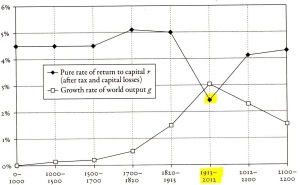
Picketty Chart on page 357

That graph, from the period of 1913 to 2012 includes the period in which radio and television were born. It’s the era when advertising supported media took off. I worked the last forty years of that graph in the radio business and experienced the change in business that this graph shows.

Commercial radio was born in 1920. Commercial TV took-off in the 1950s. And I quite agree with Seth Godin when he writes “Mass production, the ability to make things cheaply, in volume, demanded that we invent mass marketing – it was the only way to sell what was being made in the quantity it was produced. Mass media exists because it permits mass marketers to do their job.” To which I would add to Seth’s thoughts that mass media and mass marketing both existed because there was a strong American middle class of consumers.

If Piketty is correct, the concept of a middle class consumer economy that existed between 1913 and 2012, was an anomaly. It didn’t really exist anywhere in the world before 1913 and it’s very likely not going to exist anywhere in the world as we journey away from the year 2012. The middle class consumer economy will evaporate and along with it, advertiser support for mass media.

1913-2012 was a unique period in world economic history. It gave birth to consumers who had money to spend, mass production that could produce lots of goods and mass media that could advertise those goods. All three were simultaneously occurring at the very same moment.

The new buzz words are “shared economy” and “collaborative economy.” What roles will large corporations, universities and mass media play when people are getting what they need from one another?

In 2014, Nielsen Music reported a staggering drop in music sales where as much as a fifth of music buyers didn’t buy anything.   2014 also saw box office ticket sales plunge to their lowest level in three years. The home ownership rate reached its lowest point in 25 years at the end of 2014. More people were now living in shared living arrangements or going back home to live with mom and dad. And NYC Mayor Bill de Blasio appearing on “The Nightly Show with Larry Wilmore” told viewers that:

“The wealth gap in New York City today is worse than during the Great Depression or The Roaring 20s – and the gap is growing bigger. Today over half the people in NYC pay over a third of their income for housing. The reality is, (according to the mayor) if we don’t change course middle class families won’t exist in New York City.”

Are these reports canaries in the consumer coal shaft?

Medialife Magazine, a magazine devoted to media buyers and planners, reported that 2014 wasn’t good for advertising. Total spending was up 3.0 percent, but if you take out political spending and the Winter Olympics, the number shrinks to 1.6 percent. “That’s the worst yearly growth pace since the recession began in 2008,” said writer Bill Cromwell. Traditional media is struggling and according to Magna Global, “this appears to be a lasting trend.”

Only recently have broadcast operators said things like “flat is the new up” when comparing year-over-year revenues. I realize there are exceptions to what I’m saying. Your broadcast property might be one of them. But what are the trends that are taking place and how will they impact you in the years to come?

It took two world wars to re-set the wealth inequality gap and put into place FDR’s New Deal. Changes that have in more recent times been stripped away returning things to the way they were in the 19th Century; a period of time when the concept of a middle class of consumers didn’t exist.

Roy H. Williams, aka The Wizard of Ads wrote recently (Monday Morning Memo, March 2, 2015) about “the shrinking of mass media” and “the growing reality of gender equality.” America went from being 16% single to 46% single in just one generation, Williams writes. “A once-proud nation of families is evolving into a proud nation of individuals.” And Williams sees “The trend toward singleness is sociological (while) the erosion of mass media is technological (as) each trend accelerates the other.”

Williams comes to this conclusion:

“We’re approaching the end of a golden time when courageous advertisers can invest money in mass media and see their businesses grow as a result. My suspicion is that we’ve got perhaps 5 to 7 more years before retail businesses and service businesses will be forced to begin playing by a whole new set of rules. Buy mass media while the masses can still be reached.”

The future of ad supported media is tied to consumerism. Consumerism is tied to having a strong middle class.

Does the Piketty graph on page 357 of his book “Capital” send a chill down your spine like it does to mine?

P.S. Thomas Piketty published an amplification on his r>g theory. You can read that here.

36 Comments

Filed under Education, Mentor, Radio, Sales

What Ronald McDonald Could Teach Radio

Today in America there are more radio stations on the air than at any time in its almost 100 year history. More radio stations are taking to the air every day. That’s a good thing, right? I would argue it’s not.

When I was working for Clear Channel Radio (yes, it was once called that – now it’s iHeartMedia), the President was a man named John Hogan. Hogan came up with a plan to reduce clutter. He called it “Less is More.” On the surface it sounded like a grand plan. However, the devil is always in the details and the devil was Clear Channel was now going to move away from a unit based inventory management system to a one that included half-minute long commercials, ten-second commercials, five-second long commercials it branded as “adlets” and one-second long commercials it branded as “blinks.” In the “blink” of an eye, the amount of units grew and we would learn that people don’t notice the length of commercials as much as they do the number of interruptions they are confronted with. “Less is More” would inadvertently introduce more clutter in the name of reducing clutter.

Well some clown named Ronald McDonald must have been watching us because at the end of last year, McDonalds announced that its menu had become so unwieldy that even the chain’s president had no clue as to how many items it contained.

In his book, “The Paradox of Choice – Why More is Less” psychologist Barry Schwartz argues that eliminating consumer choices can greatly reduce anxiety for consumers. That while autonomy and the freedom of choice can be healthy and good for our well being, modern Americans are faced with more choices than any group of people in the history of the planet and all this choice is having the reverse effect.

I remember the headline in Forbes “You Can Now Play 100,000 Radio Stations On Your TV with Google’s Chromecast.” A hundred grand? I have trouble finding enough radio stations I want to listen to, to fill the pre-sets on my car radio and they only give me pre-sets for 6 AM stations and 12 FM stations. I have a 10-minute commute on a bad day, so I don’t do a lot of button pushing.

Edison Research now calls their radio study the “Infinite Dial” because with the advent of streaming audio, we have the ability to listen to radio stations all over the world. I have ten Apps for listening to streaming radio on my iPhone and iPad. Of those, I primarily use three of them the bulk of the time. Of the three, one dominates. That single App now curates over 90 different genres of music. The good news is that I can create a “Favorites” section so I only need to choose from a limited number of genres to match my mood.

When radio began consolidating into clusters, adding HD signals & sub-channels and then streaming, the complexity proved to be a challenge to an ever shrinking workforce challenged with programming and selling all of those product offerings.

Schwartz tells us that modern psychology shows that happiness is affected by success or failure of goal achievement. Radio workers and McDonald’s folks probably aren’t all that happy; not like they once were.

McDonalds last year recorded its worst domestic comparable sales figures in more than a decade. In radio, being even with last year’s numbers was being called the new “up.”

McDonalds plan is to reduce the number of choices, focus on those items they will serve to improve their quality to delight the customer.

Most people’s cable or satellite TV package delivers hundreds of channels and yet, the most common thing people are heard to say “there’s nothing GOOD on to watch.” “Good” being the operative word. What a change from when I was growing up and my biggest problem was a GREAT show was playing on all three television networks; at the same time (days before VCRs and DVRs).

Radio in that same era was exciting, innovative and totally focused on delivering great content. These were the days when a Top40 radio station like CKLW had a 20-person news department on a radio station that was all about music not news. Had an air staff that was refreshed every three hours with a new disc jockey, had an off-air program director, a music director & assistant that did music research, a promotions department & promotions budget, plus consultants all for a single radio station.

Less is more works if more people can focus their attention on less.

Take it from a famous restaurant clown, “Less IS More” in more ways than one.

2 Comments

Filed under Education, Mentor, Radio

Top 3 In-Demand Radio Jobs

What is the future for jobs in radio in our digitally connected world? Three jobs in particular stand out as being in demand right now and look to be still in demand as radio celebrates its 100th Anniversary in the year 2020. The first won’t surprise anyone, the second is a job that only recently became critical and the third is a job that’s been a part of radio since day one.

#1 Radio Sales People

I’m sure it comes as no surprise that the need for trained, professional sales people is the number one radio job in demand today and as far out as the eye can see. Since I’ve been in radio it seems hiring good sales people was always on the lips of general managers and sales managers. So when we asked the operator’s of Kentucky’s 300 radio stations what were the jobs they most needed to fill, sales was job one.

Ironically, it’s the class not offered by many of America’s colleges and universities that offer a broadcast curriculum. Where I teach at Western Kentucky University, Bart White started teaching radio sales decades ago as part of the broadcast degree program in Radio/TV Operations. In fact, Barton C. White wrote two books on radio sales, his second called The New Ad Media Reality Electronic Over Print should have been widely distributed from the day it came out in 1993. I know I wished I had been aware of it back then.

I was hired to replace the retiring Professor White and immediately charged with teaching both the Broadcast Radio/TV/Digital Sales class as well as the Radio/TV Operations Capstone class. Since I began five years ago as a tenure track professor at WKU, I’ve overseen the creation of the KBA WKU RADIO TALENT INSTITUTE that contains a strong sales component as well as adding a second sales class to the broadcast curriculum in Advanced Radio Sales that enables students earn their professional Radio Advertising Sales certifications in both radio and digital sales from the Radio Advertising Bureau (RAB).

My students have learned that with this type of training, they are almost guaranteed a job upon graduation wherever they decide to live. I’ve successfully placed students with companies like iHeartMedia, CBS Radio, E. W. Scripps, Cromwell Broadcasting, Alpha Media, Commonwealth Broadcasting, Viacom, Summit Media, and Forever Communications.

This year at BEA2015 (Broadcast Education Association) in Las Vegas I’m moderating a panel I proposed to encourage other colleges and universities to consider adding radio sales classes to their curriculum by letting them hear directly about the need in this area from some of the radio industry’s leaders who will be in Vegas attending the NAB April Convention.

#2 Internet Content Creator

The next position that is in demand is for people who can create original content for radio station websites. Not cut and paste artists who “borrow” others’ website content and re-purpose it but innovators that can act like a combination of journalist/advertising/public relations specialist and populate radio station websites with engaging, compelling original content that is of interest to people in the station’s service area.

#3 RF Broadcast Engineers

Not that it was ever easy to hire great radio engineers, the talent pool used to be a whole lot bigger. Consolidation chased a lot of them out of the business and what they learned was the job could be more lucrative by becoming a consultant engineer to groups of radio stations. Other engineers found new opportunities in other industries that could apply their talent and strong work ethic that was instilled into them by radio’s 24/7 on-call employment. Computers and digital technology also demanded that radio engineering learn this new radio operational system or get out.

Well, those who went into private consulting are now reaching the age of retirement. Those who went into other industries learned the pay and hours were often better than radio. Further complicating things, most schools are teaching the skills needed for the digital world and radio stations still generate broadcast signals using radio frequency (RF) and there are fewer schools turning out these types of engineers for radio stations. Graduates are sought by the wireless communications companies that have similar needs to radio stations and have the deep pockets to entice them to work for them.

Positions Not In-Demand

General Managers, Promotions Directors and News Reporters are found on the bottom of the employee needs list. It would appear this is a result of radio’s consolidation. One manager is now needed to oversee a cluster(s) of radio stations. Promotions are now planned on a group-wide basis and news hubs have been set-up to serve regional areas.

22 Comments

Filed under Education, Mentor, Radio, Sales

Hooked on a Podcast

Did you know you don’t need an iPod to listen to a Podcast? OK, if you’re reading this, you probably did know. I know my students know, because they are already listening to Podcasts on all kinds of devices that connect to the Internet.

I never really thought of hearing the end of an NPR story that I couldn’t complete when I was listening to it being broadcast over-the-air, on the NPR website, as a Podcast. It was just a way I could finish listening to something that had captured my attention. But that is a Podcast too.

To me, Podcasts were more along the lines of content developed to be delivered only via the Internet that could be

Then I heard the buzz about Serial. It premiered in October 2014 and season one was made up of twelve episodes. Serial is a spin-off of the public radio program This American Life.

By the time I joined the “party” of fans hooked on this Podcast it had ended. All twelve episodes had been created and streamed. The last episode had just been posted before I was getting ready to leave for my annual Christmas vacation back in my hometown in New England. The drive from Kentucky to my hometown is a 15-hour, two day journey.

My plan was to download the entire first season of Serial and listen to it on my drive. I actually own an iPod Classic 80GB so it seemed appropriate to go on iTunes and download season one into this device for my drive. I also knew that I would be able to complete the entire first season before I arrived home for Christmas. What was season one about? I actually knew very little about it other than it was not fiction, but a true story about a homicide and a young man sitting in jail as a result. I had also heard that it gave the listener a behind the scenes look at how journalists work when covering a story. Not “parachute journalism” that is typically what we see on the national TV evening newscasts, but real investigative, shoe-leather journalism. I was as excited to get on the road to see my friends and family for Christmas as I was to plug in my iPod and begin listening to the first episode of Serial.

Full disclosure, I did have a fleeting thought that I might not be engaged by Serial and a major portion of my audio accompaniment for my long drive might be toast. That didn’t happen. Actually, I experienced a totally different problem, that being getting out my car to fill-up with gas or stopping for a necessary restroom break and having to stop the playback of Serial while I was out of my car. Yes, it’s that engaging!

Sarah Koenig hosts Serial and she’s a fabulous storyteller. What this Podcast does is cover one true story, one episode per week, and no one, including the Serial Team knows where it will end until they get there. Because of this, listeners to the Podcast that might have intimate information about the story contact Sarah and her team with leads and information for them to pursue. Had I been listening in “real time” as each new week’s episode was posted I would have been able to contribute had I had such knowledge about this story myself. (I didn’t) However, because I had the entire season one loaded onto my iPod, I had a similar problem to the year one of my son’s gave me season one of the TV show 24. Knowing I had the next episode at the ready meant I got very little done once I began watching that DVD. The good news is when it comes to audio content; you can do other things while listening, such as driving 15-hours back home for Christmas.

I’m not going to reveal details of the story of season one in this post, I think you will enjoy it more the less you know going in. I will tell you that I sent in my donation to keep this Podcast going. Sarah only mentions this once during the twelve episodes, but it immediately resonated with me and I made a mental note to send in my contribution when I got back to “my old Kentucky home.”

So what did I learn other than a company called Mail Chimp was the major sponsor after listening to the Serial Podcast? That Podcasts are a serious challenge to over-the-air broadcast, they’re easy to use and addictive.

Podcasters are also not afraid to dismiss folks who may not like what the Podcaster is doing. Maybe that’s because the Internet opens up the entire planet to them and when you consider what a niche program can attract when the potential pool of listeners is in the billions, it’s OK if not everyone’s a fan.

UPDATE: The Maryland Court of Special Appeals on Friday, February 6, 2015 agreed to hear his case after two unsuccessful attempts to appeal his conviction over the past 12 years.

1 Comment

Filed under Education, Mentor, Radio