Tag Archives: talent

Reviving Radio: Embracing Change for a Brighter Future

Today, I invited Dales Whyte, Business Advisor Enterprise Plus (South Coast Of NSW), Charity Founder & Creator Of Businesses, Community Leader, and International Broadcaster to share his perspective on the state of commercial broadcast radio from his home, Down Under.

-0-

Radio, a medium that has been a source of entertainment, information, and connection for generations, is facing a crossroads. As a radio enthusiast who fell in love with this industry in the late ’70s, it pains me to see its decline. The ghost of radio may linger, but its glory days seem to be fading unless we take action now! I refuse to attend its funeral, and I believe that with the right strategies, we can breathe new life into Radio.

Today, I serve as a business advisor for the New South Wales (NSW) Government, working with small to medium-sized clients daily. Ironically, this role has given me a unique insight into the state of the radio industry in Australia.

I’m not advocating a return to the good old days of the ’70s, ’80s, ’90s, and yesteryear’s hits. Instead, I’m championing the use of modern technology and techniques to rejuvenate the industry. The future of radio lies not only in its past but also in its present.

One strategy I often recommend to my clients is reverse engineering the sales process to better serve and adapt their businesses. Radio must apply the same principle to secure its future. We need to focus on two key client bases crucial for our survival.

1.         The Customer:

•          The customer is not just the listener but also the one who pays the bills, keeping the radio station afloat.

•          While streamlining operations and adopting network-centric models can save money, we must not sacrifice localism. If we do that then the customers advertising will be impacted by not having the number of listeners to act on the message of the commercial stop

•          Balancing cost-saving measures with local touch is essential to keep our customers satisfied and our revenue strong.

2.         The Radio Listener:

•          Listeners are the lifeblood of radio. We must provide them with content that meets their needs, wants, and desires.

•          Local radio plays a vital role in informing communities about local events and news, making it an invaluable resource.

•          We need to address the growing disconnect between what listeners want and what we deliver.

 To revive the radio industry, we must consider the following strategies:

1.         Embrace Social Media:

•          Radio has traditionally shied away from social media, but it’s time to change. Social media can enhance the connection between listeners, customers, and radio stations. We have to be the leaders in social media in our marketplaces.

•          Utilize platforms like Facebook, LinkedIn, and Instagram to engage with the audience and expand reach.

•          Use social media for the coverage of events. Radio must now return to the days of turning up to every dog and pony show.

2.         Live Streaming:

•          To cater to today’s audience, we must offer live streaming of radio shows.

•          Interact with the audience in real-time during shows and engage them through video and audio content.

3.         Invest in Talent:

•          Radio’s success hinges on having the best talent in the industry. Not just announcers but for the entire radio station.

•          Encourage people to pursue careers in radio by providing opportunities and training. I have long advocated that nights and mid dawns should be utilised as training/sessions to create a true radio school.

Shared Responsibility: The responsibility for radio’s survival falls on all stakeholders in the industry.

1.         Announcers:

•          Announcers should consider their role as being a dedicated professional, not just a job.

•          They should stay informed about local events, engage with the community, and embrace localism. Announces need to embrace localism!

•          Never miss an opportunity to localise or interact with the community.

2.         Sales Teams:

  • Sales teams should focus on creating successful advertising campaigns that truly benefit clients.
  • The quick sale mentality must be replaced with a client-focused approach.
  • Members of the sales team have to be individual advertising agents understanding and utilising skills in conjunction with creative writers to achieve outstanding results for radio customers,

3.         Station Staff:

•          Every member of the station’s staff plays a critical role in its success.

•          The friendliness and engagement of receptionists, for example, can leave a lasting impression on visitors.

4.         Managers:

•          Managers should lead the way by encouraging new ideas and a change in business practices.

•          Regular positive meetings and staff collaboration are essential for radio station success.

5.         Owners:

•          Owners must be willing to embrace change and enforce ethics in the industry. People must feel safe in their job and part of a living breathing team that is growing and won’t replace them at the drop of a hat.

•          A long-term approach is needed to ensure financial success and maintain radio’s relevance.

Conclusion: The radio industry is at a pivotal moment. We can choose to let it fade into history, or we can take action to revive it. By embracing change, focusing on the needs of both customers and listeners, and using modern technology, radio can continue to be a vibrant and essential part of our lives. It’s time to write a new chapter for radio, one that ensures its survival and success for years to come.

-Dales Whyte

Empowering businesses along the picturesque South Coast of New South Wales as a dedicated Business Advisor under the Enterprise Plus / Business Connect program, I also take pride in my role as a philanthropist, founding charities and nurturing innovative enterprises. As a community leader, I strive to foster growth and collaboration, creating a positive impact locally and beyond. Additionally, my voice extends globally as an international broadcaster, sharing insights and stories that resonate across borders. Together, let’s build a thriving and interconnected world.

16 Comments

Filed under Education, Mentor, Radio, Sales

P E R S O N A L I T Y

In 1959*, Lloyd Price released the song “Personality.”

It was about a girl and what made her special.

Here’s a sample:

            ‘Cause you got personality

            Walk, with personality

            Talk, with personality

            Smile, with personality

            Charm, with personality

            Love, with personality

With the exception of a daypart or two, it’s what most radio lacks today – PERSONALITY.

Rewound Radio

Every Saturday, Rewound Radio, a streaming-only radio station features its “DJ Hall of Fame.” They are air checks of some of America’s best radio personalities, like Dan Ingram, Ron Lundy, Robert W. Morgan, Charlie Tuna, The Real Don Steele and so many more. While everyone of the personalities I just mentioned are now in radio heaven, their recorded radio shows sound as vibrant and exciting as ever. That’s why people from all over the globe dial in to hear them, and not just radio people, radio listeners who grew up with them.

People like me.

Techsurvey 2022

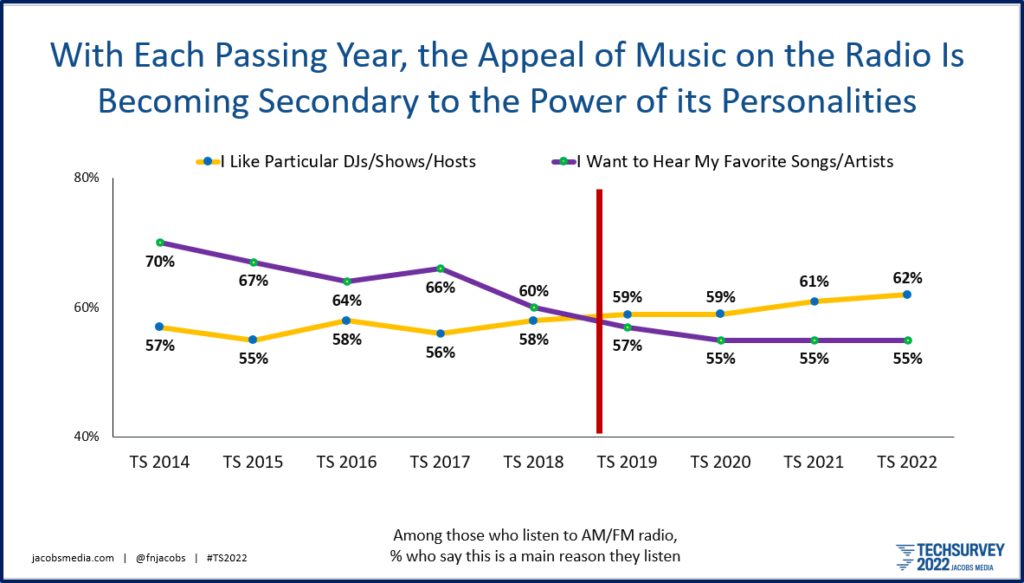
So, it wasn’t really a surprise when Fred Jacobs gave us a sneak preview of his latest research on why people listen to over-the-air (OTA) radio.

People today listen to OTA radio for the very same reason that they always have, to hear their favorite radio personality. The unfortunate thing is, the radio industry talks the talk, but doesn’t really walk the talk.

Radio’s ultimate strength as a medium is dependent

on the power and popularity of its personalities.

-Fred Jacobs

Club DJs

When I walk the boardwalks in New Jersey, Delaware or Maryland in the summertime, you can’t help but be very aware of how important it is for each club to have a popular DJ. Club DJs get people dancing, having fun and spending their money in that particular club for hours.

The longer club patrons stay, the more money club owners make.

The reality is the role of a Club DJ could be easily automated and the music would be non-stop, but it is the special magic a live personality delivers that makes all the difference. Great performers make people feel things. They deliver an emotional experience that can’t be duplicated by automation.

“People are always neglecting something they can do

in trying to do something they can’t do.”

-Edgar Watson Howe

Living in a VUCA World

The world today is volatile, uncertain, complex and ambiguous; it’s a VUCA existence. Many businesses are told they must innovate or die.

In radio’s race to stay relevant, it tries to compete with streaming audio services, where at best it can only be second best when it plays on their terms. What OTA radio should be heavily investing in is the development and promotion of outstanding, compelling, relatable radio talent.

“Treat talent with respect.

They are the reason radio remains so important.”

-Lori Lewis

Family Feud

Sue & I love watching Family Feud with Steve Harvey. This TV game show debuted on ABC on July 12, 1976 with host Richard Dawson. It would be broadcast for nine years before the network pulled the plug,  but would continue to air periodically over the following decades. The show has had six hosts, but only its original host and the current host have seen the show be an audience hit.

In fact, it was when Steve Harvey took over as host in 2010, that Family Feud was finally resuscitated. His hosting abilities with his stand-up comedy and radio background has the audience always wondering what he will say next and almost always producing laugh-out-loud moments on the game show. It also doesn’t hurt that Steve Harvey is as nice as he seems. Being genuine is always an asset in the media world.

I said there were six hosts of this show over the years, Richard Dawson was the first and Steve Harvey is the current host, but you probably can’t name the other four without looking it up on Google. And that’s my point.

Personalities are the difference maker.

Radio leaders talk a good game when it comes to telling us how important local talent is to the power of great radio, but it’s time they put their investment monies where their mouths are, by hiring and training the next generation of radio performers.

It’s time for the radio industry to focus on a change that matters.

Family Feud Hosts: Richard Dawson, Ray Combs, Louie Anderson, Richard Karn, John O’Hurley and Steve Harvey.
*Note: an earlier version of this post stated the date of Lloyd Price’s hit record “Personality” as 1957. It was updated to 1959 after a reader pointed out this error.

8 Comments

Filed under Uncategorized

The Waiting for Godot Fallacy

I know many people who come to this blog and post comments about the articles I write pine for radio to return to the way it was twenty years ago. They’re hoping that one day the big consolidators will move on to new business ventures and will sell their radio stations back to radio people who will run those stations correctly. Sadly, wishing for that to happen is like Waiting for Godot .

But that doesn’t mean there’s not a future for radio. One of my readers, a multi-decade broadcast manager, engineer and consultant wrote the perfect prescription for making radio healthy again. Today, I would like to share with your those thoughts.

It’s Not About Being Local

“Local” being the savior of radio is a canard and always has been. The beauty of social media is that it is a rich media experience that is personalized expressly for one person: you. Radio cannot hope to be so “local” that it can beat that.

Serve Your Tribe

The secret to radio’s survival is not localism but “tribalism.” Providing not just a service but an experience. An experience that joins numerous people together, regardless of geography. Hence the success of right-wing talk radio, the success of NPR (which is rarely less than 21 or 22 hours of national progamming out of every day on virtually every “member station”) and most informatively, the success of K-Love, which has near zero local content at all yet has grown a huge and profitable audience.

These outlets’ content has precious little to do with the local community, but they all share a powerful defining aspect: listeners self-identify as being proud to listen (and prouder to donate to) the outlet in question.

Commercial Radio’s Tribal Leadership Vacuum

Most commercial radio outlets have achieved this tribalism on the backs of longevity of a given host: KISS 108 has been top-rated in Boston for decades because that audience has tuned in to hear Matty Siegel every morning for over forty years. Rush Limbaugh had his legions of Ditto Heads for nearly as long.

And therein lies the rub. Most of those hosts are in their 70s or older…or dead…and the pipeline to replace them has been sealed off thanks to post-1996 consolidation. Non-commercial radio operators, like K-Love and NPR, have succeeded in finding a content/style niche but there’s only room for so many of those.

It All Comes Down to Your Talent — Growing & Retaining It

So, to put it another way: it’s not localism that’ll save radio; it’s talent. And radio has worked very hard to drive good talent out of the business.

“Talent hits a target no one else can hit.

Genius hits a target no one else can see.”

-Arthur Schopenhauer

3 Comments

Filed under Education, Mentor, Radio

Just In Time Learning

66In a post I wrote about “Where You Should Be Recruiting Radio Talent” I mentioned a concept of “Just In Time Learning” that struck a chord with many readers. Commenter’s said they found the idea interesting and something they had never heard or thought of before. So I thought I’d expand on that thought with a little more detail and why it’s time has come.

Toyota’s Better Idea

Manufacturers used to stock everything they would need to build a product in warehouses. It was expensive and often wasteful. Then the idea of having parts shipped just-in-time to be assembled into a finished product was introduced.

Originally called “just-in-time production,” it builds on the approach created by the founder of Toyota, Sakichi Toyoda, his son Kiichiro Toyoda, and the engineer Taiichi Ohno. The principles underlying the TPS are embodied in The Toyota Way.

College Degree Credential Creep

Once upon a time, college was an optional final stage of learning in the United States. Today even a Starbucks barista probably has a college degree. So what’s causing this college degree credential creep? In many cases the reason is that employers feel that by requiring candidates to have a bachelor’s degree they will see a higher quality group of candidates. It has nothing to do with what job skills are actually required. It’s used mainly as a screening tool. Unfortunately, two-thirds of the workforce in America gets screened out when a B.A. degree requirement is inserted into the advertisement. Burning Glass researched how the demand for a bachelor’s degree is reshaping the workforce and you can read more about all of this here.

The 20th Century College Education

When the 20th Century began, America had about a thousand colleges and those colleges had less than 200,000 students enrolled in them. By mid-century the number of colleges exploded and colleges that once had about a thousand students expanded to universities with enrollments of tens of thousands of students.

Unfortunately our 20th Century higher education system simply wasn’t designed to deliver what’s needed in a 21st Century world.

Your Teacher, Your Doctor and Your Barber

In our high tech world, things can quickly scale. Productivity grows quickly. But a teacher still teaches at the same pace. Your doctor can only see patients at the same pace.  And your barber can only cut hair at the same pace as each of these professions did in the 20th Century.

When something can’t scale, the price to provide the service goes up.

In the case of higher education, this price problem has been compounded by states reducing funding to their colleges and universities, resulting in public colleges being funded more and more by student tuition and lots of fees. This has resulted in a trillion dollar student loan crisis in America.

Certifications vs. Degrees

For the radio industry, the answer may be professional certifications versus bachelor’s degrees. Students simply can’t afford to go to college for four to six years and come out with tens of thousands of dollars in student loan debt to take an entry level radio job that will pay them fifteen to eighteen thousand dollars a year. Even worse, most likely the job you’re most looking to fill – sales – a college grad won’t have received any course work in learning about. Broadcasting in college is focused on teaching all of the low demand jobs in radio and the classes in the high demand jobs are either non-existent or being eliminated.

The Radio Advertising Bureau offers professional certifications in selling starting with their Radio Marketing Professional (RMP) certification. Burning Glass says that jobs in fields with strong certification and licensure standards have avoided the problem of “upcredentially.” They write: “This suggests that developing certifications that better reflect industry needs, together with industry acceptance of these alternative credentials, could reduce pressure on job seekers to pursue a bachelor’s degree and ensure that middle-skill Americans continue to have opportunities for rewarding careers, while continuing to provide employers with access to the talent they need.”

Radio’s Recruitment Mission

The National Association of Broadcasters (NAB) and the Radio Advertising Bureau (RAB) need to spearhead the radio industry in creating bonafide certification programs for all job classifications that will be accepted by the radio industry as the equivalent (or better) than a bachelor’s degree. These programs need to be offered to high school aged students and recent high school graduates.

Certification programs can be designed to provide the kind of just-in-time learning needed for each radio position. When a person shows they’re ready to advance additional certification training can be taken to prepare them for the next higher position.

Done in this way, the training will be up-to-date, cutting edge instruction to insure the student is learning exactly the skills needed for the position they will be moving into.

Time for Radio to Think Different

The radio industry will need to attract new talent in order to stay viable and continue growing. Embracing a better form of training for the skills needed and making this a requirement versus a college bachelor’s degree is 21st Century thinking.

Many of these programs are already in place, but industry recognition and acceptance of them lags in comparison to requiring a college degree.

It’s time to think differently about how we find, train and grow the radio talent of tomorrow.

-0-

Note to weekly readers of my blog: I publish every Sunday morning. If you would like to receive my articles by email, simply sign-up by clicking on the “Follow” button at the bottom right hand corner of your screen.


19 Comments

Filed under Education, Mentor, Radio, Sales, Uncategorized

Radio Would Be a Great Business… If It Weren’t For the Employees

21I’m sure the title of this week’s post caught your attention. If you’ve ever been a manager, quite possibly this thought has crossed your mind on more than one occasion. Unfortunately, technology has provided many a radio company the opportunity to give this concept a whirl.

The reality is radio is a people business. Take away the people and do you really have radio anymore?

My best sales people were a pain in the derriere. My best air talents were likewise. And I mean that in the nicest possible way. The fact of the matter is, great talents are always a handful to manage, but they are the engine that creates great radio.

Managing great talent is the art of keeping them from killing one another. Managing great talent is respecting that they are outstanding at what they do and at the same time looking them in the eye and under no uncertain terms letting them know that their talent doesn’t transcend to every other aspect of their life.

Very talented people often think that because they are outstanding in one area, they are in all areas and this is often what leads to their downfall.

Managing great talent is like keeping a nuclear reactor under control. You need to know when to push the control rods in to calm things down and when to pull them out to create a powerful, positive reaction.

Managing great talent will exhaust you. Managing great talent will frustrate you. Managing great talent will challenge you. Managing great talent will be the greatest experience of your life.

I’ve had the honor of running some great radio stations over my radio career and I’ve been fortunate to have worked with some incredibly talented people in every area of radio station operations. I credit my success to them and doing my best to clear the field of obstacles that might prevent them from performing at their highest personal best.

Since I started teaching, I’m finding a similar scenario with students. Great students will get every piece of knowledge they can out of you. They are self-motivated to excel. And yes, they too, can be a handful. But the greatest reward a teacher can experience is having students who want to learn and then apply what they’ve learned to grow and excel at whatever they put their mind too.

Warren Buffett’s “3 Qualities to Look for in Hiring:”

Integrity, Intelligence & Energy.

If you don’t have the first one, the other two will kill you.

To sum it all up, the most important thing any business or school can do is pay attention to how it recruits the people it will work with. You can’t teach attitude. You hire attitude. Everything else can be taught.

Radio is a great business if you will do these three things: 1) focus on hiring great employees, 2) make sure everyone is focused on the same goal and 3) let your people know you really care about them.

Just remember, like a high performance automobile will command a lot of attention, the finest race horses will command a lot of attention, so will high performance talent. Anything that performs at the highest levels of its field will command a lot of attention.

If you like winning, then everything it takes to get there will be worth it.

14 Comments

Filed under Education, Mentor, Radio, Sales, Uncategorized