Author Archives: Dick Taylor, CRMC/CDMC

Dick Taylor, CRMC/CDMC's avatar

About Dick Taylor, CRMC/CDMC

I’ve been a “Radio Guy” all of my life. My earliest memories were of building a radio station out of tinker toys and pretending I was a disc jockey. Later I would build a radio station in the basement of my parent’s home and using AM & FM transmitters I bought at Radio Shack I would begin broadcasting to my neighborhood for about a three block radius. I began in commercial radio in the 10th grade in high school. A local radio station in my hometown of Pittsfield, Massachusetts decided to start a Junior Achievement company in radio. This was a really new concept in Junior Achievement as all JA companies at that time were production oriented and a radio station would be a service oriented JA company. I was a member of that first Junior Achievement radio company (WJAC) and it quickly led to a part-time job with that radio station (WBEC). Radio would pay for my college education and graduate degrees, both of which were in education. I loved college and could have very easily become a career student. When I graduated with my Masters Degree, there were no jobs in education to apply my earned degrees but there were radio jobs and I went into the radio business full-time as a program director, operations manager and air personality. Deciding what I’d really like to be is a radio station general manager, I knew that I would need to earn my chops in sales and so I quit my job on the product side of the business and started over at the bottom of the sales ladder as an account executive. I quickly rose to sales manager, station manager and general manager. For 27 years, I operated at the market manager level of the radio industry. I’m a Life Member of the New Jersey Broadcasters Association and Radio Ink Magazine has named me one of radio’s best managers. Former professor of broadcasting at the School of Journalism & Broadcasting at Western Kentucky University (WKU) in Bowling Green, Kentucky. I have a successful track record in sales and people development, growing top line revenues, achieving leading audience ratings, reducing expenses and meeting bottom line goals. I’m a recognized expert in radio and media regulations. I’m a turnaround specialist. I'm the founding director of the KBA WKU Radio Talent Institute coordinating a professional faculty of broadcasters who teach broadcast students who qualify and are accepted to attend a ten-day intensive program that trains tomorrow’s broadcasters in all aspects of radio station operations. My specialties include: dynamic public speaker/presenter and sales trainer. I currently teach classes in the Process & Effects of Mediated Communications, Broadcast/Internet Sales, Broadcast Performance/Production, Broadcast Management and the History of Broadcasting in America. I hold a BA in Physics/Education, an MS in Educational Communications, the Diamond CRMC (Certified Radio Marketing Consultant) and the CDMC (Certified Digital Marketing Consultant) from the Radio Advertising Bureau. I’m a graduate of Roy H. Williams Wizard Academy and Gitomer Sales Training. Note: The picture on my blog is when I was invited to do a guest disc jockey appearance on The Legend - 650AM - WSM in Nasvhille, Tennessee (July 2014). For this "Radio Guy" doing a four-hour air shift on this legendary clear channel signal radio station was a dream come true.

Winners Invest in the Future

America got to be the leading country in the world by investing in its future and much of that investment came from the government investing in the new ideas of its citizens.

In 1825, an American painter was commissioned by the City of New York to paint a portrait of Lafayette.   The painter traveled from his home in New Haven, Connecticut to Washington, DC to paint Lafayette before he departed back to France. While in DC, the painter received word his wife was very sick. Before he could even begin to travel back to New Haven, a second letter arrived to say his wife had passed away. Grief stricken, this event would cause the middle aged painter to search for a faster means of communication.

Samuel Finley Breese Morse would, with the financial assistance of the United States government, build the first telegraph system between Washington, DC and Baltimore, Maryland in 1844. He would secure his patent for the telegraph in 1847 and be given the rights to privately build telegraph systems throughout America and the world. He co-founded the Morse code language that bears his name and is still the code used today by practitioners of this form of communication.

This kind of investment in the future has been the Hallmark of America.

Radio has benefited from many creative geniuses over the years since its commercial birth in 1920. Programmers, air talent, engineers, managers and visionary stakeholders have all played a role in making radio the second greatest invention of all time (according to the History Channel).

Growth of any enterprise only occurs if there’s a steady stream of new innovation. Innovation occurs when experimental research is conducted without thought for where it may lead. The transistor was invented in 1947, but it didn’t really see a practical application until the first transistor radio was put on sale in November 1954. It was the Regency TR-1.

The transistor radio and car radio would be the salvation of AM radio with the advent of commercial VHF TV in the 1950s. The inventors of the transistor did not envision that their creation would save the radio industry by making it available to a whole new generation who wanted to hear the latest music wherever they went.

Ironically, our government funded virtually every piece of technological development that would make possible the Internet, the iPhone and even Siri. Radio can either be like Google and Apple and take advantage of what’s been created to leverage it for their business or relegate their medium to the era of flip cameras, walkman, dial telephones etc.

Radio today invests a lot of energy in trying to hang on to the past. It’s playing defense instead of offense as it did back when television was born.

To win in the future, you have to invest in it.
Leave a comment

Filed under Radio

Giving Thanks

1At this moment in time, I would have to say I’m thankful for having the opportunity to fulfill a life-long goal of one day teaching at a college or university. I’m now in my fifth year of teaching broadcasting at the School of Journalism and Broadcasting at Western Kentucky University. I’m grateful for my students that write a note to say how appreciative they are for the effort I put into my classes and how they benefitted from them. And I’m thankful for those students who stay in touch with me after they graduate to let me know how they’re doing in their broadcast careers.

I’m thankful for being able to have the whole family together for Thanksgiving for the first time in five years as each of us have moved to different parts of the country but this year will all return to my hometown of Pittsfield, Massachusetts. It will be our first Thanksgiving that will have three grandchildren celebrating this family holiday spanning four generations.

I’m grateful for my two sons that each have distinguished themselves in their chosen careers and are wonderful fathers.

I’m thankful for my two older brothers that always been there for me through ups and downs, thick and thin.

I’m grateful that a career in radio that I started in the 10th grade in high school would allow me to pay for my college education, graduate school and raise a family. It’s a career that was all I ever wanted to do besides one day pay-it-forward through teaching the next generation of broadcasters.

I’m thankful for all the wonderful people I’ve met on this journey called life, people who were only strangers until we said “hello,” and then became friends for life.

One of my mentors, Zig Ziglar said: “You can get anything in life you want, if you will just help enough other people get what they want.” I’ve tried to live those words every day.

As we approach Thanksgiving Day 2014, remember you may make a living by what you get, but you make a life by what you give.

Today, I’m giving thanks for you.

1 Comment

Filed under Education, Radio

It’s Christmas Time – Hammacher Schlemmer’s “Last Minute Gift 2014 Catalog” Arrived

Hammacher Schlemmer (2)Growing up, I always thought I was blessed to have been born in the month of October. Why you ask? Because in September the Sears “Christmas Wish Book” would arrive in the mail and I would carefully comb through its pages to make out my Christmas list for Santa.

Doing this in September was a good way to let the members of my family know of my “needs” since my birthday was right around the corner. Sometimes, I’d get an item or two on my birthday from the Wish Book and I’d update my Santa list.

Well Sears ended its catalogs years ago. That’s the bad news. The good news is that Hammacher Schlemmer still publishes theirs and I’m on their mailing list.

So what’s hot for 2014? How about a high definition camera drone. A gravity defying clock (not like I’m planning a trip into space anytime soon). There’s the instant transmitting paper to iPhone pen. The hands free hair rejuvenator (Hmm, I wonder).

There are a lot of different ways to amplify or clarify people’s hearing. Makes me wonder if the Hammacher Schlemmer customers are all going deaf.

There are lots of things to connect with your iPhone or iPad; even a piece of electronics that will transfer your records or cassettes into the digital format for use on those same devices.

But what really got me excited was that my Hammacher Schlemmer “Last Minute Gift 2014” catalog featured not one, not two, but three different radios.

The first was called “The Best Emergency Radio” and Hammacher Schlemmer says it earned their best rating because it had the longest playback time and clearest reception.

The next radio I came across was the Bose Wave Sound Touch Music System. I have one of these radios by my bed. I love it. Paul Harvey sold it to me over the radio during his page two on his news and commentary broadcasts. (Yes, radio sells stuff!)

The third radio featured was the Longwave Shortwave Radio. You can listen to AM/FM and the world using this beast.

If you count the device that converts your cassette tapes and albums to digital, you actually will find four radios in this 2014 edition of Hammacher Schlemmer’s Christmas catalog.

What you don’t find is an HD Radio. You also don’t find a single TV for sale from Hammacher Schlemmer.

HD radio was introduced the same year that Steve Jobs stood up and introduced the world to the iPod; 2003. In 2014, after four hundred million iPods had been sold, Tim Cook quietly announced the iPod was over with the introduction of the iPhone 6 and 6+.

I tried to find the number of HD Radios that had been sold in that same decade of time and the best number I could come up with was maybe seven million.

Is the HD Radio a solution to a problem the customer never said they were having?

The main application of HD Radio technology by the broadcaster has been to feed an FM translator with programming. Did you know that’s how radio broadcasters first used Edwin Howard Armstrong’s FM radio? Only back in those days, when FM was in the 40 MHz band, broadcasters were trying to avoid paying AT&T their high charges for dedicated phone lines. FM radio was an inexpensive way to get audio from one location to another and re-broadcast it over AM radio. The Yankee Network was built on Armstrong’s FM radio technology.

Hammacher Schlemmer is a catalog made up of cool merchandise. What does that say about the future of HD Radio? Just askin’.

Leave a comment

Filed under Education, Radio

5 Reasons Radio Works

1Since I got into radio, the thing I’ve probably heard more times than I can count is “radio doesn’t work.” It wasn’t true then and it’s not true now. So why is this question even still around?

Radio stations that program Adult Contemporary, Gospel, Urban, Lite Rock, Classic Rock, Country and Oldies have raised over $250 million over thirty years for St. Jude Children’s Research Hospital. The hospital says their “Radio Cares for St. Jude Kids” is one of the fastest growing radiothon programs. Who wants to be the first person to tell them the sad news “radio doesn’t work?”

In 1986, a budget hotel chain’s ad agency hired a home builder in Homer, Alaska to voice their new radio campaign. Tom Bodett was “discovered” by The Richards Group when a creative director heard Tom on NPR’s “All Things Considered.” Tom Bodett would ad lib “We’ll leave the light on for you” as the closing line. He’s been their radio spokesperson ever since. The Blackstone Group paid $1.9 billion for the chain in 2012. Who wants to be the first person to tell them the sad news “radio doesn’t work?”

A single store jeweler in Springfield, Missouri became a major jewelry retailer. It was the advertising strategy and creative copy of Roy H. Williams, aka The Wizard of Ads that would see his agency’s first client double and then triple in sales volume each year. Roy used radio to build the customer base of Woody Justice’s jewelry store. At the time Roy began working with Justice Jewelers, the gross sales volume of the average jewelry store in America was less than $650,000. I lost track after Woody crossed $11 million in sales. Who wants to be the first person to tell Woody the sad news “radio doesn’t work?”

It’s the fact that radio does work that SiriusXM radio was born. It’s the fact that radio does work that we now see every Internet pureplay call their stream radio. Pandora Radio, Spotify Radio, Rdio, Radio Tunes, iTunes Radio, TuneIn Radio etc.

There are more FCC licensed broadcast radio stations on the air today than at any time since the birth of commercial radio in October 1920 with the sign-on of KDKA in Pittsburgh, Pennsylvania. Even more amazing is that radio still reaches over 92% of persons 12-years of age and older every week in America.

Radio works just fine. The difference between using radio to get results and not, depends on the person who creates the message. The skilled writer who knows how to write persuasively and talk to the heart of the listener is worth their weight in gold.

1 Comment

Filed under Education, Radio

Is an FCC Commercial Broadcast License Still a License to Print Money?

1AM radio stations once were considered a license to print money. Then in 1952, the TV era began and having a VHF television license was an even bigger license to print money. So is having an FCC commercial broadcast license still a “license to print money?”

SPOILER ALERT: The answer is no.

The reason is, as Warren Buffett might put it, having an FCC commercial broadcast license was like having a moat around a castle. It protected others from easy entry into the broadcasting business. The problem just about every business today is having is that those “moats” also known as barriers to entry are being filled in by new technology that didn’t exist back when the business was born.

To publish a book, a magazine or a newspaper once meant you needed a printing press. To broadcast to the public you needed an FCC license for either radio or TV. Today, you can “publish or broadcast” to the world without anything more than your Smartphone.

The owning of an FCC commercial broadcast license was once a long-term competitive advantage, but we live in a time of a communications revolution; not an evolution. Those days of bringing 30, 40, 50 or more percent of the revenues to the bottom line are gone. It’s not just the media world that’s facing this creative destruction. Many traditional industries are also dealing with massive disruption to their business models.

The irony may just be that those “moats” that once were the greatest asset of a company may now be the greatest liability. So what’s the answer? I think it starts with defining radio’s mission in today’s world. What does winning in radio today look like? It’s not a great Nielsen Audio rating when all ratings are so compressed. It’s not being the tallest midget in the streaming world either. And it needs to be about more than just about the bottom line. Companies that make their mission something of real substance often are the ones that also deliver “insanely great” bottom lines.

Radio leaders need to clearly state how they will measure “winning” and then focus everyone in the company to achieve that goal. It also means not trying to do it all, some things will have to go. This is a critical point as many “leaders” shy away from a selecting a singular strategy preferring to throw everything at the ceiling and hope something sticks.

Radio, no matter how it is delivered, can still build strong and enduring relationships with its audience, like the relationship that William “Luther” Masingill built with his radio listeners in Chattanooga, Tennessee.

Luther, as everybody knew him, for 74 years signed on at 6am sharp on the same radio station. He was America’s longest running broadcaster and was on the air both during Pearl Harbor and the attacks of 9/11. Luther broadcast over the same station, with the same call letters, in the same time slot and delivered the same audience ratings success for decades. His philanthropy, both public and private, could fill an encyclopedia sized work. The people of Chattanooga knew how to get a hold of Luther even when he was not on-the-air because his name and phone number were listed in the phone book. I was at his induction ceremony this past summer as Luther was inducted into the Tennessee Journalism Hall of Fame, but Luther was not. The managers from his station, who accepted the award on Luther’s behalf, said that Luther couldn’t be there because he reported for work at 6am that morning as he always does. Luther never even took a sick day from 1940 until 2001. Sadly, Luther passed away on October 20, 2014 at 6am sharp at the age of 92. Luther is the best example of radio’s long-term competitive advantage; it’s “moat.”

The people who work inside our radio stations are what can make all the difference to the future of the radio industry. The students at college radio stations and in broadcast programs, if given the chance to perform with a clear mission of what “winning” looks like, will create the radio of the future.

Radio needs leaders who put the people inside the radio station first. Leaders that inspire and empower their people and that clear away obstacles to making that mission a reality. If radio leaders take care of the people who take care of the listeners and the advertisers, they will insure not only their success, but the success of the radio industry.

2 Comments

Filed under Radio

Radio’s Fear of Failure

1Reggie Jackson once said “The only way I’m going to get a Gold Glove is with a can of spray paint.” Reggie, a Hall of Famer, is also the strikeout king. Reggie struck out (failed) at bat 2,597 times.

Steve Jobs, while revered for his successes, was also not short on failures. The Apple integrated business model, combining software and hardware, was not the success that Microsoft enjoyed with a modular approach. NeXT wasn’t “next” either.

Think about your own life. When did you really learn the most? When you were successful or when you failed? I think you will agree with me that failure is a great teacher.

No matter how carefully we plan and execute our business plan, the nature of business is constant change. Business models come and business models go.

Radio went through this once before when TV was taking off in the 1950s. Radio saw its content leave for TV. Jack Benny, Milton Berle, Bob Hope, Bing Crosby, among so many more, all left radio for television. The prediction at that time was that radio would be dead in a couple of years. And there was good reason to think like that, because those very talented individuals were all the stars of Vaudeville. When they moved to radio, Vaudeville did indeed pass into the land of memories.

However, radio had people like Todd Storz and Gordon McLendon; innovators. Where once network radio ruled, the independent owned and operated radio stations would begin to break new ground. Top40 and talk radio among so many other innovations would come into existence. They would capture the imagination of a new generation of listeners. One of those they would inspire to dream of a radio career was me.

After over 42 years in commercial radio, today I teach a new generation about broadcasting. My goal is to light a flame of innovation in their minds to create the future of radio when they graduate. I believe they can do it too. What gives me pause is if they will be given the chance.

Today’s big radio operators are so busy minding their debt, they are afraid to innovate. I’m not just talking about the content that radio programs, but the business model that has allowed radio to support itself and the Internet technology that it uses as if it were just another transmitter to broadcast on.

This is not the radio world that attracted me back in the 60s and I’m not for a moment suggesting that we return to those days. The plate spinner of Vaudeville was good entertainment for its time, but it would not hold the attention of today’s audience.

My concern is radio got stuck in a time warp and it can’t get out.

People, like Steve Jobs, that drive great companies have the ability to never stop innovating and adapting their ideas until the world wakes up and sees them as being visionary.   They also aren’t afraid of competing against themselves. The iPhone and iPad did away with the need for an iPod. But that didn’t stop Apple from building and sell both of them. (The iPod quietly was sun-set with the introduction of the iPhone 6 and 6+, but only after four hundred million had been sold.)

Radio needs its new generation of dreamers to be sure. I just hope that they are given the chance to fail until they one day are called “radio’s visionaries.”

2 Comments

Filed under Radio

Should We Sell the FCC License?

1Last week I wrote about how Radio is Relationships and what I was talking about was the relationship between the air personality and the listener. However, relationships are also important inside a radio station.

My hometown newspaper recently wrote an article about the local high school radio station in Pittsfield, Massachusetts – WTBR – that might go dark. This FM radio station that operates out of one of the city’s two public high schools has been on-the-air for over 40 years. It was recently fined $7,000 by the Federal Communications Commission (FCC) for violating the commission’s regulations at the time of its license renewal.

The body that holds the license for WTBR is the Pittsfield School Committee and the school committee appealed the amount of the fine. The FCC reduced the fine from $7,000 to $5,600 “based on Pittsfield’s history of compliance” the local paper reported.

Now to put this fine in perspective, WTBR operates on an annual budget of only $6,000.

How it’s able to operate on such a small budget is due to the fact that everyone who works at the station is an adult volunteer from the community or a high school student. The annual budget goes to pay for equipment maintenance, fees and other miscellaneous expenses.

So what changed? A long time advisor to the school FM radio station retired. With his departure, student interest in the radio station also diminished, to just five students.   Without this inside champion, the radio station is staring at a seven day a week, three hundred sixty-five day operating schedule with no people.

The school superintendent in addressing the school committee at a recent meeting outline three alternatives: invest in the program to develop a more professional broadcast curriculum, partner with a local media company that would be charged with overseeing the station’s operations or selling the FCC license.

The superintendent said with around five students interested in the operation, it didn’t appear that the investing option made much sense. Consolidation of the commercial radio industry in the area didn’t seem very plausible either. The last option could bring in $100,000 he thought.

The irony here is that WTBR is usually the only radio station in the city that is doing LIVE & LOCAL programming when I return home to visit family and friends during holidays. The local commercial radio stations usually are running either voice-tracking, syndicated or network programming.

The difference to me as a listener is the passion and one-on-one nature of WTBR. It’s the kind of radio that still attracts me as a listener. But without a visionary inside this radio station who’s building relationships with both students and the local community to run the station and be responsible for its operation and not getting it in trouble with the FCC, it may nearing its final days.

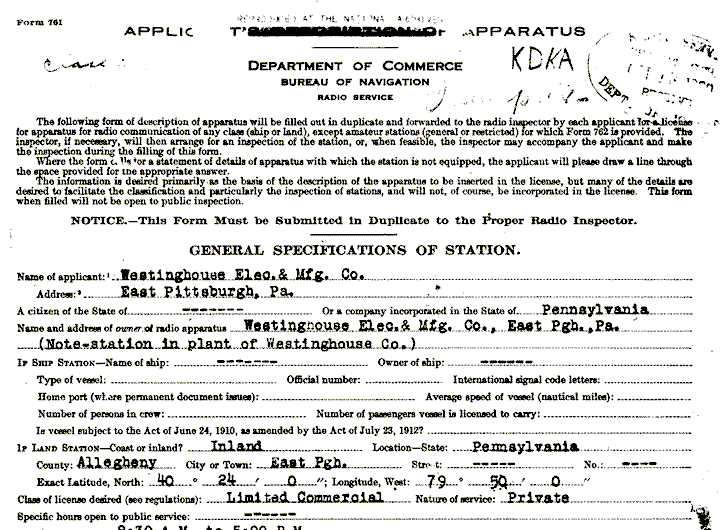
(Note: The first commercial radio station license was issued to Westinghouse for KDKA in Pittsburgh, PA in October 1920. In October 2020, radio will mark its 100th Anniversary. That original license for KDKA is pictured above.)

2 Comments

Filed under Education, Radio

Radio is Relationships

1
Radio, from the very beginning, has been about relationships. The first radio stations were amateur experimental stations. Dr. Frank Conrad, a Westinghouse engineer, was a ham radio operator. On October 17, 1919 he broadcast a recording over his station and that precipitated requests for more musical broadcasts. Conrad obliged by programming two hours of recorded music on Wednesday and Sunday evenings. Conrad even took requests.

It was from these early beginnings that a Westinghouse VP decided that Westinghouse should build a radio station and encourage people to listen and acquire the habit of listening to the radio. Westinghouse would benefit, because it was in the business of building radio receivers.

Westinghouse would file an application with the Department of Commerce on October 16, 1920 and receive its license for radio station KDKA eleven days later.

Radio gave people at that point in time a new way to connect and build relationships.

When radio pretends that what can’t be easily measured doesn’t exist, it’s on the path to extinction. Radio is relationships. No one ever had a relationship with automation.

Throughout radio’s history, savvy operators have known that being different can be a competitive advantage. Howard Stern, Rush Limbaugh, Ryan Seacrest, Casey Kasem, Arthur Godfrey among many others all knew how to distinguish themselves from the pack and build a relationship with the radio audience.

The competitive advantage that Pandora has is through its ability to be like your iPod, with an element of surprise. Each person creates his or her own personalized radio station.

But I seriously doubt anyone would say they have a “relationship” with Pandora. It serves a need in much the same way a low price retailer serves a need. Once someone comes along with a little bit better “mouse trap” the people quickly move on. That certainly was the case with Blockbuster when Netflix came along.

America’s radio stations that have a relationship with their audience will not have to live in fear. Relationships can transcend technology. Just ask Howard Stern’s listeners.

What concerns me is when audience relationships that took years to build are so quickly dismissed with automation in one of its various forms. Do you think radio would have grown to be the industry it is had it started out with automation?

-0-

This post was previously published in RBR-TVBR’s “Thought Leaders” on October 3, 2014 and in the New Jersey Broadcasters Association’s “QuickNews” on October 10, 2014.

Leave a comment

Filed under Education, Radio

Your Reception Rights

1

This week Marriott agreed to pay $600,000 to resolve a Wi-Fi blocking investigation that was being conducted by the Federal Communications Commission (FCC). The issue with the FCC revolved around an investigation into whether Marriott intentionally interfered with and even disabled Wi-Fi networks that its customers had established in Marriott’s conference facilities at their Gaylord Opryland Hotel and Conference Center located in Nashville, Tennessee. The FCC in their news release said their enforcement bureau investigation revealed that Marriott employees had used containment features of a Wi-Fi monitoring system at the property to prevent individuals from connecting to the Internet via their own personal Wi-Fi networks. This allowed Marriott to charge those same customers, small businesses and exhibitors as much as $1,000 per device to access Marriott’s Wi-Fi network.

I’ve always been amazed that when you stay at some of the biggest and best resorts that you have to pay for Wi-Fi access, whereas when you stay at a Hampton Inn, it’s not only FREE Wi-Fi but they also include a really wonderful breakfast too.

According to the FCC, “Consumers who purchase cellular data plans should be able to use them without fear that their personal Internet connection will be blocked by their hotel or conference center.” Enforcement Bureau Chief Travis LeBlanc added, “It is unacceptable for any hotel to intentionally disable personal hotspots while also charging consumers and small businesses high fees to use the hotel’s own Wi-Fi network. This practice puts consumers in the untenable position of either paying twice for the same service or forgoing Internet access altogether.”

And it’s not just your right to receive a personal hotspot on your smart phone, tablet or laptop but also those same rights extends to TV antennas and satellite dishes.

In 1999, the FCC amended its rules so that even renters could erect a satellite dish in “exclusive use areas” such as a balcony or patio. Then in 2000, the FCC added that it also applied to “customer-end antennas that receive and transmit fixed wireless signals.”

You have a right to receive over-the-air signals.

The $600,000 education and three-year compliance plan that Marriott just got from the FCC hopefully will have other hotel chains and conference centers sitting up and taking notice that you don’t need to be a federally licensed broadcaster to receive a monetary slap on the wrist from the Federal Communications Commission.

You might want to make a note of this case in case you ever find your service is being blocked. Here’s a link to the FCC’s press release: http://www.fcc.gov/document/marriott-pay-600k-resolve-wifi-blocking-investigation

Leave a comment

Filed under Radio

I Heart New York

1

Do you think if the State of New York had to do it all over again, they would have gone with “I Heart New York” instead of “I Love New York”? Neither do I. So what always puzzled me was why Clear Channel launched their new streaming application and called it “iHeartRadio.” I mean the logo design for the App was cool, but to me it said “iLoveRadio,” because everyone knows the heart is the graphic symbol for love. Or maybe everyone didn’t know that.

I Love Radio. There, I said it. I’ve loved radio since my earliest days on planet Earth. And so having an App that says that I love radio would have been a pretty cool thing to have on my smart phone. But that’s not what happened. This makes one wonder if the techies who did the design weren’t all that cool.

So you can imagine my amazement when Clear Channel Media & Entertainment (which had already dropped the word “radio” from their name) changed their name less than two years after the last name change to iHeartMedia.

In the meantime, I note that pure play streaming companies are all putting “radio” into their name. Pandora Radio, TuneIn Radio, Spotify Radio and the streamer I’ve enjoyed Sky.FM recently just did a name change of their own. They now call their streaming service “Radio Tunes.”

I think it might be a case of “The Other Man’s Grass Is Always Greener” (cue Petula Clark to start singing). Those that ARE radio companies are trying to erase it from their name as fast as they can and those companies that don’t have an FCC broadcast license are adding to their name.

Maybe adding the small “i” to your name or taking “radio” out is the radio industry’s “mid life crisis.” It’s radio getting seduced by the new.

Instead of trying to be something you’re not, why not work harder at being the best at what you are. Radio has an incredible legacy. Radio was the #2 greatest invention of all time on The History Channel’s list of the world’s greatest inventions. (#1 was the smart phone, to which most people today listen to their favorite radio station or stream)

It’s time for us to say it loud and proud. I LOVE RADIO.

Leave a comment

Filed under Radio