Author Archives: Dick Taylor, CRMC/CDMC

Dick Taylor, CRMC/CDMC's avatar

About Dick Taylor, CRMC/CDMC

I’ve been a “Radio Guy” all of my life. My earliest memories were of building a radio station out of tinker toys and pretending I was a disc jockey. Later I would build a radio station in the basement of my parent’s home and using AM & FM transmitters I bought at Radio Shack I would begin broadcasting to my neighborhood for about a three block radius. I began in commercial radio in the 10th grade in high school. A local radio station in my hometown of Pittsfield, Massachusetts decided to start a Junior Achievement company in radio. This was a really new concept in Junior Achievement as all JA companies at that time were production oriented and a radio station would be a service oriented JA company. I was a member of that first Junior Achievement radio company (WJAC) and it quickly led to a part-time job with that radio station (WBEC). Radio would pay for my college education and graduate degrees, both of which were in education. I loved college and could have very easily become a career student. When I graduated with my Masters Degree, there were no jobs in education to apply my earned degrees but there were radio jobs and I went into the radio business full-time as a program director, operations manager and air personality. Deciding what I’d really like to be is a radio station general manager, I knew that I would need to earn my chops in sales and so I quit my job on the product side of the business and started over at the bottom of the sales ladder as an account executive. I quickly rose to sales manager, station manager and general manager. For 27 years, I operated at the market manager level of the radio industry. I’m a Life Member of the New Jersey Broadcasters Association and Radio Ink Magazine has named me one of radio’s best managers. Former professor of broadcasting at the School of Journalism & Broadcasting at Western Kentucky University (WKU) in Bowling Green, Kentucky. I have a successful track record in sales and people development, growing top line revenues, achieving leading audience ratings, reducing expenses and meeting bottom line goals. I’m a recognized expert in radio and media regulations. I’m a turnaround specialist. I'm the founding director of the KBA WKU Radio Talent Institute coordinating a professional faculty of broadcasters who teach broadcast students who qualify and are accepted to attend a ten-day intensive program that trains tomorrow’s broadcasters in all aspects of radio station operations. My specialties include: dynamic public speaker/presenter and sales trainer. I currently teach classes in the Process & Effects of Mediated Communications, Broadcast/Internet Sales, Broadcast Performance/Production, Broadcast Management and the History of Broadcasting in America. I hold a BA in Physics/Education, an MS in Educational Communications, the Diamond CRMC (Certified Radio Marketing Consultant) and the CDMC (Certified Digital Marketing Consultant) from the Radio Advertising Bureau. I’m a graduate of Roy H. Williams Wizard Academy and Gitomer Sales Training. Note: The picture on my blog is when I was invited to do a guest disc jockey appearance on The Legend - 650AM - WSM in Nasvhille, Tennessee (July 2014). For this "Radio Guy" doing a four-hour air shift on this legendary clear channel signal radio station was a dream come true.

Who’s in Their Ear?

When radio was first introduced, to listen to it, you needed to wear headphones. Radio was one-to-one and very intimate. As the technology evolved the radio speaker would change the medium from one-to-one to group listening. Radios were expensive. If you owned a radio you shared it. A family would gather around the radio and listen together. Families would transfer this together media habit to TV and the transistor radio would become the refuge of teenagers who wanted to go in a different direction.
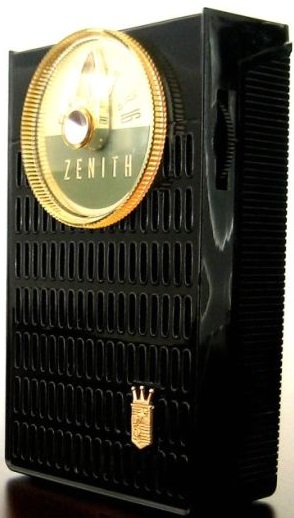
Zenith Transister Radio

My first radio was a Zenith transistor with a little ear piece for one ear. I would go to bed and turn it on under the covers and listen to “the world.” It was all AM radio and after sunset, the DX’ing of the nighttime skywave would always bring a new radio station into my ear to savor.

In the mid-70s the Boombox would be introduced to America and these radios grew both in size and the amount of bass they 1could produce. By the 80s they could be as big as a suitcase and carrying them around on your shoulder was a status symbol.

Go to a beach resort, and whether you were walking the boardwalk or on the beach, radios were blasting music from every direction.

When Y2K didn’t impact our fully computerized radio stations, we all breathed a short-lived sigh of relief because it was quickly followed by a new threat; the iPod and ear buds. Once again listening to music became a very personal activity.

The ear buds would transfer to the iPhone and iPad. The introduction of the iPhone6 may have killed the iPod, but not the use of headphones or ear buds to listen to your audio.

So what exactly are all those people listening to? lady listening with ear buds

The latest research from Edison Research says American Teens are spending more time with streaming audio services from places like Pandora and Spotify, than they are listening to either streaming AM/FM radio or over-the-air radio. Edison reports this finding in their fall 2014 “Share of Ear” report.

Remember it was my generation that grew up hooked on radio & TV that were credited with eroding newspaper readership. (Full disclosure: I read all my news online using my computer, iPad or iPhone.)

It’s not all bad news for AM/FM radio. It is still popular Edison tells us “by a significant margin among all other age groups.” So where did the teens go? Pureplay Internet streamers. What do they love most? The ability to skip a song they don’t like.

That’s really not hard to understand. I love my DVR for a similar reason. Especially when it comes to award shows. I never watch them live anymore. I record them for later viewing and I can watch a 3+ hour awards show in about 20 minutes time. I skip all the bad parts.

In fact, I rarely watch anything on TV live anymore. Everything is recorded so I can control it. So is it any surprise that teenagers once they are given this kind of control will ever want to give it up. A new habit is being formed.

The other aspect about pureplays that AM/FM radio could be addressing is their complete focus on the quality of their streaming product. What I’m hearing is a clean commercial insertion. Nothing gets cut off in the middle or repeated multiple times in the same long break. Pureplays deliver their commercial messages in a style that compliments the music programming; in a way that actually has you enjoying listening to the commercial message.

The teenagers have moved their listening to streaming and podcasts. The spectrum auction being held by the Federal Communications Commission is all about creating more wireless connections for all kinds of mobile devices.

I live in South Central Kentucky. I can stream my iPhone into my car’s seven speaker sound system through Bluetooth and everywhere I drive it’s clean and clear with no dropout or buffering. It’s scary good. It’s as easy to do as turning on my car’s audio system. Nothing to plug in or connect. It happens automatically.

South Central Kentucky is also blessed with some excellent over-the-air radio stations. So they very effectively compete, in my opinion, with streaming. But I wasn’t raised on streaming. I also like a good air personality.

The next generation is being raised on streaming that they have some power over to skip things they don’t wish to hear. Reminds me of the old saying “How are you going to get the kids back on the farm, after they’ve seen New York?”

baby listening to ear buds

2 Comments

Filed under Education, Mentor, Radio

The Problem with Digital Radio

The problem with digital radio is FM radio. FM radio is loved by the consumer. They don’t find anything wrong with FM radio (other than too many commercials). With no perceived need to change, the FM radio listener doesn’t. That’s not just a problem for radio station owners in America, but all around the world.

I often like to compare the start of HD Radio with the introduction of the iPod by Apple. Both happened about the same time. One has sold hundreds of millions of units and now is no longer made, and the other is HD Radio.

Interestingly enough, the introduction of digital audio broadcasting was born around the same time as the World Wide Web. It was born before MP3s and iPods. Born long before the advent of Smartphones and Tablets and yet, digital in the world of over-the-air radio transmission is still waiting to get traction with the consumer.

FM radio commanded 75% of all radio listening in America back in the 1980s when the number of AM and FM radio stations in America numbered about the same. So it’s no surprise that over three decades later that FM dominates when the number of FM radio stations, translators (FM stations) and LPFM (FM stations) far outnumber AM radio stations that are on-the-air today in the USA.

Across the pond, the British government was planning to switch that country’s radio listening from FM analog to digital when the penetration of digital radio listening reached 50%. They thought that would happen by 2015. Currently digital radio listening in England stands at only 36% and the government has now wisely put off setting a new date for this transition.

The problem in England goes beyond just radio sets in homes and cars. British folks also can listen to FM radio on their Smartphones. Unlike here in America, the FM chip that comes inside Smartphones has been turned on. These chips remain in the off position in America with no way for a Smartphone owner to turn it on without “jailbreaking” their phone which is illegal. The members of parliament aren’t about to turn off a system that serves around 25 million listeners, if they want to get re-elected.

I own one HD Radio. My local NPR FM radio station broadcasts with 100,000 watts on their analog FM signal. It’s crystal clear and comes in everywhere I go. They simulcast their NPR and other talk programming on their HD Radio signal too. That is plagued with dropout and a short range in terms of where I can pick it up. The same HD Radio that picks up the digital broadcast of my local NPR radio station also has an FM tuner (but no AM tuner). I can switch between the analog FM and digital FM, and to my ears they sound about the same. And therein lies the problem. No perceived difference other than one goes great distances with no drop out and the other is HD Radio.

At this point in time, what seems clear is that is FM radio isn’t going anywhere anytime soon. AM radio station operators would benefit by having a similar FM signal that delivers the same coverage area as their AM license provides sans the sky wave effect. Giving them a low power translator is an insult in my opinion. All Smartphones should have their FM chips turned on. NextRadio should be embraced by FM broadcasters. All broadcasters need to focus on their content and make sure that whether it’s over-the-air or over-the-Internet, it’s of the same high quality and offers all of the same content on both.

I’ve never heard an FM radio listener complain about the quality of their signal and what they do complain about, isn’t being focused on by broadcasters. We have no time to lose.

FM radio has the delivery system in place. Take advantage of it to serve, entertain and inform.

7 Comments

Filed under Education, Mentor, Radio

Radio’s NOT Like it Used to Be

Marconi Wireless(Spoiler Alert: It never was, starting with day 2) When I hang out on social media – or imagine this, have a real face-to-face conversation – with my radio contemporaries that grew up listening to radio in the 60s & 70s, the conversation invariably turns to “radio’s not like it used to be.”

From the moment of its birth, radio has been one long experiment.

It took hold when Marconi International Marine Communication Company, Limited began to make money with wireless over-the-air transmissions. Marconi was in it for the money. He really cared little how it all worked. He wanted to build more powerful transmitters and cover greater distances. He didn’t sell his technology but leased it. He also trained and employed the wireless operators who used his equipment.

So, imagine you’re a wireless operator on Christmas Eve 1906 and you’re at sea monitoring your dots & dashes – all that you’ve ever heard come through your headphones – when at 9 PM EST on Christmas Eve you suddenly hear a human voice coming through your headphones. Then singing. Then a violin playing. And finally a man speaks a Christmas greeting. What would you have thought to yourself?

The man who did this was Reginald Fessenden. In addition to being a brilliant scientist, he also sang and played the violin. From his transmitting station in Brant Rock, Massachusetts his first wireless transmissions of voice and music were heard up and down the Eastern seaboard. He would repeat this again on New Year’s Eve.

In the United States the final commercial Morse code transmission was sent on July 12, 1999. The last message sent was the very same as the first message sent by Samuel Morse in 1844, “What hath God wrought”, and the prosign “SK”.

What brought this all to mind was a news item that has been circulating recently about a survey by Morgan Stanley that was released by Quartz.

The survey is a positive for radio. In a survey of 2,016 American adults taken last November, AM/FM radio use was #1 with 86%. Number two was YouTube, number three was Pandora and number four were “TV music channels”.

The first four were all advertising supported and thus free to the user. The fifth on the list was also the first paid service; SiriusXM radio (tied with iHeartRadio).

So one thing that hasn’t changed is that most people would rather access free-with-ads entertainment versus paid-without-ads entertainment when given a choice.

However, this survey has spurred a lot of discussion in the radio world. Broadcasters are divided on what this survey is really telling us. Owners/operators are saying that it shows “radio ain’t dead.” Broadcasters that have been consolidated out of the industry are saying “not so fast.” And to some extent, they’re both right.

As Mark Ramsey pointed out on his blog, “86% of respondents saying its part of their usage routine” is what radio folks would call “reach” and does not really address frequency of usage or “time spent listening;” two key radio metrics.

Conspicuously missing from the Morgan Stanley list is a service I use and enjoy TuneIn radio. I wonder why?

So where does that leave us?

I think it’s a twist on one of Henry Ford’s most famous quotes:

Whether you think radio is or is not, you’re right.

Radio owners/operators have it within their power to create the future for the radio industry. So what’s it going to be?

2 Comments

Filed under Education, Mentor, Radio

Combined or Separate?

When I started in radio sales, the company I went to work for after leaving programming and operations ran an AM/FM combo that simulcast all of their programming. Selling for these two stations meant every spot sold was heard on both broadcast bands. (Piece of cake)

Then one day, the owner announced the signals were being split apart. The AM station would program an entirely different format from the FM station, but the sales team would be selling both separately programmed radio stations. (A two layer cake)

Anyone who has some history in the radio business will tell you the answer to the age old question of whether it’s better to field two separate sales teams for an AM/FM combo versus having one sales team. In fact they will give you a definitive answer: “it depends.” (Did someone leave my cake out in the rain?)

Before the radio industry could wrap their brain around this puzzle regarding sales staffing, along comes the Telcom Act of 1996 and companies now own clusters of radio stations. It was now possible for a cluster to number 5 or more radio stations serving a metro. (My cake is melting, melting. Did I mention I never really understood the lyrics to MacArthur Park?)

One brave company in Florida announced they were going with the single sales force concept for their nine station cluster. That got my attention as I was now in management. Well you can imagine I wanted to catch up with these folks at the next RAB Managing Sales Conference to find out how it was going. I did. I asked. The answer they gave me? “Oh well.” “Oh well?” I asked puzzled. They then explained it was very difficult to find radio sales person who could manage selling multiple formats (music, talk, sports, etc). They maybe had one person on their rather large sales team that could do it. A couple could handle maybe 50% of the cluster at the same time, but the rest maybe two radio stations in the cluster at most. The result was they abandoned the idea of one sales team selling everything.

Closer to home, I launched a print program at a cluster I was managing that had an AM station, an FM station and an LMA’d FM station. We had separate a separate sales team selling the LMA’d FM station and a combo sales team selling the owned AM/FM stations. It was decided that all sales people would now sell the new print program. I should explain the print program was actually two components. It was a quarterly coupon book distributed in five different mailing zones in the metro and then there was a calendar that was sold in all the mailing zones on an annual basis.

So, my sales force was now responsible for selling radio spots (and promotions) where you saw the advertiser today and he started in the next couple of days. A print coupon book where you saw the advertiser today and the ad would come out in the next quarter. And an ad in a calendar you sold today and it came out next year.

So how did that work out? Fabulously, actually. Till it didn’t.

What we would learn is it was a good way to launch and put immediate new revenue on the books. Over time the print program re-trained our radio sellers; which was an unintended consequence. They soon learned when an advertiser said they didn’t want radio ads; they had found themselves a print customer.

After an ownership change, I made the decision to break away our print program into a separate entity with its own management and sales people.

So it was no surprise when Borrell Research came out with their latest research study this week “2015 UPDATE: Assessing Local Digital Sales Forces” and it said that those companies that had sales people who were digitally focused produced more digital revenue than those that had one sales team selling everything. You can find the full report clicking on the hyper-link.

Quoting from Borrell’s Executive Summary: “The result is stark: Those with digital-only sellers report far greater confidence in their staff’s ability to understand market trends and clients’ digital needs, and they generate four times as much digital revenue. For instance, two different newspapers, each with a total of 22 sales reps, reported $7 million in digital sales last year and $360,000 in digital sales. The difference? One had seven digital-only reps; the other had none.

But before you get the idea that I’m taking the position separate is best, it really depends…..depends on the skill level of your sales people and their embracing of new technology and new ideas.

When I was starting out in radio sales I got to see and hear a lot of great sales trainers. One that I really liked was Don Beverage. Don would categorize sellers in one of four ways. They were “Commercial Visitors,” “Product-Oriented Peddlers,” “Problem Solvers,” or “Sustaining Resources.” See the snake in the wood pile when it comes to answering the question “Combined or Separate?”

If your sales team is made up of first three types of sellers, separate your sales force. If they are level four sales people, “Sustaining Resources” then you might win with a combined force.   But here’s one more twist. The very best sellers will be “Problem Solvers” with some of their clients and “Sustaining Resources” with others. Even Don Beverage was quick to point out that reaching the level of “Sustaining Resource” was being in rarified air.

So you know a “Sustaining Resource” level of selling is when the client believes in you so much that they pick up the phone and call you in BEFORE they take the first step in the advertising/marketing program. YOU are part of the team that will create and design the strategy and then plan out the tactical steps to get to the finish line and win.

So there you have it. Put on MacArthur Park by Richard Harris and spend the 7-minutes, 25-seconds and ponder what’s best for your operation.

2 Comments

Filed under Radio, Sales

Entertainment for nothing….

When radio was born, no one had a clue how to make money with it. The early radio station operators made radio sets. They knew if they wanted to sell radio sets, they had to provide something for those radio sets to pickup and for the people who owned those radio sets, something entertaining to listen to.

It was AT&T, that didn’t make radio sets, that was the first radio operator to try selling the first radio commercial over their radio station WEAF. AT&T was in the phone business and the selling of phone lines to carry network radio programming. It put on-the-air a radio station merely to understand the business better. Not wishing for it to be an expense, they went looking for a way to make their radio station pay for itself, if not make a profit.

Many ways of making money with radio stations were tried, but by the late 1920s, the selling of advertising reached the tipping point for this business model going forward. Radio had conditioned people to expect, that if they bought a piece of hardware – a radio set – the content would be provided for free; albeit supported by advertising.

When the Internet came along, people expected to buy the hardware – a computer, modem and connection to the World Wide Web – but they expected that the content would be free, and it was; again supported by advertising.

Newspapers and magazines grew up with no hardware to buy, just the content that was printed on paper. The subscription cost was relatively low and advertising would pick up the rest of the expense along with providing the owners a nice profit.

The problem today is newspapers and magazines have joined radio and television in the new distribution channel of the Net. Two of these mediums should be adept at marketing their content in this manner and the other two, well, are finding it challenging.

Cable TV’s HBOs and SHOs, on the other hand, charged for their content from the get-go. And when Netflix came along, it also created the pay-for-content habit which it easily converted from the mail to the Net. They also provided their content commercial free. This created an expectation that when you pay for content, you don’t have to have your content interrupted by ads.

The pay walls that have been tried by newspapers and magazines include advertising, but that’s only part of the problem. You see the print consumer was never really paying for the entire cost of printing and distribution. They merely made a contribution to that cost. The rest of the cost was picked up by the publisher, who gladly subsidized the whole thing because of the tremendous profits they realized via the sale of advertising. The other is a case of supply vs. demand. The supply of content has never been greater and the demand, so fragmented. This post is just one example of the free content anyone can get off of LinkedIn with a free account or via my blog (DickTaylorBlog.com).

The bucket of cold water reality is that marketers are more willing to pay to reach consumers with their message than consumers are willing to pay for content they want to consume.

So why are radio and television spinning their wheels while others (BuzzFeed, Vice Media, etc.) are walking away with the mother lode? To paraphrase the famous line from the movie “Cool Hand Luke”: What we have here is a failure to innovate.

Radio and TV merely want to put their content on the Net and count the money. To compare it to sports, these two legacy mediums are good at baseball (over-the-air) and now when they move to the Net, where the game is football, they want to continue playing baseball.

In radio, FM finally came into its own when young broadcasters were given the chance to innovate. We are living during a communications revolution. Revolutions are periods of huge disruption to what was, as what will be gets created. The new opportunities are being seized by those not clinging to their old business models. The bad news is the “good old days” aren’t coming back. The good news is, what will replace them will be just as good, if not better.

6 Comments

Filed under Radio, Sales

New Radio World Column Premieres

Thirty years ago Michael C. Keith entered a small New England college to start a new career. Keith had just spent the past ten years as a professional broadcaster and was now transitioning into the world of teaching. The first thing that he would learn was the only textbooks available at that time were woefully out-of-date. Radio was now format driven and there were no textbooks available in 1986 that were teaching the kind of radio Michael Keith had just left. So, Keith decided to write his own textbook. He called it simply “The Radio Station” and he pitched his manuscript to Focal Press.

If you like to read the entire article, simply click here: Focal Press Updates “Keith’s Radio Station”

This is the premiere of my new column in Radio World that will appear quarterly.

Leave a comment

Filed under Education, Radio

What Radio Could Learn from Vladimir Putin’s Dilemma

History never really repeats itself, but it often does rhyme with the past.

For the radio industry, today’s Internet is a challenge not unlike what the industry faced when TV began to take off in the 1950s. For Putin, the plummeting price of a barrel of oil is reminiscent of what happened in 1985 when the Saudis stopped protecting oil prices and focused instead on share of market. Then, as now, the Saudis decision is putting Russia in a corner.

Russia is dependent on oil and gas. The radio industry is dependent on the sale of radio commercials.

52% of Russia’s revenues and over 70% of its exports are oil and gas. 78% of radio’s revenues come from the sale of radio commercials.

See the similarity?

Gordon Borrell will be holding his 2015 Local Online Advertising Conference in New York City this coming March (https://www.borrellassociates.com/loac2015/) and the key note speaker will be investment banker Jim Dolan. In a comment promoting this conference, Dolan has been quoted as saying that valuations for companies with a strong digital presence will be much higher than for any company relying on legacy platforms for 50% of more of their income. (http://rbr.com/boring-in-on-digital/)

For Putin, 25 years after the last time the Saudis turned wide open their oil spigots the lessons not learned from past history have put this leader into corner. Radio has the lessons learned from the birth of TV.

Again quoting Dolan, “I think the smartest thing that legacy media managers can do is plow all of their free cash flow into digital products and services….it’s too late to knit a digital parachute when you’re falling off the cliff.”

Leave a comment

Filed under Radio

The Paradigm Shift in Auto Mobility

I just finished watching a webinar on “The Paradigm Shift in Auto Mobility” presented by TU-Automotive Detroit 2015 (www.tu-auto.com/detroit). It was fascinating hearing Doug Claus of BMW talk about self-parking cars. Imagine, you pull into a parking garage and get out of your car and your car goes into the garage on its own and seeks out a free parking space and parks. It then patiently waits until you summon it to pick you back up using either your Smartphone or Smartwatch technology.

Doug pointed out that car sharing vs. car ownership is where many young adults see the future. Autonomous vehicles are also on the horizon, though he pointed out that European countries have better painted roads, better road signage and better road maintenance than we do here in the United States. It’s another example of our crumbling infrastructure and how it makes us a less competitive place in the world when it comes to implementing these coming new technologies.

But the reason I attended this webinar was to hear about the future of AM/FM radio in the car dashboard of the future. What Raj Paul of LochBridge calls “Infotainment Systems.”

Raj said that each OEM (Original Equipment Manufacturer) has built a unique proprietary system. He mentioned a couple of them like Honda’s HondaLink, Ford MyTouch, Toyota Entune, Chrysler UConnect, Cadillac Cue and Mercedes mBrace2. There are also the Google Android and Apple iOS systems that are being developed. Expect that every OEM will seamlessly work with their own proprietary system as well as both Android and iOS.

When Raj put up the slide about existing infotainment architecture, you couldn’t help but notice the Pandora button on the screen. The other two symbols were apparently there to represent how Apps from your Smartphone would load into the car’s system.

The next generation integrated infotainment interface was packed with GPS maps, live traffic, navigation, routing, parking locator, gas & price locator, etc. A lot of information displayed in front of the driver. Yes, the Pandora button was once again prominently displayed on this slide, but only to indicate the accessibility of streaming audio services. I was happy to see an AM/FM button there too.

The competition for utilization of each point of access has never been greater. It makes the AM radio with push buttons for favorite radio stations seem quaint by comparison.

You won’t have to set your favorite applications, because your car will learn what you like and what you use and put that configuration up when you sit in the driver’s seat and push the button for your personal seat position. This is what OEM’s call adaptive profiling.

For radio station operators, being at the top of your game has never been more important. Advertising and promoting your brand will be critical to make listeners aware of what you offer and why they should care.

In a way, I see it as history repeating itself. For before there was radio, those early pioneers needed to tell people why they needed to go out and buy one. Then they had to program those radio stations and promote themselves to be the “must listen to” radio station and keep those listeners returning each day. Those days are back, only this time the game has changed to how do you brand your radio product and stand out in an car infotainment world where audio programming options are ubiquitous.

Leave a comment

Filed under Radio

Different or Better?

In education, we measure students by GPA (grade point average). The higher a student’s GPA, the more everyone believes that student is the higher achiever. In school, that measure is usually pretty accurate, but what about when the student graduates?
The best baseball players don’t always become all-stars. The best scientists don’t always win a Nobel Prize; the best known do.

Stanford’s business school once tried to learn what their most successful graduates had in common. They found two things. They all graduated in the lower half of their class and they all were very good at socializing. Being able to work a crowd, it turns out, is a skill-set that leads one to be successful.

Lee de Forest wanted to be called “the father of radio.” He even tried to use the “Miracle on 34th Street” concept having the post office make that determination. Only unlike in the movie, the United States Post Office did not deliver the mail addressed “the father of radio” to de Forest. Worse, de Forest never really understood his own Audion tube that made the radio we know today possible.

Edwin Howard Armstrong, the creator of FM radio (that is also the way the audio on your TV set gets delivered too) did understand the science that made the Audion tube work, but most people don’t know Armstrong.

Armstrong was better than de Forest, but de Forest was different.

Nielsen Audio measures better, something audiences really can’t distinguish. However, different is something that audiences can distinguish.

Think of top rated radio personalities. Were they better or different? Howard Stern? The Real Don Steele? Salty Brine? Dale Dorman? Paul Harvey? Jean Shepherd? Wolfman Jack? Etc.

I’m sure you will say they were better, because they were different. They were also all well promoted; either through self-promotion or a radio company that promoted them.

Today, every streaming audio service calls themselves “radio” and they’ve all copied the best practices of radio stations and one another that eliminate their differences; except one. Pandora. Pandora uses their “Music Genome Project” to put together their stream. Is it better than a music format that a person curates? Probably not. But it’s different.

Radio used to be filled with innovators dreaming up different. We need to let those folks back into the business and turn them loose. It’s why FM radio finally got traction and HD Radio never did.

It’s time for radio, like Steve Jobs did for Apple, to “Think Different.”

Leave a comment

Filed under Education, Radio

If Radio Ran the NFL

Full disclosure, I’m not a sports person. But sports is ubiquitous in our world and in America, the NFL is the top sport. The NFL’s Super Bowls are TV’s most watched programs with the season finale of M*A*S*H being the first non-Super Bowl show to appear in the Top Ten most watched television programs.

The NFL is made up of people. Head coaches, assistant coaches, sales people, support people and of course, the players on the field. Radio is also made up of people. General managers, program directors, sales managers, sales people, support people and of course the personalities on the air.

Team brands are strongly associated with each particular team. If I say “Eagles” you immediately know that I’m talking about the NFL’s Philadelphia franchise. If I say “Cowboys” you again know that I’m talking about the NFL’s Dallas franchise. But if I say “Kiss FM” you really don’t know which radio station in which city I’m referring to. If I say “Jack” you again have no idea of which radio station in which city I’m referring to. While this may not have been a problem back in the day, today the Internet brings all radio together on one platform.

When I was growing up, each major city had at least two Top40 radio stations that would be engaged in a battle for the best. What made radio exciting at that point in time was that each of those radio stations were unique and very much in tune with their city of license.

While many radio folks would dis “Drake Radio” I fondly remember enjoying WRKO in Boston, CKLW in Windsor-Ontario, WOR-FM in New York City and KHJ in Los Angeles (via air checks). Yes they all had those incredible Johnny Mann jingles, but they all had very unique air talent and were tweaked to the city they served. They were the same, but different.

Each radio station was a special and unique culture of people. Culture trumps best practices.

Radio is starved for new ideas. They won’t come from inside radio. The next big thing is happening right now in another field. What it will take is for someone to see it and adapt it for radio.

Henry Ford is said to have seen the meat packers of Chicago disassemble a cow in a line where each worker cut out one section of the cow and adapted the model to create his assembly line for building cars.

The great coaches of the NFL are searching far and wide for new ideas. They are bringing in academics and scientists to learn how to make their players better; both on and off the field. When is the last time you heard of radio making that kind of investment in their players? By that I mean the air personalities and the people who coach them; the program directors.   When was the last new programming idea created for radio?

Remember when a new radio station format premiered back in the day? The launch was exciting and the day it was turned on, everything was in place. The air personalities often had been practicing the format off-the-air before the day it premiered. Today, new formats premiere in pieces. You don’t get a second chance to make a first impression. Why do radio companies repeatedly do this?

This manner of premiering formats would be like the NFL getting a new stadium, a new logo, and new uniforms and on game day having everything laying on the grid iron and telling the fans we will be hiring the players in the next 60-90 days. But radio does this all the time.

Just like the NFL players on the field, the radio air talents are a vital part of the product.

If radio ran the NFL, they wouldn’t have the coach standing on the sidelines, he’d be in the huddle playing the quarterback position, just like radio’s program directors are on-the-air; often anchoring morning drive.

The reason that the NFL hasn’t adopted radio’s model for operating their game is simple. Their model has made them the most watched and listened to sport in America. Maybe radio should be adapting the NFL model for running its industry.

Leave a comment

Filed under Radio