Tag Archives: free speech

Radio’s Most Pressing Issues

This past week, Radio/TV state broadcast associations were in our nation’s capital meeting with their elected representatives in both the House and Senate about issues that are important to them. It’s the annual National Association of Broadcasters (NAB) State Leadership Conference.

More than 500 radio broadcasters from across America assembled to hear Senator Ted Cruz (R-TX) speak on his support of the “AM Radio for Every Vehicle Act,” and advocating for a level playing field in the advertising market.

Cruz is the new Chairman of the Senate Commerce Committee and he pledged a proactive approach to support broadcasters, create jobs and uphold free speech.

Free Speech

Brendan Carr is the new Chairman of the Federal Communications Commission (FCC) and in only a couple of weeks, since taking this leadership position, his actions have caught the attention of some members of Congress, who were alarmed by recent moves impacting broadcasters.

Representative Jerold Nadler (D-NY) expressed his concern over the Carr’s FCC assault on a media organization’s free speech.

“Exploiting his asserted ‘unitary executive’ powers, [President] Trump is unleashing his sycophant FCC Chairman, Brendan Carr, on every newsgroup whose news stories he does not approve of — actually threatening to pull the broadcast licenses for ABC, CBS, NBC, PBS, and NPR,” said Rep. Jamie Raskin (D-MD). “Is this North Korea?”

The President of Free Press Action, Craig Aaron, in testimony said that threats and opening investigations into broadcast outlets by the FCC is out of the norm.

“The FCC usually talks about licenses on very narrow terms, such as if an owner has committed a major crime,” Aaron said. “The idea that a news organization would be threatened because they asked a tough question of the President, or because they tried to fact check him during a debate, or because they edited their own news content before putting it out over the airwaves is preposterous, and it’s dangerous.”

DEI

Diversity, Equity and Inclusion (DEI) has been terminated by Carr at the FCC and he’s been signaling that the agency might go after FCC licensees over their own DEI programs.

Are DEI programs good for business? Apple’s shareholders think so, so do Costco shareholders, and Hyundai’s marketing executive, Erik Thomas, credits its DEI programs with driving the automobile manufacturer’s bottom line.

SiriusXM

Nine years ago I wrote an article with a title that sounded like click bait titled “SiriusXM Radio is Now Free,” which speculated when the FCC licensed satellite broadcaster would start offering ad-supported channels for free.

Four years later, I wrote that “Could 2021 Be the Year SiriusXM Adds FREE Channels?” speculating that new SiriusXM CEO, Jennifer Witz, would be pursuing revenue growth by  leveraging the 132 million cars the service was available in. SiriusXM, like commercial radio over-the-air (OTA) broadcasters, knows that the competition for listener ears is in the car. The advantage the satellite broadcaster has over AM/FM radio operators is they know exactly what their listeners are listening to, and don’t have to rely on audience estimates that may or may not be accurate in today’s media saturated world.

Last year, what I have been predicting since 2016, became a reality, as I wrote in:  “Ad-Supported SiriusXM Requires No Paid Subscription.”

Monopoly

One of the radio industry’s most respected researchers, Dr. Ed Cohen, wrote “The direct-to-consumer satellite radio business is a monopoly,” shortly after my 3rd article on this subject was published. Originally, the FCC offered only two satellite broadcast licenses, one went to a company called “Sirius” and the other to a company called “XM,” with the idea being they would be competitors and that the consumer would benefit by not having a single company – a monopoly – control satellite radio and what it could charge.

The two companies were supposed to never be able to merge, but in August of 2008, by a 3 to 2 vote of the FCC, that changed. Dr. Cohen does a really good deep dive into explaining how this all came about in his article “SiriusXM and the FCC: Is the Camel’s Nose Under the Tent?” Which is an allusion to a story that takes place in Arabia, with this metaphorical moral:

If the camel once gets his nose in the tent, his body will soon follow.

What the FCC never took into consideration was, how much damage might occur to local AM/FM radio stations, if and when, the new combined SiriusXM ever decided to provide an ad-supported free radio service.

Dr. Cohen believes that while this new free service from SiriusXM is limited in scope, like the proverbial camel, it won’t be long before the whole service becomes real competition for audio listeners and advertisers.

People Love Free

AM Radio vs SiriusXM

Dr. Cohen makes an excellent case for commercial radio broadcasters to be demanding, the FCC revisit the SiriusXM merger decision in light of this change by the satellite broadcaster.

By the way, public broadcasters also have a horse in this race, as NPR Now is part of the new free SiriusXM service.

“While the NAB is busy with getting Congress to force OEMs (Original Equipment Manufacturers) to include AM in every vehicle, the battle with SiriusXM’s ad-supported venture is probably more important to the industry in the long run,” says Dr. Cohen.

It’s The Economy Stupid

But the most important issue facing the commercial radio industry are the financial fears that have been generated by the Trump tariffs and fire hose of government regulatory changes that seem to come at us on an hourly basis. I wrote about this concern in February with an article titled “The Cost of Uncertainty to Radio.”

Now BIA Advisory Services this week updated its local advertising revenue forecast for 2025. Cameron Coats, in Radio Ink, reports that “over-the-air revenue [for radio] takes the largest hit, falling by 6%.” Digital radio, says Coats, shows a slight increase of 0.1%.

SiriusXM has enjoyed growth through the sale of new cars, but with the high tariffs Trump has announced, it wouldn’t be a surprise if people hang onto their current vehicles a little longer, which also means that AM radio will still be accessible. Without an economic downturn, the average life of a car in America is 12-years, up from 8.4-years in 1995. Progressive Insurance says that a well-maintained car will reach 300,000 or more miles, and those cars have both AM/FM radios as well as SiriusXM.

The radio industry’s most pressing issue is who wins in the car, and in that arena AM radio – a hundred year old medium is not our industry’s best play –

stopping satellite radio’s FREE ad-supported service is.

When the pie isn’t growing,

the game becomes who can cut the biggest slice.

5 Comments

Filed under Uncategorized

What was The Fairness Doctrine?

After the January 6, 2021 siege on Capitol Hill, I began hearing people saying we need to bring back “The Fairness Doctrine,” as if that genie could be put back into the bottle.

But what exactly was “The Fairness Doctrine?”

It was a policy enacted by the Federal Communications Commission (FCC) in 1949 requiring the holder of a broadcast license to both present controversial issues of public importance, and to present these issues in a manner that was honest, equitable, fair and balanced.

In other words, broadcasters were supposed to not only uncover what the people in their broadcast service area should be aware of, but also to present both sides of the issue.

Operate in the Public Interest, Convenience and Necessity

From the beginning of my broadcast management career, I knew that my number one job was to protect the radio station’s FCC broadcast license to operate. Without a broadcast license, you were out of business. Second, my radio station(s) must operate in the public interest, convenience and necessity of the people in the area we were licensed to serve with our broadcasts.

The FCC created The Fairness Doctrine to ensure that “all sides of important public questions were presented fairly.”

For decades, this doctrine was seen as the keystone of broadcasters fulfilling their commitment to operating in the public interest. Compliance with The Fairness Doctrine was a primary litmus test during the license renewal process.

It was during the 1960s, when I started my radio career, that the FCC increased their enforcement of broadcaster compliance to The Fairness Doctrine. In 1963, the FCC formally stated that the presentation of only one side of an issue during a sponsored program would require that opposing views be given free air time to present their side. That rule became known as the Cullman Doctrine.

Broadcaster’s Free Speech

It probably won’t surprise you to learn that all of this increased oversight by the FCC on a broadcast station’s program content was seen as interference with a broadcaster’s “free speech.”

This would eventually be challenged at the Supreme Court in the Red Lion Broadcasting v. FCC decision of 1969, with the high court upholding the constitutionality of the public interest standard in general and The Fairness Doctrine in particular. In their decision, the court stated, “It is the right of the viewers and listeners, not the right of the broadcasters, which is paramount.”

The End of The Fairness Doctrine

In 1985, the FCC finally decided that The Fairness Doctrine was incompatible with the public interest. It would eliminate this rule in 1987, and in 2011, the FCC removed the rule that implemented the policy from the Federal Register.

“[T]he Federal Communications Commission should reestablish two principles that formerly served this country well: the public service requirement and the fairness doctrine. Every television and radio station should once again be required to devote a meaningful percentage of its programming to public service broadcasting. The public, after all, owns the airwaves through which signals are broadcast, and the rights-of-way in which cables are strung. And every television and radio station should once again have to follow the fairness doctrine: those with opposing views should have the right to respond to viewpoints expressed on the station.”
― 
Bernie Sanders, United States Senator

Trump Tweets NBC Broadcasts “Fake News”

In October of 2017, President Donald J. Trump tweeted “With all the Fake News coming out of NBC and the Networks, at what point is it appropriate to challenge their License? Bad for country!”

Broadcast legal experts immediately criticized and dismissed Trump’s tweet as both implausible and having no legal basis.

The American Bar Association’s Legal Fact Check wrote:

“The FCC publishes specific rules and guidelines related to news hoaxes and distortions and bars a licensee from knowingly broadcasting false information concerning a crime or a catastrophe. But the bar or threshold is high. Six days after Trump’s tweet, FCC Chairman Ajit Pai said his agency cannot revoke the license of a broadcaster ‘based on content of a particular newscast,’ and cited First Amendment protections of the press. FCC statements previously noted that the commission ‘often receives complaints … that stations have aired inaccurate or one-sided news reports or comments, covered stories inadequately or overly dramatized the events that they cover… (but) the commission generally will not intervene in such cases because it would be inconsistent with the First Amendment to replace the journalistic judgment of licensees with our own.’”

FOX NEWS CHANNEL

The Fairness Doctrine ended during the Presidency of Ronald Reagan, however, it’s often wrongly stated that this gave birth to cable’s FOX NEWS CHANNEL. It did not. Cable channels are not, nor have they ever been, regulated by the Federal Communications Commission (FCC).

Similarly, the internet is also not regulated by the FCC.

The Fairness Doctrine only applied to the licenses of broadcast radio and television stations.

A case could be made that the end of The Fairness Doctrine did open the door to the Rush Limbaugh Show, which made its nationally syndicated premiere in 1988. Rush Limbaugh was a savior for AM radio stations, who saw most of their music audiences moving over to FM radio stations, and those advertising dollars moving right along with them.

Limbaugh proved so popular with AM talk radio audiences, that AM radio station owners added more talk shows like Sean Hannity, Michael Savage, Glenn Beck, Mark Levin and others.

Cumulus Media

Following the siege on our nation’s Capitol in Washington, DC on Wednesday, January 6, 2021, Cumulus Media, the radio syndicator for the Mark Levin Show sent a memo to its talk show hosts to stop spreading rhetoric about a stolen election or face termination.

Brian Philips, executive vice president of content for Cumulus Media wrote in his memo:

“We need to help induce calm NOW (and) will not tolerate any suggestion that the election has not ended. The election has been resolved, there are no alternative acceptable ‘paths.’ If you transgress this policy, you can expect to separate from the company immediately.”

Cumulus Media operates Westwood One, which syndicates Trump-supporting radio talk personalities like Mark Levin, Ben Shapiro and Dan Bongino.

Free Speech

I find it ironic that the people screaming the loudest about what Cumulus Media has done is to thwart free speech. It’s not “free speech” to tell lies. United States constitutional law does not always protect false statements under the First Amendment.

Moreover, these same people are usually the ones who say, “Let the market decide.” In other words, let the corporations and companies make those hard decisions.

In this case, Cumulus Media did just that.

iHeartMedia which syndicates Trump-supporter hosts Rush Limbaugh and Sean Hannity has not publicly announced any similar action for these talk hosts as of the writing of this blog article.

In 2016, SiriusXM suspended conservative talk host Glenn Beck for agreeing with one of his show’s guests who asked, “what patriot will step up to remove Donald Trump from office if he’s elected president and oversteps his authority?” SiriusXM, operator of America’s two satellite radio services, suspended Beck because they worried the conversation might “be reasonably construed by some to have been advocating harm against an individual currently running for office.”

Michael Harrison, who publishes Talkers magazine was sympathetic to the Cumulus memo saying:

“Corporations are responsible for what’s on their air. They have to deal with client feedback. They have to deal with public image and protection of their license. Private corporations can control their platforms, and I believe that in and of itself is an expression of free speech in action.”

I’m all for the Fairness Doctrine, whatever that is.

-George Voinovich*

*George Victor Voinovich (July 15, 1936 – June 12, 2016) was an American politician who served as a United States senator from Ohio from 1999 to 2011, the 65th governor of Ohio from 1991 to 1998 and the 54th mayor of Cleveland from 1980 to 1989, the last Republican to serve in that office.

21 Comments

Filed under Uncategorized

The Importance of Free Speech

Tom Taylor NJBAI had the honor this past week to attend the 71st Annual New Jersey Broadcasters Association (NJBA) Conference and Gala held at the Tropicana Resort and Casino on the Boardwalk in Atlantic City.
I plan to share more information about this East Coast NAB style event in a future blog, but today I want to focus on something Tom Taylor said that I feel is critically important for all broadcasters to hear.

Tom Taylor Receives Lifetime Achievement Award by NJBA

I’m sure, like me, you are still experiencing some “Tom Taylor Now” withdrawal since the time Tom announced his retirement in December of 2018 and his daily coverage of the radio industry ceased publication. For anyone who’s lived around the Philadelphia area, Tom’s style was akin to that of Channel 6’s Action News. You got all the news you needed to know, delivered in an easy to digest style, sometimes accompanied by a sense of humor.TT NOW

NJBA President/CEO Paul Rotella and his Board of Directors’ selection of Tom Taylor for his 31-year run as a radio trade journalist was well deserved.

How It All Began

Tom was the son of a radio broadcaster. He was born in North Carolina and started at a radio station where his dad once worked.

Tom moved to New Jersey over 40 years ago to program the heritage WPST in Princeton, New Jersey and he has lived in the Garden State ever since.

Tom left WPST after 12 years with the title of Station Manager and Vice President of Programming for Nassau Broadcasting to begin a career in radio trade journalism. First for Kal Rudman’s Friday Morning Quarterback (FMQB) and then to Jerry Del Colliano’s Inside Radio, both based in Cherry Hill, New Jersey.

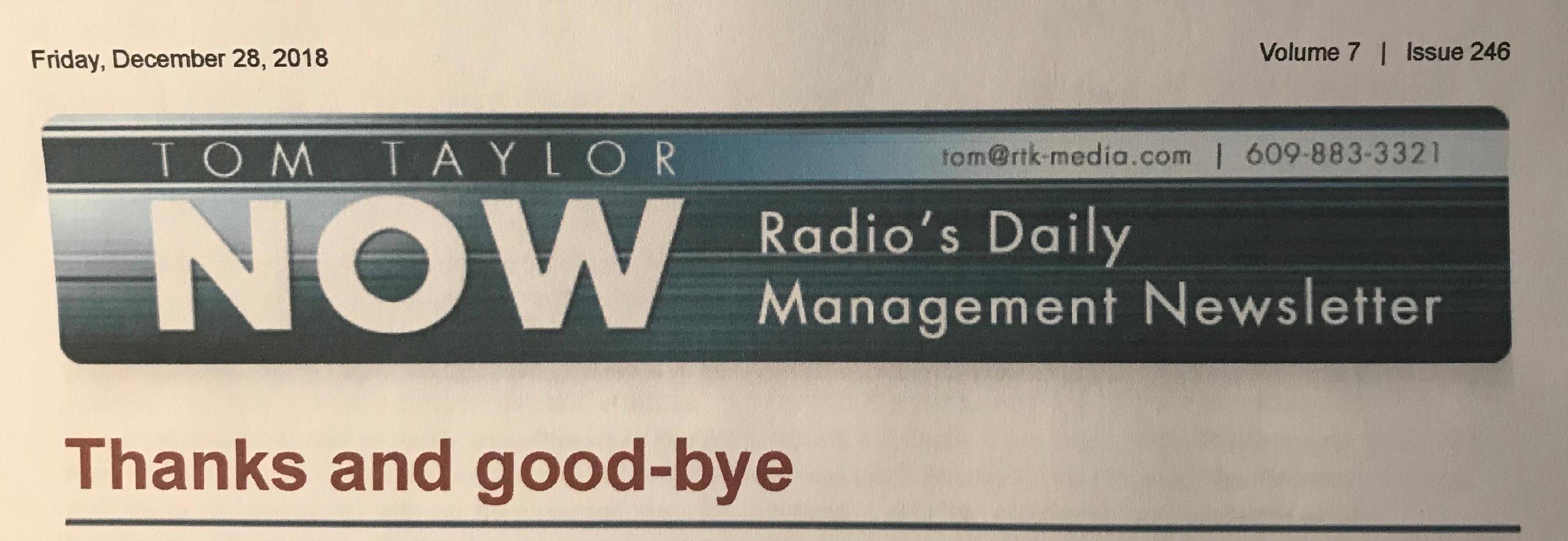
For the last six years of Tom’s radio trade journalism career, he rejoined Robert Unmacht and Kristy Scott to form RTK Media and publish Tom Taylor NOW – Radio’s Daily Management Newsletter. That publication ended on Friday, December 28, 2018 with Tom writing his “Final sign-off for the daily Tom Taylor NOW Newsletter.”

Tom’s “One Quick Word About Journalism”

In his acceptance speech, Tom said something I believe all broadcasters should hear about the importance of journalism in today’s world and the role of radio/TV operators in carrying out our responsibility to the communities we are licensed to serve. Here’s what Tom said:

“I spent 31 years as a New Jersey-based trade journalist. During that time, no boss or business partner ever said ‘Don’t do that story, because it will make somebody mad.’ Or, ‘be nice to so-and-so.’ More than ever, we need to support good journalism. And as local broadcasters, the responsibility is especially on us, because people look up to us – or down to us – as ‘the media.’ We’re really in the crucible.

This is something I said at the opening session of the recent NAB Show in Las Vegas – Regardless of your politics, does anyone in this room really believe that journalists are the enemy of the people?

Mark Twain said this – ‘Free speech is the cornerstone of every right we have.’

Let’s not forget that – or why we became broadcasters in the first place.

There’s an old joke, where the guy says ‘I wanted to be on the radio when I grew up. But then, I was told I couldn’t do both.’ On the inside, part of us is still a little kid, and that’s probably a good thing. But the rest of who we are is… (are) grownups who have a responsibility to the community. As long as we remember that, we should have listeners (and podcast users, and video consumers, and social media fans).

Here’s the other thing I said at the NAB Show – Plan well. Try new things. And adopt some extra confidence and pass that along to the folks who work for you. It’s contagious. And as you go home from Atlantic City – keep having fun with broadcasting. Because I believe, and I’ll bet you believe, that it’s still magic.”

Thank You Tom

Tom Taylor is still an inspiration to broadcasters everywhere and I’m grateful for this friendship that has spanned over 35 years since moving to Atlantic City, New Jersey in 1984 and becoming a member of the NJBA.Sharan & Tom Taylor

You and your lovely wife Sharan, have earned your retirement.

Live well. Live long. And be happy.


P.S. Scott Fybush produced a podcast with Tom Taylor and you can hear that HERE 

The part with Tom begins in 11:16 minutes into the podcast.

8 Comments

Filed under Education, Mentor, Radio