Tag Archives: Steve Goldstein

Instant Podcast

I’ve been writing this blog for ten years. A question that comes up occasionally is, why don’t I record my articles and make them into a podcast. The reason in one word is “focus.”

Seth Godin, a marketing genius I’ve followed for years says, if you want to communicate to the world, pick one medium and give it your all. For me, it was the written blog.

But – never say never.

Google’s NotebookLM

Steve Goldstein* wrote on this week’s Amplifi Media blog about a new audio product from Google, called “NotebookLM.” Steve says:

“If you’re in the audio business and haven’t yet explored

NotebookLM, you should.

It’s an impressive, jaw dropping tool that is exciting, weird and unsettling at the same time.”

Now, that sounded very enticing; so, I gave it a try.

We Never Called It Content – Podcast

I published my most read article on September 6, 2015 titled “We Never Called It Content.”  I decided that I would put my words through Google’s NotebookLM Artificial Intelligence Tool (AI) and see what came out.

NotebookLM produced an eight minute and seven second audio conversation between a man and a woman (both AI generated voices) discussing my article, as if I were a listener to their podcast and submitted this topic for their analysis.

The end result was produced in less than four minutes. Take a listen:

https://notebooklm.google.com/notebook/30d99a06-d33e-467e-84be-09c61a6a8a25/audio

We Never Called It Content – Blog Article

Now, for comparison of my original work, here’s the blog article I wrote back in 2015:

Larry Lujack, The Real Don Steele, Robert W. Morgan, Dale Dorman, Ron Lundy, Salty Brine, Bob Steele, and so many, many more.  These names I’ve dropped are all no longer on the radio.  Terrestrial radio anyway.  We radio geeks like to think they are now Rockin’ N Rollin’ the hinges off the pearly gates.

Everyone can understand the circle of life.  People retire, people pass on.

But this past week saw the “forced retirement” of more big names in radio.  Two of them that were on Los Angeles radio have a star on the Hollywood Walk of Fame.  They delivered, according to what I’ve read in the trades, excellent audience ratings.  So, what happened?

Bill Gates once famously announced “content is king” as we entered the Internet age.  Microsoft would give businesses WORD, EXCEL, PowerPoint etc.  The business schools graduated a whole gaggle of spreadsheet nerds who excel at these computer tools.  The Telcom Act of 1996 was the beginning of the consolidation of radio and when Wall Street would jump into this wonderful new investment opportunity.

When you look at radio stations via spreadsheets, you primarily are reducing everything to numbers.  It completely eviscerates the human element from the decision making process.

Nobody turned on Steele, Lujack, Morgan, Dorman, Lundy, Brine, Steele and the rest of radio’s iconic personalities and said, “I’m going to get me some great content.”  We turned on our favorite radio station because the people behind the microphone were members of our family.  We enjoyed spending time with them.  We knew that what we were experiencing, they were experiencing right along with us.  They were local & live. 

Radio is an art form.

When you remove the artists, there’s not much left.

Radio is a pretty simple business.  You play recordings people want to hear, you keep your hand on the pulse of the community you’re licensed to serve and report on what’s going on that people need to know and you hire personalities that become the audio glue that keep it all together running smoothly and engage the listener.

To support the expense of doing all of this, you work with businesses to expose their products and services to the audience you’ve attracted to your radio station.

The irony with today’s radio is that more radio stations operate out of a single location than at any time in radio’s 95 year history, but with less people per station than at any time in that same history.  I wouldn’t be surprised to see Rick Moranis (Honey, I Shrunk the Kids) return to make a new movie about today’s radio called “Honey, I Shrunk the Staff.” 

Frederick Allan “Rick” Moranis, a native Canadian, was a disc jockey on three Toronto radio stations back in the mid-70s performing on the radio under the name “Rick Allan.”

No one has a clue how much the employment in the radio industry has shrunk as the industry rushed to consolidate.  What we do know is when you walk into any of these huge clusters; there are rows of empty cubicles, offices that are no longer occupied – it can be depressing. 

I’m not saying that radio, like every other business, shouldn’t be running more efficiently and taking advantage of technology to control the costs of operation.  But the buzz you hear is that the fat cutting has become cutting the bone.

As Ken Levine wrote in his blog about the state of the radio industry http://kenlevine.blogspot.com/2015/08/why-im-glad-i-got-out-of-radio.html?m=1 “In the past when a great disc jockey got fired he would simply show up elsewhere.  But who knows today? Nobody is hiring. They’re all just firing.”

Today’s radio is being driven by Excel spreadsheets and PowerPoint presentations trying to put a pretty face on the new strategy.  But radio is more than just studios, transmitters, and now websites/social media, radio is made up of people, albeit fewer of them by the day.

Radio was never a just a job.  Radio was a mission inspired by people who were passionate about all the medium could be.  Everyone inside a radio station worked towards this common goal, just like the people at Google, Apple, Southwest – to name a few – do.

People didn’t get into radio, radio got into people.

Holy Audio, Batman!

Now remember, everything in my original article was simply uploaded to Google’s NotebookLM and the audio you just listened to, of a man and a woman, discussing my blog – in some cases actually expanding on my original thoughts – was completely AI-generated.

I honestly don’t know what to think, but I’m very curious as to what your impressions are about all of this.

Please post your thoughts in the comments section of this blog article, so that others may be stimulated to share their own, and we can all learn from one another’s perspective.
*Steve Goldstein’s Amplifi Media works with media companies and podcasters in developing audio content strategies.

12 Comments

Filed under Education, Mentor, Radio

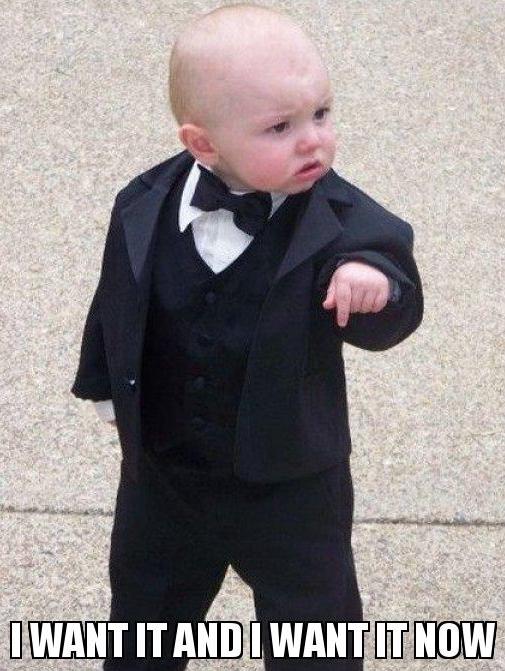
I Want It Now

I want it nowGrowing up telling mom or dad that I wanted something now, got the usual response of “you will have to work for it” or “you’ll get it when it’s ready.” Learning that good things come to those who wait was part of my maturing process.

But not any longer.

Google

I remember when I wanted to know about something, I either had to spend some time going through our family’s World Book Encyclopedia or take a trip to the library. But not any longer, I just Google it.

Alexa

I’ve been able to stream radio around the world for years, but it never became easier than when Alexa entered my world. Now, anything I want to know or hear, I simply ask Alexa, and that little genie in my Echo serves it up. My wish is Alexa’s command.

FOX TV

Remember when we used to have television seasons? Every fall, I couldn’t wait for TV Guide to arrive to plan out my TV viewing strategy.  ABC, NBC and CBS would introduce lots of new shows every fall and it was a big deal.

Then FOX changed things up while working to become America’s fourth television network. FOX began introducing new shows during the summer, and winter break, while ABC, NBC and CBS were showing re-runs.

Now new television programs are a year-round affair. Gone are pilots, re-runs and the fall season being the only time networks introduce brand new shows.

Netflix

But the most dramatic change to the introduction of a new television series happened five years ago when Netflix started releasing an entire season’s worth of shows, all at the same time. Netflix now gave viewers a choice in how you could watch a new season. You could watch on a weekly basis, watch a new episode every night, or binge watch the entire season.

Binge watching became the preferred method.

Disney+

Which is why I was surprised to hear Disney+ announce that it would be releasing its new shows an episode a week. History has shown with many different products and services, that you can’t go back to the way things used to be. I wish the mouse house good luck.

Knowing Your Audience

Netflix spends a lot of time trying to understanding what their subscribers want and like. They’re adamant that releasing an entire season all at once won’t ever change. They cite two reasons for this:

  • TV viewers have moved away from appointment viewing in droves, preferring to watch shows ON DEMAND, often by binge watching, and
  • 2) Netflix has found that people tend to watch only one show at a time. In other words, once a Netflix viewer finds a television series they like, they will watch all the episodes of that program before moving on to another show.

Netflix knows a happy customer remains a paying customer.

Reflecting on my own Netflix viewing habits, I would have to agree that I’m hooked on the concept of ON DEMAND television viewing and when I start a Netflix TV series, I watch the entire series, usually several episodes a night, until I’ve finished it. I’ve watched Downtown Abbey that way twice now.

Radio vs Podcasting

GoldsteinIs there a lesson for radio broadcasters from what I just shared about television viewing habits? I think there is. Programmer Steve Goldstein puts it this way, “Traditional radio – by design – is a lean-back business. Podcasting is a lean-in business.” That perfectly describes the difference between Netflix (lean-in) and broadcast (lean-back) commercial television.

These changing media habits are not just a temporary thing.

These changes in how people want to access and use media are the future, and we can’t wish the past back, no matter how much we might want to.

Goldstein says a podcast needs to be “thumb stopping.” By that he means the listener doesn’t exit the program and move on to something else with a press of their thumb.

Because of push button pre-sets, radio stations know all too well how easy it is for car radio listeners to change stations when something they don’t want or like comes on. Today, it’s in the car where most broadcast radio listening takes place.

Sadly, radio operators aren’t acknowledging this reality in the digital world.

Mad Men

Matt Weiner, the creator of the Mad Men television series that played on A & E, said that if he ever approached Netflix to run one of his shows, he would try to convince them to release the episodes on a weekly basis.matt weiner

It’s the same kind of thinking old timers in radio might suggest when they talk about how to make radio great again.

What would Netflix tell Mr. Weiner if he pitched his idea of releasing his programs a week at a time?

“He would lose,” said Ted Sarandos, Netflix’s content chief.

Radio should think of this reality as its “canary in the coal shaft” moment.


8 Comments

Filed under Education, Mentor, Radio, Sales

The Past is Not Prologue

200px-Duck-Rabbit_illusion

Thomas Kuhn used the duck-rabbit optical illusion, to demonstrate the way in which a paradigm shift could cause one to see the same information in an entirely different way.

One of my favorite weekly reads is Tim Moore’s “The Midweek Motivator.” You can sign-up for Tim’s weekly wisdom here.

This past week, Tim wrote about how people inside radio stations are asking him, “is radio failing?”

Now Tim’s a student of history, and he responded with “If you care about history (because the past is prologue) here’s the simple truth: some large groups are faced with debt loads that will either force bankruptcy or massive reorganization.”

Tim’s analysis about how America’s two largest broadcasters dug huge debt holes that can’t be re-filled by current operating revenues is spot-on. With radio, like a lot of businesses, it’s a matter of buying it right from the get-go. Start out upside down and most likely you won’t have a good day.

A system that is over-reliant on prediction through leverage, hence fragile to unforeseen “black swan” events, will eventually break into pieces.

-Nassim Taleb

Technology

Crystal balls are hard to come by but my tea leaves are leading me to believe that mass mediated communication is confronting more than just debt loads. What we are also dealing with is “paradigm paralysis.”

Radio’s leaders are holding onto a set of beliefs and views that radio is invincible.

Thomas Kuhn coined the term “paradigm shift” in his influential book “The Structure of Scientific Revolutions” in 1962. The business world adopted this terminology of “paradigm shift” to describe a profound change in a fundamental model.

Paradigm paralysis, on the other hand, is the inability or refusal to see beyond the current models of thinking.

Let Me Share a Story

John C. Harrison told this story at the First World Congress on Fluency Disorders held in Munich, Germany in 1994. See if you see a parallel to radio and the advent of satellites, streaming, podcasts, and smart speakers.

In the late 1940s a man walked into a laboratory of a major photographic

manufacturer in America to demonstrate a new photographic process.  But

he didn’t bring along a camera or film.  He brought along a red box with a

shiny steel plate, a charging device, a light bulb and a container of black

powder.  The picture he created was faint but discernible.


“But where’s the film?” they asked.  “Where’s the developer?  Where’s the

darkroom?  Why, that’s not really photography!”  And so, the company

passed up an opportunity to acquire the process for electrostatic

photography, or xerography…a process that has grown into a multi-billion

dollar industry.


Why did they pass up such a great opportunity?  Because the people who

saw the process were suffering from PARADIGM PARALYSIS.


Call Me an Outsider

Joel Barker wrote a book called “Paradigms: The Business of Discovering the Future.” Joel says that anyone who develops a new paradigm is often labeled an “outsider.”

Truthfully, when you’re running a cluster of radio stations, you don’t have time to think let alone take a step back and look at things with a fresh eye. I know. I’ve been there.

What teaching and now blogging have given me the opportunity to do is listen to everyone talk about the prevailing paradigm of radio broadcasting, in all of its subtleties and contrast it, to what I’m witnessing taking place before my eyes and ears by the end users of mass media.

And what I sense may be happening, is the radio industry being on the verge of a “black swan event.”

Black Swan Events

Credit card companies, who amass tons of data on their customers, still managed to miss the huge financial crises in housing back in 2007-2009.

When a tidal wave struck Japan’s Fukushima nuclear plant, the predictive model used to calculate how high the protective wall should be built, provided for a 20-foot wave. Yet, the wave that struck the plant was 24-feet high.

AIG, an insurance company in the business of predicting risk, missed seeing the financial collapse that bankrupted them.

Digital Advertising

Now Facebook is dealing with a black swan event over their data breach by Cambridge Analytica. Only this black swan could have major implications for how digital advertising is bought and sold in the future. The UK and Europe will put in place in May 2018 the “General Data Protection Regulation,” that will protect their citizens’ personal data or offending companies will suffer stiff penalties and fines.

So, what the Facebook story is doing, is making its two plus billion users aware of such massive collection and abuse of our data, but the fallout from this breach of trust will impact the ad supported business model of everyone in the digital advertising world.

30% of American Homes Don’t Have a Radio

Edison Research and Triton Digital’s annual “Infinite Dial” research just produced this astounding statistic. Close to a third of America’s homes no longer have a radio set in them.

Many people see smart speakers as the way back into the home for radio. But are they really?

Cable TV & Over-The-Air (OTA) TV

In the beginning, cable television was called “Community Antenna Television.” The concept was simple, TV stations were primarily located in big cities and the suburbs couldn’t receive those TV signals. So, antennas were placed high on mountains and cables would carry the signals received to homes in the valley.

TV operators loved this back then. It was like getting a power increase for no money.

Ah, but remember, there’s no such thing as a “free lunch.”

As the cable industry grew, channels such as ESPN and CNN and The Weather Channel were born and would compete with OTA TV.

Then along came streaming video.

Netflix

At the end of March 2017, one year ago, Netflix surpassed cable TV with its number of subscribers. And if you were to add up all the other streaming video services available to today’s television consumer, the lead over cable wouldn’t be a couple million viewers, but tens of millions.

What happens when a household begins subscribing to these advertising free channels? They find it almost impossible to return to ad supported ones.

Smart Speakers

Now we circle back to the smart speakers, Amazon’s, Google’s, Apple’s and Microsoft’s for starters. Instead of a handful of audio choices, the smart speaker delivers an almost infinite choice, and many, advertising-free.

When you put a prime rib steak next to hamburger and they are both the same price, which do you think most folks will choose?

The smart speaker lets you customize your favorites, much like the pre-sets on your car radio does. I’m willing to bet that the average consumer will end up with about 3 to 5 favorite audio streams they spend the bulk of their listening time with.

In fact, Nielsen’s Total Audience Report released in the second quarter of 2017 said that 87% of OTA radio listeners spent their listening time tuned to one of their three favorite radio stations. And 58% of that time was spent listening to just one station, what Nielsen calls their 1st Preference or P1 station.

Why would we expect this number to grow with the advent of smart speakers?

Goldstein’s Words

I think Steve Goldstein summed it up best in his recent blog when he wrote, “Commercial radio should put down the hammer and stop searching for nails. As they think beyond the stream, they will see how people are using audio media these days and create on-demand solutions in-sync with the vast opportunity of the exploding Smart Speaker universe. On Smart Speakers, the listeners are asking for it.”


5 Comments

Filed under Education, Mentor, Radio, Sales

Reflecting on Radio Show 2016

60The radio show was close to home this year, just down the road from my university, in Music City USA, Nashville, Tennessee. Plus, the Tennessee Association of Broadcasters decided to roll their annual convention into an opening event at the Radio Show. So as soon as I finished my morning class, I was on the road to Nashville.

Tennessee Association of Broadcasters Kick-off

Whit Adamson, President/CEO of the TAB, put together an amazing opening reception and event inside the Country Music Hall of Fame. We were welcomed by TN Governor Bill Haslam who declared it “Radio Week” in the State of Tennessee. Then the Mayor of Nashville, Megan Barry, gave us a warm welcome to Nashville where she declared it “Radio Week” in Music City. The “red carpet” was fully rolled out for the radio industry and attendance would set a new record for the Radio Show.

Pillsbury’s Broadcast Finance Forecast Leadership Breakfast

The good news is radio is the “King of Audio.” The bad news is that revenue growth for radio underperformed ad spending post-recession. Radio’s 7% share of all advertising is predicted to decline to 6% by 2019. Why? Digital ad spend will grow significantly (40%) by 2019. And radio will struggle to reach mobile users.

The big takeaways from this session were: Investors want to see new growth catalysts like NextRadio, more event revenue and growth in digital/mobile ad revenues. Investors want no more than 3 to 4 times leverage with more industry consolidation. All of this investors feel will yield more “free cash flow.”

Investors worry about audience fragmentation and Millennial reach, radio’s competition in the car dashboard, the challenges coming from digital/internet, continued uncertainty over royalties and excessive leverage.

Focusing on Your Career Future

The room here was filled with young people. Radio mentors from all areas (except engineering) met with tables full of students and recent graduates to talk about the many opportunities available in today’s radio industry. The mood was once of excitement and enthusiasm.

Brittney Quarles and John Focke both would share their personal radio journeys with students as they shared advice such as: “the industry is small, don’t burn any bridges” and “find a champion for you and your talents” and “be careful who you share your dreams with.” The right mentors are essential to your career.

Beyond Basics – The Prosperous, Professional You

John Bates, Elizabeth Burton and Heather Monahan led a session in how to reach beyond your limits and build a better “Brand You.”

John Bates shared “3 ways to inspire and connect”: 1) logic is not the way, 2) human eyes connect you to another person and 3) be authentic. For example, people don’t connect with your successes, but your messes. You message is your mess. But above all else, “Make A Difference.”

Elizabeth Burton drilled down the importance of your online brand and that today your online activities build your reputation.

Heather Monahan told us that people take only 10-seconds to make an opinion about you when they first meet you. 50% of communication is nonverbal and your attitude is everything. And if you want to know what your personal brand is, ask others this question: “What value do I bring to you?”

The Digital Dash – Improving the Consumer Experience

Fred Jacobs, Steve Newberry and Scott Burnell (from Ford) all shared their perspective on radio in the car. The first big thing is car manufacturers don’t call it a radio in the dash anymore (and probably haven’t for some time) but “the center stack.” Into this part of the dashboard, everything a car owner wants can be accessed.

Steve Newberry (former NAB joint board chairman) really brought the whole issue home with his analysis of the technology revolution by saying there are two kinds of events: disruptive and modifying. Disruptive events would be things like television and FM radio. Modifying events would be things like cassette tapes, CDs and MP3s. Disruptive events change the landscape and prevent an entity from doing things the way they’ve always been done. Television stole radio’s programming and added pictures and radio had to reinvent itself with new kinds of programs. Modifying events such as records being replaced by cassettes and 8-track tape, then CDs replacing both of those to be replaced by MP3s merely modified the way people listened to their own music libraries but not how they used radio. The new digital/internet connected world is a disruptive event and radio needs to once again adapt to this revolution in communication. The future is bright if radio is agile and adapts.

Perception vs. Reality – The True Power of Radio

My first Arbitron rep was Pierre Bouvard. He’s a fountain of information. His presentation on “7 Things Brands Have Completely Wrong About Radio” tells the story in great detail and shows the challenges faced by radio sales people today.

Podcasting

Steve Goldstein did an amazing presentation on podcasting by starting out with this Thomas Edison quote from 1922 “The radio craze will die out in time.”

Today mobile is eating the world. 20% of audio listening comes from the smartphone. For radio, podcasting is all about retention, growth and relevance.

Podcasting is no longer niche. It delivers the demos advertisers want. Podcasting is different than broadcasting. There’s money to be made in podcasting and radio has the perfect megaphone to promote podcasts to its audience. That’s radio’s “secret sauce” that podcasters wish they had access to.

Radio – The Local Media Company of the Future

Gordon Borrell and his research company are doing some incredible studies on the future of advertising. He immediately got the audience’s attention when he said in the last ten years $56 Billion has disappeared in advertising expenditures.

Banner ads are dead. But digital is not.

Local advertising growth is forecast to increase 7.6%, but non-digital will see a 6.9% decline in ad spend and digital will see a 22.4% increase in ad spend. In fact, 2017 is the year that digital advertising will eclipse all traditional media.

Borrell said when advertisers cut ad spend in one medium they spend it in another medium. Radio will continue to be bought, but only those stations who have well-trained representatives that understand the realities of today’s advertising and can put together a total marketing plan that goes beyond simply radio spots. Advertisers will partner with any media company who has reps that listen.

The good news is traditional media – like radio – is still necessary to drive digital advertising goals and deliver maximum digital R.O.I. (Return On Investment).  You can see Gordon’s full PowerPoint deck here.

Final Thought

The mood in the halls and in the sessions at this year’s Radio Show was very upbeat. The things being discussed and presented did not shy away from the realities all ad supported media face.

Anyone who attended came away with lots of action steps that need to be implemented immediately.

Radio currently is the #1 Reach & Frequency medium in the United States of America.

There’s no time to waste. It’s time to roll up our sleeves and “Make A Difference.”

Radio’s future depends on it.

4 Comments

Filed under Education, Mentor, Radio, Sales, Uncategorized