Author Archives: Dick Taylor, CRMC/CDMC

Dick Taylor, CRMC/CDMC's avatar

About Dick Taylor, CRMC/CDMC

I’ve been a “Radio Guy” all of my life. My earliest memories were of building a radio station out of tinker toys and pretending I was a disc jockey. Later I would build a radio station in the basement of my parent’s home and using AM & FM transmitters I bought at Radio Shack I would begin broadcasting to my neighborhood for about a three block radius. I began in commercial radio in the 10th grade in high school. A local radio station in my hometown of Pittsfield, Massachusetts decided to start a Junior Achievement company in radio. This was a really new concept in Junior Achievement as all JA companies at that time were production oriented and a radio station would be a service oriented JA company. I was a member of that first Junior Achievement radio company (WJAC) and it quickly led to a part-time job with that radio station (WBEC). Radio would pay for my college education and graduate degrees, both of which were in education. I loved college and could have very easily become a career student. When I graduated with my Masters Degree, there were no jobs in education to apply my earned degrees but there were radio jobs and I went into the radio business full-time as a program director, operations manager and air personality. Deciding what I’d really like to be is a radio station general manager, I knew that I would need to earn my chops in sales and so I quit my job on the product side of the business and started over at the bottom of the sales ladder as an account executive. I quickly rose to sales manager, station manager and general manager. For 27 years, I operated at the market manager level of the radio industry. I’m a Life Member of the New Jersey Broadcasters Association and Radio Ink Magazine has named me one of radio’s best managers. Former professor of broadcasting at the School of Journalism & Broadcasting at Western Kentucky University (WKU) in Bowling Green, Kentucky. I have a successful track record in sales and people development, growing top line revenues, achieving leading audience ratings, reducing expenses and meeting bottom line goals. I’m a recognized expert in radio and media regulations. I’m a turnaround specialist. I'm the founding director of the KBA WKU Radio Talent Institute coordinating a professional faculty of broadcasters who teach broadcast students who qualify and are accepted to attend a ten-day intensive program that trains tomorrow’s broadcasters in all aspects of radio station operations. My specialties include: dynamic public speaker/presenter and sales trainer. I currently teach classes in the Process & Effects of Mediated Communications, Broadcast/Internet Sales, Broadcast Performance/Production, Broadcast Management and the History of Broadcasting in America. I hold a BA in Physics/Education, an MS in Educational Communications, the Diamond CRMC (Certified Radio Marketing Consultant) and the CDMC (Certified Digital Marketing Consultant) from the Radio Advertising Bureau. I’m a graduate of Roy H. Williams Wizard Academy and Gitomer Sales Training. Note: The picture on my blog is when I was invited to do a guest disc jockey appearance on The Legend - 650AM - WSM in Nasvhille, Tennessee (July 2014). For this "Radio Guy" doing a four-hour air shift on this legendary clear channel signal radio station was a dream come true.

How You Say It, Makes All the Difference

A few of weeks ago, my wife Sue & I went to two different churches for Easter Sunday services; our new church, where we just became members and our old church where we exchanged our vows of commitment to each other.

Here’s what I learned…

Talking versus Preaching

One of the pastors delivered the service as if he was talking to us. He engaged us with his message, as if he were having a conversation, and even posed questions to the congregation. The religious meaning of Easter Sunday was delivered in a relatable way, bringing meaning and perspective to the world we are living in today.

The other pastor, at our second Easter service, preached…or what I might characterize as “talking at and not to” me. It didn’t really relate to the world outside the church doors, in tone or message. The sermon made no effort to tie a religious message to our current reality.

WABC – “The Last Aircheck”

On Saturday, May 10th, Rewound Radio aired, what’s become known as “The Last Aircheck,” the day that WABC Music Radio 77 would switch their format to Talk Radio 77. That happened 43 years ago on May 10, 1982.

Those final hours were hosted by Ron Lundy and Dan Ingram, and as I listened to the replay of that broadcast, I got goosebumps. The sound of their voices took me back in time, when listening to the radio was like a religious experience for me.

Techsurvey 2025

Fred Jacobs has been tracking the power of personalities in his annual Techsuveys, the most recent one which came out in the first quarter of this year. Here’s the trendline:
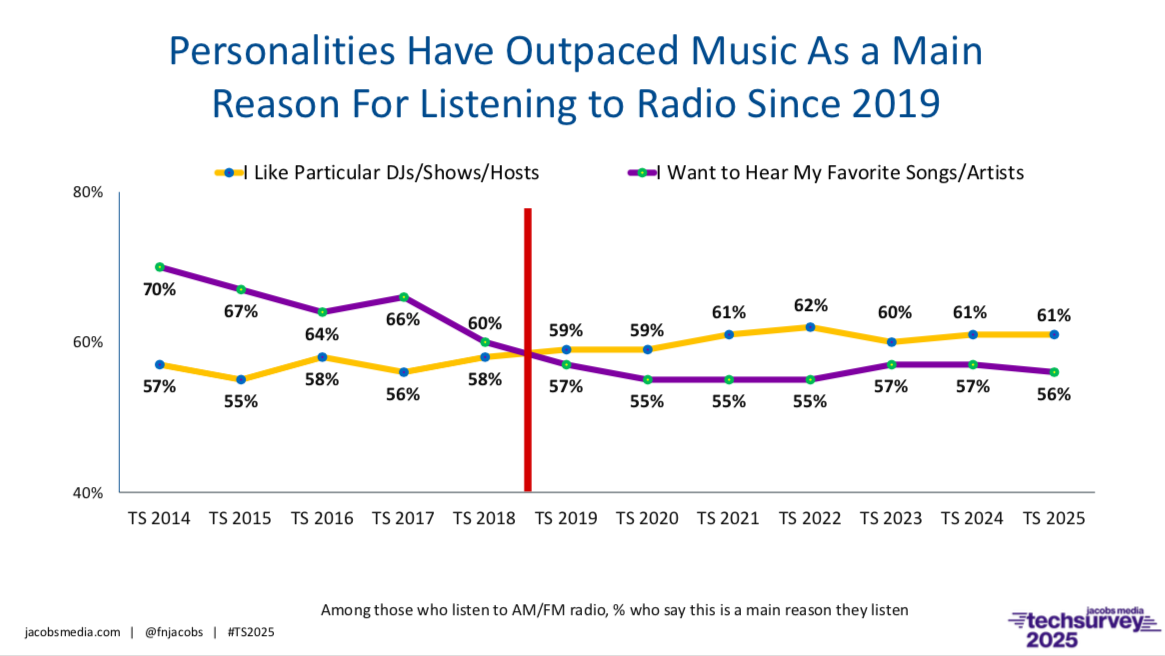
Fred’s graph only goes back to 2014, but radio captured my heart in the 60s. It was a time when great radio personalities ruled the airwaves on virtually every broadcast signal.

Radio owners would covet, promote and value their air personalities and so did the radio audience. For the radio listener, meeting their favorite air personality was a heart pounding experience.

The Human Voice
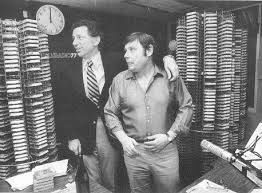
I never had the opportunity to meet Ron Lundy or Dan Ingram, but their voices owned real estate in my brain. As it was broadcast over Rewound Radio, hearing them talking on “The Last Aircheck” made the same impact as it did when I heard them LIVE 43 years ago.

That’s the power of the human voice.

Church Attendance & Radio Listenership

In today’s world, both entities are challenged to build and hold an audience. Our new church saw its lead pastor of 12 years promoted and a new pastor was named to replace him.

Like a radio station that loses a popular personality, and causes listeners to seek out other listening possibilities, a church changing its pastor is monumental change, often causing people to try other churches.

One saving grace in our church’s situation was having an assistant pastor that provided continuity to the congregation during this time of change.

The good news is that when the new pastor arrived, he would be as dynamic as the pastor who had left; maybe even more so. Our congregation has grown under his leadership, at a time when other churches have not. He talks, not preaches; and he listens.

Every Hour in Radio is Front Page

Radio, unlike print publications, doesn’t have a back page. Every minute of the broadcast day is like being on the front page. Every minute counts and a radio station is either building an audience, keeping an audience or losing an audience.

Radio’s reduction in force (RIF) of its air personalities has created two problems:

1) many hours of the broadcast day are now sterile and

2) those sterile hours aren’t just driving away radio listeners to other venues, but they also aren’t attracting a new generation of broadcasters who’ve been inspired by what they hear coming through their radio speaker.

BOTTOM LINE

Today’s radio lacks personality and FOMO.*

*FOMO is Fear Of Missing Out

18 Comments

Filed under Radio, Education, Mentor

What Skills Are Needed in Today’s Media & Communications Industry?

This week, Sarah McGrath, an editor with the LinkedIn News team, emailed me to get my feedback about their inaugural “List of Skills on the Rise in Media and Communications.”

LinkedIn mined its member data base of media and communications folks to compile a list of the 10 fastest-growing skills that working professionals feel are needed to get ahead and grow in the 21st Century.

I’m going to post LinkedIn’s list and invite you to share your thoughts and comments about what people interested in a career in the media and communications industry should be investing in. If you feel this list missed a skill that you believe should have been included, please respond on the www.DickTaylorBlog.com website’s comments section.

AI Literacy

Artificial Intelligence or A.I. is certainly a must in today’s world. A.I. is turning our world upside down at the speed of light. I don’t believe anyone could imagine not having the skills and understanding needed to leverage this technology, for fun and profit.

Emotional Intelligence

In a world where your smartphone can quickly provide the answers to any question you might have, the skill I see that should be on this list – and maybe #2 – is emotional intelligence, also referred to as EQ.

People with a high EQ possess the skills necessary in building strong relationships and navigating social situations. They are able to manage emotions effectively, allowing for the achievement of both personal and professional success.

The Harvard Business Review says that while technical skills may have helped you to secure your first promotion, without emotional intelligence it may not guarantee your next one. For EQ is the skill that will help you successfully coach teams, manage stress, deliver feedback and collaborate with others.

“Emotional Intelligence is one of the most sought-after interpersonal skills in the workplace. In fact, 71 percent of employers value emotional intelligence more than technical skills when evaluating candidates.”

The good news is, emotional intelligence can be improved in each of us if we make a conscious effort to practice on developing self-awareness, self-regulation, empathy and social skills.

My wife Sue, who edits this blog, says listening is a very important EQ skill. It’s one I’m still working on.

Active listening means to pay close attention to what others are saying, both verbally and nonverbally, and trying to understand their perspectives.

For “50 Tips on Improving your Emotional Intelligence” click on this LINK.

Now It’s Your Turn

I would really love to hear what your thoughts are on the skills young people should be developing and strengthening to thrive in today’s media and communications world.

Be sure to click on this LINK and share your thoughts in the comments section on the blog.

I look forward to hearing what you have to say.

4 Comments

Filed under Education, Mentor, Radio, Sales

Radio’s Most Pressing Issues

This past week, Radio/TV state broadcast associations were in our nation’s capital meeting with their elected representatives in both the House and Senate about issues that are important to them. It’s the annual National Association of Broadcasters (NAB) State Leadership Conference.

More than 500 radio broadcasters from across America assembled to hear Senator Ted Cruz (R-TX) speak on his support of the “AM Radio for Every Vehicle Act,” and advocating for a level playing field in the advertising market.

Cruz is the new Chairman of the Senate Commerce Committee and he pledged a proactive approach to support broadcasters, create jobs and uphold free speech.

Free Speech

Brendan Carr is the new Chairman of the Federal Communications Commission (FCC) and in only a couple of weeks, since taking this leadership position, his actions have caught the attention of some members of Congress, who were alarmed by recent moves impacting broadcasters.

Representative Jerold Nadler (D-NY) expressed his concern over the Carr’s FCC assault on a media organization’s free speech.

“Exploiting his asserted ‘unitary executive’ powers, [President] Trump is unleashing his sycophant FCC Chairman, Brendan Carr, on every newsgroup whose news stories he does not approve of — actually threatening to pull the broadcast licenses for ABC, CBS, NBC, PBS, and NPR,” said Rep. Jamie Raskin (D-MD). “Is this North Korea?”

The President of Free Press Action, Craig Aaron, in testimony said that threats and opening investigations into broadcast outlets by the FCC is out of the norm.

“The FCC usually talks about licenses on very narrow terms, such as if an owner has committed a major crime,” Aaron said. “The idea that a news organization would be threatened because they asked a tough question of the President, or because they tried to fact check him during a debate, or because they edited their own news content before putting it out over the airwaves is preposterous, and it’s dangerous.”

DEI

Diversity, Equity and Inclusion (DEI) has been terminated by Carr at the FCC and he’s been signaling that the agency might go after FCC licensees over their own DEI programs.

Are DEI programs good for business? Apple’s shareholders think so, so do Costco shareholders, and Hyundai’s marketing executive, Erik Thomas, credits its DEI programs with driving the automobile manufacturer’s bottom line.

SiriusXM

Nine years ago I wrote an article with a title that sounded like click bait titled “SiriusXM Radio is Now Free,” which speculated when the FCC licensed satellite broadcaster would start offering ad-supported channels for free.

Four years later, I wrote that “Could 2021 Be the Year SiriusXM Adds FREE Channels?” speculating that new SiriusXM CEO, Jennifer Witz, would be pursuing revenue growth by  leveraging the 132 million cars the service was available in. SiriusXM, like commercial radio over-the-air (OTA) broadcasters, knows that the competition for listener ears is in the car. The advantage the satellite broadcaster has over AM/FM radio operators is they know exactly what their listeners are listening to, and don’t have to rely on audience estimates that may or may not be accurate in today’s media saturated world.

Last year, what I have been predicting since 2016, became a reality, as I wrote in:  “Ad-Supported SiriusXM Requires No Paid Subscription.”

Monopoly

One of the radio industry’s most respected researchers, Dr. Ed Cohen, wrote “The direct-to-consumer satellite radio business is a monopoly,” shortly after my 3rd article on this subject was published. Originally, the FCC offered only two satellite broadcast licenses, one went to a company called “Sirius” and the other to a company called “XM,” with the idea being they would be competitors and that the consumer would benefit by not having a single company – a monopoly – control satellite radio and what it could charge.

The two companies were supposed to never be able to merge, but in August of 2008, by a 3 to 2 vote of the FCC, that changed. Dr. Cohen does a really good deep dive into explaining how this all came about in his article “SiriusXM and the FCC: Is the Camel’s Nose Under the Tent?” Which is an allusion to a story that takes place in Arabia, with this metaphorical moral:

If the camel once gets his nose in the tent, his body will soon follow.

What the FCC never took into consideration was, how much damage might occur to local AM/FM radio stations, if and when, the new combined SiriusXM ever decided to provide an ad-supported free radio service.

Dr. Cohen believes that while this new free service from SiriusXM is limited in scope, like the proverbial camel, it won’t be long before the whole service becomes real competition for audio listeners and advertisers.

People Love Free

AM Radio vs SiriusXM

Dr. Cohen makes an excellent case for commercial radio broadcasters to be demanding, the FCC revisit the SiriusXM merger decision in light of this change by the satellite broadcaster.

By the way, public broadcasters also have a horse in this race, as NPR Now is part of the new free SiriusXM service.

“While the NAB is busy with getting Congress to force OEMs (Original Equipment Manufacturers) to include AM in every vehicle, the battle with SiriusXM’s ad-supported venture is probably more important to the industry in the long run,” says Dr. Cohen.

It’s The Economy Stupid

But the most important issue facing the commercial radio industry are the financial fears that have been generated by the Trump tariffs and fire hose of government regulatory changes that seem to come at us on an hourly basis. I wrote about this concern in February with an article titled “The Cost of Uncertainty to Radio.”

Now BIA Advisory Services this week updated its local advertising revenue forecast for 2025. Cameron Coats, in Radio Ink, reports that “over-the-air revenue [for radio] takes the largest hit, falling by 6%.” Digital radio, says Coats, shows a slight increase of 0.1%.

SiriusXM has enjoyed growth through the sale of new cars, but with the high tariffs Trump has announced, it wouldn’t be a surprise if people hang onto their current vehicles a little longer, which also means that AM radio will still be accessible. Without an economic downturn, the average life of a car in America is 12-years, up from 8.4-years in 1995. Progressive Insurance says that a well-maintained car will reach 300,000 or more miles, and those cars have both AM/FM radios as well as SiriusXM.

The radio industry’s most pressing issue is who wins in the car, and in that arena AM radio – a hundred year old medium is not our industry’s best play –

stopping satellite radio’s FREE ad-supported service is.

When the pie isn’t growing,

the game becomes who can cut the biggest slice.

5 Comments

Filed under Uncategorized

Pilot of the Airwaves

Forty-six years ago, Charlie Dore wrote and recorded the song “Pilot of the Airwaves,” a song about a girl who stays up late every night to listen to her favorite radio air personality. She requests that he play a record for her, either the one she suggested or a record of his choice, and adds “I’ve been listening to your show on the radio and you seem like a friend to me.”

Companionship

Radio’s most important strength has always been its ability to provide companionship to the radio listener, and the radio air personality becomes a trusted friend, like a member of the family.

Freddie Mercury

Forty-one years ago (1984) Queen released “Radio Ga Ga,” a song that reflected on the changing popularity of radio and television with the advent of MTV and music videos. In the song, Freddie Mercury belts out “Radio, someone still loves you!”

Which begs the question, if in 1984, Queen felt it necessary to reaffirm the power of radio – before there was the internet and streaming – what must it be like today, 41-years later? Who’s showing the love now, and why?

I Watched It All On My Radio

Thirty-Five years ago, Lionel B. Cartwright released a song that spoke to how radio is “the theater of the mind” in a song called “I Watched It All On My Radio.” It’s a song about a young boy’s remembrances of listening to his transistor radio growing up. This song brought to mind how Charles Osgood (CBS Radio Commentator) would sign-off his radio broadcasts saying “I’ll see you on the radio.” Ah, the good old days.

Video Killed The Radio Star

MTV signed on in 1981, playing music videos that were introduced by Video Jockeys (VJs). The first song played on MTV on August 1st of that year was by The Buggles, “Video Killed The Radio Star.” A key line in that song was “In my mind and in my car, we can’t rewind we’ve gone too far.” The original VJs were all gone before the end of the decade and while MTV still exists, it’s less focused on music videos having  migrated into reality shows for teenagers.

So, video didn’t kill the radio star, but consolidation of radio ownership certainly has.

Radio Listeners Miss Hearing Their Favorite DJs

CRS ‘25 (Country Radio Seminar) just ended in Nashville. Listener research done by NuVoodoo’s Carolyn Gilbert and Leigh Jacobs found that listeners are noticing their favorite personalities are getting downsized, telling the audience that “thirty-six percent agreed that many of the hosts and DJs they had enjoyed hearing on the radio [have] lost their jobs. They’re aware.”

Techsurvey 2024

A year ago, Fred Jacobs released his company’s 20th annual Techsurvey on the habits of radio listeners. One of the major findings of Techsurvey 2024 was how a majority of listeners enjoy the local feel and connection with personalities.

Yet, radio companies continue to de-emphasize experienced local talent – in other words, fire them.

Expiring Skills & Permanent Skills

Morgan Housel, a partner at The Collaborative Fund and an expert on behavioral finance and history, says that every field has two kinds of skills:

  • Expiring skills, which are vital at a given time but prone to diminishing as technology improves and a field evolves.
  • Permanent skills, which were as essential 100 years ago as they are today, and will still be 100 years from now.

Is Being a DJ an Expiring Skill?

  • Seems like everyone’s been talking about what artificial intelligence (A.I.), means for the future of air personalities. Radio owners seem to be excited about A.I. but radio personalities view this new technology with trepidation.
  • You might be wondering if being an air personality is something that will no longer be relevant and can be replaced by a robot.
  • If we’re talking about replacing mindless voice tracking, maybe A.I. is an improvement, but if we’re talking about making a human connection, I think not.
  • Most permanent skills are human-centric, meaning that they are not something a chatbot can duplicate. Sharing of human experiences can only be done by another human. Permanent skills require emotional intelligence which compound over time.
  • People who spend a lifetime perfecting one skill whose importance never wanes, will be the ones in demand.

AI (Artificial Intelligence) Is Not The Answer

The popular TV game show, Family Feud, began airing on ABC in 1976. It would be the personal charm and witty banter of host Richard Dawson that would make the Feud hugely popular with television audiences.

The show continued on after Dawson left, hosted by Ray Combs, Louie Anderson, Richard Karn and John O’Hurley, but it wasn’t until radio star Steve Harvey took over in 2010 that Family Feud saw renewed success. Ratings for the program increased by as much as 40%, and has become the fifth most popular show in syndication being renewed once again through the 2025-2026 season.

By the way, Steve Harvey hosts the #1 syndicated morning radio show in America too.

Personalities like Steve Harvey are not worried about being replaced by artificial intelligence because they have developed a useful and permanent skill in a world that is constantly changing.

Yes, this is both a national example, as well as one about television, but great local radio stations embrace the importance of having strong personalities, like a Steve Harvey, filling their rosters of air talent.

Humans connect with other humans that engage them.

Being human is something artificial intelligence will never be.

10 Comments

Filed under Uncategorized

The Cost of Uncertainty to Radio

In January, I characterized the future of radio in a word, and that word was “uncertain.” Since then, the future of the business world is now being described using that same word.

Radio Advertising

The radio industry has one means of support for all that it does in our local communities;

ADVERTISING.

Local businesses that advertise their products and services are the economic engine that pays for everything a radio station provides to its listeners. Depending on the size of a radio market, additional monies may come from regional and national advertising too. But it is through advertising that commercial broadcast radio exists.

It’s a business model that today is challenged by digital media services, which offer a subscription with an advertising plan allowing two revenue streams for their support.

Uncertainty is Bad For Business

Every business student has heard repeatedly that “uncertainty is bad for business.”

Under President Trump, uncertainty is gripping the business world, with the Associated Press writing:

Trump is taking a blowtorch to the rules that have governed world trade for decades,” and the “reciprocal” tariffs “are likely to create chaos for global businesses and conflict with America’s allies and adversaries alike.”

The reality is business has no idea how to plan in a long-term, sustainable way, and that includes the radio business.

Seventy percent of America’s economy is based on consumer spending, and the National Retail Federation (NRF) is warning that the myriad of tariffs being proposed “will be extremely disruptive to [America’s] supply chains.” It will also mean higher prices for America’s families which will erode household spending power.

Recessions & Advertising

I started in radio sales during the recession of the early 80s. Orders for radio advertising didn’t just come in over the transom, as had been the case up until that time. If you wanted to build your account list with advertisers, you had to burn some shoe leather and go out to see them, work with them to developing an advertising program that would bring customers into their establishment. I remember Warren Buffett describing these days as…

“Only when the tide goes out

do you discover who’s been swimming naked.”

Which meant to those of us selling radio, tough times revealed who was actually working at the art of radio sales and who was just waiting for the phone to ring.

History clearly taught that businesses that advertised during difficult economic times like during a recession were taking advantage of a strategic opportunity to increase their share of the market and increase their business’s awareness in the mind of the consumer.

The University of Michigan, which monitors consumer sentiment, says that its index continues to decline, suggesting that consumers are very aware of what’s happening in Washington, DC with the talk of tariffs and the possibility of a global trade war.

“Tariffs are taxes,” said the European Commission. “By imposing tariffs, the U.S. is taxing its own citizens, raising costs for business, stifling growth and fueling inflation. Tariffs heighten economic uncertainty and disrupt the efficiency and integration of global markets.”

Uncertainty & Business

Economists have tried to study what uncertain conditions mean for business in countries all over the world. What they’ve consistently learned was that uncertainty makes businesses:

  • More reluctant to hire
  • More reluctant to invest
  • Leads to lower sales

Businesses can adapt when they have some idea of what the future looks like, but when it isn’t clear what the rules will be, both businesses – and their customers – end up in limbo.

Past spikes of uncertainty were caused by recessions, financial crises, negative word events – and most recently, the Covid-19 pandemic. However, this time the uncertainty is almost like a deliberate move to cause it, making it hard for anyone to predict how both businesses and consumers will respond.

Already both businesses and consumers are pulling back on expenditures of big ticket items, spending only on those things necessary for their daily existence. It’s that pull-back that could result in a much larger impact to the American economy.

People in times of uncertainty hunker down.

When anyone of us is uncertain about our future, we tend to hold on to our money, preserving capital to be ready for whatever the future may hold.

These days, whether you are the radio station owner, the radio seller of advertising or the radio listener, we are all trying to figure out what’s going on, what it means to the world and our family – for at this point in time…

No one knows what’s going to happen next, and that’s the problem.

6 Comments

Filed under Education, Mentor, Radio, Sales

UNCERTAIN

If you had to sum up, in one word, what the year ahead for radio would be like, what word would you choose?

The word I chose was “UNCERTAIN,” when Fred Jacobs posed that question to the readers of his blog.

Word Salad

To be more specific, the question Fred Jacobs asked his readers to respond to was:

What’s your unique “take” on broadcast radio in 2025?  In a word, how would you describe this next 11+ months?  What’s the state of radio in 2025 – in just one word?

He put that question to the readers of his blog on Monday (1/20/2025) and on Wednesday (1/22/2025), after more than 225 people responded,  produced the “Word Cloud” shown below.

My response of “UNCERTAIN,” can be found in the upper left hand corner.

CES 2025

On Tuesday (1/21/2025), Fred gave a webinar on this year’s Consumer Electronics Show (now just simply called CES) held at the beginning of each year in Las Vegas. He characterized this year’s show as “NOT NORMAL” calling it a transformative event.

In his summary of the Top 10 Themes at CES 2025, all of them included Artificial Intelligence (AI).

Filling Talent Shortages

A new study released Tuesday (1/21/2025) by Hult International Business School and Workplace Intelligence found that even when faced with widespread talent shortages, employers would rather hire a robot or AI than a recent graduate.

You don’t have to be in radio to feel a sense of terror for what lies ahead for America’s working class.

College Graduates

“Meanwhile, recent graduates who have successfully joined companies, have found the work experience invaluable. 77% said they learned more in half a year on the job than in four years of undergrad and 87% said their employer provided better job training than college.”

“Over half (55%) said that college didn’t prepare them in any way for the job they currently hold,” according to the survey, which isn’t a glowing endorsement for getting an expensive college education and racking up a large debt.

This was something I realized while teaching at the university back in 2016 and blogged about in an article called “Just In Time Learning.”

Division

Fred summed up the results of his unscientific experiment saying:

“And we wonder why radio discussions on social media turn into debates, while often devolving into rants and responses in ALL CAPS. We may as well be talking politics. Actually, we very much are.”

The one word that never came up in the more than two hundred participants was…

“unified.”

For America today, the one word that best describes our country is “divided.”

So, it shouldn’t surprise anyone that when asked about what the future of broadcasting is, the answer is…

Radio, like our country, is divided.

We have the large and powerful radio operators and then we have a few mom & pop stations, with the rest of the local service primarily being the dedicated operators of Low Power FM (LPFM) radio stations, supported by listeners and local business underwriters.

The gap between the haves and have-nots keeps widening, which prevents the radio industry from speaking with one voice.

America’s 2nd Gilded Age

You tell me if what happened a century ago sounds like what’s happening in America today.

During the 1920s, America became more prosperous and saw unprecedented growth in industry and technology. But the Gilded Age had a more sinister side: It was a period where greedy, corrupt industrialists, bankers and politicians enjoyed extraordinary wealth and opulence at the expense of the working class.

3 Comments

Filed under Education, Mentor, Radio

I Propose the “Speedometers in Every Car Act”

When my wife Sue & I are driving, locally or on one of our road trips, we’ve noticed that drivers have no idea how fast they’re going. Speed Limit signs are no longer even considered a suggested “speed limit,” but more like something that should be considered a minimum speed.

Speedometers

In 1902, German engineer Otto Schulze patented the speedometer and Oldsmobile would be the first American car company to factory install them into their vehicles. However, speedometers were originally considered an option, that owners could buy.

It wasn’t until 1910 that speedometers started becoming standard equipment in American automobiles.

How to Become a Road Hazard

If you really want to put your life in jeopardy, try traveling the posted speed limit. We have, and there’s not a single vehicle that will follow us. NOT ONE.

The Drive Rite Academy says: Speed limit signs serve as a guide for drivers to maintain a safe and appropriate speed, based on the type of road, traffic, and environmental conditions. They are designed to protect both drivers and pedestrians by reducing the risk of accidents and ensuring smooth traffic flow.

            KEY POINTS:

  • The number on the sign represents the maximum speed you’re legally allowed to drive, under ideal driving conditions.
  • Ideal driving conditions include clear weather, dry roads, and low traffic.
  • It’s important to note that the posted speed limit is NOT a target speed. Drivers should adjust their speed based on traffic and weather conditions, even if it means driving below the posted limit.

Does Your Car Have a Speedometer?

The question posed at the beginning of this section is rhetorical. Every vehicle built and sold for use on our highways and byways in America comes equipped with a speedometer, but we’re beginning to wonder if today’s drivers know how to use them.

Speed Limit signs are the law on our roadways.

Once upon a time, Americans believed no one was above the law. But those days are now in the rearview mirror. 99% of today’s drivers believe that speed limit signs don’t apply to them.

And don’t get me started on drivers who don’t come to a full-stop at STOP SIGNS.

AM Radio

It’s why I chuckle when the National Association of Broadcasters (NAB) will try again in the 119th Congress to pass their “AM Radio in Every Vehicle Act.”

Personally, I believe, it’s more important that every vehicle come equipped with an FM radio, as that’s what the majority of Americans use – if they listen to broadcast radio at all.

Just Because…

Just because a vehicle has an AM radio – or speedometer for that matter – doesn’t mean anyone will use them for their safety, or that of their passengers.

I rest my case.

9 Comments

Filed under Education, Mentor, Radio

Best of the Blog 2024

2024 marked my 10th year of writing this blog, and while I reduced the number of articles I would write this year to focus more on faith, family and friends, here are the Top 5 Most Read articles from the past year.

To date, 508 articles have been published over the decade since the blog began, with over 314,215 views from folks around the world; maybe you missed them or perhaps you’d like to read them again.

Most Read Article of 2024

In 2016, Winchester, Virginia’s WINC AM/FM celebrated its 75th anniversary; eight years later this historic radio station and its 37-year morning man, Barry Lee, would be “Gone in a WINK.

As the radio industry continues to eliminate radio personalities that have become a part of the fabric of the communities they broadcast to, this story about the end of one local radio station resonated with readers.

Second Most Read Article of 20214

How important is it to have AM radio in cars, if the majority of the people on the roads don’t listen to any AM radio stations, with the subject of “Use It or Lose It.”

While I became attracted to a career in broadcasting due to AM radio and even had the opportunity to be an air personality on “The Air Castle of the South, 650AM-WSM” the reality in the 21st Century is that AM radio is the past and digital is the future.

Third Most Read Article of 2024

In the 1970s, listening to FM radio stations was pretty much equal to that of AM radio stations. However, FM radio gradually surpassed AM in popularity throughout the late 1970s, with the shift largely attributed to the introduction of FM stereo broadcasting and the FCC’s “non-duplication rule” that encouraged FM stations to offer unique programming compared to their AM counterparts.

The article “Are We Helping or Hurting by Giving AM Radio a Piggyback Ride on the Power of FM Radio” did a deep-dive into the subject of why AM radio stations can’t compete for ears with FM radio stations.  

Fourth Most Read Article of 2024

Radio station operators – commercial, public and religious – don’t play by the same rules. Readers were surprised to learn that the largest radio broadcaster deals with fewer regulations in “What If Every Radio Station in America Could Operate Like EMF?

Fifth Most Read Article of 2024

It became quite clear as I reviewed the list of articles written in 2024 and what most readers both read and shared (over 13,000 times), that AM radio stories dominated the list.

While the National Association of Broadcasters (NAB) tried to get Congress to pass the “AM Radio in Every Vehicle Act” – and failed to do so – the number of AM radio stations in America (and indeed around the world) continued to sign-off. That was the subject of “AM Radio in Retreat.”

Why I Blog

I blog for broadcasters, educators and students, to provide media mentorship and to pay-it-forward to the broadcasting industry that I have been a part of for over 56-years. I’m grateful for the more than 233,000-people from all over the world who have visited this blog (https://DickTaylorBlog.com) and have read articles that have caught their interest.

Also, every article I’ve written is archived on my blog site and easily accessible.

As I begin my 11th year of blogging, I plan to continue writing new articles when I feel I can add a different perspective to how our media world is changing and evolving; but just not on a weekly schedule.

If you’re a subscriber to my blog – IT’S FREE – you will automatically receive new articles as they are published.

8 Comments

Filed under Education, Mentor, Radio, Sales

What Christmas Means Now

As we age, unwrapping gifts at Christmas doesn’t have the appeal it did in our youth. Jesus, not Santa Claus is what it’s all about.

With each of life’s seasons, what we hold dear changes. It migrates from acquiring things, to seeking out new experiences or cherishing the moments we spend with family and friends.

Giving and getting hugs truly is the perfect gift for all occasions.

Presence, not presents is the Christmas gift we cherish the most.

Sue & I are so very grateful for a family that includes us in everything our grandchildren do, whether it’s a cross-country race, a band concert, a violin recital, an awards day, talent show or birthdays and anniversaries. Tears well up in our eyes with pride as we participate in these special moments.

It’s during these times our iPhones are not used to check emails or social media, but to record the experience with pictures and videos; most of which end up in our digital frames allowing us to enjoy these wonderful moments again and again.

I know we make it hard for children and grandchildren, who still are at that stage of life where giving gifts of “things” is required.

The irony is, presence, while being the simplest thing to give, can also be the hardest, in a world that runs at warp speed.

Aging makes us aware of life’s fleeting nature. It’s why parents and grandparents cherish this gift of presence so very much.

Aging gives us the wisdom that the gift of one’s time, attention and love are the best gifts we could ever receive.

‘I’ve learned that people will forget what you said,

people will forget what you did,

but people will never forget how you made them feel.’

-Maya Angelou

This Christmas, as we celebrate the Birth of our savior Jesus Christ, we ask for God to bless us, so that we may become a blessing for others. Because what matters most in life, are the moments we make together.

4 Comments

Filed under Education, Mentor

A Purple Pine Tree

Last weekend, Sue & I joined other members of our family as they went on the hunt for their Christmas tree. We had a sleigh load of fun, but I was stunned when we arrived at the Christmas Tree Farm to see a purple pine tree amongst all the green ones.

It certainly grabs your attention!

The Purple Cow

Seeing this purple pine tree immediately brought to mind, Seth Godin’s book “The Purple Cow.”

In the book, Godin argues that companies need to innovate and create unique products to stand out in a crowded marketplace. The book’s main points include: 

  • Traditional marketing is no longer effective

The traditional marketing cycle of buying ads, getting distribution, selling products, and buying more ads is no longer working. 

  • Create a remarkable product or service

To cut through the clutter, companies need to create products that are new, different, and exciting. 

  • Target people who will spread the word

Companies should focus on creating products that people will be likely to tell others about. 

  • Be “too something”

Products and services that are “too something” for some people, but just right for others, are more likely to grow. 

DX’ing

Growing up, I loved to listen to as many different radio stations as my Grundig radio could receive.

DX’ing is the hobby of receiving and identifying distant radio or television signals, or making two-way radio contact with distant stations. The term “DX” is telegraphic shorthand for “distance” or “distant”.

Growing up in the 60s provided a young person a plethora of purple cow radio signals. Every turn of the tuning knob brought a new listening experience and that made listening to the radio a very exciting experience, and it was hard to turn the radio off at night to go to sleep for fear of missing something.

Fast-Forward to Today’s Radio

Sadly, today, finding that unique or special radio station is “Mission Impossible.”

We might blame it on automation, or syndication, or consolidation, or simply everyone following the same “Best Practices” playbook, but the result is a world of sameness in the radio broadcasting world.

If Everyone Was Exactly The Same The World Would Be A Boring Place

– Kerry Magro

General George S. Patton put it this way: “If everyone is thinking alike, then somebody isn’t thinking.”

I rest my case.

8 Comments

Filed under Education, Mentor, Radio, Sales