Category Archives: Mentor

War of the Worlds Radio Broadcast

This being Halloween Eve 2022, I thought it might be fun to revisit one of radio’s most famous broadcasts, Orson Welles Mercury Theater of the Air broadcast based on the novel by H.G. Wells’s “The War of the Worlds.”

On October 30, 1938, 84 years ago today, the program aired on the CBS Radio Network.

If you’ve never heard it, or would like to listen to it again, click HERE

Remember, listeners had no TV, no internet and no Google Search to confirm or deny what they were hearing over their radios.

The Morning After

When Orson Welles woke up on Halloween morning, he would quickly learn that he had become the most talked about man in America. Some listeners thought those fake news bulletins were the real thing and called police departments, newspaper offices and radio stations, which led many journalists to believe that the broadcast had caused a nationwide mass panic.

The 23-year old Welles thought his career might have ended with that broadcast, telling friends at the time “If I’d planned to wreck my career, I couldn’t have done it better.” In an effort to salvage his reputation and career, Welles would go before reporters, photographers and newsreel cameramen in a hastily arranged press conference held at the CBS building in New York City.

All of the questions centered around one key issue, and that was, did he intend or anticipate that his Mercury Theater broadcast would cause its listening audience to panic?

That question would haunt Welles for the rest of his life. Click HERE for a short clip of that press conference.

WKBW’s War of the Worlds

The Mercury Theater broadcast of The War of the Worlds was over a decade before my time, as it occurred during a time considered to be The Golden Age of Radio and it was when a radio set could be found in 80% of America’s households. (Today, less than 68% of American households have one working radio in them.)
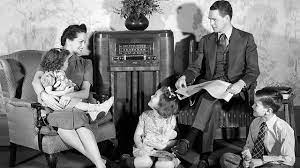
By the mid-1930s, after finishing dinner, families would spend their evenings all gathered around the radio set. Ending a day, listening to the radio, had become a nightly habit that united Americans nationwide; across class, race, gender, regional and ethnic differences.

American families had become Radio Families.

The War of the Worlds radio broadcast that would keep me on the edge of my seat was produced by one of my favorite Top 40 radio stations in 1968, WKBW AM 1520 out of Buffalo, New York. I encourage you to listen to this broadcast by clicking HERE

The Original “Fake News”

While the fable of Orson Welles broadcast of The War of the Worlds causing mass panic in the streets of America is well-known, it is also famously inaccurate.

The broadcast did produce nearly two thousand letters to the Federal Communications Commission (FCC) about the broadcast, but more likely bold headlines and news reports in the newspapers across America were the real the culprit. Newspapers feared the power of radio and were eager to show that it was a medium that could not be trusted.

The Moral Questions

What role does media play in our society today? Can media cause citizens to be in a constant state of “moral panic?” How is media impacting the minds of our children? How do we determine what is real and what is fake?

Many scholars believe that pre-war tensions at the time of the Mercury Theater broadcast led to the anxiety listeners felt.

Today we live in a world of 24-hour news cycles and social media,  it’s non-stop “Breaking News.” The tensions of people living in the 1930s are not that much different than those we all are experiencing today.

As much as radio impacted and changed the world in so many ways back in the 1930s, today it’s the internet, smartphones and social media that’s impacting us in the 21st Century.

One can look no further than the podcast Serial. It told the story of Adnan Syed and caused both its listeners, as well as America’s legal system to question whether he should be sitting in a jail cell for the rest of his life. Thanks to the Serial podcast, Syed, whose 2000 murder conviction became a media sensation, became a free man after 23 years when new prosecutors found alternative suspects in the killing of He Min Lee, along with unreliable evidence in the case stirred up by the podcast.

The Age Gap

Of the two thousand letters sent to the FCC about The War of the Worlds broadcast, only twenty-four were from people under the age of 18 complaining about the program. It appears that children of the 1930s were better able to understand the nature of the broadcast than were their parents. In fact, most of the letters written by children approved of the broadcast, saying it didn’t frighten them.

Children were also more likely to recognize Welles’s voice from The Shadow broadcasts than were their elders, and also were more likely to listen to other science-fiction radio broadcasts of the time like Buck Rodgers and Flash Gordon.

Halloween Pranks

And finally, children were more likely than adults to understand that the broadcast on Halloween Eve was presented as a fun prank and not something real.

A fourteen year old girl from New York City summed it up best in a letter she wrote to Orson Welles:

“Didn’t any of our so called adults realize that Sunday night was Halloween Eve

and that it is the night for scary things?”

11 Comments

Filed under Education, Mentor, Radio

What’s a Radio Look Like?

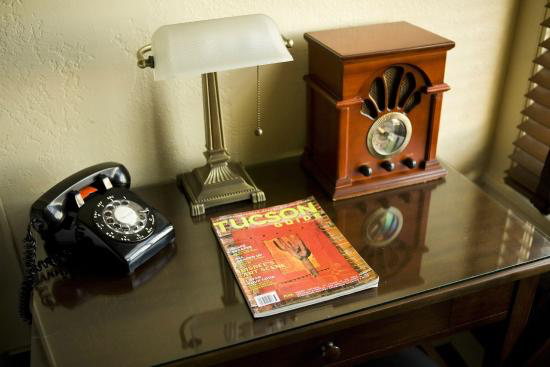
When someone uses the picture of a radio in an article, it often looks like this:

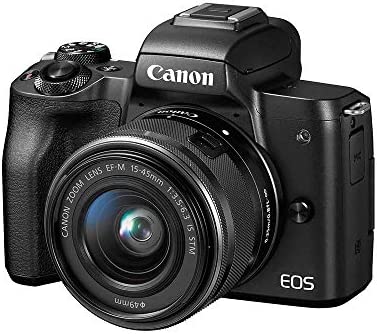
And if they are talking about a camera, the picture they show looks something like this:

The problem for both of these single use devices is today they look like this:

The smartphone has replaced so many of the past’s single use devices. Here’s a partial list:

  • Camera
  • Cam-recorder
  • Radio
  • Portable Music Player
  • eBook Reader
  • Calculator
  • Voice Recorder
  • GPS
  • Flash Light
  • Leveler
  • Scanner
  • Compass
  • Portable Gaming Device
  • Game Console Controller
  • Barcode Scanner
  • Credit Card Scanner
  • USB Thumb Drive
  • Portable Video Player
  • Walkie Talkie
  • Traditional Landline Phone
  • Clock/Alarm Clock
  • Wrist Watch
  • Timer
  • Books
  • Calendar
  • Notepad/Sketchpad
  • Newspaper
  • Photo Album
  • Contact List/Phone Book
  • Board Games
  • Watching Movies
  • Landline Internet
  • Checking eMail
  • Surfing Internet
  • Video Chatting
  • Thermostat
  • Measuring Tape
  • Guitar Tuner
  • Light Meter
  • ATM/Debit/Credit Cards
  • Airline Tickets
  • Business Cards
  • Remote Controller
  • Car Keys
  • Paper Money/Coins
  • Cable TV
  • Laptops
  • Getting an Uber/Lift
  • Magazines
  • Tourist/Visitor Guides
  • Sheet Music
  • Paper Tickets for Shows/Events/Movies
  • Diaries
  • TVs
  • Pedometer
  • Magnifying Glass
  • Compact Mirror
  • Cardiac Monitors
  • Stopwatch
  • Weather Forecasts
  • Banking
  • Train/Bus/Airline Schedules

You probably have some things I’ve missed. Please feel free to add them in the comments section of this blog.

Smartphones Wipe Out Decades of Camera Industry Growth

When I saw that headline, I thought about my old Canon 35mm camera and lenses that haven’t seen use in a couple of decades. Even my Nikon digital pocket camera hasn’t been out of its case in over twenty years. My iPhone, which is always with me, is my camera of record.

And I’m not alone, because worldwide camera shipments have dropped 93% between 2010 and 2021. This graphic from Statista show how dramatic and swift this change is.

Phones In, Radio Out

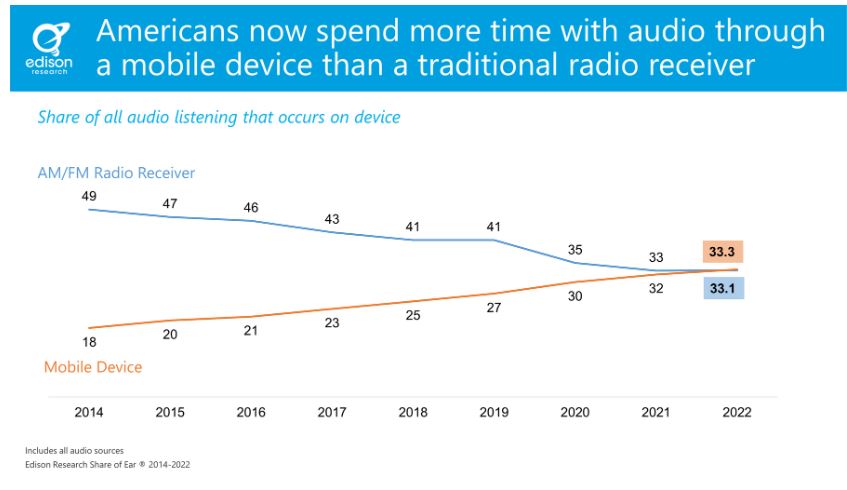
So, it was hardly a surprise to read the latest Edison Research report that found 88% of Americans over the age of 16 own a smartphone. Moreover, 31% of those smartphone owners now use it to listen to audio versus a traditional radio.

While the Statista graphic covered a ten-year period of time, this Edison Research graphic shows the dramatic change occurring in audio listening over just eight-years’ time. Compounding this problem for broadcast radio is the fact that radios have disappeared from store shelves.

Sue & I just returned from a trip to New England for our two-year delayed 50th High School Reunion. We stayed in our Timeshare, two different historic inns, a Boston Marriott, a Residence Inn and a Bed and Breakfast during our latest road trip. None of them had a radio in our room, but all had places to charge our smartphones.

The B and B even had an Amazon Echo, which allowed us to ask for anything we wanted to know about the city we were staying in, or audio we wished to listen to. I would not be surprised to see smart speakers appearing in more lodging rooms soon.

It was in the spring of 2000, that the late publisher of Radio Business Reports (RBR), Jim Carnegie, launched the first streaming radio station operated by a radio trade publication. Carnegie said that changes were happening too fast for radio owner/operators to wait until the morning fax to arrive. In addition to RBR’s website, they would now stream the latest news 24/7.

Jim & Cathy Carnegie devoted their lives to the radio industry and were passionate about pushing for everyone in radio to not be complacent and rest on their laurels. He not only talked the talk but through his publications walked it as well.

I will always remember what Jim Carnegie said about change and his words resonate with me still:

Change: you either get with it or get left behind by it.

21 Comments

Filed under Education, Mentor, Radio, Sales

Does Your Radio Station Have Schwerpunkt?

Many people have often wondered what the radio industry might have been like today, if it had had a Steve Jobs.

Steve Jobs had Schwerpunkt.

What is “Schwerpunkt”?

The term is attributed to Carl von Clausewitz and is now considered the heart of any sound plan.

“An operation without Schwerpunkt

is like a man without character.”

-Field Marshall Paul von Hindenburg

Schwerpunkt means “focus of effort.”

When Steve Jobs returned to Apple in 1997, he stunned his employees not by creating anything, but instead destroying many of the products Apple was making; like the Newton personal digital assistant and the many Macintosh clones.

Jobs quickly made it clear that Apple would no longer try to be all things to all people, and that the key to Apple’s future success would be winning where it mattered and focusing Apple’s resources on just a few meaningful products.

iPod

In December of 1996, under the leadership of then CEO Gil Amelio, Apple suffered its worst financial quarter in the company’s history. Michael Dell, founder of Dell Computers, when asked what he’d do to fix Apple if he were made the new CEO said, “I’d shut the company down and give the money back to shareholders.”

Steve Jobs knew that he couldn’t compete against Microsoft and Dell when he returned to Apple, so he focused the company’s resources in an area he saw as fragmented and that made products that as Jobs put it, “sucked.” He decided that Apple would produce a digital music player that would allow him to have a thousand songs in his pocket. The result was the iPod.

Focus On Your Strengths

The iPod took advantage of Apple’s strengths in simplicity of design and an ability to build easy-to-use interfaces. Jobs learned everything he needed to know about negotiating intellectual property rights from his ownership of Pixar. This knowledge was perfect for the creation of the iTunes store.

When you identify weakness in a market, and then apply a good strategy to exploit that weakness for your business success, that application is a key part of Schwerpunkt.

Steve Jobs was confident he knew where Apple’s strengths were, and how to apply them for the best opportunities that could leverage those strengths.

iPod = Apple’s Schwerpunkt

The iPod was an immediate game changing hit which changed the basis of competition in the music business.

While Dell was playing catchup, developing its Digital Jukebox, and Microsoft was creating its Zune, neither of which saw much success, Apple was preparing to launch the iPhone.

Schwerpunkt

When Steve Jobs returned to Apple in 1997, the company was near death, while Microsoft and Dell were giants. It was by employing Schwerpunkt that Apple went from worst to first. Today, Apple is the richest company in the world with a market cap of $2.294 Trillion.

While his competitors were still reacting to his latest innovation, Jobs was already hard at work on his next big thing.

Radio & Schwerpunkt

When I read the radio trades or sit in on a webinar, what strikes me most is how the radio industry’s leaders are talking about working to develop areas that are already owned by others. Areas, that don’t align with radio’s strengths.

When I worked for Clear Channel, I also remember management meetings that spoke of how we needed to focus, and then rolled out an agenda of 20 to 50 things we needed to focus on.

In 1952 Rosser Reeves, the ad man who developed the television ads for President Dwight Eisenhower was confronted with Ike’s multiple talking points. Reeves told the President that he needed to focus on just one thing, but relented to allow Ike to have three. Reeves understood the concept of Schwerpunkt, though he may never have heard of it.

Radio’s strength has always been about serving its community of license with live local personalities that provide companionship for the listener.

The very people the radio industry continues to eliminate.

When hurricane Ian bore down on Florida this past week, I’m sure I’m not alone in turning to The Weather Channel to see Jim Cantore and Stephanie Abrams tell us what was happening.

Jim Cantore joined The Weather Channel upon graduating from college in 1986 (36 years) and Stephanie Abrams has been with the network since 2003 (19 years). Cantore and Abrams along with the rest of the team of meteorological professionals have earned our respect and trust. Trust that has been earned over many years of excellent broadcasting.

Good luck to anyone who thinks they can beat them.

The Weather Channel has Schwerpunkt.

Until the radio industry truly focuses on its strengths, and leverages them for both its own financial benefit as well as that of their advertisers and listeners, its future will remain cloudy.

Radio = Schwerpunkt-less

14 Comments

Filed under Education, Mentor, Radio, Sales

What I Learned at a Tom Jones Concert

A few weekends ago, Sue & I traveled to Wolf Trap to attend a Tom Jones concert. Tom is 82 years old and his concert was SOLD OUT. Ticket prices for some of the best seats went for over a thousand dollars apiece. So, what was the make-up of the audience that evening? People like us, senior citizens.

America’s Age Tipping Point

Today’s 65-plus demographic in America has increased to 17% of the population, or about 56 million people. Back in 1960, this age group only made up about 9% of Americans.

While the over 65 age group is comprised of 55% women, when you get to those 85 years and older, the percentage of women increases to nearly 66%.

In just 8 more years, 2030, every Baby Boomer will be over the age of 65, and in just four years after that, people over the age of 65 will outnumber children for the first time in the history of the United States.

Music of YOUR Life

Back in the early 1980s, I worked with Al Ham to put his Music of YOUR Life format on a radio station in Western Massachusetts. The format was targeting senior citizens and we played the music of Glenn Miller, Tommy Dorsey, The Mills Brothers, Rosemary Clooney, and Frank Sinatra. The format was perfect for an AM radio station, as the audience we were targeting grew up with AM radio and these artists.

I remember joking that one day, The Rolling Stones would be played on a Music of YOUR Life radio station.

Well, it’s happened. Radio stations like WMEX-LP 105.9FM are thriving by playing the artists of the Baby Boomers, and The Rolling Stones fit right in; Mick Jagger is 79, Keith Richards is 78 and Ronnie Wood is 75. Their average age is 77.

117th Congress

The current Congress of the United States is the oldest, on average, of any Congress in two decades, with half of the members being over 65 years old.

Turning 70

Next month, I will be turning 70. The 50th high school reunion that was to have taken place in 2020, was delayed two years and when Sue and I get together with our fellow classmates, it will be for the Class of 70 Turns 70 reunion.

How Has 70 Years Changed Me?

First, let me tell you that the 18 year old me and the 70 year old me are really not all that different. The younger me has merely become part of the many layers of the person I’ve grown into today, with one caveat: the music that I loved in my youth, is the music I love most today.

This is why it puzzles me that it’s so hard to find my music on today’s AM/FM radio.

We have more radio signals broadcasting into the ether in America, than at any time in our history. Yet, the variety of programming is so very narrow.

It’s Not Unusual

Which brings me back to Tom Jones. When the audience knows the words to all of his hit songs and sings along with him, why is it so hard to hear any of his songs on today’s commercial radio stations? The fact that Tom Jones continues to perform to SOLD OUT audiences should be a wake-up call to radio broadcasters, advertisers and advertising agencies.

America’s citizens aren’t getting any younger. By 2060, the United States Census Bureau says 1 out of every 4 Americans will be 65 or older.

  • The Motely Fool*, on February 28, 2022, says that as of 2019, the median net worth of Americans under 35 years old was $14,000, while the median net worth of Americans aged 65 to 74 was $266,070. In other words, Americans at retirement age had a median wealth 19 times that of those in the under 35 age group.

Venues like Wolf Trap understand this and know that if they want to stay in business, they need to cater to people who have the money to spend on live entertainment.

Why should radio broadcasters think it’s any different for them?

*The Motley Fool is a private financial and investing advice company based in Alexandria, Virginia.

17 Comments

Filed under Education, Mentor, Radio, Sales

Where Are the Radios?

Thinking about our recent road trip through Atlantic Canada, I can’t help but reflect on the fact that the radio has vanished from hotel and BnB (Bed & Breakfast) accommodations. This really hit home with me when we entered our room at The Great George on Prince Edward Island. Not since my days as general manager of beautiful music WFPG-FM in Atlantic City have I entered a hotel room to hear instrumental easy listening music playing, but that’s how the management of The Great George want it be for the next guests when they arrive.

WiFi Replaces Radios

The music we heard upon entering our room however, wasn’t coming from a radio station, but from a music channel streaming through our large flat screen TV.

Wireless internet is the must have lodging feature we find everywhere we travel. It’s always available throughout each property and I always connect our iPhones and my MacBook Air before we even unpack a single bag.

Bluetooth

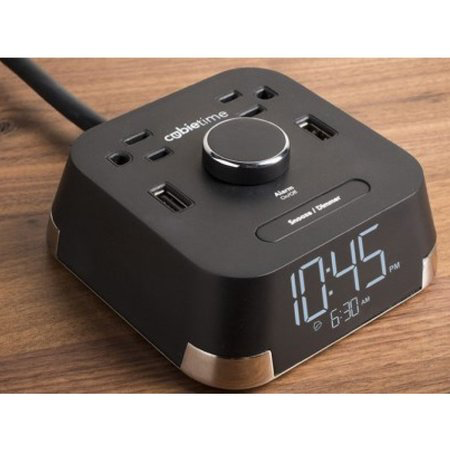
The other thing I’ve noticed is that the radio on the night stand by the bed has been replaced by a charging station with a clock in it.

In Montreal, our room at the Hôtel William Gray featured a Bang & Olufsen Bluetooth speaker that easily connected to my iPhone. The fidelity of B&O audio equipment is legendary and it was a joy to be able to connect any of my audio Apps on my phone during our stay.

Phone Books & Bibles

Radios aren’t the only item disappearing from hotel rooms, it’s getting harder to find both phone books and Bibles.

I know that when it comes to phone books, most people these days take them from their mailbox or hanging off their front door and immediately place them into their trash or recycling bin. So, having them disappear from hotel rooms doesn’t come as a surprise.

But those Bibles placed by the Gideons have been ubiquitous for as long as I can remember. In 2006, 95% of hotel rooms had a Bible in them and the most recent study I could find from 2017 said that number is down to  less than 69%.

It was in 1908 that The Gideons International decided to place Bibles in hotel rooms. The idea was born when two traveling salesmen were forced to share a room in a crowded hotel in Wisconsin. They discovered their shared faith and decided to start an association of Christian traveling businessmen that would place Bibles in every hotel room in America.

Radio & Hotel Rooms

Commercial radio broadcasting was born in 1920 and it was only seven years later that the first radio set appeared in a hotel room.

Ellsworth Milton Statler is considered the father of the modern hotel building his first permanent hotel in 1907 in Buffalo, New York featuring a private bath or shower and running water in every room. By the mid-1920s he grew his hotel company into the largest in the United States owned by a single individual. E. M.’s slogan for his hotel business was “The customer is always right.”

In 1927, E. M. would open his last hotel, the Boston Park Plaza, and once again it would offer something no other hotel did, a radio headset in each of its 1,300 rooms.

On March 20, 1951 the radio show, Cavalcade of America sponsored by DuPont, featured the story of E. M. Statler in a thirty minute drama.

What Would E. M. Do?

If E. M. Statler were alive today, I’m sure he would have been leading the hotel industry with free, fast WiFi in every room. After all, if you want to stay in business you have to give the customer what they want.

Even Gideons International now has an App, which offers mobile access to Scripture with the popular features for reading and listening to God’s Word.

It’s just one more reason that the future of audio, including radio, is via a smartphone or other WiFi connected device.

Imagine how much better radio today might sound if broadcasters operated with the philosophy of E. M. Statler.

The customer is always right.

9 Comments

Filed under Education, Mentor, Radio, Sales

What’s NOT Going to Change About Radio?

It’s human nature to wonder about how our world will change and most times, what we think will change or maybe what we worry might change, doesn’t.

So, why do we do this?

Most likely because we all want to know what the future will bring and this is why fortune tellers are still in business or why we watch The Weather Channel. It’s definitely not because they always get it right.

What’s Going to Change in 10 Years?

I just finished listening to Bob Pittman, CEO of iHeart, on the Borrell Local Marketing Trends podcast on how radio will change in the years ahead. Gordon Borrell and Corey Elliot wanted to know “how radio will remain unique over the next 10 years, whether its dependence on advertising revenue might need to change, and whether we should be calling it ‘radio’ at all.”

What was his answer? Well you can listen to the podcast HERE, if you really want to know. But I can save 23-minutes and 15-seconds of your time by telling you it doesn’t matter what he said, because he’s probably wrong, and that’s OK, because no one will remember what he said a month from now.

What’s NOT Going to Change in 10 Years?

I remember reading that Jeff Bezos said people constantly asked him the “change in 10 years question,” and he said the question they should be asked is “what won’t change in 10 years.” Both Bezos and the brilliant investor, Warren Buffett, believe this is a very important question you should be asking yourself about your business or industry.

“When you have something you know is true, even over the long term, you can afford to put a lot of energy into it,” says Bezos.

Radio Personalities

Over the Labor Day holiday weekend, Rewound Radio presented the sound of classic Chicago Top 40 radio with air checks of WCFL (Super CFL) and WLS (The Big 89 – The Rock of Chicago).

When I was growing up both of these radio stations greatly influenced me and were responsible for creating the desire to make radio my lifelong career.

Listeners to this special Labor Day Weekend presentation on Rewound Radio said they loved hearing their favorite radio personalities once again.

The program was not broadcast over any AM or FM radio signal, but was only streamed on the internet to a worldwide audience.

In fact, this past July 2022, more people watched their favorite programs by streaming them versus a cable TV subscription. Streaming, says Nielsen, is now “the most popular way to consume content.”

The one thing that Bob Pittman did share in his Borrell interview worth noting, was that in focus groups people didn’t call our medium, “radio.” They called what they listened to by the station’s brand, as much as we don’t refer to our mode of transportation as a “car”, but as a Ford, Chevy, Honda etc.

So, having a unique brand for your radio station is very important. The one unique brand every radio station in America has are its FCC call letters, like WCFL or WLS.

Dan Mason

Dan Mason was recently inducted into the Broadcasting & Cable Hall of Fame 2022. Dan said he grew up in Louisville, Kentucky listening to Cawood Ledford, the voice of the University of Kentucky sports for decades. It was Cawood that created the desire in Mason to be on the radio and he never pictured himself in the executive suite. But Dan Mason would rise to the president and CEO of CBS Radio, which he retired from at the age of 64.

Upon retiring that position, Mason quickly return to his first love, that of being on the radio and broadcasting sports play-by-play.

Dan Mason believes that great radio depends on two things: 1) community & companionship for the listener, and 2) having integrity.

For the listener, both of these are created, and earned, by the radio station’s air personalities.

And that’s something that’s never going to change.

4 Comments

Filed under Education, Mentor, Radio

Are You Counting What Counts?

I believe it was Albert Einstein that said “Not everything that can be counted, counts, and not everything that counts can be counted.” One of the things that distressed me during the period of radio’s great consolidation, and even recently, is the elimination of radio talent.

Jim Zippo

On August 19, 2022, Jim Zippo wrote on his Facebook page:

“Well, it’s been a week and it’s finally sinking in…

I’m no longer on the air for 98.7 KLUV (Audacy) here in Dallas after 15+ years of great  times and really fun radio. Also gone: Jeff Miles and Rebekah Black of “Miles in the Morning” – corporate streamlining in tough financial times. I was reassured my performance has been outstanding, and this is just a $ issue happening at stations nationwide. Similar stories are out there.

Jim Zippo

It’s been a great opportunity to continue my on-air career, now in its 47th year. I feel certain I will “see ya on the radio” again, soon, hopefully! JZ”

Friday morning, going into the Labor Day Holiday Weekend, Jim Zippo posted his latest DEMO on Facebook as he searches for his next radio gig. You can hear that here: https://www.facebook.com/thezipdude/videos/594790472346561

CKOA-FM

Last week I wrote about a radio station that Sue & I enjoyed listening to while we drove The Cabot Trail on Cape Breton Island in Nova Scotia. It was LIVE and very LOCAL.

This week Bill MacNeil, CKOA-FM’s General Manager reached out to me about my article saying that a radio colleague shared it with him and his team.

Bill wrote:

“We like to think of ourselves as the little station that could. We always put our listeners first and are proud to provide the most live and local programming in the market.”

I wrote back to Bill and said:

“Bill, you and your team have every reason to be proud of the radio service you provide. CKOA-FM provides both community and companionship. AND you don’t have to be a local to enjoy the programming that you provide.”

CKOA-FM even provides tourist information about the area on the radio station’s website: https://coastalradio.ca/tourist-information/

Radio is Show Business

When radio was taken over by Wall Street, it became numbers obsessed. It basically increased profits through firing people, never realizing radio’s attraction was the very people who sat in the air chairs of their stations. They were the “show” in the radio business.

And when there was no more talent to RIF (Reduction In Force), they began trimming the people in other areas of the radio station, like sales and promotions.

The results of all these staff reductions has produced a radio industry that is less competitive to other forms of entertainment and less dynamic.

Passionate Leaders

When we look at other industries and great leaders we find they were passionate about the mission of their company. Henry Ford was passionate about the power of transportation. Sam Walton was passionate about super-serving the customer. And Steve Jobs was passionate about making insanely great products. It was this passion for, and being lazar focused on the mission, that brought about their company’s economic success.

I was attracted to the radio industry as a boy by people who were passionate about making great radio and everywhere I turned my radio dial I heard talented people on-the-air.

Most radio people my age rarely listened to the records playing, we were the ones who switched stations when the music started to hear another radio personality, on a different radio station, work their magic.

Today’s radio industry is counting the wrong things.

The success of radio depends on the well-being of those who are passionate about it and live it.

18 Comments

Filed under Education, Mentor, Radio, Sales

Canadian Radio

During our recent road trip through Atlantic Canada, Sue and I had the opportunity to listen to local Canadian radio. The first thing we noticed when we scanned the AM radio band throughout Nova Scotia was there was nothing to listen to. I don’t mean there was nothing worth listening to, but there was literally nothing but static on the AM band.

When I got home, I did a search for AM radio in Nova Scotia and found there are actually four AM radio stations listed as being on-the-air, but our Honda Accord radio couldn’t find them.

AM versus FM in Nova Scotia

In the Canadian province of Nova Scotia, there are 102 radio stations, of which only four are broadcasting on the AM band and ninety-eight are broadcasting on FM. The population of Nova Scotia is a little over a million people.

To put the land mass of Nova Scotia into context, it’s about the size of West Virginia.

West Virginia has 224 radio stations with a population of 1.76 million. Sixty-five of West Virginia’s radio signals reside on the AM band and 159 on the FM band.

Radio Programming in Nova Scotia

As we scanned the dial through Nova Scotia, the biggest impression we both had was how under-radioed Atlantic Canada was compared to the radio dials in the United States. The programming we heard basically broke down into French speaking radio, religious radio, CBC (Canadian Broadcasting Corporation, Canada’s NPR-style radio service), rock radio, country radio and community radio.

Community Radio

Community radio in Canada is a legally defined broadcast category by the CRTC (Canadian Radio-Television and Telecommunications Commission, the Canada equivalent of America’s Federal Communication Commission or FCC). CRTC licenses radio service for commercial broadcasting, public broadcasting and community broadcasting.

Community radio began in Canada in the mid 70s. While many community radio stations are associated with a school campus, it’s not unusual for a college to hold both a campus radio license and a community radio license. Both licenses are governed by the same document.

CRTC policy states that community radio “distinguishes itself by virtue of its place in the communities served, a reflection of its needs and values, and the requirement for volunteers in programming and station operations. This helps ensure that programming is different from that of commercial and public radio, in both style and substance, and is rich in location information and reflection. The programming provided by campus and community radio should meet the needs and interests of the communities served by these stations in ways that are not met by commercial radio stations and the Canadian Broadcasting Corporation (CBC).”

These radio services were created much like our LPFM (Low Power FM) radio service here in the United States. But there is one big difference between Community Radio in Canada and LPFM radio in the United States, and I will address that in a moment.

Content Restrictions

One of the things the CRTC governs in Canada that the FCC does not in the United States is the content of programming on its radio signals.

All broadcasters in Canada, including community radio, must follow strict CRTC regulations regarding the minimum amount of Canadian content they must broadcast. For music broadcasts, 35% minimum must be Canadian between the hours of 6 AM and 6 PM.

Canadian broadcasters make this determination using the MAPL System.

  • M (music) – the music is composed entirely by a Canadian
  • A (artist) – the music is, or the lyrics are, performed principally by a Canadian
  • P (performance) – the musical selection consists of a performance that is wholly recorded in Canada or performed wholly in Canada and broadcast live in Canada
  • L (lyrics) – the lyrics are written entirely by a Canadian

(CRTC, Government of Canada, MAPL System)

Community radio stations must also have 15% of their content be spoken word programming, that is produced locally, and 5% of all music played consists of lesser known and/or emerging/experimental genres, and of this 12% must be Canadian.

LPFM vs Community Radio Restrictions

The big difference I found between the LPFM radio service here in the United States and Community Radio in Canada was in the ways of funding the service. While the CRTC puts all kinds of restrictions on content, when it comes to funding a Community Radio Station, both donations from listeners and businesses as well as advertisements, provide financial support for these non-profit operations.

LPFM radio stations can accept underwriting and donations from listeners but there can’t be a “call to action” in the message, as there can be on a commercial radio station. This is the same restriction that Public Radio in the United States operates under.

A call to action, are words like “hurry down right now,” “call now,” or “check out our low prices.” This language while alright for commercial radio advertisements in the United States, are not allowed on LPFM or Public radio stations.  

CKOA-FM, The Coast 89.7

The radio station we enjoyed listening to while driving the Cabot Trail was The Coast 89.7 FM. The station has local air personalities, local musical artists, local news and provides real companionship for both the residents of northern Nova Scotia as well as tourists. In fact, their website has a section just for tourists visiting Cape Breton Island.

We listened long enough to hear the ads for Roger Burns Real Estate so often, that we could say the tag line with the ads when they came on: “If our sign is on your lawn, YOUR MOVIN’!”

CKOA-FM targets a 55-plus audience, and we certainly fit that target demographic.

Being a community-based not-for-profit radio station, CKOA-FM is one hundred percent locally owned and operated – not part of a large conglomerate.

It’s website states:

“We depend on advertising from community-minded businesses and upon our listeners’ generosity to continue our tradition of bringing you programming that you can’t find anywhere else.”

The station went on the air on December 3, 2007 and appears to be thriving in the 21st Century.

New Experiences

We travel to meet new people, see one-of-a-kind sights, and have new experiences. After two road trips across America, everything but listening to radio fulfilled those expectations.

After road tripping through Atlantic Canada, we can honestly say this part of the world exceeded our expectations, for its beauty and its warm/welcoming people.

Having great original radio programming to listen to on the ride, like CKOA-FM, was a wonderful bonus.

3 Comments

Filed under Education, Mentor, Radio, Sales

Touring a Transmitter Manufacturer

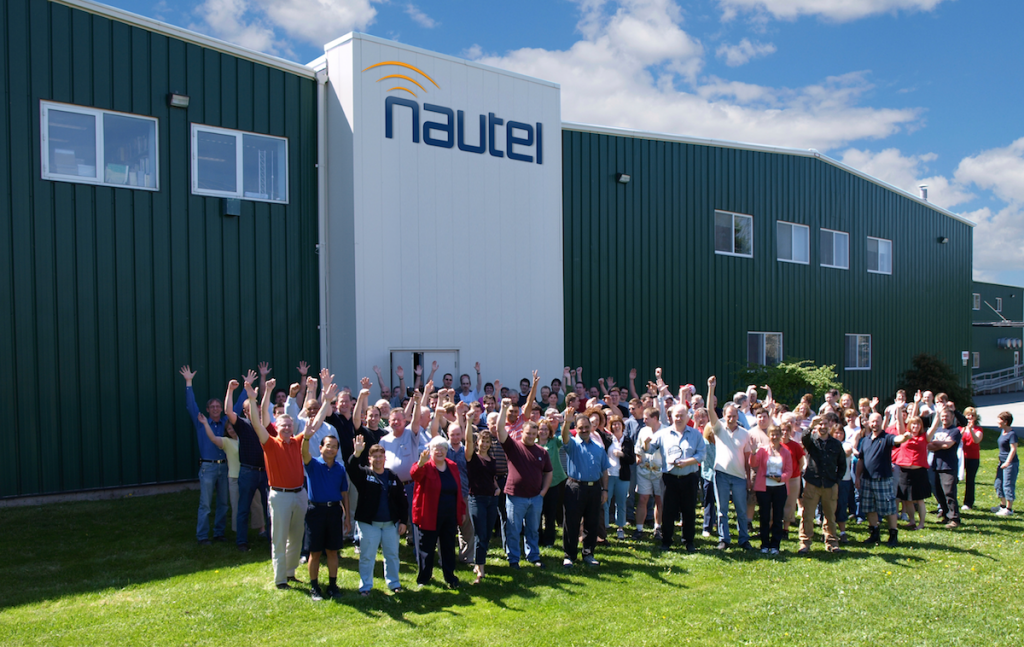
I started in professional radio in 1968. A transmitter company in Hackett’s Cove, Nova Scotia was founded in 1969. That company was Nautel, and both of us have been in the radio business for over 50-years.

Nautel initially began as a company that would build and supply solid state navigation beacons for the Canadian government. These solid state transmitters replaced ones built using tubes and proved to provide greater reliability and longevity; in fact, many of these early models are still in service today.

In the early 80s, Nautel would apply their knowledge and experience in building solid state beacon transmitters to radio broadcast transmitters, introducing 10,000 and 50,000 watt solid state AM transmitters.

Jeff Welton

One of the readers of this blog, saw that I would be doing a road trip through Atlantic Canada and reached out to me suggesting I email Jeff Welton at Nautel and ask for a tour of the company’s headquarters and manufacturing facilities in Nova Scotia. When I reached out to Jeff, he quickly responded that he would be happy to give us a tour.

In 2020, Jeff Welton was the recipient of the NAB Radio Engineering Achievement Award.

Jeff has been with Nautel over 30-years, and is an expert in digital radio, radio technology and radio engineering. He is currently sales manager for the central United States region for the company. When I reached out to him, he quickly responded that he would be happy to give Sue & me a tour.

Since COVID-19 closed down the world, many of the people not involved in the manufacturing process at the Nautel facility work from home, so like most businesses these days, the volume of workers in the plant on any given day is lean. However, business for the company has never been stronger. The amount of orders they have in their production pipeline is noticeably higher than what it was before the pandemic began.

Jeff told me the company’s support team maintains several lower power standby transmitters (both AM and FM) for their customers that can be immediately moved to a location where a customer’s transmitter plant has experienced an emergency. Currently all of the support transmitters are in the field, as several stations have faced challenges this year, ranging from floods to fires to older (non-Nautel) equipment failing and needing something to get back on the air fast.

Solid State Technology

I had always heard Nautel being referred to as the “Cadillac of broadcast transmitters.” After Sue & I toured the plant, we understood why. Nautel oversees every element of their transmitters, from building the cabinets, to the internal components, down to the wooden crates that the finished product will be shipped in.

Nautel’s large impact on the radio broadcasting industry came with its introduction of solid state AM & FM transmitters and as the benefits of solid state technology became clear, radio broadcasting quickly embraced solid state designs over tubes.

Its focus on solid state technology from Nautel’s inception in 1969 is what made it a leader.

The company is privately owned, and Kevin Rodgers the current CEO/President of Nautel, worked for the company for decades before taking over the company from its founders.

Pipe Organs

While I’ve been to several different manufacturing plants over the years, what I found touring Nautel’s operation in Nova Scotia reminded me of touring a pipe organ manufacturer in Ohio. In each case, the company’s employees were like family, with the newest employees having multiple years with the company. There is enormous pride in the construction of the finished product down to the smallest detail.

Both the organ company we visited as well as Nautel, want their products to provide years of trouble free service but are always ready to provide customer support on a moment’s notice.

Nautel’s customer locations around the world.

Today, Nautel has more than 19,000 customers in 177 countries, with their RF (radio frequency) solid state solutions providing reliable service in harsh climates from the arctic circle to the world’s deserts.

Nautel is one of those rare companies that is big enough to be at the cutting-edge of innovative technology and small enough to respond to specific customer needs.

8 Comments

Filed under Education, Mentor, Radio, Sales

Voice Cloning Technology

While I was traveling through Atlantic Canada in July, this news story broke in Radio World:

iHeartMedia’s plan to use Veritone’s voice-cloning technology for its podcast platform has some radio industry observers asking the obvious questions: How good does it sound and is broadcast radio far behind? 

The largest radio company in the United States says that for now, the synthetic voice solution will only be used to translate podcasts from English to other languages for use on the iHeartPodcast Network, first for Spanish-speaking audiences. But Veritone officials confirm its technology could someday be used for advertising to reduce time-to-market and production costs for radio.”

You can read the complete article here: https://www.radioworld.com/news-and-business/headlines/veritone-synthetic-voice-gets-an-audition

It reminded me of an article I wrote on this very subject in December 2021. I thought readers might find my article of more interest now that the deployment of this technology is happening at warp speed.

Is it Live, or is it Memorex?

I remember when the audio quality of tape recorders became so improved with audio reproduction, that the question of the day was, “Is it live or is it Memorex?” Memorex was a company established in 1961 for selling magnetic computer tapes. In the 70s Memorex moved into producing quality audio tape for recording music and voice.

TV commercials at that time featured Ella Fitzgerald singing a note that shattered a glass, while simultaneously being recorded on an audio cassette. The recorded audio would then be played back and the recording would also shatter a glass, to which the announcer would ask, “Is it live, or is it Memorex?”

Is AI Going to Replace Voicetracking?

Then Radio Ink published a story that got many of the people in my radio, podcasting and other social media groups talking about, titled “Is AI going to replace voicetracking?”

Voicetracking technology has been used to replace live radio personalities for decades, but what AI presents the industry with is the possible ability to bring back the big name radio personalities.

Dan Ingram, Larry Lujack, Robert W. Morgan, The Real Don Steele…

Imagine your radio market’s favorite radio personality returning to the airwaves. It’s not out of the realm of possibility.

A company called WellSaid Labs has created dozens of human voice avatars where all one needs to do to get them to talk, is type text into a computer and the voice will say it.

Imagine how having a creative person, who has studied the style of an iconic personality, and then creating new, contemporary material to be delivered in that personality’s voice might sound.

Netflix Research

Now you might be wondering why anyone would want this type of technology. Well, Netflix now streams content worldwide and buys new content from producers all over the world. Much of that content is produced in the country’s native language and so Netflix has to show that content with either subtitles or voice-dubbing the dialog with voice actors speaking in the language of the country the material will air in.

It might not surprise you to learn that when Netflix has offered viewers two ways of viewing  a program, Americans in particular, prefer voice-dubbing to subtitles. (I know I do.)

To speed up the process of voice-dubbing and to have voices that sound the same as the original actors, companies like WellSaid are developing artificial intelligence technology that by voice sampling can then re-create the voice automatically.

ALEXA

I already have conversations with Alexa and have wondered what she might sound like as a DJ on a radio station, haven’t you?

The afternoon DJ on KCSN, Andy Chanley, has been on-the-air there for over 32 years. Now using a robot DJ named ANDY (Artificial Neural Disk-Jockey), Chanley’s voice will continue to be heard in many places throughout Southern California. During a demonstration for Reuters, reporters say that Chanley’s AI voice was hard to distinguish from his human voice.

You can listen to these computer generated voices WellSaid has created for yourself by clicking on this link: https://wellsaidlabs.com/?#actors-preview-list

Is Your Favorite DJ Already a Robot?

WellSaid says its voice avatars are doing more than just DJ work, they are being used extensively in corporate training material and the creation of audio books.

Do I think I will live to see radio’s great personalities coming back to life? No, because I think there will be too many legal issues that might complicate that from happening anytime soon.

But I do think that original voice avatars, teamed up with creative content developers, might just come into existence sooner than we imagine and provide us with an entirely new form of radio entertainment.

(This article was originally published on December 19, 2021)

6 Comments

Filed under Education, Mentor, Radio, Sales