Category Archives: Sales

Paying It Forward

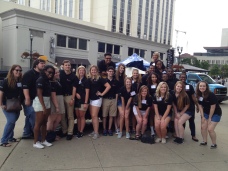
47The picture on the left is of the 2016 KBA WKU RADIO TALENT INSTITUTE class. These twenty-three outstanding students all earned their Radio Marketing Professional (RMP) certification in radio sales from the Radio Advertising Bureau during the ten-day institute.

I began working with Steve Newberry, former NAB Joint Board Chairman and President/CEO of Commonwealth Broadcasting to bring the talent institute to my university in 2012. Our first class would graduate in 2013. The 2016 institute marks my fourth and last one as director at WKU. It truly has been the university activity I’m most proud of.

The whole concept of a radio talent institute was conceived by Dan Vallie and Art Kellar. I wrote more extensively about the program in Radio World and you can read that article here.

Working with Dan Vallie over these past five years has been an incredible experience. No one is more dedicated to “paying it forward” to the next generations than Dan. He has boundless energy and has grown the number of talent institutes in America to five.
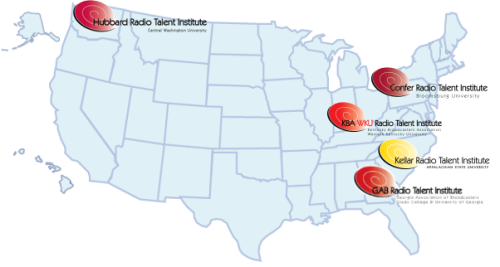
inst_map_keller_kbawku_confer_gab_hubbard


Expect more radio industry leaders like Kerby Confer and Ginny Hubbard’s Hubbard Broadcasting along with state broadcast associations like the Kentucky Broadcasters Association and the Georgia Association of Broadcasters to sponsor even more locations in the years ahead.

Some of the industry professionals that presented at this year’s institute in Kentucky were Kristin Cantrell-owner/CEO of CapCities Communications and Seven Mountains Media, Mike Keith-the voice of the Tennessee Titans, Christine Hillard-President/COO of Forever Communications, Steve Newberry-President/CEO of Commonwealth Broadcasting, John Ivey-Senior Vice President of Programming iHeartMedia and Program Director of KIIS-FM in Los Angeles, Don Anthony-Publisher, Morning Mouth & Jockline, Creator & Host of Morning Show Boot Camp and Founder & President of Talent Masters, Gary Moore-Air Talent at KLOS in Los Angeles, Bryan Sargent, PM Drive Air Talent at Mix 92.9 in Nashville, John Shomby-Director of Programming at NASH-FM & Charlie Cook-VP/Country at Cumulus Media, Lynn Martin-President of LM Communications, Terry Forcht-Founder, Chairman & CEO of the Forcht Group of Kentucky (a company with 2,400 employees) along with the Presidents of both the Tennessee Association of Broadcasters, Whit Adamson and the Kentucky Broadcasters Association, Henry Lackey.

Thirty-six professional radio broadcasters, two of whom have been awarded the National Radio Award – the highest honor bestowed on a radio broadcaster – by the National Association of Broadcasters shared their passion and performance knowledge.

Every student that has gone through the program has told me it has been the best ten-days of their life and as the director these past four years; I know it has been for me as well.

If you know a student that wants to get into broadcasting, point them in the direction of the National Radio Talent System website  for more information, applications forms, scholarships and the dates/location of the institute nearest to them. Students who apply are thoroughly vetted for acceptance in the program.

Broadcasters looking for air talent, sales talent; digital and video talent should also go to the National Radio Talent System website for a complete listing of graduates that have gone through the program. There they will find each student’s bio and a sample of their on-air work.

I know Dan Vallie is already hard at work on the 2017 radio talent institutes. The radio industry is truly fortunate to have someone of Dan’s vision and action in establishing this innovative radio talent farm system for broadcasters.

46

Dan Vallie

4 Comments

Filed under Education, Mentor, Radio, Sales, Uncategorized

Your Idea Is Ugly

44Ever had someone say that to you? How did it make you feel?

Well, all ideas start out as ugly.

Ed Catmull, CEO of Pixar writes in his book Creativity Inc. that early in the creative process every movie Pixar has ever made sucked.  They all start out as “ugly babies” that are “awkward and unformed, vulnerable and incomplete.” And that’s OK, because the public never sees these “ugly Pixar babies.” Catmull says it’s the company’s job to protect these original, fragile ideas from being judged too quickly. They understand that great ideas aren’t born; they are created from ugly ones.

Ideas Are Born Ugly

The problem today is too many ugly ideas are released to the world while they are still ugly. No one has invested the time, love and attention to craft them into something great. Or, just as bad, ideas not ready for broadcast are put on-the-air piecemeal. Radio is famous for doing this sort of thing when they change music formats and start off with 10,000 songs in a row. You don’t get a second chance to make a first impression. So why put something on the air that is not going to be what it will be when it’s finished?

Practice, Practice, Practice

You don’t see a Broadway show open without there being a lot of practice first. You don’t see any type of performance art take to a stage without practice. “All of showbiz except for radio has rehearsals,” observes programming genius George Johns. Why is that?

When Did Radio Stop Rehearsals?

Ron Jacobs, the first Boss Radio PD in America at 93/KHJ writes in his book KHJ Inside Boss Radio that before the new KHJ launched, every air personality and board engineer spent two weeks practicing for the station’s debut. “Every word and every nuance was critiqued on the fly by Jacobs and (Bill) Drake,” said Boss Jock Gary Mack. “More up! More energy! Faster! I remember the distinct odor of flop sweat. But every day got better, and we made our mistakes off the air,” said Mack.

The entire original Boss Jock air staff was all seasoned radio professionals by the time they were hired to launch the new KHJ. But they all had to attend “Boss Jock Kindergarten” before they could go on the air. Boss Jock Tommy Vance put it this way, “I was to spend six hours a day doing it (practicing) until he (Jacobs) decided I would be ready for the real thing. He would be listening in his office. If the red phone rang, pick it up and listen to every word he said – very carefully. Take notes and follow his directions to the letter. Jacobs left me in my Boss Jock kindergarten.”

“Six hours every damn day I played the records. Read the commercials. Again and again, and yet again. The red phone never ceased ringing. Criticism was heaped upon me hour in, hour out. I began to picture Jacobs as the force behind the Spanish Inquisition. As the Marquis de Sade. Jack the Ripper. Eventually I was let out of the bag and given the six to nine pm shift,” said Vance.

That Used To Be Us

This was the way radio worked once upon a time. Nothing went on the air unrehearsed. Everything that went on the air was screened to insure it would meet the standards set by the station. “Ugly babies” were nurtured until they became great ideas that became great radio stations.

Great radio takes work. Great radio is exciting to listen to. Great radio gets results.

Let’s make radio great again.

9 Comments

Filed under Education, Mentor, Radio, Sales, Uncategorized

SiriusXM Radio is Now Free

43

What would you do if you woke up one morning and saw this as the headline in all the radio trades? Have you ever considered the possibility of this happening? Well lots of people woke recently to this headline “Angie’s List is now free: What this means for your business.”

Call it a subscription, a membership fee or a paywall, what happens when they are eliminated? In Angie’s List’s case, less than one percent of Americans were members at the $40/month fee that had been in place. Paying that fee let people see the reviews of other members that had experienced certain businesses or services they had used. Now everyone can see those reviews. Angie’s List had developed a reputation for its members writing rather substantial reviews as well as being a website that is strong, trusted and contains valuable content.

Why Did Angie’s List Tear Down Their Paywall?

Angie’s list is a publicly traded company. Their stock is down seventy-five percent from three years ago. Management is under pressure. Tearing down their paywall means increased page views. When page views go up, revenue goes up. See the strategy?

Could SiriusXM Follow Suit?

Satellite radio currently captures about ten percent of radio listening and mostly in vehicles. The new digital dashboard entertainment centers will be a gateway to Pandora, Spotify, Apple, YouTube and more. Having an XM button on my Honda Accord, I know that my access can be selectively turned on or off by SiriusXM. When they do one of their free listen promotions, they don’t turn on all the channels, just the ones they think will hook me to listen. So, I would imagine, they could create a group of channels that could be on all the time and carry a limited commercial inventory attractive to national advertisers. Like the most popular musical venues, such as adult contemporary. Even if they only turned on the top five music formats, it would mean drivers could listen to them wherever they drove across America, plus SiriusXM would have the ability to pop in promos for their other channels that remained behind a paywall. It’s almost too scary to consider the possibility.

Teens Love Streaming

Teens love streaming audio and their smartphones. According to the Music Business Association and their data partner LOOP, teens spent 51% of their listening time on a typical day streaming their music versus only 12% of their time with AM/FM radio. This is a media usage habit being formed in the next generation. It not only affects traditional AM/FM broadcasters but satellite radio as well. This is a problem that needs to be addressed.

NextRadio App

Thanks to Jeff Smulyan and Emmis, the NextRadio App is the way FM broadcasters can get their audio into those smartphones, without running up a user’s data plan. However, Sprint has already removed many audio streaming services from running up their data plans by letting their customers listen as much as they want at no extra charge. Since teens avoid paying any fees whenever possible, free is always an attraction.

Less Than 1% of World Pays For Streaming Audio

AM/FM radio has been built on free. That’s an advantage that too often gets taken for granted. According to Nielsen 61% of people find out about new music via their AM/FM/satellite radio.

Price is the number one reason more people don’t pay for streaming audio. Out of a worldwide population of over seven billion people, about forty-one million buy some form of audio streaming; 0.58% of the world’s population. That percentage turns out to be lower than the total number of people who have a Netflix subscription around the planet.

23,870 AM/FM Radio Signals On-The-Air

The FCC just published their latest numbers for broadcast stations as of June 30, 2016. We are approaching 24,000 signals for radio in America. 19,194 of those signals are FM and 4,676 are AM. Plus we have two satellite radio signals, Sirius & XM, which are now under a single owner.

Pay & Free

It doesn’t take a whole lot of imagination to see satellite radio one day deciding to have the best of both worlds. Offer premium pay channels to those willing to pay for them and at the same time create a free tier of channels that could be ad supported by national advertisers.

What history shows us are things that happen in other industries and services eventually make their way around to virtually all of them. It’s only a matter of time.

31 Comments

Filed under Education, Mentor, Radio, Sales, Uncategorized

What We Have Here, Is a Failure to Embrace Complexity

42The world we live in today is a complex place. The KISS operational style seems like it would be a good idea. (KISS = Keep It Simple Stupid) But maybe not.

Turns out in a complex world, being agile is more importance than being efficient. Being efficient kills innovation. Innovation today is the primary driver of building value and creating value is one of the basic reasons for any organization to exist.

Managing Complexity is a 21st Century Skill

People who can manage complexity will be the leaders of the future. Managing a radio station was complex due to the fact that radio has two customers, which want totally opposite things. One customer is the radio listener. This customer wants information and entertainment. This customer usually isn’t fond of commercials. The other customer is the radio advertiser. Anytime their ad isn’t dominating the airwaves and driving consumers into their store is a moment the radio station isn’t doing its job. To add to this complexity are the talented people needed to service both of these customers. Air personalities that attract listeners and sales folks that service advertisers.

Consolidation & Complexity

As the radio industry began consolidating after the Telcom Act of 1996, the traditional thinking of protecting margins was amplified. This resulted in reducing labor costs. RIFs became commonplace (RIF = Reduction In Force). For those that were left wages became stagnant, little money was invested in training and the number of people left in the workforce was reduced to a bare minimum.

The problem is, when you have low paid, poorly trained and overworked people, your operation lacks new and innovative ideas that can improve the business. When the only ideas that are introduced come from the tippy top, they rarely connect with the challenges seen at the front line.

Zeynep Ton writes in her book The Good Jobs Strategy about a discount retailer that took a different approach to their operation than most companies when the great recession of 2008 struck the world. Rather than cut wages or reduce staff, Ton says they asked their employees to contribute ideas. The result was that this company managed to reduce prices to their customers by ten percent while increasing their market share from 15% to 20% from 2008 to 2012.

Herb Kelleher writes in his book NUTS! about how Southwest Airlines created a culture where employees are treated as the company’s number one asset. Southwest does a number of things to benefit its employees, including such programs as profit-sharing and empowering employees to make decisions. This empowerment during the period when oil prices hit a high of $145 per barrel in 2008 saw the Southwest pilots taking the initiative to plot more efficient flying altitudes and work with ground crews to get in and out of the gates quicker to control the Southwest ticket prices and not lay off any people while maintaining a positive profit margin. These actions did not come from the corporate home office but from employees in the field.

What to Do When You Have Maximized Efficiency

Let’s face it; the ability for any radio operator today to squeeze out any more profit through efficiency is over. Radio consultant George Johns puts it this way: “Radio today is in the no business, it has no money, no time and no people.”

So what’s the answer? Collaboration.

The radio companies of the 21st Century will need to develop the ability to make collaboration a competitive advantage. The game has changed from what you own and control to what you can access. Access happens via platforms. Radio needs to create platforms that bring consumers and producers together, much like the Apple App store does globally, but locally for their service area.

Radio needs to find a way to attract listeners by causing them to be fearful of missing something if they’re not listening while directing them to local places via platforms they control that can fulfill their wants and needs on demand.

In other words, radio needs to “think different.”

13 Comments

Filed under Education, Mentor, Radio, Sales, Uncategorized

The Lesson of High School

41Everything you need to know to succeed in life you probably learned by the time you graduated high school. Do you remember your high school days? You probably couldn’t wait to graduate and begin the next chapter of your life. We were all in such a hurry. Many of us were looking forward to going to college. College, we thought, would be what real life was like. It would be a world where real talent is what counts.

Meryl Streep once told an interviewer that she thought life would be like the life she lived in college. Only it wasn’t. “Life,” Streep said, “is like high school.” Life, it turns out, is a popularity contest. The competent and likeable person will soar in life whereas the intelligent but socially inept won’t.

Real Life Doesn’t Give Written Tests

Education revolves around the test. Tests produce grades. Grades are compiled into GPAs. GPAs are part of the process to measure a person’s intelligence quotient or IQ. Not to burst your bubble, but the world’s most successful people are those that often finish in the bottom half of their class but were probably the best known and best loved.

What’s Your EI?

This begs the question, why don’t we measure what’s important? Or better yet, why don’t we teach it? Marc Brackett, a senior research scientist in psychology at Yale says “we know from doing dozens of studies, that emotions can either enhance or hinder a person’s ability to learn.” Emotions impact our memory, our attention and our ability to focus. EI is Emotional Intelligence. EI is something we talk about in my broadcast sales class. Great media sales people score high in emotional intelligence skills.

We Are Controlled By Our Emotions

Whether you are in sales, a television/radio performer or running for political office, just like in high school, you will be judged by if people like you or feel good about you. The world works not by logic and reason, but on emotions and feelings. Radio and television are a people business. It is all based on relationships. Relations are all about feelings.

Academics & Success

Our educational system is built upon the premise that if a student achieves academically they will be employed, healthy and everything else in their lives will be a bowl of cherries. The reality is something quite different. Turns out academic success predicts very little about the future outcome in these metrics.

Talent Assessments

Can emotional intelligence be taught or do we all start out emotionally intelligent and have it beaten out of us by our home life, our friends – or most likely – the educational system? In my broadcast sales class, I have my students take a talent assessment. These tests give insight into how a person is wired. Unlike most tests students take, there is no pass or fail. The results give insight into a person’s emotional intelligence and make-up. These tests were developed from the research of people like Sigmund Freud. They came into widespread use during the Second World War. The goal was to quickly place people into jobs that they would naturally excel at doing. After the war ended, many companies continued to use these tests when hiring. They are another tool in the tool box for evaluating a person.

Can An Old Dog Be Taught New Tricks?

What is not known is at what ages these emotional intelligence skills can be taught and if there comes a point when the cake is baked and can no longer be changed. Few studies in this area have been conducted. Plus the deck is stacked against this area of education by people who take the “that’s not the way we’ve always done it” approach to anything new and different. At this point, it would appear these “emotional habits” get baked into a person’s personality early in life and it is a mixture of home-social-school environments.

Life Is Like High School

So maybe Meryl Streep is right. Success in high school and life is basically a question of one’s personality. Zig Ziglar put it this way, “people don’t care how much you know, until they know how much you care.” In a world that is wired for reciprocity, going first and showing you care is always good when it comes to building relationships.

10 Comments

Filed under Education, Mentor, Radio, Sales, Uncategorized

My 100th Blog Post

40Today is a milestone of sorts for me. It marks my 100th blog post since beginning my blog. Also notable since my blog has long passed the threshold of four months, the period of time most new bloggers quit blogging.
What Have I Learned So Far

Reflecting on my blogging journey on the way to my 100th post, I learned that running out of material to blog about was not my biggest problem, but rather having files of ideas and issues I wanted to address and not having the time to develop them due to more pressing issues bursting onto the scene.

I learned that blogging was more about organizing my own thoughts than if anyone else read them or reacted to them.

I learned that blogging connects you with incredibly talented people all over the world that you never would have met other than by doing a weekly blog.

I learned that blogging is fun.

My Biggest Hits

Two blog posts in particular standout as being noteworthy. It’s funny, because they are not the ones I might have thought would have gone viral.

The first one was me venting my spleen about the loss of great air personalities in my post entitled “We Never Called It Content.” What troubled me was the “forced retirement” of some iconic air personalities and that the radio industry wasn’t valuing the relationships that such personalities owned with their audiences. That short-term revenue gains due to expense reduction were at the peril of longer term audience erosion.

As the old farmers used to say “Anyone can tear down a barn, but it takes a craftsman to build one.”

The other blog post that would see over 3,700 reads in a single day was “The Day the ‘Dumbest Idea’ Invaded the Radio Industry.” This post grew from an article in Forbes I had read by Steve Denning. The “dumbest idea” was that of increasing shareholder value. What I realized was that when the Telcom Act of 1996 was signed into law by President William Jefferson Clinton it opened the doors of the radio industry to Wall Street. Wall Street would bring their philosophy of “increasing shareholder value” to broadcasting. The effects of this modus operandi would be as devastating to radio as it had been to every other industry it was used in. Sadly it doesn’t have to be that way and we see that privately held radio companies avoid this metric and as a result are doing well by both their stakeholders as well as the communities they are licensed to serve.

What’s Next?

So next week, I will begin my next one hundred blog posts. I have lots of ideas about what’s going on in our media world to reflect on, research and share with you.

The commercial radio industry is only about three and half years away from celebrating its 100th birthday in 2020. The year 2020 should prove to be interesting for so many reasons beyond just radio, TV or media, for the prognosticators are envisioning so many changes in all aspects of our world.

So I will end my 100th blog post much like the singing group The Statler Brothers used to say at the end of their television show….

“Don’t go anywhere, because we ain’t even started yet.”

8 Comments

Filed under Education, Mentor, Radio, Sales, Uncategorized

Why Internships Are Important

39In his new book There Is Life After College Jeffrey Selingo discloses an important statistic. 79% of students that had an internship while in college moved into a full-time job upon graduation. So having an internship is important. But there are some tips I’d like to share to make sure you get the most out of an internship.

Internship Tip #1

When you are in an internship, say “Yes” to everything. Be passionate and enthusiastic and let people around you know you want to learn about everything and that you’re hungry for every opportunity.

Internship Tip #2

To get the most out of your internship, ask lots of questions. Internships are learning experiences, so be curious. Mentors love sharing what they know with people who are really interested.

Internship Tip #3

Don’t be afraid to contribute your ideas. Interns bring a fresh perspective, one that may seem obvious to you, but isn’t necessarily to the people inside the station. Learning can be a two-way street.

Internship Tip #4

Interns need to earn the trust of the people inside the station. People at the station may feel it’s easier to just do something themselves than to ask the intern to do it. Don’t expect people to just give you things to do, ASK for things to do.

Internship Tip #5

Be persistent. One of my favorite quotes about persistence comes from President Calvin Coolidge: “Nothing in this world can take the place of persistence. Talent will not. Nothing is more common than unsuccessful men with talent. Genius will not. Unrewarded genius is almost a proverb. Education will not. The world is full of educated derelicts. Persistence and determination alone are omnipotent.”

Internship Tip #6

Never think what you’re doing goes unnoticed. People are watching. If you spend all your time on your smartphone, people will notice. If you’re a student that is always there, helping out even before being asked, people will notice that too.

Bonus Internship Tip

Remember, when you are being interviewed for an internship, that you are also interviewing the person who will mentor you. Mentoring Talent is a subject I wrote about on another blog post and it’s a list of things you will want to be looking for in the person you will be interning under.

I’ve seen so many students of mine turn their internships into their first job upon graduation, because they so impressed the people at the radio or TV station they were interning at the management of the station didn’t want to see them leave at the end of the internship.

This is how you full leverage your internship into a job opportunity.


6 Comments

Filed under Education, Mentor, Radio, Sales, Uncategorized

Radio’s Dilemma (or Opportunity?)

38Radio’s a business. Peter Drucker said “The purpose of a business is to create a customer.” A business also needs to make profit or it won’t be in business for very long. On that we can all agree.
Surprisingly, many business people who know this still go out of business, often because they focus on the profit part and not the customer part. Plus those businesses either never had or lost their competitive advantage.

Radio’s dilemma is it lost that competitive advantage. That being having an FCC license to broadcast. Not everyone could obtain a broadcast license – they were limited by the Federal Communications Commission (FCC) – or had the ability to profitably operate a broadcast property. Profitability is when you earn money in excess of your cost of capital.

The radio business made a lot of money. Many enjoyed cash flow margins north of 50%. Its success attracted more people into radio ownership because it “looked easy” and made a bundle of dough. As more radio stations came on the air, it drove up wages, increased competition and increased multiples for valuing radio properties when they were bought and sold.

If this type of growth and expansion was all that was taking place, the “circle of (business) life” would have seen the radio industry slow down as the overcapacity from all of the new radio stations fought over the not-as-fast-growing advertising pie. It’s similar to what happen to the casino industry as expansion took off in America after just Nevada and New Jersey were no longer the only two states to license casino gaming.

Enter the great disruptor; the Internet. Radio, as we all once knew it, would be changed forever. For the Internet would now provide the world with an infinite number of “radio” options, like Pandora, Spotify, iTunes, RadioTunes et al. All trying to be ad supported like OTA radio.

Clay Christensen wrote about what happens when an industry is disrupted in his book The Innovator’s Dilemma.  He tells the reader how incumbent companies often respond to their disruptors with disastrous consequences.

Radio looked at the Internet as a “free broadcast license” and put their OTA signals onto a stream and then tried to squeeze a little extra profit by running separate ads on the stream versus over the air. It created a little extra money for the radio business but created a less enjoyable listener experience.  Sean Ross recently wrote in his newsletter “Ross On Radio” how different and better a radio station he listens to online sounded when he actually traveled to the market and heard the same station over the air. The difference was in the breaks and it was HUGE.

It doesn’t have to be all doom and gloom.

Southwest Airlines has enjoyed four decades of profitability. Like Walmart, Southwest had a root purpose for existing. Sam Walton’s Walmart mastered logistics to keep prices to his customers low and Herb Kelleher’s Southwest focused on constant improvements to make travel by air more affordable to more Americans. Like all successful enterprises, they put the customer first and profits were the result of doing everything else right.

For radio to be successful on the Internet, it needs to create a better user experience that attracts and delights the listener or that creates a new and different user experience that will enrich the end users’ lives. Radio, over the air, FCC licensed radio has the best platform to promote its Internet products. The possibilities are infinite. But each product must have a purpose beyond just making a buck.

Businesses that grow have a purpose beyond profit. Businesses that focus their growth on profits won’t have either growth or profits.

6 Comments

Filed under Education, Mentor, Radio, Sales, Uncategorized

Radios Go High-Definition

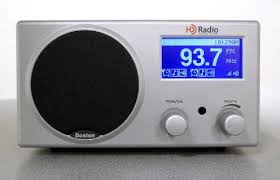
37That was the headline that appeared in the Baltimore Sun on January 7, 2004. Unfortunately, unlike HDTV (High Definition Television) HDRadio never stood for “High Definition” radio. And maybe that was the first mistake. HDRadio was simply a name they chose for the digital radio technology.

The iPod was introduced in October 2001. Steve Jobs introduced this music delivery changing device this way. Only a month earlier, XM began broadcasting the first satellite radio programming to be followed four months later by Sirius satellite radio. So by 2004, digital radio was already late to the party.

KZIA-FM Z102.9 saw Kenwood USA sell its first digital receiver in Cedar Rapids, Iowa to take advantage of KZIA-FM’s HDRadio broadcasts. “This is a significant move,” Michelle Abraham, senior analyst at In-Sat/MDR, a market research firm in Arizona, said of the roll-out of digital radio equipment. “It may not seem duly significant in the beginning, but in a few years from now, it will be a huge leap.” The hope was it would prove to be competitive to the newly launched satellite radio offerings from XM and Sirius (now merged into a single satellite company). HDRadio was also seen as improving FM to have CD quality sound and making AM sound like FM. It was heralded to help struggling AM radio stations.

Solving a Problem That Didn’t Exist

What HDRadio did for FM radio stations was solve a problem that listeners to FM didn’t feel existed. No one who listened to FM radio was complaining about the quality of the sound of the transmission. (They were complaining about other things, like too many commercials.) And for AM radio stations, it meant people buying radios for a service that didn’t offer anything they really wanted to hear or couldn’t get from someplace else. AM radio was now the service of senior citizens who already owned AM radios, who grew up with AM radio’s characteristics and whose hearing was not the best now anyway. So HDRadio for AM wasn’t something they were asking for either. Worse, AM radio stations that put on the new digital signal found it lacked the benefits of skywave and often interfered with other company AM radio stations as the industry quickly consolidated radio ownership.

Industries Most Disrupted By Digital

In March 2016, an article published by Rhys Grossman in the Harvard Business Review listed “Media” as the most disrupted by the growing digital economy. Turns out if you’re a business to consumer business, you’re the first being most disrupted by digital. The barriers to be a media company used to be huge, but in a digital world they are not. The business model that media companies depend on has not adapted well to the digital economy.

Education – Disruption Ahead

Having moved from media to education I only got ahead of digital’s disruption for a while. But even those industries that had perceived high barriers of entry are finding those walls crumbling quickly. Grossman says fifty percent of executives see education being impacted in a big way in the next twelve months.

Where Are The Radios?

Edison Research did their latest “Infinite Dial” webinar and the slide that most impacted me was the one about radio ownership. From 2008 to 2016 the percentage of people in America that don’t own a single radio in their home has gone from 4% to 21%. When Edison narrowed this down to household between the ages of 18-34, non-radio ownership rose to 32%. Mark Ramsey’s Hivio 2016 Conference had one Millennial describe a radio set as being “ancient technology.” Ouch!

It doesn’t seem all that long ago that Jerry Lee’s WEAZ in Philadelphia was giving away high quality FM radios to increase listenership to not just his radio station but to FM radio. And KZIA in Cedar Rapids gave away HDRadios to allow people to hear their new signal. It now appears time for the radio industry to begin giving away AM/FM radios every time they are doing station remotes, contests or appearing at venues that will attract lots of people.

Elephant in the Room

But the elephant in the room remains the broken media business model. Newspapers, magazines, radio, and television – any media that is ad supported – will be challenged to find a way to capture revenue to continue.

As Walt Disney famously said “We don’t make movies to make money, we make money to make movies.”

To anyone in ad supported media, we would agree we do it for the same reasons.

The $64,000 question is how.

16 Comments

Filed under Education, Mentor, Radio, Sales, Uncategorized

When Radio Was Color Blind

35Once upon a time, radio was pretty much like the TV show The Voice. We only knew what we heard coming through the speaker on our radio.

Those pilots of the airwaves were magical.

We may not have had a clue as to what they looked like, but we created a persona in our minds as if we did. It was never even close to the real person, if we ever happened to meet them.

As a young lad, most of my radio listening occurred at night, after the sun had gone down and when AM radio signals enjoyed the benefit of the skywave effect. The reasons for this were simple. First, during the day I was in school and when school got out, I was outdoors playing sandlot sports. Second, at night the only TV set in the household was controlled by either my parents or older siblings. But the transistor radio was completely in my control. I’d listen to radio stations from all over North America. One of those stations would be the most listened to AM radio station of its day, WABC out of New York City.

Who’s the Black Guy?

I got my best school friend hooked on radio and each day at school we’d compare notes of who we listened to the night before and how far away the stations we picked up were and where on the dial they were located.

Music Radio 77 – WABC out of New York City threw a pretty consistent signal over Western Massachusetts at night and so it got a lot of my after dark listening time. My friend listened to WABC a lot as well, so you can imagine our surprise the first time we saw a picture of the WABC All Americans (that’s what they called their air personalities back in the 70s). We looked at one another and said simultaneously, “Who’s the Black Guy?”

That personality was Chuck Leonard. His cool factor just went up in our eyes. Chuck Leonard was not only heard over WABC late at night but on one of our local ABC network affiliated radio stations doing the feature show “Sneak Preview.” Chuck was famous for one-liners like “The best that ever did it and got away with it.” Yes we heard a lot of Chuck Leonard and loved everything he did. But in our minds, we had never thought of him as being black. And once we found out, we didn’t care.

Jerry Lee Lewis and Chuck Berry

In 1958, two hit recording artists were having a backstage fight over who would close the show that night, Lewis or Berry. The decision would be made by the show’s host and producer. He chose Berry. Lewis would end his act with Great Balls of Fire and then torch his piano.

The man who enraged Lewis was the radio personality who is credited with coining the term “Rock and Roll,” Alan Freed.

While many remember Freed for his involvement in accepting payola for playing records on his radio show, Freed was instrumental in integrating Top 40 radio with black artists.

Motown Sound

Contemporary music on the “kid’s stations” was integrated with the birth of this type of radio. Everything that wasn’t your parent’s music was embraced. It was the silent rebellion for many of us.

My favorite artists were The Four Tops, The Supremes, Stevie Wonder, Marvin Gaye, The Temptations, The Spinners, Smokey Robinson & the Miracles, Al Green, Martha Reeves, Gladys Knight, Michael Jackson among many others. Berry Gordy’s Motown Records out of Detroit would craft the sound that quickly integrated America’s contemporary radio stations.

I remember thinking; I should have been born black.

But it was Alan Freed that would be the first to break down the color barrier and integrate the music he played over the radio. It’s almost hard to believe that people in his day considered Freed a threat to society because he was playing “race music.”

You can read a really interesting history about Alan Freed and this period in his life at my professor friend Jay Douglas’ “Out of My Mind” blog.

Radio Formats Begin to Silo

As music radio began moving from AM to FM, the Top 40 – or the best of the newest songs type of format – began to silo into their own formats. Depending on who’s counting, there are at least 20 different music radio formats today. It’s hard to find any radio station nowadays that plays the wide variety of artists, styles and music that one could hear over a single radio station back in the 70s, as this 1970 Top 100 Songs from WABC demonstrates.

Bowling Alone

In  2001, Robert Putnam wrote a book called Bowling Alone. His thesis was that our American society was breaking down as we became more disconnected from our families, our neighbors, our communities and from the republic itself. While once upon a time bowling leagues had thousands of members, today we are more likely to bowl alone.

The great Yogi Berra captured this societal breakdown this way, “If you don’t go to somebody’s funeral, they won’t come to yours.”

PTSD

More recently, Sebastian Junger made an interesting observation about PTSD. What he wrote about and famously talks about in his TED Talk is that soldiers don’t experience PTSD from being at war, but from coming back home to America where today’s society is such a disconnect from the close tribal life of a soldier’s military unit. Where they eat together, sleep together, care for one another and protect each other’s life. When they come home from today’s modern warfront, what they find is an alienating and bitterly divided modern society. Maybe a better term for what our soldiers feel should be called “post deployment alienation disorder” says Junger.

The question becomes not can we save our vets, but can we save ourselves?

For radio’s future, the question might not be all that different.

20 Comments

Filed under Education, Mentor, Radio, Sales, Uncategorized