
 The other day, we took two of our grandchildren to a wildlife safari park here in Virginia. It was a simply magical day. But that’s not the part of the story I want to share. It is that both kids were wearing their Boston Red Sox baseball caps.
As we were getting ready to leave we met one of the animal caretakers who screamed “YES!” Then a second later, she exclaimed, “They’re both Red Sox Fans!” Instantly, there was a bond between complete strangers.
Purple People

I’m convinced that Minnesota Vikings fans bleed purple. I know one whose whole wardrobe is virtually branded with Vikings colors and logos; even his lawn mower.
Sports franchises truly understand the power of their brand and building their fan base.
So, whatever happened to this sort of thing with radio stations?
Eazy 101
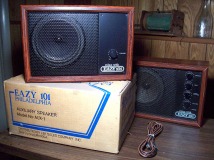 Jerry Lee recently sold his only radio station, WBEB in Philadelphia, Pennsylvania. It was 55-years ago this past May that Jerry and his partner David Kurtz put the station on the air. It signed on as WDVR. In the 1980s the call letters were changed to WEAZ and the station was branded as “EZ 101.” The station brand was not only well known, but fixed tuned FM radios were given out by the radio station to area businesses to play the station in their stores and offices.
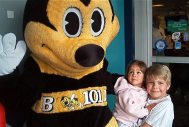
When the station updated its format, and changed its call letters again, this time to WBEB and branded itself as “B101.1,” giant bees appeared at events all over the “City of Brotherly Love.”
The End of an Era
Marlin Taylor (no relation) was there from the beginning and recently blogged about the station’s sale to Entercom. His article was titled “End of an Era.” You can read it HERE
Marlin wrote:
“While I pretty much grew up with a ‘Can Do’ attitude…seeing Jerry in action confirmed that staying pro-active and constantly on the offensive were keys to a meaningful and effective life! If you need proof, just take a look at the 55-year track record of the station at 101.1 on the FM dial in Philadelphia.
There’s no question that Jerry was and is a promoter, pure and simple! And, yes, he’s a Futurist…a person who studies the future and makes predictions about it based on current trends and conditions. I would also add…always looking down the road to see what challenges and opportunities lay ahead, then utilizing (his) assets to most effectively counter-act or benefit from them.”
Familiarity
As Jerry changed his brand over the years to keep his station’s programming and image in vogue with the times and his target listeners, he understood the power of familiarity in attracting and keeping a radio audience tuned to his radio station. Mark Ramsey suggests that “familiarity IS preference.”
 Most recently, Jerry rebranded his station as “101.1 MoreFM.” This change, like all the others, was promoted in every imaginable way and became familiar to listeners virtually overnight.
Bumper Stickers
Once upon a time, you couldn’t drive in New Jersey without seeing a WOBM-FM bumper sticker on the car driving in front of you. They were everywhere. They made this station VERY familiar and Paul Most, a former GM of WOBM-FM, always used to say “When you can’t be heard, you’ve got to be seen.”
Arbitron Diary
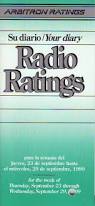 Once upon a time, all radio listening was recorded using a diary, kept by a listener for seven days. Years of diary reviews at the Arbitron headquarters in Maryland proved to me that the radio stations most familiar to their listeners got the most “votes” from their fans.
When PPM measurements were introduced, the importance of unaided recall seemed to take a back seat with radio operators. Best Practices in large radio companies replaced the old tried and true ways of doing things. Radio promotion, except for over a station’s own airwaves, was cut from station budgets.
New Media Platforms
The shiniest new media platform on the block is the smart speaker. A recent research study, “The Smart Audio Report” from NPR and Edison Research, showed that traditional OTA radio was seeing the time people spent with radio, being the most disrupted. 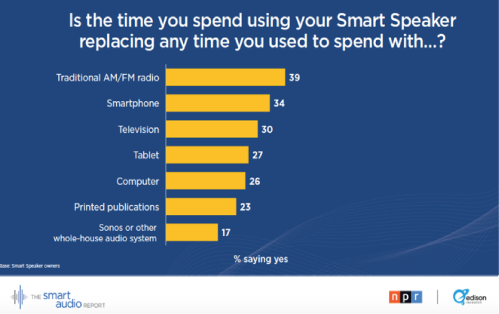 People in the survey said traditional AM/FM radio was the thing most replaced by audio listening via their smart speaker.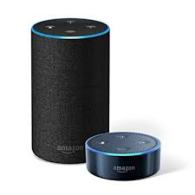
Having now owned three Amazon Echo smart speakers for six months, I can tell you Alexa is very addictive. But she’s also very precise. To have her serve up what you want to hear, you need to say it correctly, in the exact way she is programmed to understand, or else she will serve up some really bizarre things.
My household pretty much matches the research on why audio consumers love their smart speakers: 1) it’s fast, 2) it’s convenient and 3) it provides great choice.
Brand Promotion
In an interactive voice world, if people are familiar with your brand, they will ask for it by name. If not, the digital assistant will make that choice for you. That will make branding more critical than ever.
This means that the way radio promoted itself to its listeners back before PPM – the unaided diary days – will be the way it will need to promote itself in a world of voice control devices.
“Brands are a risk of being marginalized in a voice driven world, so brand marketing may matter even more.” -Bryan Moffett, COO, National Public Media
“Brands now have a chance to behave like human beings, talking, understanding, guiding, empathizing…voice is the single biggest vector of emotion, emotion is the biggest driver of preference. This is a true 1:1 marketing opportunity and a chance to build relationships like never before.” -Mark Paul Taylor, Chief Experience Officer, Global DCX Practice, Capgemini
Jerry Lee never deviated from his proven path of spending on promotion and delivering a quality product.
Everything old is new again, when it comes to branding a winning radio operation.
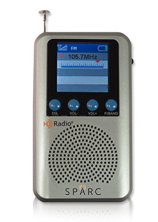 There’s something that’s been troubling me for some time. It’s the radio industry’s habit of reporting radio listening results by calling it “AM/FM” versus what it really is, virtually all FM radio listening.
 WTOP was built on AM radio. It moved its entire operation over to the FM band and grew its audience, revenues and lowered its listener demographic. People who never heard this radio station on its AM dial position were suddenly newly minted fans of their all news format.
 From my blogging, I get lots of feedback about a variety of things concerning broadcasting. One reader wrote to me about his father, a sports fan, who turned on WIP-FM to hear the latest chatter. WIP-FM was broadcasting a game of no interest to his father, so his son said to him, why don’t you turn on WIP AM610. Sadly, this person wrote the audio was unlistenable. He wrote: “You’d think the FCC would mandate that AM have standards for audio quality in receivers.”
 When I was living in Bowling Green, Kentucky, I couldn’t receive 650AM WSM in my office, even though my office looked south and my antenna was able to enjoy a full wall of windows. The noise floor both inside my university office as well as around town while driving in my car made the station unlistenable. WSM was once listened to all the way to Louisville in northern Kentucky. Instead, I downloaded WSM’s app and could enjoy the radio station in crystal clear stereo. (I see WSM has stopped subscribing to Nashville Nielsen Audio ratings.)
 The British Broadcasting Corporation (BBC) did a review of the range of services it offered on the AM band (called medium wave across the pond) and it included a financial review of all its services too. They concluded the ROI (return on investment) in AM was not there and announced they would be turning off some 13-AM radio stations in January 2018 according to Radio Business Reports.
 There’s a great radio operator in Cadiz, Kentucky by the name of Beth Mann. WHVO is her AM radio station at 1480, but if you go on her website, you won’t find any mention of this station being on the AM radio dial. It’s promoted as
  I read a recent article in
 Jeff Bezos’
  I’ve been reading the trades, trying to grasp what is happening, and it is all so very confusing. Have you felt that way too? That’s what a period of disruption looks like. Black is white. Up is down. It’s enough to give you an Excedrin headache.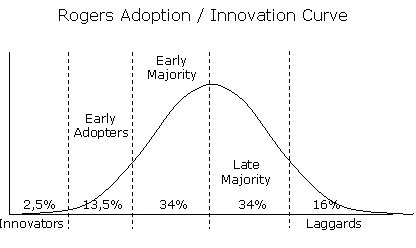
 at a time when AM/FM radio is no longer the entertainment focus of the vehicle dashboard, replaced by the entertainment center that resembles the touch screen on your smartphone.
 The other night I watched Jim Gaffigan’s 5th Netflix special called “CINCO.” In his standup comedy routine, he hit the nail on the head about why Netflix is more popular than cable TV. Here’s what Jim said:
 On the surface these two things appear to have nothing in common. Right? But stay with me as I explain. I follow Duke Professor, celebrated author and student of human nature Dan Ariely. Dan writes a regular
  DickTaylorBlog