

I just finished reading the public radio research report “An Audience Growth Strategy for Public Media” prepared by Jacobs Media and Mark Ramsey Media for Maine Public radio service. What really stood out to me was how clearly this report shows where the future is for all traditional linear media.
Linear Is In The Rear-view Mirror
Broadcast radio and television – traditional media – was built on a linear program schedule, delivering to the media consumer, information and entertainment on a schedule determined by the broadcaster. The VCR (video cassette recorder) developed in 1956 became widely available in the late 70s and by the early 2000s was in virtually every American household, giving television consumers the ability to now watch shows on their schedule, not the program provider’s.
“It is painfully obvious neither broadcast radio nor television is growing, especially as it concerns traditional (terrestrial) usage and linear program schedules,” writes Jacobs/Ramsey.
Today’s Media Consumer
America continues to become more diversified: 72% of Baby Boomers are white but only about half of Millennials are white and four-in-ten of Gen Zs are white.
Millennials were born between 1981 and 1994, so VCRs have always been a part of their life and Gen Zs were born 1995 and 2009, which means also having an iPod type device has always been part of their life. Both of these devices contributed to the habit of having what you want, ON-DEMAND.
In 2007, the iPhone introduced us to a media device that made ON-DEMAND media consumption ubiquitous.
Listening Options
Today’s non-radio listeners have a plethora of media options:
- Spotify
- Pandora
- Apple Music
- Amazon Music
- Radio Tunes
- SiriusXM
- Podcasts
- Audio Books
- YouTube
- Social Media
…just to name a few.
Jacob/Ramsey says “Linear program schedules common to over-the-air [broadcast] stations are not in alignment with new media consumption habits.” Today’s consumer is in control, not the media provider.
ON-DEMAND Digital
In today’s world, the future is “Go Digital, or Go Home.”
Today’s traditional broadcasters (Radio & TV), must take advantage of digital’s ability to serve their audiences with what they want, when they want it and on the media platform they want it on. The same attention given to over-the-air broadcasts will need to be given to all the other ways of content distribution; as each is of equal importance to the media consumer.
“Broadcast radio and television will remain the core business for years to come, but a focus on traditional media can no longer be considered a growth strategy,” writes Jacobs/Ramsey.
Peacock & Netflix
NBC’s Peacock streaming service paid $100 million dollars to exclusively stream the wild-card playoff game between the Kansas City Chiefs and the Miami Dolphins, setting a record for the most-streamed live event in American history. Comcast Chairman & CEO Brian Roberts considered the streaming gamble a success and a very proud moment for the company, but for consumers it will mean having to pay for playoff games in the future.
This week Netflix announced it had struck a 10-year deal with WWE to air “Monday Night Raw” on its streaming service. This program has been on linear television since 1993; 31-years ago.
Peak Listening On Audio Platforms
This pat week, when Edison Research published their article on which media platform commands the most listening in different dayparts, it was eye-opening.
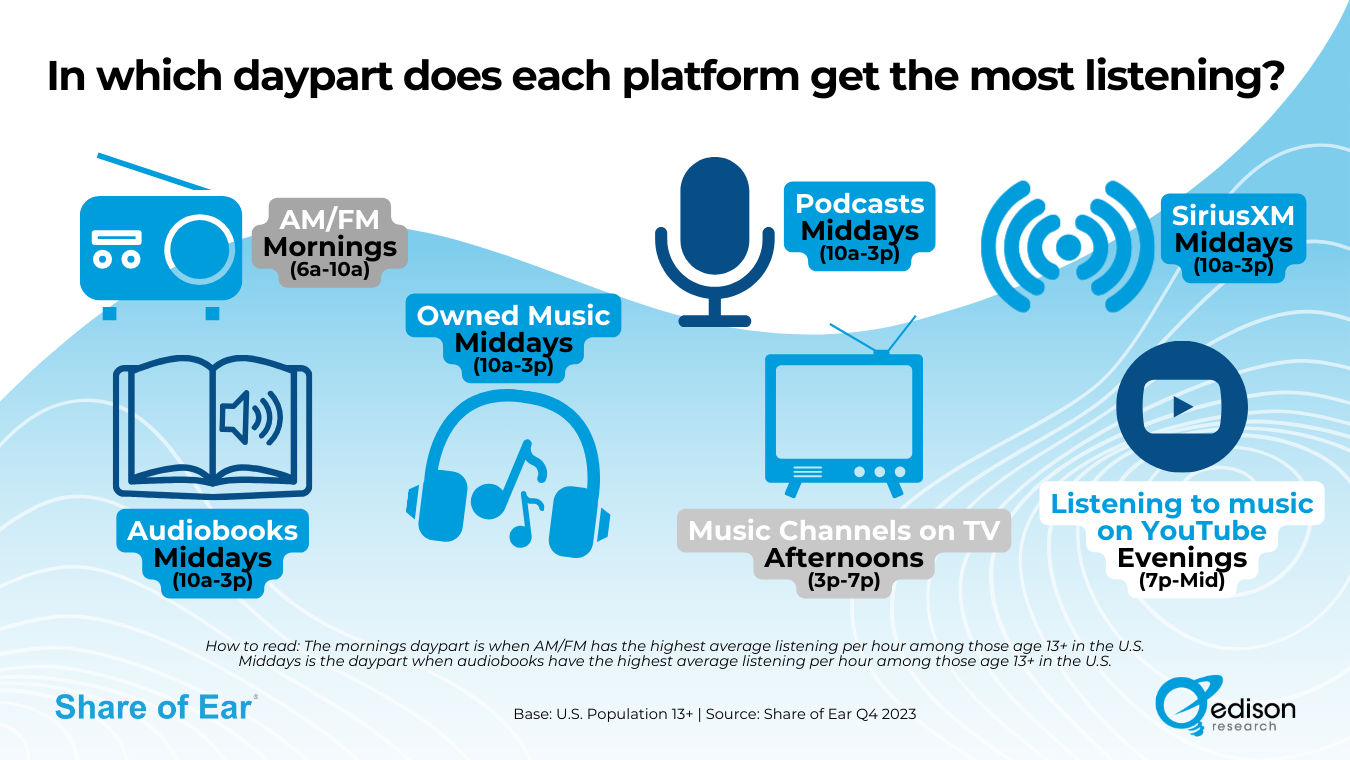
The only daypart that broadcast radio commands is morning drive (6-10am), which just happens to be the one daypart the broadcast radio industry still invests in live air personalities. For the rest of the dayparts, consumers utilize streaming audio or previously downloaded content to their media device.
My favorite time to listen to radio growing up was 7pm to midnight. Some of the best known and loved air personalities broadcast during this daypart; Big Ron O’Brien, John Records Landecker, Wolfman Jack, Cousin Brucie among others. However, today the research shows that YouTube is what people listen to at this time of day.
Just before the end of last year, SiriusXM announced the debut of its new streaming App. It offers “discoverability and personalization at the forefront, [so] listeners can quickly and easily find and dive into the content they love across SiriusXM’s 400+ channels and tens of thousands of hours [with] on-demand content and podcasts, [allowing] fans to go deeper into their passions and get closer to their favorite music, artists, personalities and sports; [providing] a seamless listening experience across streaming devices that reflects listener preferences and interests, [ensuring] subscribers never miss a moment wherever they are and whenever they want to listen.”
Don’t you wish the NAB (National Association of Broadcasters)
was working on something like this, instead of focusing on linear AM radio?*
 DickTaylorBlog
You absolutely nailed it Dick. Great article. The save AM movement is hilarious. There are a handful of great AM’s, but most are totally ignored and the stations run unattended. Dead air, poor audio quality, and the stations crash and burn. Meanwhile, the radio industry suddenly wants to save AM when the industry itself has ignored it and pushed it aside.
LikeLiked by 2 people
AMEN! Brother, but around here..you’re preaching to the choir. Though I had a long history at AM stations, even I realized AM’s glory days were over by the late 70s. I never see it returning. About the only AM stations in my area of Kentucky that are able to succeed in any measurable way have FM translators.
LikeLiked by 1 person
AM radio is the “sad sack” of the industry. We can’t look backwards, we need to be focused on the future.
Yes, there are still some excellent AM radio stations, but they are few and far between. Looking at the latest monthly ratings you maybe can find one AM radio station listed; but many markets don’t have a single AM station that appears. If that’s not the reality, then today’s radio ratings are FUBAR.
Thank You Mike for the positive feedback.
-DT
LikeLike
Your post today was a great summary of the current state regarding the “radio” business whether over the air or internet streaming. I have contented the “Alexa” and other smart devices is the home radio of the future. I recently spoke to a lady about ten years younger than me and asked if she even owned a radio. She said she ha a clock radio but never listens to the radio…when the clock dies it will go in the trash. But I found the article you linked too, more interesting and wonder if you posted a comment on the National Association of Broadcasters continuing to push the public safety importance of AM radio, which serves as the backbone of the Emergency Alert System. The government needs to adopt a more European system, and not rely on commercial broadcasters for such an important function. Why are they not developing a new plan, or is there one in effect. In the old days we had CONARAD but now I don’t know who or what office overseas national notification in case of an emergency. If there is an alternate plan, I for one would like to know what it is.
LikeLiked by 1 person
During the last nationwide test of the EAS system, Sue & I were driving in Concord, NH. We had a FREE 60-day trial of SiriusXM and so that was playing on our car radio.
When the test took place, both of our iPhones immediately sounded the alarm tones. About 2 to 3 minutes later, the same test came over SiriusXM. I’m not sure how accurate the old “AM radio is the backbone” is anymore. The EAS sarted in 1997; over a quarter of a century ago. The ubiquitous iPhone was introduced in 2007. The world has moved on.
Thank You for sharing your thoughts Paul.
-DT
LikeLike
The problem with your experience, when you said “both of our iPhones immediately sounded the alarm tones.” Cell towers would be one of the first things to go I would imagine in a national “attack” or earthquake…whatever is considered an emergency. And “satellite” radio doesn’t and can’t provide local emergency information in case of flooding, etc. Neither is a replacement for a radio station on generator power.
LikeLiked by 1 person
In those types of situations, we’ve seen radio stations go down, along with cell towers. Nothing is 100%, but today, we have multiple ways of alerting people to impending danger.
Look at how ineffective broadcast radio was in the recent fires in Maui, for example.
-DT
LikeLike
“In the old days we had CONARAD”
He probably meant CONELRAD, which ended in 1963.
“but now I don’t know who or what office overseas national notification in case of an emergency.”
If a broadcaster doesn’t know about the Integrated Public Alert & Warning System (IPAWS), something is wrong. Every radio and TV station in America is required to connect to IPAWS through their EAS devices.
“If there is an alternate plan, I for one would like to know what it is.”
It is the National Public Warning System (NPWS), part of IPAWS mentioned above. From nuke-proof bunkers distributed throughout the US, NPWS can remain on the air, covering most of the US after the electric grid, Internet and phones are down. The government continues to spend millions on maintaining and upgrading NPWS facilities, most of which are at the largest AM stations.
NPWS is one of the few solid reasons to retain AM receivers today. If auto makers don’t want to use digital techniques to overcome noise in AM reception, there is still the business opportunity of aftermarket portable receivers optimized for vehicle AM – for cars without factory AM radios but whose owners want to keep connected when the big time stuff hits the fan.
LikeLike
The Integrated Public Alert and Warning System (IPAWS) is an architecture that unifies the United States’ Emergency Alert System, National Warning System, Wireless Emergency Alerts, and NOAA Weather Radio, under a single platform. IPAWS was designed to modernize these systems by enabling alerts to be aggregated over a network and distributed to the appropriate system for public dissemination.
Integrated Public Alert and Warning System (IPAWS) is designed to integrate the various systems into one modern network, and also update them to take into account newer forms of communication such as cellular telephony and Cell Broadcast, satellite and cable television, electronic billboards and the internet.
The program is organized and funded by the Federal Emergency Management Agency (FEMA), an agency of the Department of Homeland Security. The system allows for alerts to be originated by Federal, State, local and tribal officials, and subsequently disseminated to the public using a range of national and local alerting systems including EAS, CMAS and NWR.
So, whether one has an AM radio or not, they can be reached via all communications systems.
The most recent national test last October 2023, reached me on my iPhone and via SiriusXM (which was listening to in New Hampshire at the time).
-DT
LikeLike
I remember, there was the guy, Darryl Parks was his name I think, that wrote a blog about 10 years ago, saying what the NAB (and convention) was – “a circle jerk” I believe he said. The blog pointed out the joke that “AM Revitalization” was, which was presented at that year’s convention. Point by point, as attendees mindlessly cheered, he revealed the fallacy of what was proposed and their ignorance toward it. Turns out a decade later not even a syllable of what he wrote was wrong. Hmmmm. Oh, and as he always said, “An FM translator can’t save AM radio…’cause it’s on FM.”
LikeLiked by 2 people
Darryl and I both believed it then, and we have never changed our position about FM translators “saving AM radio.”
The current energy being expended on keep AM radios in new cars is trying to preserve the past. It is NOT the future.
Thank You Kent for stopping by the blog and reminding us of Darryl’s thoughts on this subject.
-DT
LikeLike