Category Archives: Mentor

What if the problem isn’t PPM?

I’ve been reading a lot lately about PPM (Nielsen’s Personal People Meter) and how it may not be capturing all the listening in a radio market.

In Las Vegas at the NAB2015 show, Telos Alliance was demonstrating their Voltair.   This additional “black box” in a radio station’s audio chain will correct for times when the PPM isn’t properly watermarking a radio station’s signal. As I understand it, some formats that have pauses – like talk radio formats, classical formats – aren’t being encoded with the audio watermark the PPM encoder is supposed to transmit to be received by the PPM device a listener in a Nielsen panel carries (or not) with them.

OK – let’s take a time out here.

PPM is now the radio measurement system used in the Top 48 radio markets in the USA. It began being the currency for radio listening in the City of Brotherly Love (Philadelphia) in the spring of 2002. When a measurement system is considered “up-to-snuff” an agency called the Media Ratings Council gives that measurements service its Double Checkmark seal of approval. (The diary method of radio listening measurement has had that seal in all markets it’s used and is still the measurement method used in radio markets from #49 to #273 by Nielsen Audio.)

Now you would think that in the lucky 13-years since PPM was officially launched (it was being tested in England back in the late 90s) that it would have earned that gold standard of ratings methodology approval in all PPM markets by now, but no; it apparently only has it in about 25 markets, leaving another 23 without it. But make no mistake it IS the ratings currency used Double Checkmark or not.

This new PPM device replaced the paper diary methodology in America’s largest radio markets and here are a couple of more interesting twists to the story. There were less PPM meters deployed than the number of paper diaries they replaced. They also raised the costs of measuring these radio markets by something like 60%. (That’s sounds like Clear Channel’s old “Less is More” strategy.) But if the ratings will be more accurate, then everyone should rally around this newer system and it will be worth what they’re paying for, right?

That’s what makes the Telos Alliance Voltair black box so disturbing. Its seller’s claim it fixes a problem that no one (or not a lot of people) knew even existed. It made the PPM encoder do a better job of encoding a radio station’s signal so PPM receivers could decode the audio watermark and give that radio station its due. And to implement this “fix” to your radio signal, all it would cost you is $15,000.00 per Voltair.

I’ve had the pleasure to actually visit a station in a major metro and watch the Voltair work. The telemetry it displays appears to be doing just what its sellers claim. So maybe it IS fixing things. But what about all those formats that are no more? What about all those PDs and air personalities that are gone because a new measurement device was not giving them the proper credit they should have been getting? A lot has changed in those 13-years since the first PPM market went online.

Another manufacturer points out that this additional black box in your audio chain designed to capture more PPM receivers will actually make your radio station sound worse and drive listeners away from your station. And I know some radio engineers that would agree with that analysis.

So what’s a radio broadcaster to do?

Dick Harlow thinks he knows. He’s in PPM market #46. He’s dropping Nielsen Audio’s PPM measurement service. He’s not spending $15,000.00 on a Voltair. And he’s not going without audience ratings like Saga has done (and is still doing in some of its markets). He’s hired Mike Gould’s Eastlan ratings to measure the Greensboro/High Point/Winston-Salem market for his radio stations; WKRR-FM Rock 92 and Top 40 WKZL 107.5 FM.

Mr. Harlow says “enough is enough.”

Eastlan will reportedly deploy a sample size that’s triple the number PPM meters currently used in this radio market using its proprietary ratings estimate methodology.

And no it isn’t MRC Double Checkmark approved, or as far as I can see, under review by the MRC.   But then again, there appears to be a lot of ratings currency being used that lacks this approval.

A quick check of the Greensboro/High Point/Winston-Salem market shows that PPM is also not receiving the MRC Double Checkmark seal of approval for that market, so there’s no loss for Mr. Harlow on that metric either.

I studied the Eastlan reports back in the early part of the 21st Century when I was running radio stations. At that time it was Arbitron and Eastlan that were battling it out in a few radio markets where we could examine how each company ranked the stations. What I saw at that time was they could both agree on the Big Dawg stations, but Eastlan found those little pups that super-served a niche audience and that was the eye-opening difference to me, for at that moment in time I was running some low powered AM radio signals and needed a ratings company that could drill down a market deeper and uncover more of the radio listening that was actually occurring.

My gut tells me that Dick Harlow will find that too. And if he’s smart, he will take the cost savings by switching to Eastlan and pour it back into advertising and promotion of his radio stations; for if he does, he will not only win in Eastlan’s audience estimates, but in those done by Nielsen too. But the real win will be for his listeners, advertisers, employees and his company, for he will be investing his resources where they will pay the biggest dividends for the community he’s licensed to serve.

To sum this all up, the problem isn’t PPM. It’s that PPM has taken radio broadcaster’s eyes off the ball. The game is programming radio stations with great content. It’s hiring great talent. It’s crafting commercials for advertisers that get results and don’t annoy the listener. It’s super-serving the community you’re licensed to operate in. In other words, it’s doing all the right things, all of the time. Ratings are a by-product of doing it all fabulously well. And profits are the reward that the stakeholders receive for investing and believing in their radio team.

21 Comments

Filed under Education, Mentor, Radio, Sales

3 Leadership Lessons

Being a leader today is not for faint of heart. Gone are the good old days of simply planning your work for your business and then working your plan. Today, leaders need to solve problems and think creatively. They need to, as Wayne Gretsky so eloquently put it “skate to where the (business) puck is going to be, not where it is.”

Leadership today is all about inspiring people and empowering them to believe in themselves, their company and the path that lies ahead.

Whether that business is a radio station or a university (where I now work), the task is the same.

Lesson #1: Don’t run your business poorly

Leaders lead by example. People will follow more what you do than what you say. If you misuse your expense account or run your personal mail through the office mail machine, others will follow your example regardless of what the “official policy” is on personal use of the mail machine or what qualifies as a legitimate business expense.

In a radio station, sales people aren’t programmers and program people don’t sell. So sales people don’t have a say in programming decisions and programming people don’t set advertising rates.

Leadership means getting the people who are skilled at what they do to “Just do IT” not somebody else’s “it.”

I worked for a radio station owner who had a favorite phrase, “Money makes honey.” He knew that you needed to have money coming in the door to pay for everything his radio stations did and so he took the sales aspect of running radio stations VERY seriously.

Walt Disney put it this way “I don’t make movies to make money; I make money to make movies.”

Lesson #2: A Unified Vision is Key

 I used the words “unified vision” for a reason. Most folks would have said “mission statement.” I am not a fan of mission statements for a couple of reasons. They are often crafted by committees. Like the old joke about what’s a camel, it’s a horse created by a committee. So most mission statements are too unwieldy and no one can remember them much less carry them in their heart as a guiding star.

Leaders like Steve Jobs create a vision for their company. Steve’s was to create “insanely great products.” He didn’t say make the world’s best computer, iPod, tablet or iPhone. He just said whatever Apple is committed to making, it would be insanely great.

Lesson #3: Your Product is Job One

 In higher education, the product is the quality of your teachers, facility and the success of your graduates. In radio, it’s the quality of your air personalities, content, facility and the success of your property to serve the community, advertisers and listeners.

American broadcasting executive, Randy Michaels, once said at a conference I attended “you give me a poorly programmed radio station with a great sales force and I’ll lose you money, but if you give me an excellent programmed radio station with a mediocre sales force, I’ll make you money.” Randy was always clear that the way to make money in radio was making the radio product job one. (Sounds like Walt Disney, doesn’t it)

Look at any successful company and you will see that the product comes first; always.

The challenge in a digital world is that things are changing more quickly than at any time in history. Innovation isn’t a luxury; it has to be an integral part of your business plan. The only constant is change.

The trick for both radio and higher education is to innovate without tinkering with the core product in the process. You also don’t fear cannibalizing your core product either.

Again, Jobs didn’t tinker with his iPod while developing his iPhone, but never worried that his iPhone and later his tablet would cannibalize his iPod and MAC in the future. (Note: the era of the iPod ended in 2014 with the introduction of the iPhone6. Over 400 million iPods have been sold.)

But when you have instilled in your people a unified vision like to make insanely great products, you have sowed the seeds of success into the very fabric of your organization.

3 Comments

Filed under Education, Mentor, Radio, Sales

Will Programmatic Buying Help Radio?

My good friend Pierre Bouvard circulated an article on LinkedIn that was published in Ad Age titled “Programmatic TV: Lots of Talk Lately, Not Much Real Action.”  We know what happens in TV land trickles down to radio. That’s what got me thinking about the impact that programmatic buying might make on the radio industry.

First, if you haven’t heard the term, programmatic buying is letting computers buy advertising time. This type of advertising placement is already pretty commonplace in the online world. It can take the form of data-driven real-time purchasing, online auctions or private exchanges, with transactions handled by machines according to Rino Scanzoni, chief investment officer at GroupM. It’s fast, efficient and needs no human sellers.

The large radio companies have been trimming the work force since the beginning of the “Great Recession.” Don’t waste a good crisis was the way one radio industry leader put it at a meeting I attended. Meaning, when the economy is in the dumper and all companies are trimming their expenses to survive, you can use this type of environment to make lots of cuts; especially through RIFs (Reduction In Force).

Computer automation equipment, voice-tracking, syndication, and networking has all replaced live and local radio program origination. However, when it came to ad revenue, the personnel has largely remained intact. Could programmatic buying do to radio sales staffs what the aforementioned computerization did to programming staffs?

The short answer is yes.

At the end of the last decade I watched Google’s ad insertion system place ads onto my radio stations in the very early morning hours. Google’s hardware recorded air checks of every ad they placed on my stations and Google was able to give their advertisers not just a paper verification of the ad running but air checks of every ad, run on every station. Something my local sellers could not do for their clients. It was impressive.

The downside was Google had no idea where anything was in my state and so many of the ads were not appropriate to be airing on my stations for any number of reasons; the most important reason was that business was a hundred miles or more away.

Now while I realize that what I’m talking about here is more programmatic ad placement than programmatic ad buying, I’m making the assumption that the selling of those ads were executed in a similar manner; via automation like Google sells online.

The Ad Age article stated that one big reason that programmatic buying of TV would be a ways off was due to “TV networks also still need to approve the ads before they run, both for standards and to make sure they fit with the surrounding programming. That step doesn’t exist in programmatic ad sales online.”

Remember when radio stations had program directors that listened to everything that would go out over their airwaves to make sure that it met their standards and made sure it fit with the surrounding programming? Ah, the good old days of radio. That attention to detail is why radio sounded so good.

The Google experience taught me that even as a market manager, I no longer had any control over what might be heard over my air. Automated ad insertion is why streaming commercial breaks might air the same commercial multiple times during the same break. It’s a reason that many listeners find listening to over-the-air radio stations online so annoying. (I know I do)

ESPN’s Eric Johnson put it this way: “Programmatic buying means a lot of things to a lot of people. It includes providing some automation to the buying and selling process.”

For radio, only one thing has ever mattered; what comes out of the listener’s speaker. My fear is that as radio continues to abandon this critical aspect of its product in the pursuit of saving money it will kill the goose that lays the golden egg. No one is looking out for the radio listener and in a world of infinite choice, the listener will simply go elsewhere.

You can’t save your way to success.

1 Comment

Filed under Education, Mentor, Radio, Sales

Radio’s Challenge

David Goldberg pa1ssed away on Friday, May 1st at the age of 47; too soon to be sure. He was an Internet radio pioneer having created LAUNCHcast in 1999 which evolved into Yahoo! Music Radio. Until his passing he was CEO of SurveyMonkey and he was married to the Chief Operating Officer of Facebook. He was very savy about our Internet connected world.

Brad Hill in RAIN wrote that in 2005, Goldberg was the RAIN keynote speaker. To put his words into perspective, you should know he spoke just before the iPhone was first launched. For it was the iPhone that really launched what we now refer to as the smartphone and mobile music revolutions, that would provide Pandora with its launchpad. Hill wrote that Goldberg said:

“We hope that 10 years from now almost no one is accessing Yahoo services on a PC. It needs to be in my living room, in my car, on my cellphone. This will affect the change in replacing the CD, as well as moving music off of broadcast radio which is also what we believe will happen.”

Fast-forward to Pandora’s latest earnings call and Hill reports that Pandora execs said:

“We really want to replace broadcast radio for music discovery. We believe music will migrate off of terrestrial radio to the services we are offering because we can deliver the music consumers want, when they want it, where they want it. CDs will be replaced by on-demand subscription services. ‘Personalization’ and ‘community’ features will be key ways we’ll be able to deliver the right music to people at the right time, on devices, on a global basis.”

And Pandora is not alone in this quest. Spotify recently reported a market cap more than twice that of Pandora’s in the neighborhood of $8 billion to pursue their quest of being the world’s music provider. (Contrast that to America’s largest radio group iHeartMedia $20+ billion in debt.)

The world is also watching Apple. It made a $3 billion acquisition of Beats and is working on its iTunes streaming audio product. More about Apple in a moment.

Then Fred Jacobs authors a column talking about “Moodstates.” Jacobs’ latest Techsurvey continues to find how much emotion plays a role in broadcast radio listening. Jacobs writes:

“While consumers enjoy hearing their favorite songs, personalities, and information, mood plays a role why they continue to come back to AM/FM radio stations. In our research, it is often in the form of companionship, mood elevation, and escape.”

I’m a big fan of Rewound Radio and their weekly Saturday feature “The DJ Hall of Fame.” What I’ve personally found is that I’m not so enamored with just listening to old tapes of radio broadcasts from the 60s & 70s – I can hear this music anywhere, including my own CD library – but hearing the air personalities that provided me with hours of companionship, mood elevation and escape. And I’m not alone in feeling this way. I’m a member of a couple of DJ groups on Facebook and we all experience these same emotions.

This fact evidently hasn’t been lost on Apple. Apple has been raiding the talent at the BBC. Zane Lowe was their first hire. Lowe is known as a trend-spotter. He’s also a presenter (they don’t call them disc jockey’s in jolly old England) that builds a strong rapport with his listeners. At least three more folks from this BBC talent tank have announced they are joining Lowe at Apple.

Unlike Pandora or Spotify, it appears that Apple plans to put the personality into their streaming. Could Apple be the first to do for today’s generation what Dan Ingram, The Real Don Steele, John Records Landecker, Bob Dearborn, Ron Lundy etc did for my generation? Put the personality front and center in music presentation?

Horizon Media undertook a comprehensive study on the impact mood plays in effective audio advertising. As the results of what they’ve learned are implemented, the placement of those advertising dollars under Horizon’s control will be affected.

Back to Goldberg’s 2005 RAIN Keynote, he predicted that over-the-air radio would be reduced to a mostly-talk medium.

            “We don’t believe music will continue to be broadcast on analog radio,” Goldberg said.

A survey that I conducted with the 300 radio stations in Kentucky showed that local radio stations planned to take their talk programming more locally originated and less national syndicated talk. It also showed that no local music research was being done, but that national charts were being relied upon along with consultants and music programming service providers.

All of this comes at a time when the CEO’s of public radio companies report they’re facing strong headwinds on their advertising revenues. Radio is being attacked from all angles.

Not since the introduction of television back in the 50s has the radio industry faced such a big challenge. We are living in revolutionary times in the communications industry.

Commercial radio is 95 years old. When television presented its challenge it was only in its 40s. Still a young medium with lots of new blood entering its doors with a vision for a new kind of radio.

Boss Radio was born on 930AM-KHJ in Los Angeles and News Radio was born on 1010AM-WINS in New York City both in 1965. But even the new radio formats that were born in that era are now 50 years old.

I challenge my broadcast students to create the radio that will be meaningful for them and their generation. But for those students to have that chance, the owners of radio stations will need to open their doors and let them innovate.

Will radio pick up the challenge?

1 Comment

Filed under Education, Mentor, Radio

Are We Losing the Next Generations?

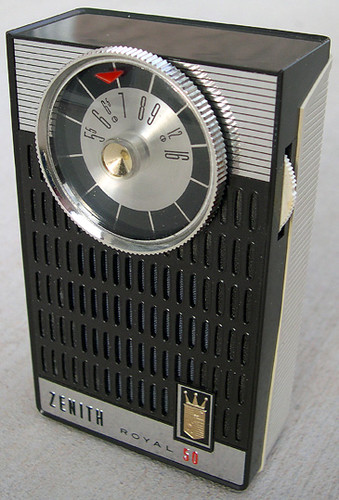
Growing up in western New England, the transistor radio would impact my life and career. Radio has been in my blood as long as I can remember, but it would be my Zenith transistor radio that would first allow me to explore new stations, new music, new personalities and new ways of delivering content without the supervision of my parents. My transistor radio and ear piece would make me the master of my own radio dial.

Growing up, it seemed like most radio markets had two radio stations battling for the teenage ear. WPTR and WTRY out of Albany, New York’s capital district would be mine. Each of those radio stations would bring their mobile studios to our county shopping center and broadcast LIVE. It was such a thrill.

Hartford had WDRC and WPOP. Boston had WMEX and WRKO. Philadelphia had WIBG and WFIL. Chicago had WLS and WCFL.

New York City would finally be a battle between WMCA and WABC for the Top40 crown in the Big Apple.

What made traveling around in my folk’s car so exciting was that each of these radio markets and radio stations were special and different. The personalities, the promotions, the station jingles and yes, even some of the music was unique to each station and market. Local and regional bands could be heard hoping to be discovered and go national with their music.

Radio stations all did music research back then and printed weekly surveys charting how the hits were doing from week to week with local listeners.

That was then, this is now. Larry Rosin at Edison Research says that today “virtually no radio stations perform formal research for music among teens nor target teens directly in their marketing strategy.”

I’ve sold “old people radio formats” where the presentation was quick to point out that what advertisers should be focused on is not the age of the audience but the amount of money they control and have as discretionary to spend as they wish.

I’ve also sold “young people radio formats” where we pointed out that kids are the masters of convincing their parents and grandparents to get them anything they wanted, so please don’t focus on how young they are. I mean once my boys were out of the house, I no longer went to Mickey D’s and ordered “Happy Meals.” (That made me very happy!)

Radio has always focused on the “family reunion demo” aka 25-54 adults; though that demo is shifting upwards with the aging baby boomers to 35-64 adults.

When Radio Disney was born and focused on little tykes, it appeared there was now a radio operator ready to pick up the torch for young people listening to radio. But then radio was shocked the day Disney announced it was selling all but one of its owned and operated Radio Disney stations. Radio Disney basically operated on AM radio. AM radio is no longer used for music listening by the public and so was Disney just abandoning AM radio for FM radio? No. Radio Disney had established a strong beach front on two audio delivery mediums; SiriusXM and online listening. (It also benefits from the Disney TV Channel on cable, satellite and streaming via the Net.)

It should also be noted that around the time Radio Disney was coming into existence that the radio ratings company known at that time as Arbitron began to measure listening audiences down to age 6+ with their new PPM device where as the diary previously only measured “adults 12+.” When Nielsen bought Arbitron and rebranded the radio ratings service Nielsen Audio it kept the 6+ listening metric. Nielsen also now is trying to establish a listening service that will measure all audio listening consumption across all platforms. Can you see where this is going?

Radio listening is a habit. My father never acquired it. I was raised on it. My sons were raised on it. But I see my grandchildren are holding iPad-like devices and easily navigate their parents’ iPhones.

You would have thought that with more radio stations on-the-air in America than at any time in history there would be more variety than at any time in our history, but that’s not the case. There’s actually less variety.

After launching two Smooth Jazz formatted radio stations and falling in love with the artists and their music I now can only hear this music streamed online. So like my grandchildren, I’m forming a listening habit that doesn’t require a radio; just my iPad or iPhone.

I believe the future is going to be all about being the best at something, not necessarily garnering the most people. Radio was always about getting the most ears. Everything was based on CPP (cost per point), but in a world of infinite choice, the best will dominate.

Radio can play in this world if programming is turned back over to people who program their passions to others just like themselves.

Steve Jobs made Apple into the world’s most valuable company by focusing on design (in radio, that’s programming) and making products that he and his team wanted to have for themselves (building a radio station that you not only own, but love to listen to yourself).

Radio is either going seize the day or have a seizure.

4 Comments

Filed under Education, Mentor, Radio

Content Creation with Ryan Recker

Ryan WreckerToday, I’m happy to welcome a guest blogger to my blog site; Ryan Recker.

In 2012 Ryan was given the opportunity to program the legendary WOWO Radio in Fort Wayne, Indiana.

Ryan is a hands on programmer… doing just about everything from hosting mornings, doing the afternoon talk show, daily newscasts, running the board, and creating content across all mediums.  In the two years that Ryan has been WOWO’s program director, the station has won:

  • Marconi Award for Medium Market Station of the Year
    4 Spectrum Awards, including Station of the Year, Best Breaking News AND Best Newscast (which Ryan won)
    2 AP Indiana News Awards
    Federated Media Program Director of the Year 

Ryan is a cutting edge radio programmer that’s interested in content creation.  He kicked off a new series of videos on this very subject recently and Ryan reached out to me to be a part of it.  I’d like to share that video with you now.

Here’s Ryan Wrecker to introduce it:

I want to thank Phil Hendrie, Craig Benzine and Dick Taylor who spent some time to share a little part of their craft.  These are some really creative guys in their own rights, and they’re part of a small group of people who just ‘get it’.

For more in this series, visit Ryan’s blog:  http://ryanwrecker.com/content-creation-series/

Leave a comment

Filed under Education, Mentor, Radio

The Cockroach of Media

The new CEO of National Public Radio is a man named Jarl Mohn. Before his life in public radio began, he rose pretty high up in commercial radio, only then he went by his “radio name;” Lee Masters.

When he was recently asked if Internet radio would replace terrestrial radio within a decade, he responded with “Broadcast radio is the cockroach of media. You can’t kill it. You can’t make it go away.” But interestingly many radio companies are hiding the name “radio.”

National Public Radio isn’t called that any more. It’s now NPR. Clear Channel Radio isn’t called that any more. It’s now iHeartMedia. Even Radio Shack tried to jettison “radio” from its name and re-brand as just “The Shack.”

Most radio companies today prefer the term “media company” or “communications company.” Why is that?

The irony is when you look at pureplay Internet companies that stream music content, they glom onto the name “radio.” Pandora Radio, Spotify Radio, iTunes Radio, iHeart Radio, Tunein Radio – even the one I’ve been a subscriber to for six years changed its name from Sky.FM to Radio Tunes.

Petula Clark probably got it right when she sang “The Other Man’s Grass Is Always Greener.”

Commercial radio is suffering because it’s not as good as it can be. It suffers from a lack of innovation and investment. At the very moment that more commercial broadcasters are slashing budgets, eliminating people and consolidating operations, NPR is committing more money to be more local and live according to Mohn.

My university’s public radio service has a four person local news team. They don’t cover national stories, NPR does that. They cover south central Kentucky and they win just about all the news awards for their reporting every year. Their stories are detailed and well told. Their stories are readily accessible online in addition to being heard over-the-air.

Public radio is enjoyed by more people and earning a bigger share of the audience than public television. And when it comes to competing against commercial radio, the public radio station is in the top 5 stations in radio markets that have a public radio service.

Here’s the problem I see with future generations of listeners. Pureplays are redefining the term “radio.” To young people today, Pandora IS radio. iTunes IS radio. Spotify IS radio. Over-the-air broadcast is “media” that their parents still use.

When I was growing up I admit I didn’t listen to the radio stations my parents listened to. They had their radio station(s) and I had mine. But we both were listening to “radio.”

Radio turns 100 years old in the year 2020. To those of us who grew up with the service that began commercially in 1920 with the radio broadcast license issued to KDKA in Pittsburgh, we might see it that way. But to the next generation of listeners, radio might only be 20 years old; the same age as Pandora.

Call me sentimental, but I think that would be a shame.

7 Comments

Filed under Education, Mentor, Radio

How to find RADIO sales people

I worked in the radio industry for over forty years. In that time, I attended a lot of meetings, conferences and worked with radio companies owned by “mom & pop” to iHeartMedia (formerly Clear Channel).
The most often heard question everywhere I went was “How do I find people to sell for my radio station(s).”

Well I have good news and bad news for you. The bad news is, it’s going to get worse. So what’s the good news? You’re not Google.

I was drawn in by an interesting article called “5 Reasons You May Not Want to Work for Google.”  It makes some excellent points from the employee’s point of view. But the bigger question is WHY do so many people aspire to work for Google?

Google has created a powerful employee brand. Google did this by building a culture. The culture then virally spreads the good word about working at Google.

Radio has been good at building cultures over the years. I just finished reading Ron Jacob’s “KHJ – Inside Boss Radio” and Ron pulled back the curtain on this iconic radio station from its Top40 birth in 1965.

Just like Google, KHJ created a powerful employee brand. Every disc jockey aspired to work there. Every performer wanted their record played on KHJ. KHJ went from being the misfit of RKO General (its owner) to becoming the economic engine that would lead the entire media company. It even out-billed KHJ-TV9 in Los Angeles.

Think KHJ’s general manager asked “How do I find people to sell for my radio station?”

When I was managing WFPG in Atlantic City I was often asked where I found my sales people. I used to joke that it was easy, because the station was located in front of a bus stop and we’d just abduct them while they were waiting for the bus. The real answer was, we created a powerful employee brand in South Jersey.

We had the reputation of being a fun, professional and winning place to work. We had applications coming in on a weekly basis for just about every position.

Sitting just a short expressway drive from Philadelphia, many rookies would be told to head for Atlantic City and WFPG to learn the business. We had earned the reputation for producing top talent both on-the-air and in sales.

Most radio stations are afraid to lose people to bigger radio stations in larger radio markets, but not us. We knew that only enriched our employee brand. Word gets around quickly that you’re the path to radio’s big show. That type of buzz helps to keep your pipeline of great candidates full.

Every employee I hired, I told “Tell me where you want to go and I will do my best to get you there.”

I tell my students today what I told my employees for years: “what will you do this quarter that you can add to your resume of successes?” Success only happens if you plan to be successful.

Now you may be wondering if I ever lost a sales person to another radio station in my market and the answer is yes. I lost sales people to other stations when they were offered the job of sales manager or general manager. I celebrated their good fortune right along with them.

I also remember some people who left because they thought all radio stations operated the way we did only to learn that they didn’t. Some of those people returned and became even better employees than when they left.

It’s never been more important for radio station owners to focus on creating a strong employee brand. A recent study by the Career Advisory Board says 93 percent of hiring managers feel they can’t find the right talent for their jobs. The job applicant pool hasn’t been this lean since 2008. You can’t stop the aging process of 77 million Baby Boomers set to retire and the brain drain that will be created as they walk out the door.

The companies that put their focus on creating a strong employee brand will be the winners.

Remember, if you ain’t the lead dog, the scenery never changes.

Leave a comment

Filed under Education, Mentor, Radio, Sales

On The Road in Las Vegas

8

What I learn in Vegas, won’t stay in Vegas.

Back next Sunday with a NEW post.

Leave a comment

Filed under Education, Mentor, Radio, Sales

Attention to Detail

I just finished reading Ron Jacob’s book “KHJ Inside Boss Radio.”  It’s an excellent read and I highly recommend it.  It’s out of print, but a new & improved Kindle version is now available from Amazon that brings in more detail about the birth of this legendary Los Angeles Top 40 radio station.

May 2015 marks the 50th anniversary of the launch of Boss Radio – 93 KHJ.

One of the really unique aspects of this book, that will have any radio geek savoring, are the volume of memos written by Ron Jacobs and sent to his Boss Jocks; Robert W. Morgan & The Real Don Steele among them.

Ron Jacobs competed against Bill Drake in Fresno, California. When Drake was hired by RKO Radio to turn things around at their decrepit AM 930 “K-indness H-ope & J-oy” he hired the guy who gave him the most competition; Ron Jacobs. Together they would launch a new contemporary sound on the radio and Top 40 Radio would never be the same.

Ron Jacobs later in life would interview Bill Drake and that’s also quite an interesting read.

What I learned as I poured though the memos Ron Jacobs wrote over his four years at KHJ was his tremendous attention to detail. Ron was a talented air personality in his own right, but he never did an air shift at KHJ. I asked Ron that very question and he said the only time he was ever heard on KHJ was in a promotional bit involving his most famous summer promotion “The Big Kahuna.” What Ron DID do was listen to his radio station. Relentlessly.

Think about that for a moment; one radio station and disc jockeys with 3-hour air shifts and a program director that wasn’t on the air.

Ron worried about EVERYTHING. He also dreamed up incredible promotions for the station; so many in fact, that a new one might be beginning before the current one ended. Oh and Ron told me he had a $50,000/month promotions budget (1965-1969).

RKO had two media properties in Los Angeles in the 60s; KHJ-TV9 and 93-KHJ. All the money was made on KHJ-TV, until the team of Jacobs/Drake launched Boss Radio. The station became so successful that it would out-bill the TV property and of course, the format would be placed all across America on other RKO owned and operated radio stations (The Drake Format).

But it’s not just radio that has lost this attention to detail. A headline caught my eye that read “And then there were none.”  It was a news story about how the copy desk at The Cincinnati Enquirer was no longer going to be staffed.

For those of you, who may not be familiar with what a copy desk is or does at a newspaper, let me explain. The copy desk is where the copy editors work. Copy editors read over the copy composed by journalists for things like spelling, punctuation, grammar, usage and a continuity of style that make a newspaper’s published prose look polished and professional. Copy editors also ask those awkward questions like: Is this clear? Is this right? Is this plagiarized? Is this libelous? Is this a story? Is this true?

Sounds like a lot of attention to detail, much akin to what I read in the memos of Ron Jacobs to his Boss Jocks.

I’m sure there are similar stories in TV land too.

Watching the Golden Globes the other night, I couldn’t help but notice the TV winners were from places like Amazon, Netflix, Showtime and HBO, and not ABC, CBS, NBC, FOX et al. What separated the winners from the losers? I would profess it was attention to detail.

If TV viewership, newspaper readership, radio listenership are down, might it be the fault of the decision of trying to save your way to success?

I’m sure you know of a TV station, newspaper or radio station that sees the world differently. Pays attention to detail and owns the loyalty of their audience.

Call me naïve, but I believe if you build a media property with attention to detail, they will come.

It’s a universal law of success.

7 Comments

Filed under Education, Mentor, Radio