Tag Archives: Audacy

What If Every Radio Station in America Could Operate Like EMF?

At the beginning of 2024, I read an article from Rolling Stone.com that I can’t get out of my head. It was titled “Why Is the Radio Full of Christian Rock? Thank This Nonprofit.” It’s a long article, that I encourage you to read, but if you’re short on time, I will summarize its most important content for the commercial radio industry.

What is EMF?

EMF stands for the “Educational Media Foundation,” a name that does not immediately convey that they are a religious broadcaster.

On their website, the foundation states their mission this way:

“Educational Media Foundation (EMF) is a nonprofit, multi-platform media company on a mission to draw people closer to Christ. Founded in 1982 in Santa Rosa, CA, with a singular radio station, EMF today owns and operates the nation’s two largest Christian music radio networks (K-LOVE and Air1) with over 1,000 broadcast signals across all 50 states, streaming audio reaching around the world, and a growing family of media ministries including podcasts, books, films, concerts, and events. EMF employs nearly 500 team members between its offices in Nashville, TN, Rocklin, CA, and field locations around the country.”

Today, I believe, EMF is the largest radio station owner in America, with more radio signals in its control than iHeartRadio, estimating that it reaches a weekly audience numbering over 18-million listeners. It’s those listeners – and their donations – that fund EMF’s operations, much like the listeners support at public radio stations. EMF’s radio stations are licensed as non-commercial educational (NCE) radio stations and the foundation receives the majority of their donations during their twice annual pledge drives; usually held in the spring and fall.

What is iHeartRadio?

iHeartRadio is America’s largest commercial radio broadcaster and owned by iHeartMedia, which was rebranded by CEO Bob Pittman from Clear Channel Radio in 2014.

Full-disclosure, I worked for Clear Channel Communications from 2004-2010, a time when the company operated in a decentralized manner, allowing each of its radio station’s general managers to make their own decisions based on local market conditions and to deliver what was forecast by the radio station’s annual budget. That would change after I left the company to a centralized management model.

At its peak, Clear Channel owned and operated more than twelve hundred American radio stations. Today, the iHeartMedia website says:

“With over 860 live broadcast stations [with 781 employees] in 160 markets across America, there’s an iHeartRadio station where you live. Discover how our stations can deliver your message live and local to your community.”

Wikipedia says ”iHeartRadio’s main radio competitors are Audacy, TuneIn and SiriusXM,” which I found interesting in that TuneIn owns no radio stations, and while SiriusXM is licensed to operate by the Federal Communications Commission (FCC) and does employ land-based transmitter sites in addition to its satellites, it is basically a subscription service.

Its real competitor, like that of the rest of the commercial/public radio industry, is flying under the radar.

EMF versus Commercial/Public Radio

Rolling Stone writes: The big difference between EMF and other commercial broadcasters is that it operates without a local presence and unmanned transmitters.  

“Almost every new EMF station operates as a repeater

with no local voices, few local jobs and barely any overhead.”

Rolling Stone says that as of 2022, this “little-known organization had just shy of a billion dollars in net assets (a number that grows steadily year after year), with an annual revenue of nearly a quarter billion. (National Public Radio, by comparison, had net assets of less than $150 million and operated near the break-even mark.)”

The EMF business model has few operating costs – unlike commercial and public broadcasters – where every new radio station they acquire becomes a new source for donations. It’s estimated that about ninety-seven cents of every dollar comes from listener donations.

“Nonprofit EMF has built an unassuming money-making machine.”

-Rolling Stone

The genius of the EMF business model is that it exploits loopholes that the FCC created to help small nonprofits.

“in my own heart, I know God was involved

[in the decision to form a 501(c)(3)]

because being a not-for-profit has paid off for us

many, many times.”

Mike Novak, EMF CEO

The decision to incorporate as a “not-for-profit” entity allows EMF to enjoy many benefits:

  • Avoid paying taxes
  • Waves FCC applications costs and other fees
  • No requirement to maintain a local broadcast studio
  • Legally accept tax-deductible donations from their listeners (a revenue stream not available to commercial broadcasters)
  • The acquisition of translators* that are made more easily available to entities such as religious broadcasters
  • Access to lower FM band frequencies (88.1 – 91.9) that the FCC reserved for use by colleges, community and public-radio organizations and tribes; entities that the FCC envisioned would have limited funds to acquire these frequencies, and  commercial broadcasters were banned from bidding on, but didn’t exclude a not-for-profit giant like EMF from buying up.

Sadly, true community broadcasters find this unlevel playing field almost impossible to compete with, when EMF’s billion-dollar foundation can offer iHeart-level prices for neighborhood radio stations. It’s something I personally witnessed happen in my city of Winchester, Virginia when EMF bought 50,000-watt WINC-FM. All local community programming vanished, along with its employees and building.

While the FCC still maintains a policy of not allowing a single radio broadcaster from owning more than five AM or five FM stations in any one city, it left open a loophole for noncommercial broadcasters by never applying its ownership cap to nonprofits. There’s also no ownership cap on the number of translators a nonprofit may own in a single radio market.

Soft Conservatism

While nonprofits can’t legally engage in any political campaign activity, don’t think EMF isn’t using its fortunes to influence its point-of-view; through lobbying and legislation. Those in the Contemporary Christian Music (CCM) industry know that the genre is a punchline for most Americans; it’s something that actually works to EMF’s advantage, by keeping them low profile.

Unfortunately, this unlevel playing field is negatively impacting local commercial and public radio stations to profitably operate, which impacts the communities these stations once served with vital local news, sports, weather and community information.

*Translators are small FM radio signals that rebroadcast a parent radio station into an area the original signal couldn’t reach.

22 Comments

Filed under Education, Mentor, Radio, Sales

For Whom Does The Bell Toll?

When I heard the news that All Access would be closing its doors after twenty-eight years in business, it came as a shock to my soul, and sent a chill down my spine that foretold of a media crisis much bigger than this publication’s demise.

It reminded me of the famous poem by John Donne, For Whom the Bell Tolls:

No man is an island,
Entire of itself.
Each is a piece of the continent,
A part of the main.
If a clod be washed away by the sea,
Europe is the less.
As well as if a promontory were.
As well as if a manor of thine own
Or of thine friend’s were.
Each man’s death diminishes me,
For I am involved in mankind.
Therefore, send not to know
For whom the bell tolls,
It tolls for thee.

The Bell Tolls For Thee

The news of the coming death of All Access made each of us consider our own mortality. Fred Jacobs wrote in his blog on Monday:

“Funerals are a mandatory attendance experience where we mourn the departed, while also considering our own mortality.  We think about the deceased and try to rationalize that he/she was older than us, in worse health, had questionable lifestyle habits, or had some undesirable traits and flaws.  And we rationalize that their sorrowful outcome will surely not be ours.

But in fact, it is hard to disassociate All Access’ fate from our own.  This isn’t just about what befell Joel and his staff – it is a referendum on radio and all of us who work in it.”

The Medium Is The Message

In his seminal 1964 book, “Understanding Media, The Extensions of Man” Canadian communications theorist Marshall McLuhan’s first chapter was titled “The medium is the message;” by which McLuhan felt “that the form of a medium embeds itself in the message, creating a symbiotic relationship by which the medium influences how the message is perceived.” (University of Michigan – Digital Rhetoric Collaborative)

But did McLuhan foresee the state of media today?

The Medium Is A Mess

Bob Iger was reinstated as CEO of The Walt Disney Company in November 2022. Iger, who had been Disney’s CEO from 2005 to 2020, had retired at the age of 69. His replacement, Bob Chapek, created two years of tumult at the mouse house, and was fired.

It was in 2006, that Iger sold Disney’s 22 ABC branded radio stations and the ABC radio network to Citadel Broadcasts Corporation in a cash and stock deal valued at $2.7 billion.

Last week, CNBC reported that Bob Iger had “opened the door to selling the company’s linear TV assets as the business struggles during the media industry’s transition to streaming and digital offerings.”

On June 30th, Audacy, the radio company formerly known as Entercom, did a 1-for-30 reverse stock split to try and prevent being expelled from the NY Stock Exchange. Stock watchers called it a “stock market Hail Mary attempt to stave off financial ruin.” (elitesportsny.com)

Adding to these two company’s woes, the media industry is also dealing with both a writers strike and an actors strike, global climate change, the ongoing war in Ukraine, out-of-control wildfires that have burned over 26 million acres of Canada, polluting the world with no end in sight, and the mess we call our democracy; it’s hard not to wonder what our future holds for anyone, anywhere.

Is This Television’s Radio Moment?

That’s what the analysts are wondering at MoffettNathanson, because radio’s lackluster revenue recovery has forced that broadcasting industry to cut into its bone and consider if using artificial intelligence (A.I.) could be their savoir to keeping investors at bay.

Goodbye All Access

To Joel Denver, Perry Michael Simon and the rest of the dedicated All Access team we say “Thank You, for 28 incredible years of chronicling the business of radio, records, and the people who made it happen.”

Your work has always been at the cutting edge, maybe that’s why your publication’s death feels like a harbinger for us all…

For whom the bell tolls,

It tolls for thee.

15 Comments

Filed under Education, Mentor, Radio, Sales

Why I Stream ALL My Radio Listening

Twelve year ago, radio broadcast engineer Tom Ray, penned these words: “Unless we give Joe Consumer a reason to go out and purchase an HD Radio for his car – until he can obtain it easily and at a reasonable cost, and a device that works – I fear HD Radio is going to go the way of FM quad and AM stereo, relegated to the scrap pile of history.”

Tom Ray wrote his article for Radio World when he was the vice president/corporate director of engineering for Buckley Broadcasting/WOR Radio in New York City. He was a strong and vocal supporter of HD Radio and his WOR was one of the first AMs on the air with an HD Radio signal. So, any broadcaster that read Tom’s article, “HD Radio Shouldn’t Be This Hard,” should have taken it as a wake-up call about steps the radio industry needed to take to stay relevant in their listeners’ lives.

Buying a New Car in 2010

Tom is a loyal Ford customer, so when his Explorer went to the automobile graveyard with 230,000-miles on it, Tom wanted to get a new Ford Escape, equipped with HD Radio. The only problem was, Ford wasn’t putting HD Radios into their Escapes, instead, they were pushing Satellite Radio. (Tom noted that his wife listened only to Satellite Radio in her car, saying “in her opinion there is nothing worth listening to in New York’s Hudson Valley, 50 miles north of New York City.)

This should have been yet another radio industry wake-up call about its future.

I encourage you to click on the link and read what Tom Ray wrote a dozen years ago about how difficult it was to put an HD Radio into a new car which, at that time, didn’t offer OEM HD Radios and how he, as a broadcast engineer, was totally frustrated trying to install an aftermarket one.

Streaming Radio at Home

Since Christmas 2017, when my wife gave me my first Amazon Echo smart speaker, our Echo family has quickly grown to four of these devices. There is nowhere you can be in our home and not ask Alexa for something.

Since 2017, all of our in-home radio listening is via streaming.

While we also occasionally streamed radio in the car, on all of our road trips from 2018-2021, SiriusXM always seemed to be offering a 3-month free listening trial that I can honestly say we enjoyed the listening to. But, I’ve never been a subscriber, because other than road trips I spend very little time in the car.

Streaming Radio in the Car

In October, while enjoying my latest free 3-month trial for SiriusXM radio, I decided it was time to bring my in-house streaming radio habit into both of our cars. We own a 2006 Subaru Forester and a 2009 Honda Accord.

The Subaru doesn’t have an AUX input, the Honda does.

Streaming in the Subaru was accomplished with a Blue Tooth receiver that will broadcast on any FM frequency (88.1 works best). In the Honda, this same device’s output was plugged into an AUX receptacle.

The result is, as soon as either my wife or myself enters one of our cars, the Nulaxy KM18 immediately pairs with our iPhones. I installed the AINOPE Car Phone Holder Mount to hold our phones, and keep them easily assessible to control whatever we would like to listen to.

Total cost for each car: $33.43. Time to install, virtually nil. I just plugged the Nulaxy KM18 into a power port and it was operational. The AINIOPE holder easily clamps to an air vent on the dashboard and holds any smartphone.

Unlike the nightmare that Tom Ray experienced back in 2010 trying to put HD Radio into his car, this installation by me, a non-engineer, was a piece of cake.

A Call to Action

I recently sat in on a Radio World webinar called “A Call to Action, radio’s existential battle for the dash.” Paul McLane, Managing Director of Content/Editor in Chief of Radio World at Radio World/Future U.S., hosted the webinar and did an excellent job. However, one particular piece of information shared during the presentation that I thought was crucial was, how Mercedes Benz was equipping their vehicles’ radio screens with the following pre-sets: SiriusXM, FM, AM and TuneIn Radio.

TuneIn Radio is the App I use for most of my radio listening, but why was it chosen by Mercedes Benz? Turns out the answer is, “TuneIn’s radio stations can be accessed worldwide in 197 countries on more than 200 different platforms and devices.” TuneIn says it “provides the displaced radio listener a connection to home with local, national, and international stations anywhere they go and on any device.”

In other words, why would any audio consumer need DAB, DAB+, Digital Radio Mondiale, HD Radio, AM or FM when they can receive any radio station in crystal clear audio via streaming?

With the exception of the proprietary content offered by SiriusXM, everything else is available via streaming at no charge.

Cellular Plan

Now it goes without saying, that streaming consumes data. Each cellphone service provider offers different plans and different price rates. My wife and I are on Verizon’s unlimited phone/text/data plan. We have no landline phone in our home and our iPhones are our lifeline to being connected with each other, our family, our community and the world.

I’ve found streaming radio in our cars provides us with audio quality that is pristine. There’s no buffering or dropout, and it’s been a more reliable signal than AM, FM or SiriusXM radio, especially when traveling through tunnels.

Streaming Apps

I thought you might be interested in knowing what streaming Apps I have on my iPhone, here’s the current list:

  • TuneIn Pro
  • Audacy
  • Pandora
  • Spotify
  • Amazon Music
  • NPR ONE
  • YouTube
  • Simple Radio
  • StreamS
  • Apple Podcasts
  • AccuRadio
  • 650AM WSM
  • Stitcher

Why I Prefer Streaming My Radio

We live far enough away from Washington, D.C. that radio signals for WTOP or WETA experience lots of noise and dropout, depending atmospherics, sometimes making them totally unlistenable. However, their streams are always crystal clear.

This fall Sue and I escaped to Cape Cod for a week and when I get on the peninsula, I love turning on WFCC – Cape Cod’s Classical station – 107.5 FM. Now with streaming radio, I can dial up WFCC on my TuneIn radio App and listen when we’re back home in Virginia.

Full disclosure, I am the midday DJ on WMEX-FM in Rochester, NH. But even if I weren’t on the station, WMEX-FM would be my #1 pre-set for streaming. Gary James, the station’s morning man and program director, puts together a music mix that I find absolutely fabulous. It’s the music of my life.

Which brings me to another important point, radio today is global. No longer is your radio station competing just with other local stations, but radio that is streaming from anywhere on planet Earth.

Streaming also makes it possible for ON DEMAND spoken word radio, also known as Podcasts, to be easily available in the car.

Simington on Streaming

FCC commissioner Nathan Simington recently addressed Ohio broadcasters saying, “content delivery power had shifted away from broadcasters – stations and networks – and toward ‘online platforms,’ something he thinks the FCC needs to recognize in its quadrennial review of media ownership regs.”

He warned that:

  1. “Online media platforms are growing rapidly and threaten dominance over traditional media platforms; and
  2. Broadcast advertising revenue has flatlined, having been siphoned off from higher margin online platforms.”

The Future is Streaming

88% of the world’s population now uses mobile broadband as its main source of internet access, and nearly 90% of homes in the United States now have internet streaming. 2021 saw an estimated 22% ad industry growth rate, which Magna Global said was “the highest growth rate ever recorded” by this agency, beating a 12.5% growth rate recorded in the year 2000. The caveat however is, digital dominated traditional advertising raking in 64.4% of the growth in ad spending.

RAIN reports “The U.S. recorded music industry will exceed a 48-year revenue record set in 1999 (based on current estimates),” all coming from revenues paid by streaming music services.

The Harvard Business Review recently published “4 Principles to Guide Your Digital Transformation,” by Greg Satell, Andrea Kates and Todd McLees. In it, the authors wrote, “digital transformation is not just about technology. We’re desperately in need of a shift in focus. Leaders must inspire and empower their entire organization to boldly reimagine their work environment, customer needs, product offering, and even the purpose of the enterprise.”

Tom Ray was the proverbial “canary in the coal shaft” back in 2010, with few paying attention. Sadly, based on the early news coming out of the 2022 CES in Las Vegas, nothing has changed.

We’re living in a communications revolution,

bringing about changes that will be both

permanent and irreversible.

Revolutions never maintain or preserve the status quo.

43 Comments

Filed under Education, Mentor, Radio, Sales

What I Recently Witnessed About Radio Use

Sue & I just returned from a seven week trip out west to visit our children and grandchildren who are living in Nevada, Montana and Washington. For me, our trip would also be a chance to witness how radio is used (or not used) in three different households, as well as in hotels, businesses and public transportation. What I would witness, was concerning.

Nevada

In Nevada, I noticed that for a household of seven, not a single radio was to be found. Audio was accessed by asking Alexa (Amazon Echo) to play something or a particular playlist was sent wirelessly to speakers via someone’s iPhone. Everyone, even the very youngest grandchild, who’s five, had their own iPhone.

In a house where both parents work, and can be called out at any hour of the day, this type of communications for all family members becomes a necessity.

Radio listening, if done at all, was something only done when in the car. Television, was connected to a cable bundle and only CNN or Netflix seemed to get viewed. The grandkids spent most of their time playing video games on the house computer, game console or their iPhones.

Montana

Here a Sonos home speaker system had been installed in the home. I found that two different local radio stations (country & classic rock) were programmed into rotation, along with an Amazon Echo smart speaker. Our grandkids called up songs they wanted to hear by asking Alexa to play them, so in the week we spent, Alexa was pretty much the default choice for anything musically played.

Television programs were all streamed via YouTube TV.

Radio pre-sets in the car were set to several country stations, several classic rock stations, several contemporary music stations and an oldies station. In all, 22 different radio stations were loaded onto the pre-sets. I added KBMC to that pre-set list when we borrowed the car a couple of times. KBMC programs a variety of jazz and classical music.

Washington

Our stay in the State of Washington took place on Whidbey Island. The only radio signal licensed on the island plays regional Mexican music and the majority of its content is in Spanish. So, it wasn’t surprising to find the pre-sets on the car radio did not include KNZW – La Zeta 103.3.

What was surprising was to see that all the pre-sets were to HD1 signals in this Mazda 6 sedan. (It appears Mazda has their radio default to HD signals and you have to toggle it off to get FM signals.) Since the island is just across the water from Seattle, all of the pre-sets were to Seattle radio stations. The two that dominated the listening in the car were KSWD (Audacy’s 94.1 The Sound) when mom was behind the wheel and KQMV (Hubbard’s Movin’ 92.5) when either of the grand kids got control of the radio. However, what is dispiriting to witness is how frequently the radio stations get changed whenever something comes on that they don’t wish to hear. When commercials come on, the station gets changed. Likewise, when songs they don’t like come on, the station gets changed. It’s like watching football using the Red Zone.

Here again, not a single radio receiver was to be found inside the home.

The Bus & Hotels

When we departed Whidbey Island, we took a bus into Seattle. On the bus we listened to KSWD 94.1 The Sound out of Seattle. It provided a nice sound track for the ride and the bus driver never changed the station for the two hours it took to reach our destination.

Every hotel room we stayed in featured flat screen TVs but none had a radio. The old clock radios have been replaced by digital clock/USB charging stations for our iPhones, iPads and laptop computers.

Summing It All Up

I realize there is nothing scientific about this, it’s all anecdotal, but it was a dose of reality that confirms much of the research I’m reading about today’s radio landscape.

No one in our seven weeks on the road tuned into any AM radio station. FM, was radio to everyone, but then, only in their vehicles. Listening to radio in the home was not possible, because there was only one radio in any of the homes we stayed at and that was in the garage.

HD Radio sounds great, but in all honesty, the one family that had this easily accessible in their car, probably didn’t know that’s what they were listening to and it certainly wasn’t the reason they were listening to any particular station.

With the exception of our two hour bus ride, radio exposure could be measured in short segments, that only happened to occur because the radio comes on with the ignition switch. Sadly, changing radio stations occurs constantly, so any commercial content never gets heard.

Likewise, businesses we frequented either had their own franchise “radio station,” like Walmart Radio or streamed a music channel from some other music service they subscribed to.

In our travels, we didn’t see a TV commercial, billboard or bumper sticker for any radio station. Lots of shirts and sweatshirts promoting lots of things, but not one for any radio station.

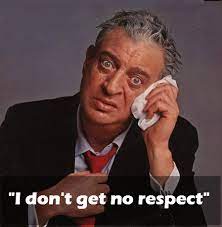
Radio, it would appear, has become the Rodney Dangerfield of media.

“We don’t get no respect.”

But then maybe, it’s a self-inflicted situation

57 Comments

Filed under Education, Mentor, Radio, Sales

You Can’t Make an Elephant into a Giraffe

Let’s face it, somethings in life are what they are. Giraffe’s have long necks and elephants have big ears, big feet and trunks. Just as pickup trucks were designed for a different purpose than speed boats. So, why do we think that radio can somehow defy the natural order and become something that it was never designed to be?

Work on Your Strengths, Not Your Weaknesses

One of the lessons I learned in classes at Clear Channel University* was how people often focus on their weaknesses and try to improve them. However, studies have shown that when we focus on our strengths, we grow faster than when we try to improve our weaknesses. Added benefits to focusing on our strengths are that we become happier, less stressed and more confident.

The cure for constantly falling short of your goals is to work on improving where you’re already strong, rather than on areas where you are weak.

Why Doesn’t Radio Focus on Its Strengths?

Entercom changed its name to Audacy, saying:

“We have transformed into a fundamentally different and dramatically enhanced organization and so it is time to embrace a new name and brand identity which better reflects who we have become and our vision for the future. Audacy captures our dynamic creativity, outstanding content and innovative spirit as we aspire to build the country’s best audio content and entertainment platform.”

-David Field, CEO

Audacy is the fourth largest radio company in America (based on the number of radio stations owned) and just like the top three radio operators ahead of them, none use the word “radio” in their name.

It was in 2010, that National Public Radio announced that it would be using “NPR” as its brand name, even though its legal name remains the same. NPR celebrated its 50th birthday in 2020, the same year that American commercial radio turned 100.

What is it about the name “radio” that has radio station owners and operators distancing themselves from this word?

Finding Your Strengths

If you want to grow your strengths, first you need to identify them. This week, Pierre Bouvard, Chief Insights Officer at Cumulus Media/Westwood One, did a pretty good job of that in his blog. While Pierre was trying to correct some misperceptions about broadcast radio, he also gave us a good place to start with identifying some of its strengths. Here are five Pierre cites:

  1. Radio reaches 88% of persons 18 years of age and older each week in America.
  2. Radio reaches the 60% of Americans who are back in their cars commuting to work every day. (The Radio Advertising Bureau says radio’s reach in the car is 83% in 2021, making it the dominate form of media on-the-road.)
  3. Radio’s audience shares are twenty-one times larger than ad-supported Pandora and ten times that of ad-supported Spotify, according to Edison Research.
  4. Radio delivers an impressive Return On Investment (ROI). Pierre says “for example, for every $1 invested in an auto aftermarket AM/FM radio campaign, there is a $21 sales return.”
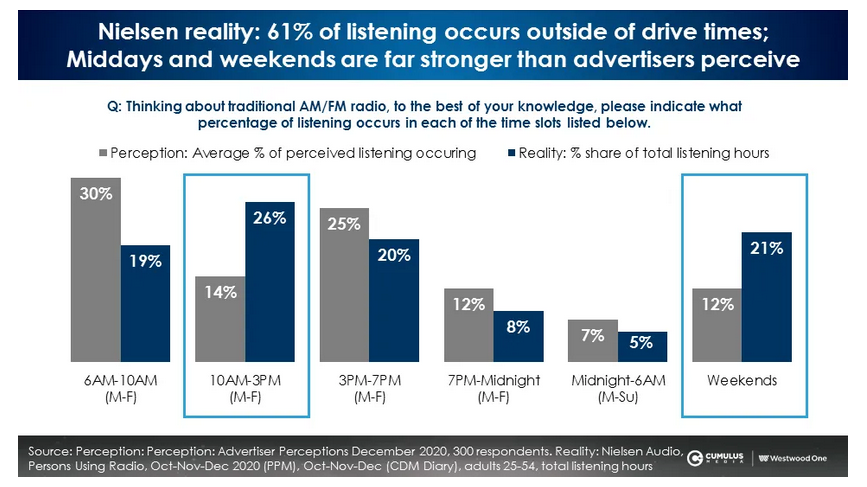
5. Radio delivers listeners at all hours of the day, seven days a week.

Radio’s Analog Audience

Lee Abrams posted a short YouTube video back in August 2020 that you might have missed explaining his “PSYCHOGRAPHIC CHART.” If you’re in radio, you should watch it now.   

View the full twelve-minute presentation HERE What I’d like to focus on is the two quadrants that Lee has labeled as “Analog Generation/Culturally Sophisticated & Culturally Unsophisticated.” These people are radio listeners. They were born with and are comfortable with analog media.

Lee makes clear that you can’t satisfy more than one quadrant. Pick one and super serve those people to the point of making what you do appalling to people in the other three quadrants.

The bottom line is that you can’t be all things to all people, but you can be everything to some people. This is really Marketing 101.

But the Future is Digital

Yes, the future of media is digital and it can’t be ignored. But you can’t make radio into something it’s not and never will be. It’s a powerful one-to-many media entity; leverage that.

The Australian Radio Network’s Neuro Lab is doing some interesting research into how a listener’s brain responds to audio, whether it’s coming from the radio, a podcast or streamed.

What should make all radio owner/operators sit-up and take notice is the fact that “radio showed the strongest ability to engage listeners and for extended periods of time, racking up 60% more neural engagement than any other audio format.” Podcasts showed higher levels of memory encoding and streaming was noted for promoting positive attitudes towards brands. You can read the full report HERE

All Audio is Not Created Equal (in the Brain)

Dr. Shannon Bosshard, the neuroscience specialist who conducted this groundbreaking research said, “This is the first time that anyone has demonstrated, from the perspective of the brain, that radio, podcasting and music streaming are processed differently and should be treated differently, in the same manner that audio and audio-visual mediums have been.”

Radio Financed TV

It was the incredible revenue streams produced by broadcast radio that were used to build out the medium of commercial television. TV also stole radio’s stars and programs, leaving the radio industry to reinvent itself and compete with television for advertising.

Today, radio is once again finding itself the “money mule” charged with funding the buildout of digital initiatives, having to sacrifice the very thing that makes radio unique in the process; its personalities. And then, just like with TV, radio has to compete with digital for advertising.

Fred Jacobs in his TechSurvey 2021 revealed how important the Radio Personality is to today’s radio listener.

But this shouldn’t come as a surprise. For generations, the radio personality has been the primary attraction drawing audiences to one radio station over another. At his peak, Dan Ingram on WABC in New York was said to be more popular to the station’s listeners than The Beatles.

Great Radio

In the end, great radio isn’t any one element, it’s all of them – personalities, jingles, promotions, station imaging, community involvement and companionship – that makes a radio station part of a listener’s family. People have favorite movies, but not a favorite movie theater; they have favorite television programs, but not a favorite television station; however, people DO HAVE favorite radio stations.

Remember that. Leverage that. Make money knowing that.

*Clear Channel University was closed in 2009

2 Comments

Filed under Education, Mentor, Radio, Sales