
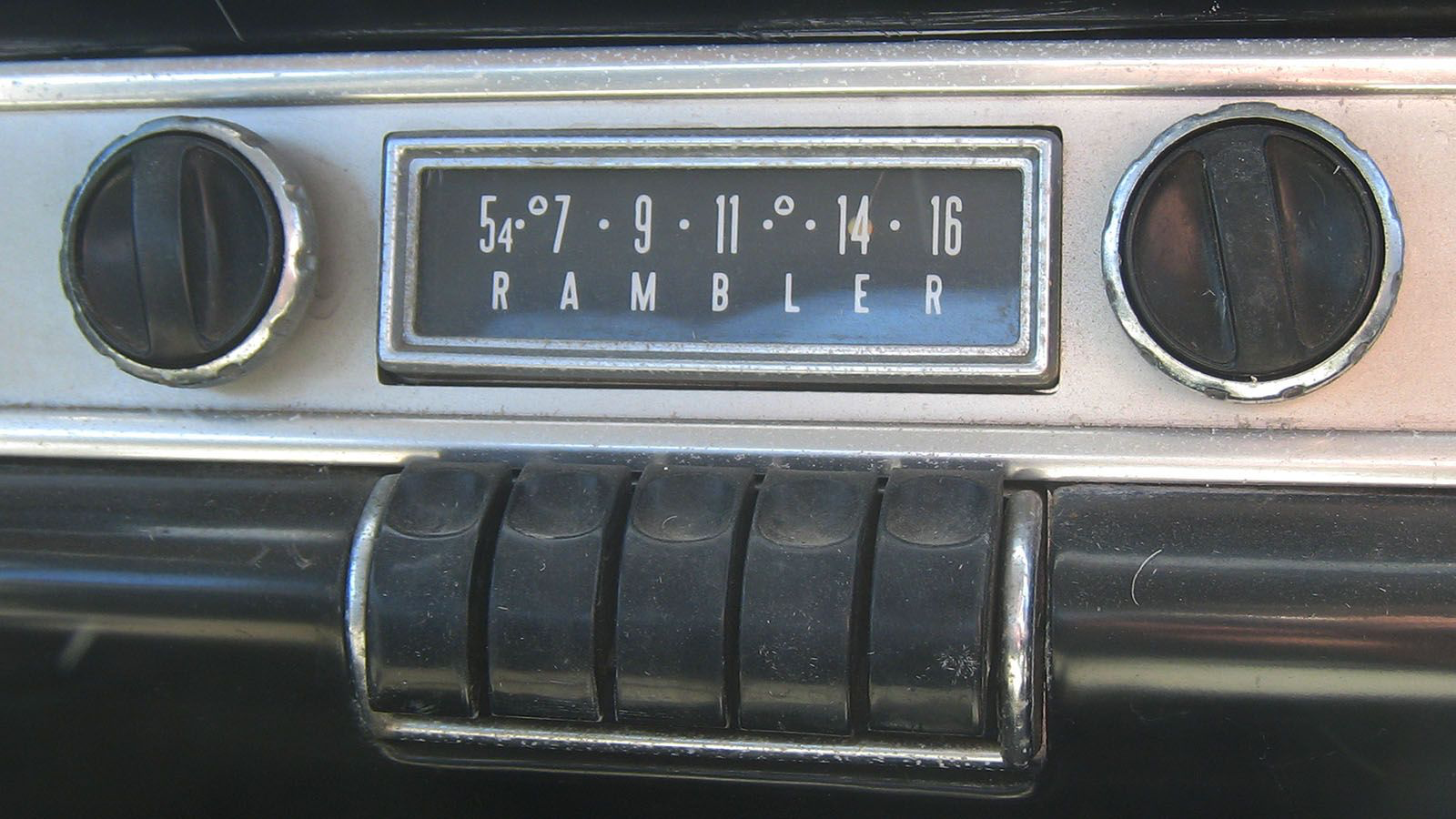
Is AM radio disappearing from new cars the issue the radio industry should be focused on?
I think not and here’s why I say that.
WBZ 1030AM
I grew up listening to WBZ AM out of Boston on my daily college commute in Western Massachusetts. Carl DeSuze, Dave Maynard, Larry Justice, Mean Joe Green in the BZ Copter with Boston traffic reports and Gary LaPierre with the news. It was truly “The Spirit of New England.”
So, when Sue and I were headed to Boston for the graduation of our son-in-law from Berklee College of Music, I put on WBZ as we left our hotel in Spring Valley, New York, and we listened to this station on our three hour drive into Boston, we didn’t listen to it on 1030AM, but via its stream on the StreamS application (App). The station, which is now an all-news operation, sounded fabulous.
The fidelity was of higher quality than FM and there was no buffering or dropout of the signal.
Once in Boston, I tried listening to WBZ over my car’s AM radio and the quality was poor, with noise and interference emanating from our surroundings.

What Does a Radio Look Like?
Back in June of 2017, I wrote a blog article asking what a radio looks like today and the most likely answer to that question was a smartphone. I also addressed in that article of six years ago, I was noticing that hotels were replacing those cheap AM/FM radios with charging stations containing a digital clock, perfect for charging smartphones, tablets and laptops.

Car Radios & The Future
Then in September of 2020, I wrote about how radios first came to be an option for buyers of new cars in June of 1930. But today’s new car buyer wants Bluetooth capabilities more than they want an FM radio; AM radio is not a must-have in 2023 according to the latest Jacob’s Media Techsurvey. What do people connect in the car with that Bluetooth, their smartphones.
What I Recently Witnessed About Radio Use
After COVID began to fade, Sue and I took a trip out to the west coast to visit our children and grand children in that part of the country. What we noticed in every hotel room we stayed was a giant flat screen TV, but no radios, just more of those charging stations with digital clocks.
This prompted another article that same year titled, “Is Radio Up Schitt’s Creek?” Sue and I became big fans of this series out of Canada, that takes place in a fictional town called “Schitt’s Creek,” and takes place primarily in The Rosebud Motel, where the shows characters use televisions, computers and smartphones, but never use a radio.
When watching movies and TV shows, I often look to see if there’s a radio in sight, noticing in British productions they often are, but not in American ones.
Once It Was Radio

When Sue and I stayed in Bethlehem, Pennsylvania we visited the museum inside the Hotel Bethlehem and found that fifty years ago, a hotel having a radio in your room was cutting edge.
The Hotel Bethlehem opened in 1922, two years after the birth of commercial radio in the United States and in 1953, it announced that patrons would enjoy a brand new AM alarm clock radio in every room.
Now seventy years later, Hotel Bethlehem features fiber optic WiFi.
Where Are the Radios?
Last year, Sue and I took a road trip through Atlantic Canada. We stayed in hotels and Bed & Breakfasts (B&Bs) throughout our trip, and found WiFi has totally replaced the AM/FM clock radios.

In Montreal, our room at the Hôtel William Gray, had a Bang & Olufsen (B&O) Bluetooth speaker that easily connected to my iPhone. The fidelity of B&O equipment is legendary and it was a joy to be able to connect any of audio Apps on my phone during our stay.
Radio Set Ownership in the Home
In American homes today, 39% don’t have a single radio set in them, and radio set ownership gets worse for young Americans age 12 to 34, where that number grows to 57% according to Edison Research.
To put this into perspective, the Federal Communications Commission (FCC), says only 6% of the population still lacks access to fixed broadband service at threshold speeds. Meaning, the internet is more accessible than broadcast radio.
Are Broadcasters in Denial?
Valerie Geller, who wrote the excellent book “Beyond Powerful Radio,” recently said
“You can sit down with a broadcaster who rails against podcasting and digital audio and artificial intelligence (AI). Then you get in the car with them, they’re using GPS, they’re listening to a podcast, they’ve got SiriusXM, they’ve got Spotify. Podcasting and radio co-exist now. That’s our truth.
Radio is its own worst enemy. We have not spent or invested in developing talent. Every other business has research and development (R&D) and they spend on it because they are investing in the future. I love radio, but I hate the state it’s in.
A lot of the voice-tracking I’ve heard already sounds like AI. There’s nothing human about it. It’s just a broadcaster playing an actor playing a broadcaster. AI is just as good as those voice-tracks because there’s nothing real being said.”
AM Radio Leaving the Dashboard
Automobile manufacturers removing AM radio from the dashboard ought to be alerting the radio industry to BIGGER PROBLEMS. The AM situation is a symptom of what we should be focused on, and that’s creating GREAT RADIO.
If you think it won’t happen to FM next, you haven’t been paying attention.
AM/FM radio sets are vanishing from hotels, B&Bs, American homes and big box retailers.
If your listeners aren’t up in arms about that, then losing AM radio in their dashboard won’t be a big deal to them either.
To paraphrase the great sales trainer Don Beverage:
Make your radio station so valuable to a listener,
that they want to hear your programming more
than you want to broadcast it to them.
 By definition, a commodity product lacks a unique selling point. Two examples of what I mean are lettuce and pencils. No one has a brand favorite of either. To the consumer of both, they’re all the same. Commodities are interchangeable with other products or services, widely available, and therefore undifferentiated except maybe by price.
 DickTaylorBlog