
 During this year’s football season, viewership to the NFL games was down. A lot of reasons were offered as to the reason why. I’m sure you have your own theories. But when it comes to the Super Bowl – “America’s party Sunday” – surely that would again show an audience increase. It didn’t.
M*A*S*H
For many years, the finale of the TV show M*A*S*H was the most watched television show, until the year that a Super Bowl would surge ahead. For a couple of years, each year the Super Bowl of that year would beat the viewership of the past year and ad rates would go up right along with the viewership. Ad clutter too.
$5 Million per 30-Second Ad
This year FOX trumpeted that it sold Super Bowl LI half-minute ads for an astounding $5 Million per ad.
Viewership to the fifty-first Super Bowl game was, like the rest of this year’s NFL season, down.
We have to go back to 2012 to see an audience this small for football’s big game.
Game Stats
Now don’t get me wrong, the NFL is still the 800-pound sports franchise to be reckoned with when it comes to broadcast. But nothing goes up forever and we may be seeing a peak.
The average professional football game lasts three hours and twelve minutes.
The average NFL game will air more than 100 ads.
The average time the ball is in play is 11 minutes.
Does this seem out of balance to you?
Super Bowl LI Ad Clutter
Media Life magazine featured this headline: “Big winner in this year’s Super Bowl: Ad clutter – It’s second-most cluttered game ever, with 51 minutes and 30 seconds”
If you’re in the ad-supported media business, this has to be concerning to you.
Ad rates can’t keep going up, ad clutter going up and audience viewership going down and expect to stay in business.
In a scholarly paper authored by Auburn University’s Herbert Jack Rotfeld he writes, “the increasing advertising to editorial ratio is causing audience inattention and consumer complaints.” And that “more effective advertising would mean that there would be less of it.”
“Abuse of audiences by intrusive advertising lowers the effectiveness of the entire communications form.”
Radio’s Ad Clutter
About a year ago this month I wrote an article entitled “Are We Killing the Golden Goose” In that article I compared the story of Aesop’s fable of the goose that laid the golden eggs to what I saw going on with the swelling advertising inventory in radio.
Radio is like a golden goose. It has the ability to deliver unlimited revenues to the bottom line for its owners. Having an FCC license was for many years considered akin to having a license to print money.
Radio is the #1 Reach & Frequency Medium
In June 2015 my good friend – and my very first Arbitron representative when I started managing radio in a rated market – Pierre Bouvard would announce that radio was now America’s #1 REACH MEDIUM.
Radio had always been America’s number one frequency medium (the ability to reach a listener with the same message multiple times) but now it beat TV and all other ad-supported media in reaching the most people too.
That’s BIG!
It’s why I’m concerned about ad clutter.
No Ad Blocking in Radio
Radio, unlike online and TV, doesn’t have ad blocking. Online ad blocking is epidemic. TV has the dreaded DVR that allows viewers to fast-forward through the ads.
Radio doesn’t have to deal with these issues, yet.
But that doesn’t mean it can abuse its audience.
Podcasting
Everywhere I turn I see that podcasting is increasing in audience size. But what I’m also reading is how effective the ads in podcasts are. Could the reason be that a single sponsor usually supports podcasts and the ad is often delivered by the very voice that also creates the content that the listener tuned in to hear?
Stephen Covey
Covey wrote in his book “The Seven Habits of Highly Effective People” “when people fail to respect the P/PC Balance in their use of physical assets in organizations, they decrease organizational effectiveness and often leave others with dying geese.”
The bottom line is the future of radio will be determined by the vision of the people leading the radio industry.
Don’t kill the goose.
 I’m not going to get into the weeds about the presidential election. But I do want to weigh in about marketing and promotion.
 This simple white on blue bumper sticker was seen on virtually every car at the Jersey Shore when I moved to Atlantic City in 1984.
 Fred and Paul Jacobs are prolific bloggers; they blog five days a week. Recently, their blog asked four questions about the future of radio. I found them interesting and thought I’d give you my answers to their questions. I’ve provided a link to their original blog post
 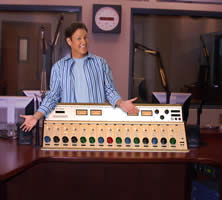 Crank it up means turning a knob. Radio people are going to have to make sure their car dealers demonstrate, or even set-up for their new car customers, how to find and lock in their local radio stations on these new digital dashboards. If the radio listener can easily find their favorite hometown companion, then they will default to what they know and love best. The reason radio has retained over 92% of its listeners is because all those new media devices mostly took out the new media device that came before it. Free over-the-air radio is unique and special. Let’s all work to keep it that way.
 DickTaylorBlog