

 A lot of people think that a new decade began in 2020, but the reality is, it’s the last year of the current decade. 2021 begins the next decade.
The 21st Century didn’t begin in 2000, but on January 1, 2001. The new millennium also began in 2001.
I think what may have confused everyone is the angst so many of us felt when the calendar turned from 1999 to 2000. I remember that New Year’s Eve so vividly because I spent it at my cluster of radio stations in Waterloo, Iowa. Why? Because virtually the entire world was anxious that their computer systems might crash at midnight.
Y2K
Did you forget about the Y2K Bug?
Y2K, short-hand for year two thousand, was a computer flaw — or bug — that was predicted to cause great problems with dates beyond December 31, 1999.
Every company worked feverishly putting in patches that were supposed to fix this problem, but no one really knew for sure if they would.
The fear was that all of our computer systems at the radio stations might not interpret the “00” as 2000 but as 1900.
New Year’s Eve 1999
The CEO of my company’s radio stations commanded that all general managers, operations managers, programmers and engineers be on duty on New Year’s Eve 1999 and be prepared to take the operation LIVE if our computers failed.
I told the staff of my four radio stations what the company plan was, and my director of sales said at that employee meeting, “If you’re going to be here on New Year’s Eve, so are we.” Shelly Routt, then began planning one of the best New Year’s Eve parties I’ve ever enjoyed at our cluster’s headquarters in downtown Waterloo.
Friday Night
December 31, 1999 was a Friday night.
What made this computer bug issue so critical at my radio cluster was, we operated all four radio stations every weekend without a single person on duty. We were fully computer automated.
On a typical Friday afternoon, when the week ended at 5pm, we locked the doors not to return until Monday morning. Think about that, we were running full automation over twenty years ago.
All those jobs that gave new radio people their start in the business, weekends and overnights, were gone.
The talent farm team system was decimated.
25 Dying Professions You Should Avoid
I guess that’s why I wasn’t surprised when a reader of this blog sent me an article from Work+ Money
about 25 professions that were going away, that BROADCASTERS was fifth from the top.

The primary reason cited was that more and more listeners prefer streaming over their local, drive-time disc jockey.
Work+Money wrote:
“One in 10 of the nation’s 33,202 radio and television announcers are expected to see their jobs disappear by 2026. Consolidation in the industry, as well as increased use of syndicated content, is fueling the decline. There’s also the explosion of streaming music services.”
Automation
As I went through the list of professions in danger, a singular reason reared its ugly head, automation. Robots, artificial intelligence – both newer forms of automation – were replacing many white collar as well as low skill jobs in the workforce.
 If your job can be replaced by a mathematical equation, a logarithm if you will, consider your future employment to be at risk.
To be perfectly clear, all broadcasters won’t be disappearing, but the profession of broadcaster will be in a state of decline.
College Degree & Broadcasting
The cost of higher education continues to soar, but the payback of a college degree hasn’t kept pace. While the price of consumer goods has increased by a factor of 4 since the late 1970s, getting a college diploma has increased by a factor of 14, according to the Federal Reserve Bank of St. Louis.
Sadly, not all degrees offer the same ROI (Return On Investment), but ironically they’re all pretty much priced the same at any college. According to PayScale a college degree in dentistry sees a dental graduate’s median entry-level salary of $118,800 versus a degree in broadcasting where a starting disc jockey or newsperson can expect an entry-level salary of $40,000.
I never went to college to be a broadcaster. Broadcasting, which I started professionally while a freshman in high school, paid for my college education; both undergraduate and graduate degrees.
What did I go to college to learn? To be a teacher.
It wasn’t until I retired from over four decades as a broadcaster that I would begin my career in education as a broadcast professor at a university.
During that time, I would witness extensive broadcast industry deregulation and consolidation and that led us to the state that broadcasting is in today.
Apprentice Programs
The radio industry needs to grow new talent. It’s time for broadcasters to have an apprentice program in place that allows youth to learn and grow as responsible community broadcasters without requiring a college degree at the outset.
Over time, the broadcast industry can provide “just-in-time-learning” programs that will allow these new broadcasters to grow and expand their skills to take on more and more responsibilities leading to senior management and ownership of radio properties.
The new decade begins in less than a year.
 I was reminded of this important statement the other day when I read an article in Radio Ink penned by Larry Rosin, President of Edison Research. Larry’s article was titled “Stop Saying ‘Still’” and you can read it
  For many of you, this past week has been a very stressful one. The world’s largest radio owner/operator, iHeartMedia, announced a countrywide Reduction In Force or RIFs. However, reading an
  “There are some things that will scare you so bad, that you will hurt yourself,” said Molly Ivins. And that’s exactly what I believe the radio industry has been doing to itself for most of its 100-year history.
 When television came along and took away radio’s people and programs that were attracting its large listening audience, it was forced to re-invent itself.
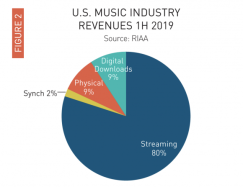 When this pie chart was posted on social media, it immediately captured my attention, by showing where the United States Music Industry is making its money. You can read the Mid-Year 2019 RIAA Music Industry Revenues Report
  On this last Sunday of 2019, it’s tradition to look back at the year just past and share with you the Top 5 Most Read and shared blog articles of 2019. Maybe you missed them or perhaps you’d like to read them again.
 It’s not unusual for little boys and girls to ask the question “Why?” They ask it a lot.
 By definition, a commodity product lacks a unique selling point. Two examples of what I mean are lettuce and pencils. No one has a brand favorite of either. To the consumer of both, they’re all the same. Commodities are interchangeable with other products or services, widely available, and therefore undifferentiated except maybe by price.
 I often wonder if today’s youth would gravitate to the style of radio that attracted me to make radio broadcasting my career for five decades. Would they be attracted to a Dan Ingram, Robert W. Morgan, Dave Maynard, Ron Lundy, The Real Don Steele, Big Ron O’Brien, Larry Lujack or any of the countless other personalities that so influenced me as I was growing up?
 AM radio. Mine was a Zenith Royal 50 that came with an ear phone, that allowed me to listen to the Red Sox while in elementary school or to radio stations from far, far away after it was ‘lights out’ and I was supposed to be asleep.
 That got me to thinking that maybe a new radio format could be created bringing back deceased personalities like Robert W. Morgan, Dan Ingram, The Real Don Steele, Big Ron O’Brien, Ron Lundy, Larry Lujack among other greats by using the power of artificial intelligence. These incomparable radio personalities would “live again” via talented writers and programmers who would tell them what to say. Can you imagine how it might sound?
 DickTaylorBlog