

 For the past half-dozen years, I’ve had the opportunity to work with college students looking for a career in radio. It’s made me think about my own radio career and college education. Let me share with you some observations.
Recruit in High School
Most of the people I know who got into radio did what I did, built a radio station in their parent’s home and began broadcasting to their neighborhood. I did that in the 7th grade; junior high school. By the time I was in the 10th grade in high school I had earned my 3rd Class Radiotelephone Operators License, Broadcast Endorsed from the Federal Communications Commission, got my work permit from my state government and was working weekends at one of my local commercial radio stations.
Students today are more advanced than I was when I was their age, yet the broadcasting industry doesn’t start recruiting these days until young people are getting ready to graduate college. Why?
Bachelor’s Degrees
So many radio jobs I post on my “Sales Jobs Board” require a bachelor’s degree. Why?
My entire radio career I had a bachelor’s and a master’s degree and not one broadcasting company I worked for ever asked me about them. It wasn’t until I pursued teaching at my current university that anyone ever asked about my degrees or to provide them with copies of my transcripts showing my GPA – I graduated Magna Cum Laude as an undergrad and was president of my college Honors Society and my GPA in grad school was a 4.0, a perfect score.
Close to 2 million students are today graduating with their bachelor’s degree and sadly are working at Starbucks just like they were before they earned their degree and amassed a ton of student loan debt.
And when I think about it, that’s what I did too. I went from working in radio part-time to pay for college and then upon graduation from graduate school went into radio full-time as a program director/operations manager/air talent. The big exception being I did it with no student loan debt because college was more affordable then than it is today.
College Education
I’m not saying a college education isn’t important; it broadens you in ways that don’t pay an immediate return on your investment. In college I really came alive as a student and developed the love of life-long learning. However, nothing I learned in college meant a hill of beans to my career in radio.
I learned programming and operations through regional and national broadcast conferences and by doing the job.
I learned sales, sales management and general management by more regional and national sales conferences plus the radio company I went to work for in sales was a very immersive sales learning environment. We were members of the Radio Advertising Bureau and the International Broadcasters Idea Bank and my owner took his entire sales/management team to learn from every sales trainer that got with a hundred miles of our property.
Just In Time Learning
What I had was basically a form of “just in time learning.” Just as manufacturers learned not to stock parts but to have them arrive at just the moment they were needed in the manufacturing process, is exactly how I learned the radio business, one piece at a time from the ground up.
The way higher education is today is like stocking parts in the days of manufacturing yore. So much knowledge is acquired that may never be used or when it is needed may be sorely out-of-date.
Our 20th Century higher education system simply wasn’t designed to deliver what’s needed in a 21st Century world.
Where to Find Radio Talent
If you want to find radio talent you should be in the high schools, middle schools and elementary schools of your community. I really believe you can’t start too young in cultivating the radio talent you will need in the future. But waiting until our youth graduate college is simply too late.
Economically, this makes sense for both radio operators as well as students. A young person graduates high school with zero student loan debt; unlike a college student that accrues tens of thousands of debt in college.
As your young employee grows, your radio station could then support more formal education with your local community college, university or professional training through broadcasting’s professional organizations like the National Association of Broadcasters or the Radio Advertising Bureau. When the student is ready, the additional education is provided.
Wharton & Wizard Learning
I paid to attend the Wharton School in Philadelphia as part of the RAB’s Sales Management Training; training so good that I used it for the rest of my professional radio management career and at the university in my classrooms.
Roy H. Williams’ Wizard Academy was inspirational, motivational and exceptional in learning more about selling radio and writing persuasively (something not taught in colleges, except in my sales classes).
Degrees, Wisdom or Experience
Colleges and universities have no metric for wisdom or experience when it comes to hiring/retaining professors. They hire/retain based on degrees, not experience or wisdom or teaching ability.
Broadcasters could care less about degrees, what they care about is results. If you’re an air talent, can you get ratings? If you’re a sales person, can you make sales? Those are the things that are important to broadcasters.
Where once upon a time universities were measured by enrollment numbers, the metric is moving to one of graduating students and improving the graduation rates; which were anywhere from 27% to 60% for students graduating after six years at four year institutions.
Colleges need to change the way they hire/retain faculty in the 21st Century as the focus goes to getting results versus just filling seats in classrooms.
Unfortunately while what employers’ needed never perfectly aligned with what a college education prepared graduates’ skills for; the mismatch in 2016 has reached a tipping point. All the more reason that the broadcast industry needs to re-think how it recruits talent and when it begins the process.
Broadcasting is a great business, but it’s a people business that needs to attract talent to stay great.
 “Well, here’s another nice mess you’ve gotten me into.” Variations of this line were always a part of Laurel and Hardy movies. In fact, the pair made a film in 1930 with the title “Another Fine Mess.”
 This is not a blog about politics. It’s a blog to mentor people about media.
 The radio show was close to home this year, just down the road from my university, in Music City USA, Nashville, Tennessee. Plus, the Tennessee Association of Broadcasters decided to roll their annual convention into an opening event at the Radio Show. So as soon as I finished my morning class, I was on the road to Nashville.
 Everyone wants to know what the future for them will be. It’s why fortune tellers with crystal balls and astrology forecasts have been so popular.
 I’m not a shopper. I admit it. Shopping for me is work. When I do shop, I like places like Costco because while they offer choices, they don’t offer so many as to overwhelm. I like stores that do the “heavy lifting” for me and give me a selection of the best to pick from.
 I worked for Clear Channel for five years. As best as I remember, not a meeting went by that John Hogan wouldn’t say “we’re not about tall towers in big fields anymore.” And as I watch radio companies all across America selling off their radio towers, I think that day has come to fruition.
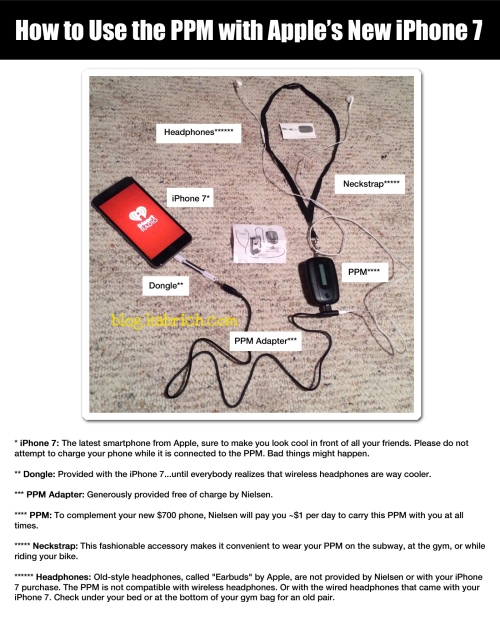 and you really should read all that Randy has to say on the subject with his article on Tom Taylor’s NOW
 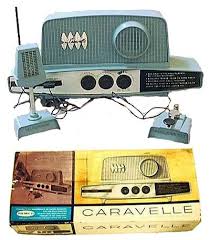 I loved being a general manager of radio stations. It wasn’t the job that first attracted me to radio however; it was to become a disc jockey. From as far back as I can remember I wanted to be a DJ on the radio. My first radio microphone was made out of tinker toys. Then I got a Caravelle (pictured) transmitter for Christmas from Santa Claus and I took to the air waves.
 I know that radio needs to be planning for the future and the future is not going to be like the past. However, to ignore the present makes no sense to me whatsoever. Here’s what I mean, take a look at this quote:
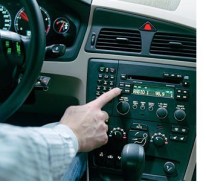 News is about the exception. A car driving down the main street of your hometown is not news. But let that “radio on wheels” run into something and that’s news.
 DickTaylorBlog