
 In 1963, Bob Dylan wrote the song “The Times They Are A-Changin” which would become an anthem for frustrated youth who were anti-establishment and wanted change. This marked the beginning of the upswing of a “Me” cycle. 1963 was the rise of the Baby Boomers, a generation that would grow to seventy-four million teenagers at its peak. A generation raised on radio.
The Rosetta Stone
Before Napoleon Bonaparte discovered the Rosetta Stone in 1799, no one had a clue how to read Egyptian hieroglyphics. But that four foot tall stone had engraved on it the same story in three different languages, two of which scholars knew how to read.
Today, we live in a world where everyone is concerned about the rapid changes being brought on by the COVID-19 global pandemic. But our world is changing in ways that go beyond the impact of a novel coronavirus, it’s also a societal time of change in America, change that will continue even after a vaccine has been discovered that will quell this out-of-control virus.
Come gather ’round, people
Wherever you roam
And admit that the waters
Around you have grown
And accept it that soon
You’ll be drenched to the bone
If your time to you is worth savin’
And you better start swimmin’
Or you’ll sink like a stone
For the times they are a-changin’
The “We” Zeniths
In 2012, Roy H. Williams and Michael R. Drew came out with a book titled “Pendulum, How Past Generations Shape Our Present and Predict Our Future.”
The essence of the Pendulum hypothesis is that society follows a predictable oscillation, meaning a pendulum that swings between a “We” zenith and a “Me” zenith. Understanding this oscillation will give us insight into the forces that drive the decisions the public makes.
“Predictable, rhythmic attractions are what move our society. Rhythm is intrinsic to the human experience. Feet patter, hearts beat, lungs breathe, planets circle, and seasons cycle to a rhythm. Music, poetry, and dance are built upon it.”
-Roy H. Williams & Michael R. Drew
Some of the “We” zeniths the book Pendulum describes:
- 1783 America wins Revolutionary War
- 1863 American Civil War
- 1943 Adolph Hitler – The Holocaust
{Each “We” zenith is 80-years apart}
Pendulum points out that “virtually every instance of widespread viciousness in Western society has happened within ten years of the Zenith of a “We.” It should be noted that a complete oscillation of the pendulum takes 80-years and that 2023 will mark the zenith of the current “We” period in the Western world.
“We” periods can be defined as “I’m OK, You’re Not OK,” and “Me” periods as “I’m Not OK, You’re OK.” “We” periods are times of witch hunts, “Me” periods are times of hero worship.
According to this book, marketing becomes very easy as we approach the zenith of the “We,” and all one needs to do is “choose what and who you will demonize, and then start tossing fear-soaked words as though they were longneck beer bottles full of gasoline with fiery rags stuffed down their throats.” Does any of this sound like the world we’re experiencing today?
Human Change vs Other Change
We live in a world where the speed of change feels like it is constantly accelerating, and on a technology level it is, but deep human change does not; like the speed of change of the trees, which is not controlled by technology.
Plant a tree and monitor its growth, it appears to not change by the day, but come back in 10-years, 20-years or 40-years and the changes will be obvious. Technology and the internet have done nothing to change the natural cycle of change.
What we can hope for is that the 21st Century’s instantaneous global communication might mitigate the negativity and viciousness as we approach the zenith of the current “We” cycle.
Come writers and critics
Who prophesize with your pen
And keep your eyes wide
The chance won’t come again
And don’t speak too soon
For the wheel’s still in spin
And there’s no tellin’ who
That it’s namin’
For the loser now
Will be later to win
For the times they are a-changin’
What Does It All Mean for You?
We’re seeing people demanding authenticity and transparency in all things. We’ve given up our liberties for the perception of security and given up our privacy for convenience.
The future of education will be about creating new pathways to wealth, and re-creating a middle class, as our current world has been bifurcated in to “haves” and “have-nots.”
How Do You Market in a WE Cycle?
You write “pull” messages, rather than “push” messages from now until 2043 for all of Western society, Williams and Drew write. What’s the difference you ask? Push messages are based on a ‘needs analysis’ and ‘over coming objections,’ where as pull messages build relationships through positive attraction. Social media via the internet is a relationship-building tool. The internet by serving up only what’s requested, is in essence a “pull” medium. Radio, television, newspapers, magazines, and outdoor are all “push” mediums.
People who attempt to “push” their messages with pop-ups and other methods on the internet are met with anger by the consumer.
How could your radio program attract an audience with seduction? How could you romance your listeners to want to spend more time with your radio station, its website and/or podcast?
Time is money is the name of the game in a “We” cycle. As Williams and Drew put it, “Whoever wins their time is the one most likely to win their money.”
The line it is drawn
The curse it is cast
The slow one now
Will later be fast
As the present now
Will later be past
The order is rapidly fadin’
And the first one now
Will later be last
For the times they are a-changin’

Pendulum by Roy H. Williams & Michael R. Drew
 South from where I live, is a little community by the name of Bumpass, Virginia. As far as I can tell, the FCC have never licensed a radio station to this little community of 8,792 people.
 and perspectives. It also works with some of the country’s largest newspapers, magazines and television networks to broaden its scope of news coverage.
 Two such operations that come to mind are: “yourKawarthaOLDIES.com” and “1059WMEX.com” that are filling a gap left by Big Box broadcasters. WMEX-FM
  recently added an LPFM to its operation, this allows locals in Rochester, NH to hear the station easily when in their cars.
 Once upon a time, radio was pretty much like the TV show The Voice. We only knew what we heard coming through the speaker on our radio.
 BIA Advisory Services conducted a rather insightful webinar at the beginning of the COVID19 pandemic. While every media sector was predicting huge downturns in sales revenues, what struck me most were comments like, ‘but radio sales executives are the most pessimistic,’ or ‘23% of radio sales people don’t feel they
 will be employed by the same company in six months.’
 Your local radio station, like your hometown newspaper, depends on local businesses and their advertising dollars. Eighty to ninety percent of their ad revenues come from local businesses, those small “mom & pops,” as we like to call them.
 day we see another local business decide to close down permanently rather than sink further into debt.
 People are adapting to working from home, home schooling their children and doing things like baking, learning to play a musical instrument, streaming their audio, video and print content. Our habits are changing and it’s quite likely they will become permanent.
 I hope you are enjoying this holiday weekend celebration of America’s independence 244-years in the making.
 joyous time for the staff and management at that radio station. It was only four years earlier that WOWO signed on the air for the first time in its storied broadcast history, March 25, 1925.
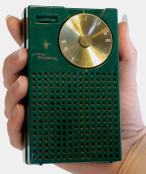 It was a joint venture between Texas Instruments and Regency Electronics that would produce the world’s first transistor radio, the TR1, in 1954. However, it wasn’t until three years later when SONY would introduce its smaller and cheaper TR-63 transistor radio that this new communication device would become the 1960s/70s mass market success story.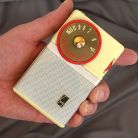

 The successful television sitcom “Seinfeld” debuted on the NBC television network. The show “about nothing” ran for nine years and has grossed more than $4 Billion, making it the most profitable half-hour television program in history.
 Each new generation of technological development has moved media consumers away from traditional broadcast radio’s position as the leader for reaching the masses with new music, news and cultural trends.
 “It ain’t over, till it’s over,” one of the many phrases made popular by Yogi Berra kept popping into my mind as I sat in on several webinars these past few weeks. COVID19 is not over, so why are people acting like it is? We can expect that we will be living with this virus through all of this year and through most of 2021.
 On November 9, 1965, around 5:21pm in the afternoon, WABC listeners heard something unusual coming through the speakers on their battery powered transistor radios. WABC was playing Jonathan King’s “Everyone’s Gone to the Moon,” but it sounded different. It sounded like it needed a shot of Geritol, as the recording turned slower and slower. Even WABC’s famous chime was off key, and popular afternoon personality Dan Ingram tried to make fun of what was happening. You can hear that moment by clicking
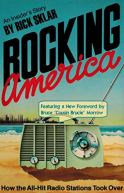 Rick Sklar wrote in his book “Rocking America” that the blackout helped him to focus his attention on technical reliability. “A station can have the best mix of music and the top jingles, but if the tapes break, the cartridges jam, or the music fidelity is off, the ratings (aka audience) begin to evaporate,” Sklar wrote.
 Would you invest more money in a company that takes your money and won’t refund it during a global pandemic, instead preferring to hide behind policies designed for the way things used to be before COVID19?
 In August 2015, the high school classes of PHS, THS and SJHS held their 45th class reunion. The weather was spectacular and members of all three high schools traveled back to The Berkshires to laugh, reminisce and enjoy good times together. We parted knowing that our next reunion, would be the milestone golden reunion.
 through a new Junior Achievement program, I would take my first steps into a commercial radio station. I would pass my FCC broadcast license exam six months later, landing a position as a commercial broadcaster.
 Growing up telling mom or dad that I wanted something now, got the usual response of “you will have to work for it” or “you’ll get it when it’s ready.” Learning that good things come to those who wait was part of my maturing process.
 Is there a lesson for radio broadcasters from what I just shared about television viewing habits? I think there is. Programmer Steve Goldstein puts it this way, “Traditional radio – by design – is a lean-back business. Podcasting is a lean-in business.” That perfectly describes the difference between Netflix (lean-in) and broadcast (lean-back) commercial television.
 DickTaylorBlog