
 On this Easter Sunday morning, I’m still processing the pictures etched into my brain of Notre Dame Cathedral, in flames. This 856 year old church, is the most visited structure in Paris, eclipsing the Eiffel Tower.
Like many people around the world, I sat in front of a video screen watching the efforts of 400 French firefighters trying to contain the inferno.
In a world that seems out-of-control, the raging flames destroying this icon seemed like a metaphor for our lives.
“Built in the Gothic era, destroyed in the social-media era.”
-Rachel Donadio, The Atlantic
This quote by Rachel resonated with me because it made me think of some similarities between the radio industry and the history of this great cathedral.
A Short History of Notre Dame
Notre Dame was a masterpiece of French Gothic architecture. It was built in the middle ages with the structure largely completed in 100-years. It would take another 100-years to see the cathedral take on more of the shape we had most recently known.
Over the centuries, Notre Dame would be badly damaged, first by the Huguenots, and then again during the French Revolution. Napoleon would order the church’s restoration and hold his coronation there as Emperor in 1804.
By the 19th Century, Notre Dame was again half-ruined inside and badly battered. It was even used as a warehouse, and there was talk of just tearing it down. A novel by Victor Hugo titled “Notre-Dame de Paris” (published in English as “The Hunchback of Notre-Dame”) would bring the cathedral new attention, and in 1844 King Louis Phillippe ordered the church’s restoration.
Notre Dame would survive two world wars, but during the 20th Century the cathedral would be battling air pollution and a lack of interest in funding the maintenance of this aging structure.
In late 2010s, it was estimated that $113 million in renovations was needed to preserve the cathedral. Only late last year had work begun on the spire.
A Short History of Radio
Radio was a communications masterpiece. The spoken word and musical art forms of radio broadcasting would spread knowledge, culture and entertainment like the world had never seen.
Commercial radio born in 1920, would quickly become the must have device in every American household. It was the “Golden Age of Radio.”
Radio was first challenged by the birth of television in the 1950s and the migration of its talent and programs over to TV. Like Notre Dame, there were many who thought radio had come to an end and that television had replaced it. But radio broadcasters with vision, renovated radio broadcasting from its block programming and national broadcast networks into a variety of formats that would be curated by the radio personality, known as the Disc Jockey or more simply the “DJ.”
Radio was now in what would be called its second “Golden Age.”
Like the great cathedral of Notre Dame, radio would be challenged by its own particular battles over its life. Things like the 8-track tape, cassette tape, compact discs and the ubiquitous CB radios of the 1970s, all these challenged radio in a place it had long enjoyed dominance, the automobile.
As Rachel Donadio so prophetically observed, radio and Notre Dame were seeing their own type of destruction in a social-media 21st Century world.
Money for Disasters but Not for Maintenance
One of the things we have learned from the fire at Notre Dame is that while it was near impossible to find donors to fund needed maintenance and restoration of the cathedral, the disaster of April 15th has secured hundreds of millions of dollars for the full restoration of this great iconic church.
I’m sure that Notre Dame will be restored to a glory even greater than before the fire.
Radio & Cooking Frogs
On the other hand, radio isn’t going up in flames. There will be no live, continuous television coverage of radio’s destruction. Most people don’t even realize there’s a problem. 9 in 10 people still are counted as weekly radio listeners.
Radio’s situation is more akin to the way you cook a frog. Throw a frog into a pot of boiling water and it will immediately jump out, but put the frog in a pot of water and slowly raise the temperature and the frog will be cooked without realizing it.
Radio’s Restoration
My heart sinks as I read how important the radio personality is to the future success of the radio industry, and at the same time read about how decades long radio people are being eliminated with job reductions on almost a weekly basis.
If all radio stopped tomorrow, people would spring into action to save it, just like they are doing for Notre Dame.
Radio, like all local, independent media, plays a vital role in our lives, our democracy, and our future.
Can you feel the water getting hotter?
 Traditional habit patterns used to be that as people grew older, they grew into the same habit patterns as their parents. Things like reading a newspaper, watching the evening television news, becoming involved in their children’s schools, the community and listening to radio. But new research says, those patterns have been upended by what else but, the internet.
 I sat on a webinar the other day and when it ended the first thought that crossed my mind was, they’re not talking to me. Their demographics in the study capped at 55-years of age. Really? No one over 55 matters to radio or to radio advertisers?
 Gordon Borrell recently hosted a webinar that hit on the highlights of his #LOAC2019 (Local Advertising Conference) held in New York City. The shocker, for me and many others came when Gordon said the future for media expenditures would be a process of “thinning the herd.”
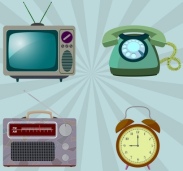 Growing up in the 20th Century, things looked like what they were. Telephones were easily identified as telephones. Television sets were easily identified as televisions. And radios were easily identified as radios.
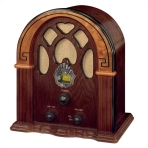 our social media pages. In my case, it’s a cathedral style radio made popular back in the 1930s. A style of radio I never owned until I received a retro transistorized version at a company manager’s meeting back in the late 1980s.
 on their phones, I wondered if the new icon for radio might be just that, a smartphone device. But then, this same device could also represent a TV, a camera, a movie camera, a book, a newspaper, a magazine…well you get the idea, a lot of media was instantly replaced by this singular device.
 never had. She’s always there, waiting for me to call her name and fetch for me whatever I need, be it the latest news, weather, wind chill, traffic conditions, music, and more.
 These days, radio still dominates in the car, and the vehicles being produced today feature entertainment systems. These dashboard entertainment centers are loaded with unprecedented engagement capabilities and each one is accessed by an identifying App. Companies like Pandora and Spotify are providing a content rich environment to take full advantage these entertainment systems.
 Albert Einstein said “We can’t solve problems by using the same kind of thinking we used when we created them.”
 In a lot of ways, the future is here, now.
 Roger Miller was a very creative guy. His 1966 hit song, “
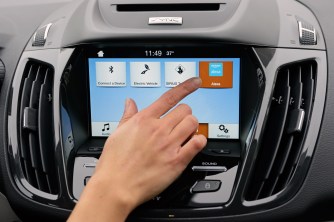 Radio’s last bastion of domination is the automobile (aka SUV, pickup truck etc.). In the home, voice activated devices are replacing AM/FM radios. I own 3 Echos, and Alexa has become a real friend of the family.
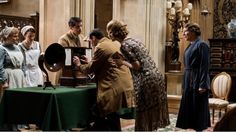 I know that Downton Abbey premiered on PBS back in 2011, but at that time I was doing my own “Mr. Molesley career transition” (more on that in a moment) – from radio management to broadcast professor – in addition to moving from New Jersey to Kentucky, I didn’t have a whole lot of time to watch the series. Amazon Prime changed that for me in 2019 when I noticed it had made available the entire six seasons (52-episodes).
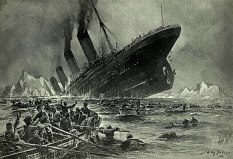 of the Titanic also set in motion more intense regulation of wireless communication for ships at sea. The Wireless Ship Act of 1910 only required ocean-going ships to carry radio equipment when visiting the United States and only required a single radio operator. That was amended after the Titanic sank in 1912 to include vessels traveling on the Great Lakes in addition to those on the oceans, plus requiring two radio operators with the wireless being manned around the clock.
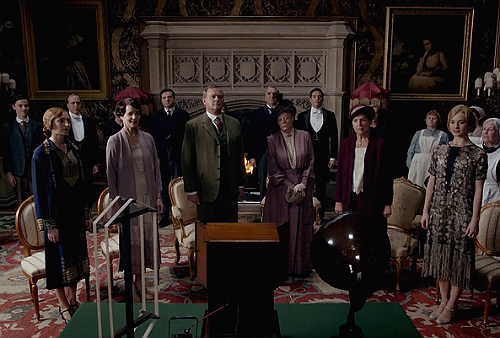 The scene could not be more amazing, seeing everyone gathered around the awkward looking device in the great hall, much as many Americans do for a Super Bowl, waiting to hear the King. When he comes on, the family all stands at attention, in much the same way they would if they were in his presence to hear him speak.
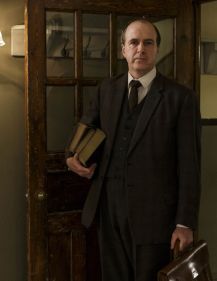 Getting back to Mr. Moseley, he’s a fine example of what I mean and how we are similar. The downsizing he encountered saw him go from a trained butler to a second footman to a laborer in the streets. He saw his working life as a series of steps down and not one that was advancing in stature and pay. But Mr. Moseley loved learning and once dreamed of being a teacher. An encounter with the local headmaster of the town’s school led Moseley to taking a series of exams which proved him to be an exceptional scholar and he was then awarded a teaching position with the school. Moseley’s life was now moving in a direction he only previously dreamed about.

