
 It’s the Sunday after Thanksgiving and you’ve probably had too much to eat. It won’t be much longer before it’s time to make New Year’s resolutions and many will again make losing some of those extra holiday pounds their goal in 2019.
But, that’s not the “weight” problem I want to address today.
Actually, it’s America’s WAIT problem.
Everyone’s in a Hurry
I guess one of the benefits about being retired is that it gives you a chance to hit the pause button on your life and bear witness to everyone else around you. Unfortunately, what I’m seeing is a world where everyone’s in a big rush to get somewhere. On the highways, traveling the speed limit, makes one feel like a road obstruction.
My GPS
Once upon a time, I used to push the speed limit. I even had a radar detector on my dashboard. But all that darn thing did was make me anxious. It gave off lots of false alarms and I finally got rid of it. No one seemed to get pulled over for going 5-miles over the speed limit, I thought, so who needs a radar detector anyway.
Then I got a GPS. I quickly learned that going 5-miles under the speed limit got me to my destination about the same time and I could drive all the way using cruise control, hardly ever touching the gas or brake. Driving everywhere has become such a pleasure.
Maybe everyone should have a GPS to show them slowing down is a positive, and makes our highways a safer place for everyone.
Skip Button
America’s wait problem extends to so many places.
Disney offers a fast pass at their parks to allow patrons to get into their favorite attractions faster. Supermarkets offer self-checkouts or carts with handheld scanners to allow their customers to get in and out of their markets quicker.
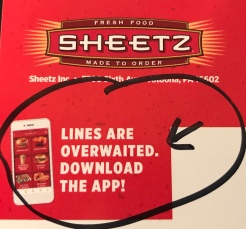
Sheetz (a gas/convenience store chain in our area) sent me a post card asking if I’d like to download their App because, as they put it “lines are overwaited.”
Pandora, Apple and Spotify offer listeners a “skip button” to bypass songs they don’t want to hear, and allow them to get to the next song faster. They all seem to limit this feature to about six songs an hour and users think this limit is too low from what I’m reading.
Short Attention Spans
Short attention spans seem to be affecting everyone these days. It’s probably the underlying cause of “America’s Wait Problem.”
Technology Enables Wait Problems
I remember having a six-transistor radio as a youth. It had two dials on it, one for volume and the other to change the AM frequency the unit could receive. Our television set at that time was connected to two antennas on top of our house, one for the NBC TV station and the other for the CBS TV station in our area. If you wanted to change TV stations, you got off the couch to turn the dial.
Then, radios got presets for the growing number of AM and FM stations that were on the air, and television sets got remote controls and became connected to a cable that offered a myriad of TV channels.
Today, the NFL offers a channel that keeps switching to every scoring drive around the league.
If you didn’t have a short attention span as a child, you’re acquiring it as an adult in today’s media world.
Why Most Songs are 3 to 5 Minutes Long
The first records were 78s. They were called that, because the discs spun around at 78 revolutions per minute. The 10-inch 78s could hold about 3-minutes’ worth of music and the 12-inch 78s could hold about 4-minutes.
In 1949, RCA introduced the 45-rpm discs with those huge holes in the middle. Like the 78s, these new records also could only hold about 3 to 4-minutes’ worth of music.
In spite of the fact that as technology took away such time constraints, artists knew if they wanted radio airplay, they had to keep their songs in that 3 to 5 minute zone.
Oh sure, there were exceptions; “Hey Jude” by the Beatles and “MacArthur Park” by Richard Harris come to mind. Back in the day many DJs called them bathroom break songs.
Some radio operators in Canada and Australia tried cutting song lengths in half, saying it was because their “listeners attention spans suck.” A format called “QuickHitz” launched in the USA in 2012 and limited the length of every hit song played to just 2-minutes. John Sakamoto, a staff reporter for Canada’s STAR newspaper wrote: “Once you get over the initial outrage, it actually makes perfect sense. Our attention spans are short, four minutes seems like an eternity, therefore something designed to capture our attention — say, a pop song — should be twice as good at half the length.”
SPOILER ALERT: That Calgary radio station John wrote about quickly abandoned the format calling it an “interesting experiment.” You can read the rest of the story HERE.
Wait a Minute
And there, in essence, is our problem as a society today. We can’t wait. Not even a minute.
We want it, when we want it, on the device we want it on, and we want complete control over it, once we have it.
This is the 21st Century media challenge for all of us.
 On this Sunday before Thanksgiving, I’d like to take a time-out from my normal blogging topics and reflect on all of the things in my life I have to be grateful for. Hopefully, it will bring to mind similar thoughts about your life this past year and those things you have to be grateful for too.
 There are lots of items in the news these days about what the radio industry should be doing. Streaming, podcasting, smart speaker accessible etc. The one thing I hear little talk about is, improving the core product and focusing on what the listener is seeking.
 Remember when the rock group, The Buggles, introduced a new cable TV channel, MTV (Music Television) with the song “
 Radio used to really promote its greatest asset, its radio talent. WHDH in Boston promoted itself as having “New England’s Finest Radio Entertainment 24 Hours Every Day!” The “Big 5 on 85” print ad featured Jess Cain, Fred B. Cole, Hank Forbes, Bob Clayton and Norm Nathan, as their air staff, and never mentions what kind of music they play, or news they featured or anything else the radio station did. WHDH was not alone in doing this. Every radio station promoted its talent line-up. Radio air talent WAS the reason people listened.
 For the radio listener, your next break is all that matters. Does it speak to your listener? Does it have relevance to your listener’s life right this second? How do you know?
 Is the retail industry dying?
 This past Friday, October 12th, was my 66th birthday. Notable because according to Social Security I’m now at “full retirement age.”
 Simon Sinek says people don’t buy what you do, they buy
 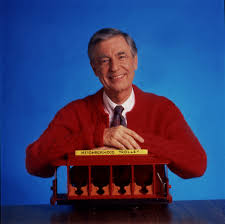 I didn’t grow up watching “Mister Rogers Neighborhood.” The television in my family’s house was connected to two different antennas that each picked up a single television station. One TV station was affiliated with the NBC television network and the other with the CBS television network. My childhood mentor was Captain Kangaroo. Bob Keeshan’s broadcast was on commercial television, so I was also exposed to products such as pre-sweetened Kool-Aid, where the “sugar, sugar, sugar…is already in it.” Sad, that I remember that sell line over 50-years later, more than any other lesson taught by that show.
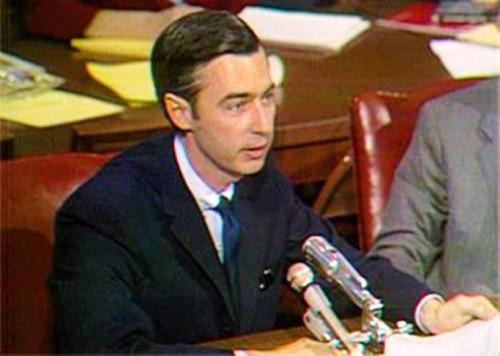 On May 1, 1969, Fred Rogers appeared before Senator John Pastore’s Senate committee to explain why they should continue to fund PBS (Public Broadcasting System) for another term at a cost to the taxpayers of America of twenty million dollars. If you’ve never seen Mister Rogers’ testimony, I encourage you to stop, and take a moment to view it now. Click
 This past week, news spread that Brother Bill Gable had died. For many of us, it was the time he broadcast over The Big 8 – CKLW out of Windsor-Ontario, Canada that endeared him to our hearts. His best friend, Pat Holiday shared a story about what made Brother Bill and the rest of the air personalities at CKLW essential radio listening. Pat wrote:

It Was Always a “Good Day!”
He broadcast six days a week, just like all radio personalities did back in those days. It was a time when all radio was delivered LIVE. Paul Harvey was heard over the ABC Radio Networks with his News and Comment week day mornings and middays. His Saturday noon-time broadcasts were extra special broadcasts that were always sure to surprise and delight his audience of as many as 24-million people a week. Paul Harvey News was carried by 1,200 radio stations in America, plus 400 American Forces Network stations broadcasting all over the world.
Page 2
The first commercial break in each broadcast was clearly announced with the words, “now page 2.” And it caused me to turn up my radio and give Mr. Harvey my full attention as he told me about another great product that he personally used. The ad copy, just like the news and comments, were all crafted by the mind of Paul Harvey.
I bought my BOSE WAVE radio due to Mr. Harvey telling me how wonderful music sounded coming through its speakers and baffle system design. It started me on the path to owning several BOSE products as a result.
Paul Harvey News had a waiting list of sponsors to get on his program. In 1986 his News & Comment broadcasts were rated #1, #2, #3, #4 and #5 in network radio programs when he was the focus of a CBS 48-Hours broadcast commemorating Paul Harvey’s 70th birthday.
Bob Sirott did the profile piece and it showed Paul Harvey as few ever saw him. I encourage you to watch the segment on YouTube by clicking HERE
Paul Harvey News
On April 1, 1951, ABC Radio Network premiered Paul Harvey News and Comment. His Chicago based broadcasts were often called “the voice of the silent majority” or “the voice of Middle America.”
Paul Harvey was making so much money for ABC, they added a third daily broadcast to the schedule on May 10, 1976 called, The Rest of the Story. These broadcasts were written and produced by Paul’s son, Paul Harvey, Jr. for its 33-year long run.
While Paul and his son maintained this entertaining feature which was based on true stories, not all critics agreed, including urban legend expert Jan Harold Bunvand.
I know from my own personal experience of the two times Paul Harvey included stories based on my hometown of Pittsfield, Massachusetts, that Mr. Harvey played fast and loose with the facts of the events to tell a good story. It made me wonder how all the other stories I heard might have been so “massaged.”
Iowa
In 2000, I was managing a cluster of radio stations for Connoisseur and Cumulus. We carried Paul Harvey on my 100,000-watt KOEL-FM. It was the only thing, other than local news in morning drive, that stopped the flow of the best in country music.
I remember being in my car at the time Mr. Harvey’s noon-time broadcast came on the air and hitting the scan button to hear Paul Harvey News and Comment on virtually every station my car radio stopped on. In media, that’s called a “road block,” the same program or advertisement, broadcast at the same time on multiple radio or television stations.
$100 Million Dollar Contract
In November of 2000, Paul Harvey had just inked a new 10-year contract with ABC Radio Networks when a few months later he damaged his vocal cords and had to leave the air. It wasn’t until August of 2001 that Paul returned to the air waves, but only with a reduced clarity and vocal presence in his voice.
I remember this very well as I was now back in Atlantic City running a cluster of radio stations, and my AM radio station WOND-AM1400, was the Paul Harvey radio station for South Jersey.
I had been cajoling Mr. Harvey’s secretary in Chicago for months before he lost his voice for customized promotional announcements to be voiced by Paul Harvey to promote his daily broadcasts over WOND radio.
One day in the fall of 2001, a reel-to-reel tape came in an envelope from Chicago addressed to me. It contained my customized, Paul Harvey voiced, WOND announcements. I was thrilled, but just a little disappointed when we played the tape due to the hoarse, raspy sound of Paul’s voice when he recorded them.
Before the end of 2001, Paul Harvey was back to full vocal dynamics.
Touched My Heart
It was after watching the Bob Sirott piece produced for 48 Hours a second time and then sharing my personal Paul Harvey memories with the love of my life, Sue, that I found myself choking up and tearing up about the heartfelt emotional impact that this gentleman from Tulsa, Oklahoma had made on me.
Using only wire copy and his manual typewriter, Paul Harvey crafted a broadcast of words that vividly created in the mind of the listener exactly what he intended. His full vocal range, the power of the dramatic pause and dynamic inflection completed his radio magic, what most like to call radio’s “Theater of the Mind.”
Could you imagine Paul Harvey doing podcasts?
I have no doubt that they would have been as popular as the original SERIAL podcast was from NPR.
Paul Harvey didn’t use any music or sound effects.
Paul Harvey created great radio, that was welcomed into homes all across the globe by his great writing ability and vocal acting talents.
Harvey receiving the Presidential Medal of Freedom in 2005
Good Day
Paul Harvey died on February 28, 2009 at the age of 90.
Three weeks after his death, ABC Radio Networks cancelled the entire News and Comment franchise.
At the time of his death, he had less than two years left on his 10-year contract.
Paul Harvey called himself a salesman, not a journalist, newsman or anything else. He loved his sponsors saying “I am fiercely loyal to those willing to put their money where my mouth is.”
He never would have promoted his broadcast as “commercial free,” as he understood that this free, over-the-air medium called radio, was a powerful way to move product for his advertisers and that it was those very folks that paid all the bills for him and the ABC Radio Networks.
Imagine that, radio ads that were as cherished to hear as the rest of the broadcast itself.
That’s the definition of “GREAT RADIO.”
14 Comments
Filed under Education, Mentor, Radio, Sales
Tagged as ABC Radio Network, Bob Sirott, CBS 48 Hours, KOEL-FM, News and Comment, Paul H. Aurandt, Paul Harvey, Paul Harvey News, The Rest of the Story, WOND