Category Archives: Sales

HD Radio – The Answer to the Question No One Was Asking

I was reading about how HD Radio was celebrating its 15th birthday recently and that had me scratching my head as HD Radio is older than that. In checking the records, I saw that the Federal Communications Commission selected HD Radio as America’s digital standard in 2002. By comparison, Steve Jobs introduced Apple’s iPod in October 2001, XM Satellite Radio began service in 2001 and Sirius Satellite Radio in 2002.

Radios Go High-Definition

This was the headline that appeared in the Baltimore Sun on January 7, 2004. Unfortunately, unlike HDTV (High Definition Television) HD Radio never stood for “High Definition.” And possibly that was the first mistake. HD Radio was simply a name they chose for the digital radio technology, but even today, many people still think it means “High Definition” or “Hybrid Digital.”

Sadly, by 2004, America’s digital radio was late to the party and if the industry is now marking the date of 2006 as its moment of birth, it was really late!

Remembering 2006

In 2006, Facebook opened up its social network to everyone in the world. The original requirement that you be a college student enrolled at a specific university was eliminated and the only requirement now was that you were over the age of 13 and had a valid email address.

In just 15-years, Facebook has grown to over 2.85 billion active monthly users.

Let’s look at what else was born in 2006 that competes for our attention:

  • Twitter was launched in 2006 and today enjoys 199 million monetizable daily active users.
  • Wii game system was introduced with its handheld motion controller that got families off the couch and in motion doing all kinds of sports in front of the TV.
  • PlayStation 3 came online to provide strong competition to XBOX 360. (Video gamers spent about eight hours and 27 minutes each week playing games, which is an increase of 14% over 2020. The video gaming industry predicts revenues of $100.56 billion by 2024)
  • Google bought YouTube in 2006 and now has over 2 billion users, the channel grosses over $19.7 billion in revenue and users are uploading videos at the rate of 500 videos per minute with over a billion hours/day spent watching videos on the platform.
  • The one billionth song was purchased from Apple’s iTunes, the dominate source for music lovers in 2006. (Two years later Spotify would arrive and not only disrupt how music was sold but how it was listened to in general.)

When we look at 2006, it becomes easier to understand why HD Radio wasn’t such a big deal to the average media consumer.

Solving a Problem That Didn’t Exist

What HD Radio did for FM radio stations was solve a problem that listeners to FM didn’t feel existed. No one who listened to FM radio was complaining about the quality of the sound, they were complaining about other things, like too many commercials. And for AM radio stations, it meant people buying radios for a service that didn’t offer anything they really wanted to hear or couldn’t get elsewhere. AM radio was now the service of senior citizens who already owned AM radios, who grew up with AM radio’s characteristics and whose hearing was not the best now anyway. So, HD Radio for AM wasn’t anything they were asking for and worse, AM radio stations that put on the new digital signal found it lacked the benefits of skywave and often interfered with other company AM radio stations as the industry quickly consolidated radio ownership.

Industries Most Disrupted By Digital

In March 2016, an article published by Rhys Grossman in the Harvard Business Review listed “Media” as the most disrupted by the growing digital economy. Turns out, if you’re a business-to-consumer business, you’re first being most disrupted by digital. The barriers to be a media company used to be huge, but in a digital world they are not, meaning that the business model that media companies depend on has not adapted well to the digital economy.

Elephant in the Room

But the elephant in the room remains the broken media business model. Newspapers, magazines, radio, and television – any media that is ad supported – will be challenged to find a way to capture revenue to continue operating.

Walt Disney famously said “We don’t make movies to make money, we make money to make movies.”

Broadcasters of my generation had that same attitude about creating great radio.

Do the people owning and operating today’s radio stations still embrace that concept?
* In 2021, it’s estimated there are 3.78 billion social media users worldwide.

8 Comments

Filed under Education, Mentor, Radio, Sales

What I Recently Witnessed About Radio Use

Sue & I just returned from a seven week trip out west to visit our children and grandchildren who are living in Nevada, Montana and Washington. For me, our trip would also be a chance to witness how radio is used (or not used) in three different households, as well as in hotels, businesses and public transportation. What I would witness, was concerning.

Nevada

In Nevada, I noticed that for a household of seven, not a single radio was to be found. Audio was accessed by asking Alexa (Amazon Echo) to play something or a particular playlist was sent wirelessly to speakers via someone’s iPhone. Everyone, even the very youngest grandchild, who’s five, had their own iPhone.

In a house where both parents work, and can be called out at any hour of the day, this type of communications for all family members becomes a necessity.

Radio listening, if done at all, was something only done when in the car. Television, was connected to a cable bundle and only CNN or Netflix seemed to get viewed. The grandkids spent most of their time playing video games on the house computer, game console or their iPhones.

Montana

Here a Sonos home speaker system had been installed in the home. I found that two different local radio stations (country & classic rock) were programmed into rotation, along with an Amazon Echo smart speaker. Our grandkids called up songs they wanted to hear by asking Alexa to play them, so in the week we spent, Alexa was pretty much the default choice for anything musically played.

Television programs were all streamed via YouTube TV.

Radio pre-sets in the car were set to several country stations, several classic rock stations, several contemporary music stations and an oldies station. In all, 22 different radio stations were loaded onto the pre-sets. I added KBMC to that pre-set list when we borrowed the car a couple of times. KBMC programs a variety of jazz and classical music.

Washington

Our stay in the State of Washington took place on Whidbey Island. The only radio signal licensed on the island plays regional Mexican music and the majority of its content is in Spanish. So, it wasn’t surprising to find the pre-sets on the car radio did not include KNZW – La Zeta 103.3.

What was surprising was to see that all the pre-sets were to HD1 signals in this Mazda 6 sedan. (It appears Mazda has their radio default to HD signals and you have to toggle it off to get FM signals.) Since the island is just across the water from Seattle, all of the pre-sets were to Seattle radio stations. The two that dominated the listening in the car were KSWD (Audacy’s 94.1 The Sound) when mom was behind the wheel and KQMV (Hubbard’s Movin’ 92.5) when either of the grand kids got control of the radio. However, what is dispiriting to witness is how frequently the radio stations get changed whenever something comes on that they don’t wish to hear. When commercials come on, the station gets changed. Likewise, when songs they don’t like come on, the station gets changed. It’s like watching football using the Red Zone.

Here again, not a single radio receiver was to be found inside the home.

The Bus & Hotels

When we departed Whidbey Island, we took a bus into Seattle. On the bus we listened to KSWD 94.1 The Sound out of Seattle. It provided a nice sound track for the ride and the bus driver never changed the station for the two hours it took to reach our destination.

Every hotel room we stayed in featured flat screen TVs but none had a radio. The old clock radios have been replaced by digital clock/USB charging stations for our iPhones, iPads and laptop computers.

Summing It All Up

I realize there is nothing scientific about this, it’s all anecdotal, but it was a dose of reality that confirms much of the research I’m reading about today’s radio landscape.

No one in our seven weeks on the road tuned into any AM radio station. FM, was radio to everyone, but then, only in their vehicles. Listening to radio in the home was not possible, because there was only one radio in any of the homes we stayed at and that was in the garage.

HD Radio sounds great, but in all honesty, the one family that had this easily accessible in their car, probably didn’t know that’s what they were listening to and it certainly wasn’t the reason they were listening to any particular station.

With the exception of our two hour bus ride, radio exposure could be measured in short segments, that only happened to occur because the radio comes on with the ignition switch. Sadly, changing radio stations occurs constantly, so any commercial content never gets heard.

Likewise, businesses we frequented either had their own franchise “radio station,” like Walmart Radio or streamed a music channel from some other music service they subscribed to.

In our travels, we didn’t see a TV commercial, billboard or bumper sticker for any radio station. Lots of shirts and sweatshirts promoting lots of things, but not one for any radio station.

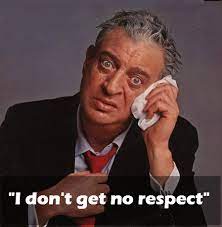
Radio, it would appear, has become the Rodney Dangerfield of media.

“We don’t get no respect.”

But then maybe, it’s a self-inflicted situation

57 Comments

Filed under Education, Mentor, Radio, Sales

Sales is the Transference of Confidence

Here are three short stories for you to ponder.

Story #1

The other night a radio salesperson was in a restaurant. Business was a little slow, so he struck up a conversation with the owner who told him that she had used radio advertising for a restaurant she had owned back in California, and it didn’t work, and she didn’t intend to use radio ever again.

He told the owner that he and his wife had been in another restaurant in town a couple of days ago, and the service and food were both terrible. But, rather than never go to another restaurant again, he and his wife decided to try her place, where they found just the opposite. He suggested to her that just because radio didn’t work for her in one situation, there is no reason why she should conclude all radio advertising doesn’t work.

That radio sales person had a new client by the time they paid for their meal.

Story #2

Another radio salesperson was calling on a jewelry store. She had made several calls on the owner and was in the middle of a presentation when the owner suddenly asked her, “Have you ever bought anything from us?” She replied, “No, because you never asked me to.” She finished her radio advertising presentation. He signed up.

Story #3

Another radio sales person was calling on a car dealer who said, “I don’t like your radio station. I’ve never liked it and I don’t listen to it.” The radio salesperson responded, “I don’t care if you ever listen to us, for you see, we have a lot of people who do listen and like my radio station, and right now your advertising isn’t reaching any of them. But we are telling them about your competitors.” The car dealer was a little taken aback, but proceeded to get serious, and is now on-the-air.

Be Confident

Sales is the transference of confidence.

In each of these short stories, a radio salesperson was confident about their radio station delivering results. They were also prepared for such objections.

COVID-19 has shaken everyone’s confidence.

It’s never been more important that radio sellers “Be Confident.”

Preparation

Prepare, prepare, prepare.

There is no substitution for preparation.

As famed Notre Dame football coach Lou Holtz put it,

“Everything is won or lost in the preparation stage.”

4 Comments

Filed under Education, Mentor, Radio, Sales

If You Can Visualize It, You Can Do It

People who are the best at what they do, have one thing in common, no lack of self-confidence.

Visualization

Whenever successful people want to accomplish something, they go at it absolutely convinced they will achieve it. Science has shown that when we visualize achieving a goal, making it real in our minds, we enhance our performance and boost our self-confidence.

Improve Your Self-Esteem

Besides visualizing success, there are other things you can do to raise your self-esteem. For example: Reach out to others. Say nice things. Lend a helping hand.

When we help other people, we begin to feel more in control of our own lives.

Avoid Perfectionism

We all would like to be perfect. However, perfectionism often paralyzes us and can actually keep us from accomplishing our goals.

Respect Yourself

Make a list 20 reasons why you should. If you can’t think of 20, think of what people who admire you would say. (They’re right, you know.)

Your Values

Act in accordance with your own values. Choose the path that feels right for you.

Treat Yourself

Be good to yourself. Do something, just for you, that makes you feel good every day.

Challenge Yourself

Pick up an encyclopedia, or go online to Wikipedia, and read one new entry at random. Take a course at your local community college. Travel to a new place. Eat a new food.

As you meet new challenges, you gain new confidence.

Practice Being Optimistic

Fight pessimism. Think of setbacks as temporary, and one of a kind, not permanent and “complete” failures.

Don’t Take It Personally

Bad encounters often tell you more about how the other person feels at that moment in time, rather than representing a failure on your part.

Don’t Take Things So Seriously

Lighten up. Most of life’s little calamities have two sides. Try to gain a balanced perspective and you’ll bounce back more quickly from disappointments and embarrassing moments. And, people will enjoy being around you.

Finally

Practicing these positive measures will reinforce your self-worth, and increase self-esteem, which will make you more self-confident.

“Success occurs when opportunity meets preparation.”

-Zig Ziglar

Leave a comment

Filed under Education, Mentor, Radio, Sales

You’ve Got to Have Goals

Everyone wants to see their hard work turn into successful outcomes, so, why do some people achieve success and some do not?

The reason often comes down to one factor, lack of consistency.

Whether you’re trying to lose weight, or play an instrument or another life achievement, each of your goals requires a sustained effort. Let me share some ideas to help you sustain and focus your energies to achieve success.

Make Sure It’s Your Goal

Nothing will derail your success faster, then trying to achieve someone else’s goals for you. So, if you want to stay motivated, make sure you are the one setting the goal. When you’re excited about the goal, working to achieve it doesn’t seem like work.

Write Down Your Goals

Zig Ziglar always used to promote in his motivational and sales seminars, “You’ve got to have goals.” Sadly, about 84% of people surveyed said they didn’t have any goals.

Remember what Lewis Carroll wrote in Alice’s Adventures in Wonderland, “If you don’t know where you’re going, any road will take you there.”

Writing your goals down turns out to be a critical step. Of the 3% of the people who have written goals, they earn on average about ten times as much as those who don’t.

When you write down your goals, you write them into your consciousness.

Plan Your Work, Work Your Plan

To stay focused and achieve your goals, you need to have an action plan. What are each of the steps you will take to move you from where you are today to where you want to be tomorrow, next month, next year etc.

Expect that as you proceed, things that you didn’t expect, like a global pandemic, will cause you to make changes in your plan. That’s why you should write your goals in concrete, and your plans in sand.

Keep Track of Your Progress

Write down where you started and then keep a record of your actions and progress. Measuring how your changing, provides you with a valuable feedback system, keeping you focused.

Have a Support System

Read positive books. Keep a success journal. Invite people you admire to become your mentor and make you responsible to someone other than just yourself.

You want people who will encourage you to reach your goals and challenge you to set them higher than you might otherwise.

Work Toward Your Goals Daily

I’m in my 6th year of writing this blog. I’ve now written over three hundred articles. My goal was to write an article a week, not hundreds.

Make sure you break down your goals into bite sized pieces. Don’t set too many for yourself,  you can achieve almost any goal you set, but not everyone, and not all at once. So, focus on just a few until they’ve been accomplished and then make some new goals.

Celebrate Every Success

Every time you do something that takes you closer to reaching your goal, celebrate. Celebration is a positive motivational tool to help you stay focused, energized and optimistic.

Tell yourself you deserve to succeed.

Here’s to your success!

Leave a comment

Filed under Education, Mentor, Radio, Sales

Profitability Depends on Repeat Customers

The radio advertising business is all about its ability to deliver both reach (the number of people who will hear your advertisement) as well as frequency (the number of times a listener will hear the same advertisement). Radio, for all of my life has been the medium for delivering the best frequency for an advertiser, but in today’s world, it now is also the best for delivering reach.

Pierre Bouvard, my first Arbitron sales representative and today the Chief Insights Officer at Cumulus Media/Westwood One, calls AM/FM radio the soundtrack of America’s recovery and spending resurgence.

Relationships

When I started out in radio sales, my first goal was to start making friends with each business person I called on. I used to say to myself, “If you can’t make a sale, make a friend.”

People do business with people they know and like, it’s first step in building relationships with your advertisers.

Advertising is an Investment

Patience is at an all-time low, so the problem in today’s fast-paced world is everyone wants things to happen immediately.

When you’re dealing with people and human nature, things move at their own pace.

Farmers know when they plant a crop, they won’t be going out the next day to harvest it. Likewise, when you put an advertiser’s message on the radio, it will take time to grow in the mind of the consumer. Done correctly, a business can be harvesting sales 52-weeks a year.

Great Radio Ads

Great radio advertising can benefit the listeners of your radio station in addition to growing the business of your advertisers. Great ads speak about the customer’s wants, needs and desires.

Getting Referrals

Make money for your advertisers and they will be happy to refer you to other local business people who could benefit from your radio station’s audience. And unlike cold-calling (knocking on doors of people you don’t know), a referral is like getting a foot-in-the-door. It’s golden.

Fair Prices & Excellent Service

Studies have shown you don’t have to have the lowest price to attract repeat business, fair prices will do.

Combine fair prices with excellent service and you have a winning combination for building repeat business with your customers.

Your goal as a radio sales person should be to become a sustaining resource for your customers. A person who they call first when they need help with their advertising or promotions; a person they can trust.

You Can’t Do It Alone

Everyone in your radio station that comes in contact with your listeners and advertisers impacts the future relationship your enterprise will have with each of them. Everyone needs to be engaged in delighting your listeners and your advertisers.

It takes a team effort to be successful.

2 Comments

Filed under Education, Mentor, Radio, Sales

2021 – Year of The Great Reassessment

When the novel coronavirus turned our world upside down, life as we had known it was dramatically changed. About the closest thing I can compare it to was when I made the decision to retire, move from Kentucky to Virginia and get married; again.

Time to Retire

All my life I had witnessed stories in movies and on TV about people retiring. I remember my own dad being forced to retire at the age of 65, because back in the 70s General Electric Company had a mandatory retirement policy. It seemed like something people planned and looked forward to, and now, after a decades long career in broadcasting and then as a professor at a university, I had arrived. My wife and I planned out two years’ worth of road trips to see America from the ground. As a flight attendant for Delta, she had flown over most of the United States, but like me, longed to see it up close and personal; as can only be done from driving the highways and byways of this great land.

Life in Retirement

I will admit that retirement brings with it, major lifestyle changes, and I truly have learned to enjoy all of it. As an example, in the summer, pool aerobics takes place in an outdoor pool bathed in the warmth of the morning sun. What’s not to like about that?

COVID-19

You might think that a retired person’s life couldn’t have changed much when COVID-19 appeared, and the world closed down. Wrong! Those pool exercise programs were terminated, our planned cruise to Alaska via Canada was cancelled as the border between our countries closed, trips to visit our children and grand children were transformed into ZOOM visits and like everyone else we wore masks, used lots of hand sanitizer and took advantage of senior shopping hours (usually from 6-7am) which meant having to get up with an alarm clock once again.

Lifestyle Changes

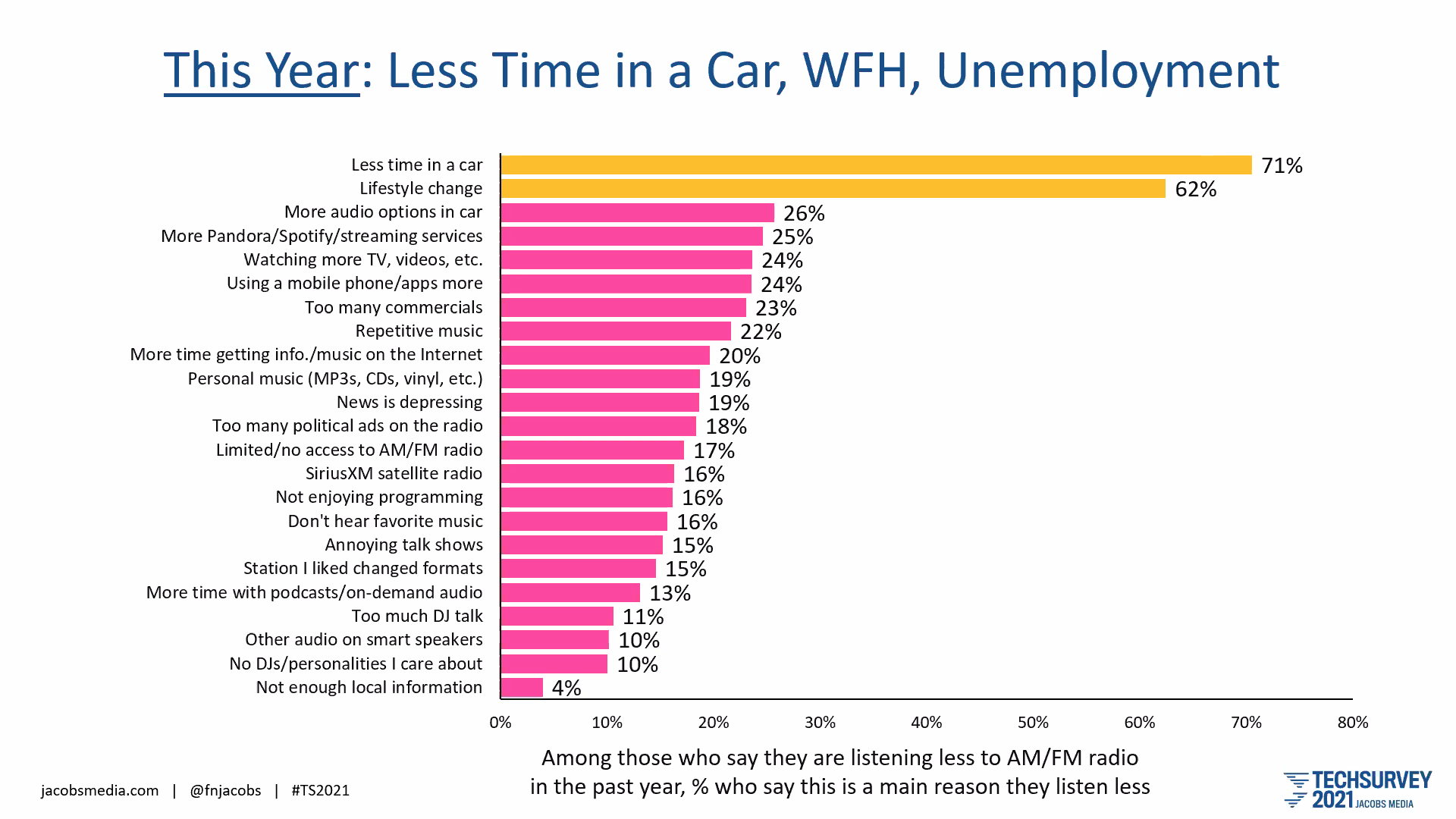
The global pandemic brought lifestyle changes to the world that were as dramatic as retirement. It’s why after sitting in on the latest Fred Jacobs webinar, TechSurvey 2021, it was this single slide that made the most impact on me.

When radio station listeners were asked why they spent less time listening to radio, the number one and two responses were basically the same: Lifestyle Change.

People were spending less time in their cars as many were now working from home, going to school from their bedroom and meals were now being prepared in the house kitchens versus dining out.

Most people listened to traditional radio in their automobile, because it may be the only radio they own and when “Work From Home” (WFH) became the norm, car usage plummeted.

So, what did we do at home while we were sequestered? We streamed everything: movies, TV shows, music, newspapers, magazines, and visiting friends and relatives, were all made possible via internet.

The last time the world saw so many important structural changes as we’re experiencing today, was in the 1920s; a time when commercial radio was born, and a time when people were yearning for change after experiencing a two year global pandemic from the “Spanish Flu.”

Reassessing the Meaning of Life

The disruption brought with COVID-19 has caused many people to really think about what’s important in their life. This great reassessment is going on at all levels of the American economy causing many people to decide if they want to do something different with their lives. People have realigned their priorities when it comes to what’s important to them, and what makes for a happy, fulfilling life.

Sixty-six percent of unemployed people in a recent Pew Survey said they had “seriously considered” changing their field of work, which might help to explain why certain businesses are having a hard time re-hiring workers as COVID vaccinations are re-opening our economy.

Reassessing Media Usage

The sequestering at home saw, according to TechSurvey 2021, that streaming video services like Netflix, Hulu, and Disney+ saw a 35% increase in use, followed by a 15% increase in usage of streaming music services like Spotify and Pandora, as well as spending time on social media. Video gaming was up 13% and the radio station that sent these radio listeners this year’s TechSurvey showed a 10% increase.

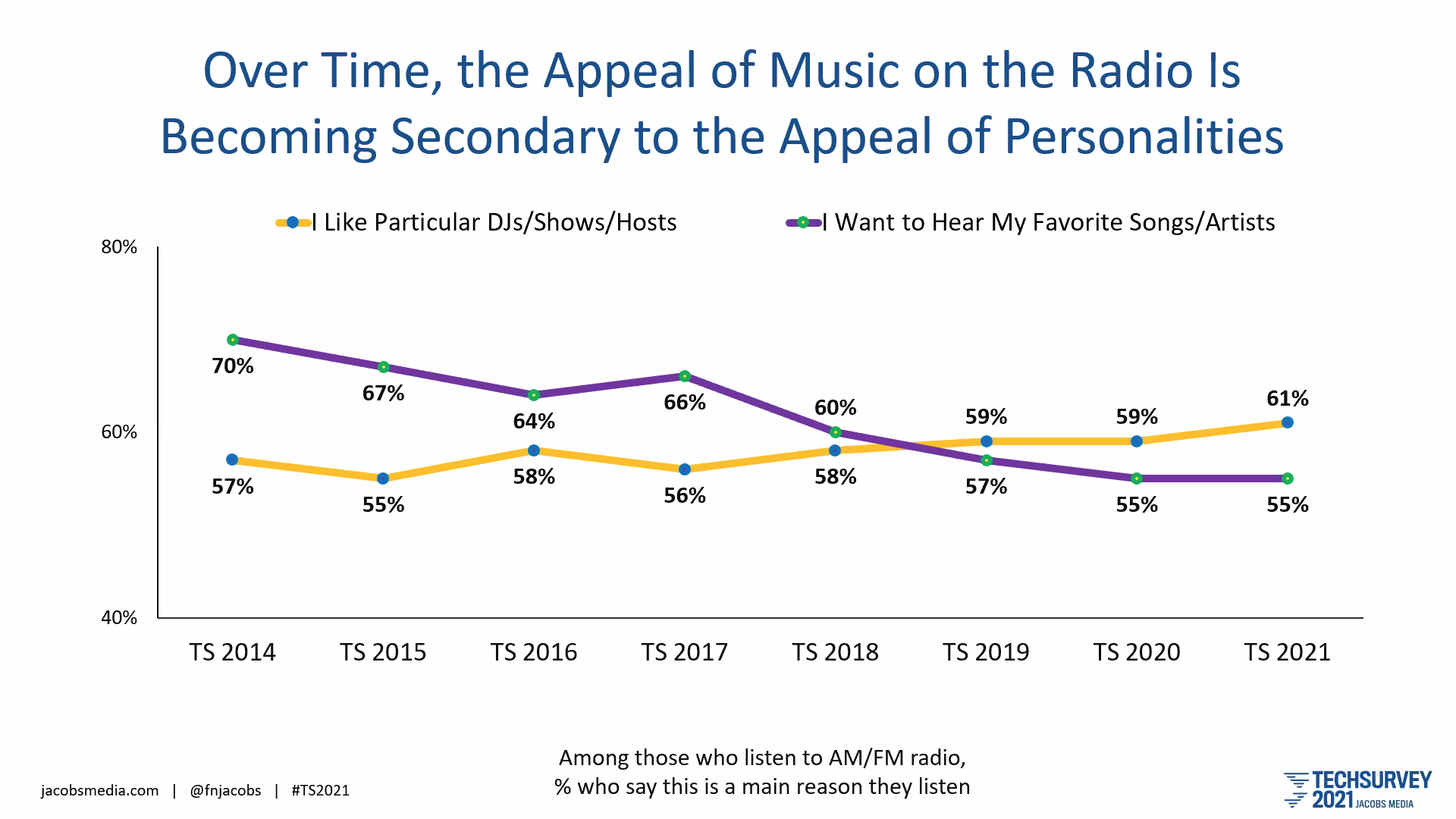
It’s important to note that the people who love listening to radio, put listening to their favorite radio personality ahead of hearing their favorite music as the reason they listen.

 The Lego Lesson

Now you might be thinking that as a radio owner/manager “I need to be doing more.” That seems to be human nature when anyone is contemplating how to beat their previous performance; whether that means increasing audience ratings or bottom line revenues.

Let me tell you about a study where participants were asked to modify a structure built with Legos. Most participants added more bricks – our gut instinct that to do better, it will take more of something – but the better strategy it turns out was to remove a few Lego bricks from the structure.

When it comes to improving your radio operation, might you find a better result by subtracting rather than adding? When you keep things simple focusing on those things that made you successful, magic happens.

It was true when radio was born, and it’s even more important today, but don’t take my word for it, listen to what radio listeners say is the main reason they’re still listening in the latest TechSurvey.

Radio’s most important assets are its air personalities.

5 Comments

Filed under Education, Mentor, Radio, Sales

Change Is In The Air, Can You Feel It?

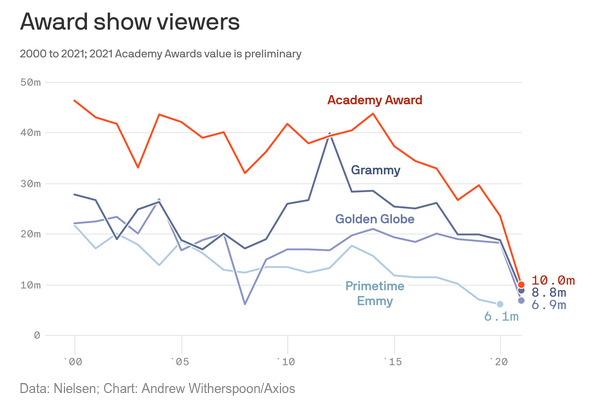
This year’s Academy Awards on ABC recorded an all-time low in viewership with fewer than 10 million people who thought it was worth their time to tune in to see which picture was named the year’s best (Nomadland), or who won best actress (Frances McDormand) or best actor (Anthony Hopkins).

Was it because all the theaters closed down in 2020 due to COVID-19 that people didn’t care about the movies?

No, the Oscars telecast is suffering the same fate that has befallen the Golden Globes, Primetime Emmys and the Grammys; today there’s lots of competition for our attention.

Miss America Who?

I lived in Atlantic City, New Jersey for the better part of two decades. My WFPG-AM 1450 radio station was the flagship station for the Miss America radio broadcasts and continued broadcasting the annual beauty pageant to the South Jersey radio market long after network television took over broadcasting the pageant to the nation, via TV.

If you don’t know who the reigning Miss America is (Camille Schrier), you’re not alone, as only 3.61 million people tuned into the NBC telecast; continuing a downward trend of its audience ratings.

World Series Strikes Out

The 2020 World Series between the Los Angeles Dodgers and Tampa Bay Rays saw Game Three entering the record books as the least-watched World Series game since Nielsen began tracking ratings in 1968. Just over 8 million people watched.

Super Bowl 2021 Fumbles

With everyone being sequestered at home, and the annual Super Bowl telecasts being the most watched programs on television since 2010, you might scratch your head wondering how the most recent Super Bowl matchup between the Tampa Bay Buccaneers and the Kansas City Chiefs only attracted 96.4 million viewers making it the lowest rated Super Bowl since 2007, when the Colts vs. The Bears attracted only 93.1 million viewers.

Before the 2010 Super Bowl, the season finale of M*A*S*H reigned as the most viewed television program for 27 years, with 105.9 million viewers saying goodbye to Hawkeye and friends in February of 1983.

The 2010 Super Bowl broadcast would garner 106.5 million viewers, and each Super Bowl broadcast after that would become the new most watched program on television.

Welcome to The Internet Revolution

In the 20th Century, the industrial economy was top-down, with all decisions originating from the CEO’s office. The 21st Century now depends on building relationships, collaboration and networking. Not since the Industrial Revolution of the 1800s has America seen anything like what’s happening today.

You’re probably in one of two camps with regard to the speed of change happening right now: one group believes things are changing too fast, and the other group believes things aren’t changing fast enough. Business leaders no longer can sit on the fence about the issues that face us, but are being forced into picking a side.

The media industry that was birthed, and has been fully supported by the selling of advertising, is now looking towards selling subscriptions to support itself. Netflix, Disney+, Hulu, PBS Passport, Amazon Prime, YouTubeTV, Paramount+, HBOMax, AppleTV+, Showtime, Starz, Frndly, and SlingTV are all subscription supported. Then there’s all the music streaming services you can subscribe to like Spotify, Pandora, Amazon Music, and Apple Music.

Do you like to listen to podcasts, well Spotify and Apple have announced those too will be adding a new subscription option for podcasts you might currently be enjoying for free.

In our house, we subscribe to seven different streaming video services, which grew from zero just five years ago and we currently use ad-supported audio streaming services from Pandora, Amazon and TuneIn. We access all of our streaming services by asking Alexa to play what we’re in the mood to hear via anyone of our four Echo’s and three Alexa equipped televisions.

I honestly cannot remember the last time I watched any commercial television channels.

Whether watching video, listening to audio or reading publications like The Washington Post, The Atlantic, AXIOS or the multitude of radio/TV publications that I devour each day, all of it comes to me ON DEMAND and via the internet.

Our household literally has more content than we have hours in a day to consume and still have time for a life with family and friends outside of the home.

The Future of Media Consumption

For the consumer, streaming consumption is the future, but there is a limit to how much media we can consume, let alone afford to subscribe to and we are approaching a peak in both.

For the media companies, understanding their future will demand a clear-eyed review at how the present came into existence. It will be survival of the fittest and not all will make it.

“Every model is flawed.

Some can be useful for decades or even centuries,

but eventually circumstances change and they become untenable.

After a period of tumult, they collapse and a new paradigm emerges.”

-Thomas Kuhn

13 Comments

Filed under Education, Mentor, Radio, Sales

Leadership is Like a Three Legged Stool

It’s never been more challenging to be a leader, but some of the basics are as important today as ever.

Leadership is about inspiring and empowering people to believe in themselves, their company and the path that lies ahead.

Leg One: Lead by Example

People will follow more what you do than what you say. I remember having one of my department managers tell me that people in our building were afraid to swear around me, because I didn’t use swear words. It’s not that I didn’t know those words, but I personally chose not to use them, resulting in others following my lead.

“Be the change you wish to see in the world.”

-Mahatma Gandhi

Leg Two: Create a Unified Vision

A lot of companies have very lengthy and detailed “mission statements.” The problem is that few people can hardly remember, let alone put into practice everything that’s in them. Created by committees, these mission statements call to mind the old joke about what a camel is—it’s a horse created by a committee.

I prefer the idea of creating a “unified vision.” My favorite is the one that Steve Jobs created for Apple: “Create insanely great products.”

Notice he didn’t say they would create the world’s best computer, tablet or smartphone, but that whatever Apple committed to making, it would be “insanely great.”

Leg Three: Inspire Everyone to be Their Best

It’s not one thing that makes an organization the best, it’s everything. Great radio stations are great in programming, promotions, engineering, sales, facilities and community engagement. They should super serve everyone they come in contact with.

“Nobody remembers who finished second,

but the guy who finished second.”

-Bobby Unser

Great leaders hire the best people for each area of their operation, and then, get out of their way to let them excel. Leaders praise in public and correct in private, mentoring everyone in their charge. They stand ready to tackle any obstacles that prevent their people from being their personal best and inspire them to become leaders.

Leaders don’t create followers,

they create more leaders.

-Tom Peters

Leave a comment

Filed under Education, Mentor, Radio, Sales

You Can’t Make an Elephant into a Giraffe

Let’s face it, somethings in life are what they are. Giraffe’s have long necks and elephants have big ears, big feet and trunks. Just as pickup trucks were designed for a different purpose than speed boats. So, why do we think that radio can somehow defy the natural order and become something that it was never designed to be?

Work on Your Strengths, Not Your Weaknesses

One of the lessons I learned in classes at Clear Channel University* was how people often focus on their weaknesses and try to improve them. However, studies have shown that when we focus on our strengths, we grow faster than when we try to improve our weaknesses. Added benefits to focusing on our strengths are that we become happier, less stressed and more confident.

The cure for constantly falling short of your goals is to work on improving where you’re already strong, rather than on areas where you are weak.

Why Doesn’t Radio Focus on Its Strengths?

Entercom changed its name to Audacy, saying:

“We have transformed into a fundamentally different and dramatically enhanced organization and so it is time to embrace a new name and brand identity which better reflects who we have become and our vision for the future. Audacy captures our dynamic creativity, outstanding content and innovative spirit as we aspire to build the country’s best audio content and entertainment platform.”

-David Field, CEO

Audacy is the fourth largest radio company in America (based on the number of radio stations owned) and just like the top three radio operators ahead of them, none use the word “radio” in their name.

It was in 2010, that National Public Radio announced that it would be using “NPR” as its brand name, even though its legal name remains the same. NPR celebrated its 50th birthday in 2020, the same year that American commercial radio turned 100.

What is it about the name “radio” that has radio station owners and operators distancing themselves from this word?

Finding Your Strengths

If you want to grow your strengths, first you need to identify them. This week, Pierre Bouvard, Chief Insights Officer at Cumulus Media/Westwood One, did a pretty good job of that in his blog. While Pierre was trying to correct some misperceptions about broadcast radio, he also gave us a good place to start with identifying some of its strengths. Here are five Pierre cites:

  1. Radio reaches 88% of persons 18 years of age and older each week in America.
  2. Radio reaches the 60% of Americans who are back in their cars commuting to work every day. (The Radio Advertising Bureau says radio’s reach in the car is 83% in 2021, making it the dominate form of media on-the-road.)
  3. Radio’s audience shares are twenty-one times larger than ad-supported Pandora and ten times that of ad-supported Spotify, according to Edison Research.
  4. Radio delivers an impressive Return On Investment (ROI). Pierre says “for example, for every $1 invested in an auto aftermarket AM/FM radio campaign, there is a $21 sales return.”
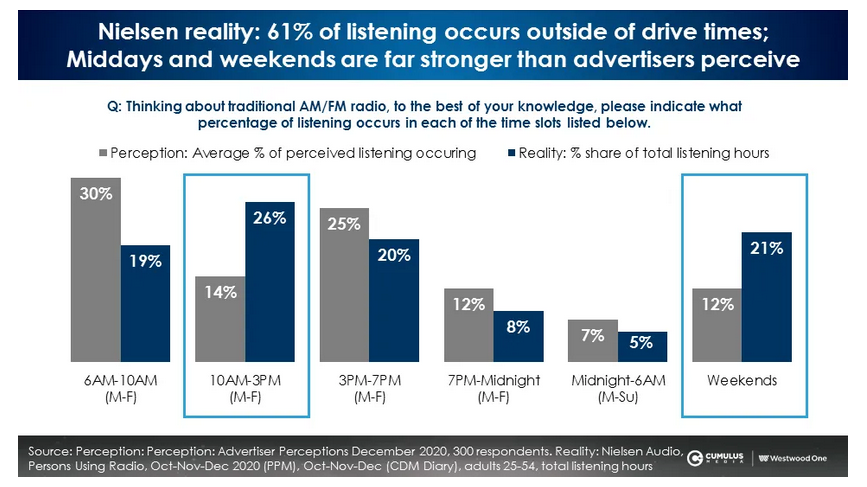
5. Radio delivers listeners at all hours of the day, seven days a week.

Radio’s Analog Audience

Lee Abrams posted a short YouTube video back in August 2020 that you might have missed explaining his “PSYCHOGRAPHIC CHART.” If you’re in radio, you should watch it now.   

View the full twelve-minute presentation HERE What I’d like to focus on is the two quadrants that Lee has labeled as “Analog Generation/Culturally Sophisticated & Culturally Unsophisticated.” These people are radio listeners. They were born with and are comfortable with analog media.

Lee makes clear that you can’t satisfy more than one quadrant. Pick one and super serve those people to the point of making what you do appalling to people in the other three quadrants.

The bottom line is that you can’t be all things to all people, but you can be everything to some people. This is really Marketing 101.

But the Future is Digital

Yes, the future of media is digital and it can’t be ignored. But you can’t make radio into something it’s not and never will be. It’s a powerful one-to-many media entity; leverage that.

The Australian Radio Network’s Neuro Lab is doing some interesting research into how a listener’s brain responds to audio, whether it’s coming from the radio, a podcast or streamed.

What should make all radio owner/operators sit-up and take notice is the fact that “radio showed the strongest ability to engage listeners and for extended periods of time, racking up 60% more neural engagement than any other audio format.” Podcasts showed higher levels of memory encoding and streaming was noted for promoting positive attitudes towards brands. You can read the full report HERE

All Audio is Not Created Equal (in the Brain)

Dr. Shannon Bosshard, the neuroscience specialist who conducted this groundbreaking research said, “This is the first time that anyone has demonstrated, from the perspective of the brain, that radio, podcasting and music streaming are processed differently and should be treated differently, in the same manner that audio and audio-visual mediums have been.”

Radio Financed TV

It was the incredible revenue streams produced by broadcast radio that were used to build out the medium of commercial television. TV also stole radio’s stars and programs, leaving the radio industry to reinvent itself and compete with television for advertising.

Today, radio is once again finding itself the “money mule” charged with funding the buildout of digital initiatives, having to sacrifice the very thing that makes radio unique in the process; its personalities. And then, just like with TV, radio has to compete with digital for advertising.

Fred Jacobs in his TechSurvey 2021 revealed how important the Radio Personality is to today’s radio listener.

But this shouldn’t come as a surprise. For generations, the radio personality has been the primary attraction drawing audiences to one radio station over another. At his peak, Dan Ingram on WABC in New York was said to be more popular to the station’s listeners than The Beatles.

Great Radio

In the end, great radio isn’t any one element, it’s all of them – personalities, jingles, promotions, station imaging, community involvement and companionship – that makes a radio station part of a listener’s family. People have favorite movies, but not a favorite movie theater; they have favorite television programs, but not a favorite television station; however, people DO HAVE favorite radio stations.

Remember that. Leverage that. Make money knowing that.

*Clear Channel University was closed in 2009

2 Comments

Filed under Education, Mentor, Radio, Sales