
 For the radio listener, your next break is all that matters. Does it speak to your listener? Does it have relevance to your listener’s life right this second? How do you know?
Homogenized America
With the growth of fast food establishments, big box stores and online shopping, one might think that America is now homogenized. That we’ve become a “one size, fits all” society. However, nothing could be further from the truth.
Defining Generations
Before we discuss what specific age group goals are, let’s first define those groups.
- Millennials (ages 18-34)
- Generation X (ages 35-52)
- Baby Boomers (ages 53-72)
- Greatest Generation (ages 73 and older)
I’m part of the Baby Boomer generation, so let me speak about a group that I personally know something about.
Boomer Goals
Harris Poll surveyed 2,002 American adults to learn what we want as we get older. The number one thing was to travel abroad (57%). I know that travel is #1 on my list and that’s why this spring I set out with Sue on a cross-country trip across America that racked up 11,175-miles on our Honda Accord.
The next bucket list item the Harris Poll found was that American’s want to take up a new hobby (52%). In my case, that has manifested itself by working on my blog and volunteering at my church.
The other items on the list were tracking one’s health using a wearable, joining new social circles, living abroad and participating in extreme sports (28% to 3%). What these things all say is that growing older doesn’t mean we have to stop having fun.
Boomer Priorities
I really can identify with what the Harris Poll found as the top priority of aging Americans, spending more time with friends and family (62%). Previously my radio and teaching careers had been my primary focus for over 50-years, but not any longer. Now, being a grandpa is Job One.
Other priorities we have as we age, is the desire to seek out new experiences (51%), which explains our desire to travel and see more of the planet. To travel, one must be healthy and so health and wellness (51%) is also a priority.
Aging Positives
Americans agree that as we age we gain wisdom (65%) and experience (62%). Which begs the question, why do companies seem to undervalue their senior employees or try to unload them with offers of early retirement and buyouts.
Other positives of growing older are that we feel more trustworthy, independent, are more comfortable in our own skin and feel more in control of our lives.
How Old is “Old?”
I think the answer to the question “How old is old?” has always been a moving target depending on the age of the person being asked that very question. The Harris Poll found that Millennials think old is 67, Generation X thinks it’s 72, Baby Boomers think it’s 79 and the Greatest Generation think it’s 82.
Usually the day after my fitness class, I think it’s my current age.
“Between now and 2029, one Baby Boomer will turn 65 every eight seconds,” says management guru Tom Peters. In his new book, The Excellence Dividend, Peters says “Most firms seem clueless – or worse, even seem to turn their back on the opportunity (of serving this huge population).”
Radio & “the Oldies” Market
Tom Peters is pretty adamant about what companies need to do to serve this segment of the American population.
- Do a stem-to-stern assessment of the skills, assets, and culture that are needed to serve this market
- People aged 50 or older have 47-times more net wealth than households headed by a person under age 35
It appears that some companies have done this and are enjoying the profits of their efforts. SiriusXM’s Q3 Conference Call saw that company’s CEO Jim Meyer telling analysts that audio is thriving like never before saying “the entire pie of audio consumption is actually growing.” Net income is up 24%, margins are up 40% and they plan to increase their dividend to investors.
Willy Sutton robbed banks, he said, because that’s where the money was.
The money is with the Baby Boomers and the Greatest Generation, the very population that was raised on radio.
I’m not saying every radio station needs to cater to this senior segment. Obviously, if radio is to be relevant to the generations following the Boomers, it needs to offer programs that are relevant to this age group too. However, in my travels around this country I’ve heard a minuscule number of radio signals appealing to the money age groups. In my opinion this is a missed opportunity, for the radio industry’s future and its current economic stability.
Another Place, Another Time
I started my radio management career back in early 1980, still in my twenties, as the general manager of an AM daytime radio station that programmed Al Ham’s “Music of YOUR Life.” Next to Rush Limbaugh, Al Ham’s music format was the next best thing one could program on an AM radio station to attract the older audience of that time.
Our FM station in that AM/FM cluster was programming the current top hits of the day, and between us, we pretty much covered all the demographics. The hardest part of attracting new advertisers to my daytime radio station, was convincing them to try it. Once they did, they quickly became regular advertisers because the people we attracted to our programming had the money to buy everything our advertisers sold. My company president always liked to say, “money makes honey,” and my success with this little 1,000-watt daytimer led to my promotion to market manager in Atlantic City running a news/talk AM radio station and a 50,000-watt FM Bonneville Beautiful Music radio station. Both stations were programmed to an older, well-heeled, audience. We were a million dollar cash flowing property.
The Time is NOW
Tom Peters pretty much sums up radio’s action plan by saying, “Cut the B.S. Can the excuses. Forget the fancy reports. Get moving now. Get the job done. On this score, nothing has changed in 50-years, including the maddening fact that all too often a business strategy is inspiring, but the execution mania is largely AWOL.”
Pay attention to the culture inside your radio operation. IBM’s turnaround CEO Lou Gerstner put it this way, “culture is not just one aspect of the game – it is the game.”
And finally, train your people.
“Training is any firm’s single most important capital investment.”
-Tom Peters
 Is the retail industry dying?
 Simon Sinek says people don’t buy what you do, they buy
 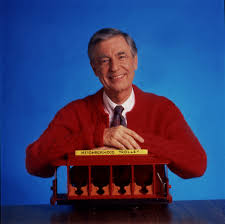 I didn’t grow up watching “Mister Rogers Neighborhood.” The television in my family’s house was connected to two different antennas that each picked up a single television station. One TV station was affiliated with the NBC television network and the other with the CBS television network. My childhood mentor was Captain Kangaroo. Bob Keeshan’s broadcast was on commercial television, so I was also exposed to products such as pre-sweetened Kool-Aid, where the “sugar, sugar, sugar…is already in it.” Sad, that I remember that sell line over 50-years later, more than any other lesson taught by that show.
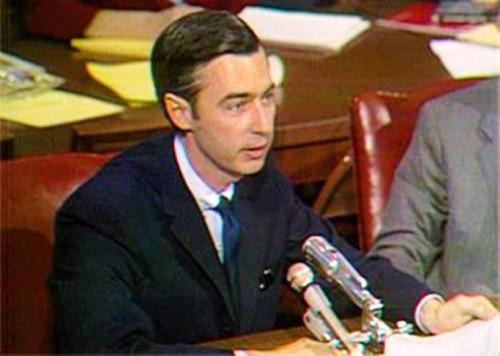 On May 1, 1969, Fred Rogers appeared before Senator John Pastore’s Senate committee to explain why they should continue to fund PBS (Public Broadcasting System) for another term at a cost to the taxpayers of America of twenty million dollars. If you’ve never seen Mister Rogers’ testimony, I encourage you to stop, and take a moment to view it now. Click
 This past week, news spread that Brother Bill Gable had died. For many of us, it was the time he broadcast over The Big 8 – CKLW out of Windsor-Ontario, Canada that endeared him to our hearts. His best friend, Pat Holiday shared a story about what made Brother Bill and the rest of the air personalities at CKLW essential radio listening. Pat wrote:
 I remember how a weekly fax changed my radio life. It was called the “Monday Morning Memo,” and it was written by a guy in Texas by the name of Roy H. Williams.
 This past Tuesday, September 11, 2018, America remembered the 17th anniversary of the 9/11 attack on America in New York City, Washington, DC and Shanksville, Pennsylvania. My class at the Wizard Academy was supposed to have 29 students. Only four of us showed up: Dr. Kevin Ryan, a famous writing coach from Utah; Chet Young, a big salesman with a booming voice from Burlington, Iowa; Akintunde Omitowoju, a senior programmer of Nintendo games from Kyoto, Japan and me, a radio station general manager from Atlantic City, New Jersey.
 Want to make your radio station more effective for your advertisers and more engaging for your listeners? Then do those things that will not change for effective radio in ten years.
 I was recently invited to be a guest on the radio show and podcast “Watch the Media with John Shrader.” The program airs on the University of Nebraska-Lincoln campus radio station and the podcast of the show can be heard on
 They are part of the Late Majority and Laggards.
 The primary way people access radio today is in their car. But by 2020, it is estimated that 75% of the cars sold will be connected to digital services.

 It was only 11-years ago that Steve Jobs took the stage and held in his hand the future. It was an iPhone.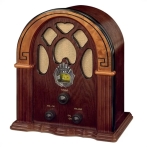

 Most research today indicates that since the introduction of the smart speaker, the device that’s getting a little less use is the smartphone. I would concur that is the case in my home as well. Our 3 Amazon Echoes are the way we access at home radio listening, get flash briefs, find out the time and latest weather forecast.
 What the smart speaker and the smartphone have in common, are both devices give the user what they want, when they want it. On Demand is the real game changer of the 21st Century communications world.
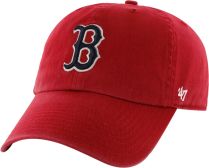 The other day, we took two of our grandchildren to a wildlife safari park here in Virginia. It was a simply magical day. But that’s not the part of the story I want to share. It is that both kids were wearing their Boston Red Sox baseball caps.
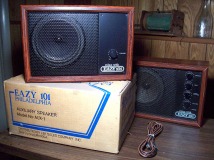 Jerry Lee recently sold his only radio station, WBEB in Philadelphia, Pennsylvania. It was 55-years ago this past May that Jerry and his partner David Kurtz put the station on the air. It signed on as WDVR. In the 1980s the call letters were changed to WEAZ and the station was branded as “EZ 101.” The station brand was not only well known, but fixed tuned FM radios were given out by the radio station to area businesses to play the station in their stores and offices.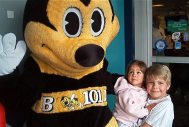
 Most recently, Jerry rebranded his station as “101.1 MoreFM.” This change, like all the others, was promoted in every imaginable way and became familiar to listeners virtually overnight.
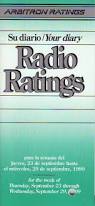 Once upon a time, all radio listening was recorded using a diary, kept by a listener for seven days. Years of diary reviews at the Arbitron headquarters in Maryland proved to me that the radio stations most familiar to their listeners got the most “votes” from their fans.
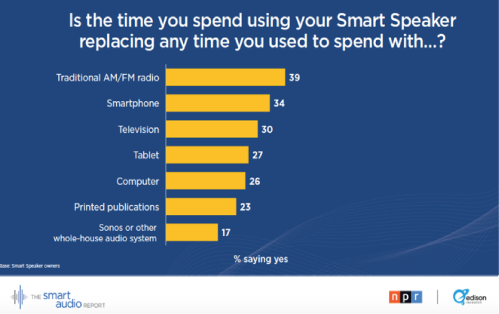 People in the survey said traditional AM/FM radio was the thing most replaced by audio listening via their smart speaker.
 “Brands now have a chance to behave like human beings, talking, understanding, guiding, empathizing…voice is the single biggest vector of emotion, emotion is the biggest driver of preference. This is a true 1:1 marketing opportunity and a chance to build relationships like never before.” -Mark Paul Taylor, Chief Experience Officer, Global DCX Practice, Capgemini
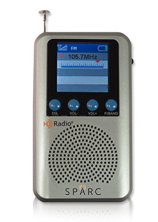 There’s something that’s been troubling me for some time. It’s the radio industry’s habit of reporting radio listening results by calling it “AM/FM” versus what it really is, virtually all FM radio listening.
 WTOP was built on AM radio. It moved its entire operation over to the FM band and grew its audience, revenues and lowered its listener demographic. People who never heard this radio station on its AM dial position were suddenly newly minted fans of their all news format.
 From my blogging, I get lots of feedback about a variety of things concerning broadcasting. One reader wrote to me about his father, a sports fan, who turned on WIP-FM to hear the latest chatter. WIP-FM was broadcasting a game of no interest to his father, so his son said to him, why don’t you turn on WIP AM610. Sadly, this person wrote the audio was unlistenable. He wrote: “You’d think the FCC would mandate that AM have standards for audio quality in receivers.”
 When I was living in Bowling Green, Kentucky, I couldn’t receive 650AM WSM in my office, even though my office looked south and my antenna was able to enjoy a full wall of windows. The noise floor both inside my university office as well as around town while driving in my car made the station unlistenable. WSM was once listened to all the way to Louisville in northern Kentucky. Instead, I downloaded WSM’s app and could enjoy the radio station in crystal clear stereo. (I see WSM has stopped subscribing to Nashville Nielsen Audio ratings.)
 The British Broadcasting Corporation (BBC) did a review of the range of services it offered on the AM band (called medium wave across the pond) and it included a financial review of all its services too. They concluded the ROI (return on investment) in AM was not there and announced they would be turning off some 13-AM radio stations in January 2018 according to Radio Business Reports.
 There’s a great radio operator in Cadiz, Kentucky by the name of Beth Mann. WHVO is her AM radio station at 1480, but if you go on her website, you won’t find any mention of this station being on the AM radio dial. It’s promoted as
  DickTaylorBlog
It Was Always a “Good Day!”
He broadcast six days a week, just like all radio personalities did back in those days. It was a time when all radio was delivered LIVE. Paul Harvey was heard over the ABC Radio Networks with his News and Comment week day mornings and middays. His Saturday noon-time broadcasts were extra special broadcasts that were always sure to surprise and delight his audience of as many as 24-million people a week. Paul Harvey News was carried by 1,200 radio stations in America, plus 400 American Forces Network stations broadcasting all over the world.
Page 2
The first commercial break in each broadcast was clearly announced with the words, “now page 2.” And it caused me to turn up my radio and give Mr. Harvey my full attention as he told me about another great product that he personally used. The ad copy, just like the news and comments, were all crafted by the mind of Paul Harvey.
I bought my BOSE WAVE radio due to Mr. Harvey telling me how wonderful music sounded coming through its speakers and baffle system design. It started me on the path to owning several BOSE products as a result.
Paul Harvey News had a waiting list of sponsors to get on his program. In 1986 his News & Comment broadcasts were rated #1, #2, #3, #4 and #5 in network radio programs when he was the focus of a CBS 48-Hours broadcast commemorating Paul Harvey’s 70th birthday.
Bob Sirott did the profile piece and it showed Paul Harvey as few ever saw him. I encourage you to watch the segment on YouTube by clicking HERE
Paul Harvey News
On April 1, 1951, ABC Radio Network premiered Paul Harvey News and Comment. His Chicago based broadcasts were often called “the voice of the silent majority” or “the voice of Middle America.”
Paul Harvey was making so much money for ABC, they added a third daily broadcast to the schedule on May 10, 1976 called, The Rest of the Story. These broadcasts were written and produced by Paul’s son, Paul Harvey, Jr. for its 33-year long run.
While Paul and his son maintained this entertaining feature which was based on true stories, not all critics agreed, including urban legend expert Jan Harold Bunvand.
I know from my own personal experience of the two times Paul Harvey included stories based on my hometown of Pittsfield, Massachusetts, that Mr. Harvey played fast and loose with the facts of the events to tell a good story. It made me wonder how all the other stories I heard might have been so “massaged.”
Iowa
In 2000, I was managing a cluster of radio stations for Connoisseur and Cumulus. We carried Paul Harvey on my 100,000-watt KOEL-FM. It was the only thing, other than local news in morning drive, that stopped the flow of the best in country music.
I remember being in my car at the time Mr. Harvey’s noon-time broadcast came on the air and hitting the scan button to hear Paul Harvey News and Comment on virtually every station my car radio stopped on. In media, that’s called a “road block,” the same program or advertisement, broadcast at the same time on multiple radio or television stations.
$100 Million Dollar Contract
In November of 2000, Paul Harvey had just inked a new 10-year contract with ABC Radio Networks when a few months later he damaged his vocal cords and had to leave the air. It wasn’t until August of 2001 that Paul returned to the air waves, but only with a reduced clarity and vocal presence in his voice.
I remember this very well as I was now back in Atlantic City running a cluster of radio stations, and my AM radio station WOND-AM1400, was the Paul Harvey radio station for South Jersey.
I had been cajoling Mr. Harvey’s secretary in Chicago for months before he lost his voice for customized promotional announcements to be voiced by Paul Harvey to promote his daily broadcasts over WOND radio.
One day in the fall of 2001, a reel-to-reel tape came in an envelope from Chicago addressed to me. It contained my customized, Paul Harvey voiced, WOND announcements. I was thrilled, but just a little disappointed when we played the tape due to the hoarse, raspy sound of Paul’s voice when he recorded them.
Before the end of 2001, Paul Harvey was back to full vocal dynamics.
Touched My Heart
It was after watching the Bob Sirott piece produced for 48 Hours a second time and then sharing my personal Paul Harvey memories with the love of my life, Sue, that I found myself choking up and tearing up about the heartfelt emotional impact that this gentleman from Tulsa, Oklahoma had made on me.
Using only wire copy and his manual typewriter, Paul Harvey crafted a broadcast of words that vividly created in the mind of the listener exactly what he intended. His full vocal range, the power of the dramatic pause and dynamic inflection completed his radio magic, what most like to call radio’s “Theater of the Mind.”
Could you imagine Paul Harvey doing podcasts?
I have no doubt that they would have been as popular as the original SERIAL podcast was from NPR.
Paul Harvey didn’t use any music or sound effects.
Paul Harvey created great radio, that was welcomed into homes all across the globe by his great writing ability and vocal acting talents.
Harvey receiving the Presidential Medal of Freedom in 2005
Good Day
Paul Harvey died on February 28, 2009 at the age of 90.
Three weeks after his death, ABC Radio Networks cancelled the entire News and Comment franchise.
At the time of his death, he had less than two years left on his 10-year contract.
Paul Harvey called himself a salesman, not a journalist, newsman or anything else. He loved his sponsors saying “I am fiercely loyal to those willing to put their money where my mouth is.”
He never would have promoted his broadcast as “commercial free,” as he understood that this free, over-the-air medium called radio, was a powerful way to move product for his advertisers and that it was those very folks that paid all the bills for him and the ABC Radio Networks.
Imagine that, radio ads that were as cherished to hear as the rest of the broadcast itself.
That’s the definition of “GREAT RADIO.”
14 Comments
Filed under Education, Mentor, Radio, Sales
Tagged as ABC Radio Network, Bob Sirott, CBS 48 Hours, KOEL-FM, News and Comment, Paul H. Aurandt, Paul Harvey, Paul Harvey News, The Rest of the Story, WOND