
 I was recently invited to be a guest on the radio show and podcast “Watch the Media with John Shrader.” The program airs on the University of Nebraska-Lincoln campus radio station and the podcast of the show can be heard on SoundCloud.
John had some interesting questions and I thought I’d share them, along with my answers in this week’s blog article.
What is the State of Terrestrial Radio?
If we look at the topline number of how many Americans listen to terrestrial radio today versus the last ten years or so, that number is remarkably stable. Unfortunately, what has changed are the TSL (Time Spent Listening) and PUR (Persons Using Radio) numbers. They’ve been in a steady decline since 2007. That’s 11-years of erosion.
What’s not pretty is the accompanying loss of revenue that comes with losing 30% of your TSL.
Radio revenues today are characterized with such phrases as “flat is the new up.”
In 2017, U.S. commercial radio’s over-the-air income declined 2% year-over-year, according to BIA Advisory Services’ Q1 2018 “Investing in Radio Market Report.”
In should be noted that, the same report showed that radio stations reported a 9.7% increase in online revenues over the same period.
Radio Revenue Recent History
During the 1990s, ratings and ad revenue rose rapidly. According to the Radio Advertising Bureau, industry revenues grew from around $11 Billion per year to nearly $20 Billion between 1994 and 2000. After 1996, revenues grew by double digit percentages every year until 2001.
PBS reported that “The collapse of advertising budgets that came in 2001 after 9/11 hit radio hard, cutting revenues by 8-percent that year to $18.4 Billion.”
In February 2005, then Viacom (today CBS) President Leslie Moonves told the L.A. Times this his top priority was returning the business to a “growth path.” Moonves recently sold off all of CBS radio stations to Entercom.
2017 Radio Revenues
In 2017, radio revenues ended at $13.87 Billion; not exactly a “growth path.”
BIA SVP and Chief Economist Mark Fratrik summarized the situation for American radio this way:
“Revenues are growing for broadcasters online but not over-the-air. We do not expect over-the-air advertising revenue of U.S. radio stations to grow much this year or in the near future. There is an unprecedented number of new audio entertainment and information sources and new advertising platforms competing with radio, including many that are unregulated. It’s an aggressive environment that competes for audiences with local radio.”
Who are Radio’s Listeners and Where do They Listen?
In general, today’s radio listeners are on the backside of Everett Rogers “Diffusion of Innovation Curve.”  They are part of the Late Majority and Laggards.
 The primary way people access radio today is in their car. But by 2020, it is estimated that 75% of the cars sold will be connected to digital services.
Today’s heaviest radio listeners are reported to be Black or Hispanic.
Radio’s best listeners tend to be employed full-time versus unemployed. That’s great news for radio sales people to share.
What’s alarming is the fact that recent research showed that 29% of all American households don’t have a single AM or FM radio in them and even more alarming, 18-34 year old households are now at the tipping point of radio ownership. 50% of those household don’t have a single AM or FM radio in them. That probably explains how monthly online audio listening reportedly increased from 5% in 2000 to 64% in 2018.
Edison Research has more HERE
What’s the Future for Podcasting?
Podcasting is still growing. About 26% of people over the age of 12 have listened to any podcast in the past 30-days. However, 36% of Americans still don’t have a clue as to what podcasting even is. So, it would appear there’s a lot of growth potential.
Great podcasts, like great radio personalities, tell great stories.
Something to watch is Amazon. It laid off its entire original podcast staff in August.
What’s the Impact of Smart Speakers on Radio?
Tom Webster at Edison Research says “smart speaker adoption is the fastest tech adoption we’ve ever tracked in the Infinite Dial research. It went from 7% to 18% in a year.” 
Smart speaker growth isn’t slowing and these new devices are replacing radios in the home.
I got my first Amazon Echo for Christmas 2017. By the end of Q1 2018, I owned three of them. 100% of my in-home radio listening now occurs via a smart speaker.
These things are addictive.
65% of people who own a smart speaker say they wouldn’t give them up.
What’s Radio’s Future?
People my age grew up with radio. Our parents controlled our home’s only television back in the 60s/70s. Radio was a way we could escape and connect with people our own age and the music of our generation.
Much as we created radio for our generation of listeners, today’s future broadcasters will need to mold it for their generation.
We are living in the days of a communications revolution. Not since the invention of the printing press and movable type has the world of communication been so rocked by change. Revolutions are messy, the future is not always clear, major disruption is par for the course.
New ways of communicating are being created.
Radio, as we knew it, is not coming back.
ON DEMAND
We now live in an ON DEMAND world. It has changed the way we use all forms of mass media. People going forward will want what they want, when they want it.
Netflix created the new phenomena of binge-watching TV shows. I do that now too. I also binge-listened to the podcast SERIAL on a long car drive after that weekly podcast had completed season one.
What Won’t Change?
What we know is that people will always be drawn to great story telling. Our brains are wired for stories. We also know that people will want to be connected to others like themselves.
Dan Mason puts it this way, radio is all about community and companionship.
I don’t see that changing, do you?
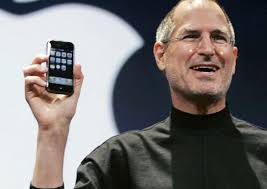 It was only 11-years ago that Steve Jobs took the stage and held in his hand the future. It was an iPhone.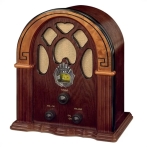

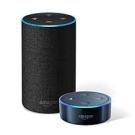 Most research today indicates that since the introduction of the smart speaker, the device that’s getting a little less use is the smartphone. I would concur that is the case in my home as well. Our 3 Amazon Echoes are the way we access at home radio listening, get flash briefs, find out the time and latest weather forecast.
 What the smart speaker and the smartphone have in common, are both devices give the user what they want, when they want it. On Demand is the real game changer of the 21st Century communications world.
 The other day, we took two of our grandchildren to a wildlife safari park here in Virginia. It was a simply magical day. But that’s not the part of the story I want to share. It is that both kids were wearing their Boston Red Sox baseball caps.
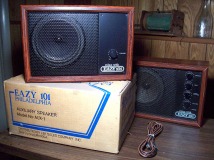 Jerry Lee recently sold his only radio station, WBEB in Philadelphia, Pennsylvania. It was 55-years ago this past May that Jerry and his partner David Kurtz put the station on the air. It signed on as WDVR. In the 1980s the call letters were changed to WEAZ and the station was branded as “EZ 101.” The station brand was not only well known, but fixed tuned FM radios were given out by the radio station to area businesses to play the station in their stores and offices.
 Most recently, Jerry rebranded his station as “101.1 MoreFM.” This change, like all the others, was promoted in every imaginable way and became familiar to listeners virtually overnight.
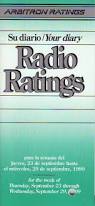 Once upon a time, all radio listening was recorded using a diary, kept by a listener for seven days. Years of diary reviews at the Arbitron headquarters in Maryland proved to me that the radio stations most familiar to their listeners got the most “votes” from their fans.
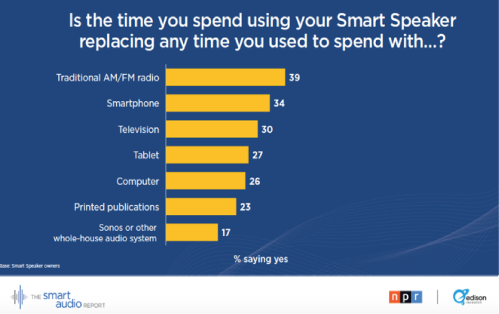 People in the survey said traditional AM/FM radio was the thing most replaced by audio listening via their smart speaker.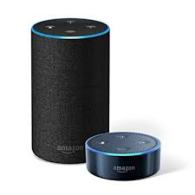
 “Brands now have a chance to behave like human beings, talking, understanding, guiding, empathizing…voice is the single biggest vector of emotion, emotion is the biggest driver of preference. This is a true 1:1 marketing opportunity and a chance to build relationships like never before.” -Mark Paul Taylor, Chief Experience Officer, Global DCX Practice, Capgemini
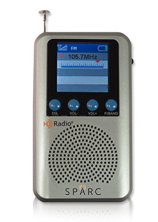 There’s something that’s been troubling me for some time. It’s the radio industry’s habit of reporting radio listening results by calling it “AM/FM” versus what it really is, virtually all FM radio listening.
 WTOP was built on AM radio. It moved its entire operation over to the FM band and grew its audience, revenues and lowered its listener demographic. People who never heard this radio station on its AM dial position were suddenly newly minted fans of their all news format.
 From my blogging, I get lots of feedback about a variety of things concerning broadcasting. One reader wrote to me about his father, a sports fan, who turned on WIP-FM to hear the latest chatter. WIP-FM was broadcasting a game of no interest to his father, so his son said to him, why don’t you turn on WIP AM610. Sadly, this person wrote the audio was unlistenable. He wrote: “You’d think the FCC would mandate that AM have standards for audio quality in receivers.”
 When I was living in Bowling Green, Kentucky, I couldn’t receive 650AM WSM in my office, even though my office looked south and my antenna was able to enjoy a full wall of windows. The noise floor both inside my university office as well as around town while driving in my car made the station unlistenable. WSM was once listened to all the way to Louisville in northern Kentucky. Instead, I downloaded WSM’s app and could enjoy the radio station in crystal clear stereo. (I see WSM has stopped subscribing to Nashville Nielsen Audio ratings.)
 The British Broadcasting Corporation (BBC) did a review of the range of services it offered on the AM band (called medium wave across the pond) and it included a financial review of all its services too. They concluded the ROI (return on investment) in AM was not there and announced they would be turning off some 13-AM radio stations in January 2018 according to Radio Business Reports.
 There’s a great radio operator in Cadiz, Kentucky by the name of Beth Mann. WHVO is her AM radio station at 1480, but if you go on her website, you won’t find any mention of this station being on the AM radio dial. It’s promoted as
  I read a recent article in
 Jeff Bezos’
  I’ve been reading the trades, trying to grasp what is happening, and it is all so very confusing. Have you felt that way too? That’s what a period of disruption looks like. Black is white. Up is down. It’s enough to give you an Excedrin headache.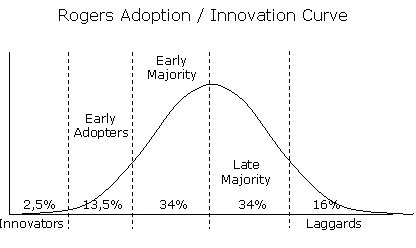
 at a time when AM/FM radio is no longer the entertainment focus of the vehicle dashboard, replaced by the entertainment center that resembles the touch screen on your smartphone.
 The other night I watched Jim Gaffigan’s 5th Netflix special called “CINCO.” In his standup comedy routine, he hit the nail on the head about why Netflix is more popular than cable TV. Here’s what Jim said:
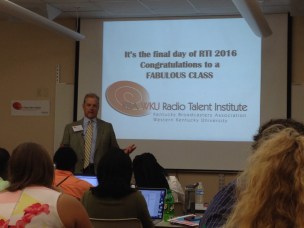 This past week, the KBA WKU Radio Talent Institute began its 10-day run on the campus of Western Kentucky University. It brought back so many wonderful memories of the four years that I was the on-site director for that first expansion of Dan Vallie’s vision for these radio training institutes to take hold all across America.
 To get ahead in any occupation, it’s about who you know as much as what you know. Students in these RTIs come away with the email addresses, direct phone numbers and an open door with dozens of industry movers and shakers who can launch their broadcast career.
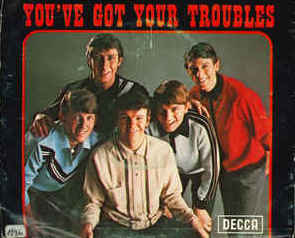 One of the things you and I have in common, I’m sure, are that we have problems.
 My blog article, “
 into existence with the creation of the Federal Radio Commission (FRC) in 1929. For a more detailed look into all of this, read “The ‘Public Interest’ Standard: The Search for the Holy Grail.” Click

 “Great article. “virtually unlistenable.” That’s exactly how to put it. In fact, I’ve commented a few times in the recent past with the same argument. I do lots of traveling between work and family. In addition, my wife and I take short road trips. We have encountered the same thing. I remember way back when, before LPFM and the abundance of translators, I could pick up stations outside the predicted coverage area. Now forget it. If you’re on the fringe or in many cases not; it’s all static (with) two station overlapping. My thought is that this increase in interference will ultimately force people to other means of listening to music – whether SiriusXM or streaming.”
 Thank God for Dan Vallie and the Radio Talent Institute. The closest thing to developing new radio stars that we have. You experienced that personally, Dick. (Editor’s note: I was the founding director of the KBA/WKU Radio Talent Institute in Kentucky.) Let’s take a page out of the Major League Baseball team handbook and create a farm system where we can develop that raw talent who can take it from here. That’s our future.”
 why when Dan Ingram passed away on June 24th, for many, the radio world stopped turning. (He signed off Music Radio 77 WABC in May of 1982 and later did weekends for another 12-years on WCBS-FM ending in June 2003.)
 Sue and I just returned from an eight-week, 11,175-mile cross country road trip across America traveling through 23-states. Seeing America from the car has been a Bucket List item for both of us. Our jobs have had us seeing this great land from the air; mine as a radio manager and educator/consultant, and Sue’s as a flight attendant.

 DickTaylorBlog