Tag Archives: Pandora Radio

Radio’s Challenge

David Goldberg pa1ssed away on Friday, May 1st at the age of 47; too soon to be sure. He was an Internet radio pioneer having created LAUNCHcast in 1999 which evolved into Yahoo! Music Radio. Until his passing he was CEO of SurveyMonkey and he was married to the Chief Operating Officer of Facebook. He was very savy about our Internet connected world.

Brad Hill in RAIN wrote that in 2005, Goldberg was the RAIN keynote speaker. To put his words into perspective, you should know he spoke just before the iPhone was first launched. For it was the iPhone that really launched what we now refer to as the smartphone and mobile music revolutions, that would provide Pandora with its launchpad. Hill wrote that Goldberg said:

“We hope that 10 years from now almost no one is accessing Yahoo services on a PC. It needs to be in my living room, in my car, on my cellphone. This will affect the change in replacing the CD, as well as moving music off of broadcast radio which is also what we believe will happen.”

Fast-forward to Pandora’s latest earnings call and Hill reports that Pandora execs said:

“We really want to replace broadcast radio for music discovery. We believe music will migrate off of terrestrial radio to the services we are offering because we can deliver the music consumers want, when they want it, where they want it. CDs will be replaced by on-demand subscription services. ‘Personalization’ and ‘community’ features will be key ways we’ll be able to deliver the right music to people at the right time, on devices, on a global basis.”

And Pandora is not alone in this quest. Spotify recently reported a market cap more than twice that of Pandora’s in the neighborhood of $8 billion to pursue their quest of being the world’s music provider. (Contrast that to America’s largest radio group iHeartMedia $20+ billion in debt.)

The world is also watching Apple. It made a $3 billion acquisition of Beats and is working on its iTunes streaming audio product. More about Apple in a moment.

Then Fred Jacobs authors a column talking about “Moodstates.” Jacobs’ latest Techsurvey continues to find how much emotion plays a role in broadcast radio listening. Jacobs writes:

“While consumers enjoy hearing their favorite songs, personalities, and information, mood plays a role why they continue to come back to AM/FM radio stations. In our research, it is often in the form of companionship, mood elevation, and escape.”

I’m a big fan of Rewound Radio and their weekly Saturday feature “The DJ Hall of Fame.” What I’ve personally found is that I’m not so enamored with just listening to old tapes of radio broadcasts from the 60s & 70s – I can hear this music anywhere, including my own CD library – but hearing the air personalities that provided me with hours of companionship, mood elevation and escape. And I’m not alone in feeling this way. I’m a member of a couple of DJ groups on Facebook and we all experience these same emotions.

This fact evidently hasn’t been lost on Apple. Apple has been raiding the talent at the BBC. Zane Lowe was their first hire. Lowe is known as a trend-spotter. He’s also a presenter (they don’t call them disc jockey’s in jolly old England) that builds a strong rapport with his listeners. At least three more folks from this BBC talent tank have announced they are joining Lowe at Apple.

Unlike Pandora or Spotify, it appears that Apple plans to put the personality into their streaming. Could Apple be the first to do for today’s generation what Dan Ingram, The Real Don Steele, John Records Landecker, Bob Dearborn, Ron Lundy etc did for my generation? Put the personality front and center in music presentation?

Horizon Media undertook a comprehensive study on the impact mood plays in effective audio advertising. As the results of what they’ve learned are implemented, the placement of those advertising dollars under Horizon’s control will be affected.

Back to Goldberg’s 2005 RAIN Keynote, he predicted that over-the-air radio would be reduced to a mostly-talk medium.

            “We don’t believe music will continue to be broadcast on analog radio,” Goldberg said.

A survey that I conducted with the 300 radio stations in Kentucky showed that local radio stations planned to take their talk programming more locally originated and less national syndicated talk. It also showed that no local music research was being done, but that national charts were being relied upon along with consultants and music programming service providers.

All of this comes at a time when the CEO’s of public radio companies report they’re facing strong headwinds on their advertising revenues. Radio is being attacked from all angles.

Not since the introduction of television back in the 50s has the radio industry faced such a big challenge. We are living in revolutionary times in the communications industry.

Commercial radio is 95 years old. When television presented its challenge it was only in its 40s. Still a young medium with lots of new blood entering its doors with a vision for a new kind of radio.

Boss Radio was born on 930AM-KHJ in Los Angeles and News Radio was born on 1010AM-WINS in New York City both in 1965. But even the new radio formats that were born in that era are now 50 years old.

I challenge my broadcast students to create the radio that will be meaningful for them and their generation. But for those students to have that chance, the owners of radio stations will need to open their doors and let them innovate.

Will radio pick up the challenge?

1 Comment

Filed under Education, Mentor, Radio

The Cockroach of Media

The new CEO of National Public Radio is a man named Jarl Mohn. Before his life in public radio began, he rose pretty high up in commercial radio, only then he went by his “radio name;” Lee Masters.

When he was recently asked if Internet radio would replace terrestrial radio within a decade, he responded with “Broadcast radio is the cockroach of media. You can’t kill it. You can’t make it go away.” But interestingly many radio companies are hiding the name “radio.”

National Public Radio isn’t called that any more. It’s now NPR. Clear Channel Radio isn’t called that any more. It’s now iHeartMedia. Even Radio Shack tried to jettison “radio” from its name and re-brand as just “The Shack.”

Most radio companies today prefer the term “media company” or “communications company.” Why is that?

The irony is when you look at pureplay Internet companies that stream music content, they glom onto the name “radio.” Pandora Radio, Spotify Radio, iTunes Radio, iHeart Radio, Tunein Radio – even the one I’ve been a subscriber to for six years changed its name from Sky.FM to Radio Tunes.

Petula Clark probably got it right when she sang “The Other Man’s Grass Is Always Greener.”

Commercial radio is suffering because it’s not as good as it can be. It suffers from a lack of innovation and investment. At the very moment that more commercial broadcasters are slashing budgets, eliminating people and consolidating operations, NPR is committing more money to be more local and live according to Mohn.

My university’s public radio service has a four person local news team. They don’t cover national stories, NPR does that. They cover south central Kentucky and they win just about all the news awards for their reporting every year. Their stories are detailed and well told. Their stories are readily accessible online in addition to being heard over-the-air.

Public radio is enjoyed by more people and earning a bigger share of the audience than public television. And when it comes to competing against commercial radio, the public radio station is in the top 5 stations in radio markets that have a public radio service.

Here’s the problem I see with future generations of listeners. Pureplays are redefining the term “radio.” To young people today, Pandora IS radio. iTunes IS radio. Spotify IS radio. Over-the-air broadcast is “media” that their parents still use.

When I was growing up I admit I didn’t listen to the radio stations my parents listened to. They had their radio station(s) and I had mine. But we both were listening to “radio.”

Radio turns 100 years old in the year 2020. To those of us who grew up with the service that began commercially in 1920 with the radio broadcast license issued to KDKA in Pittsburgh, we might see it that way. But to the next generation of listeners, radio might only be 20 years old; the same age as Pandora.

Call me sentimental, but I think that would be a shame.

7 Comments

Filed under Education, Mentor, Radio

Who’s in Their Ear?

When radio was first introduced, to listen to it, you needed to wear headphones. Radio was one-to-one and very intimate. As the technology evolved the radio speaker would change the medium from one-to-one to group listening. Radios were expensive. If you owned a radio you shared it. A family would gather around the radio and listen together. Families would transfer this together media habit to TV and the transistor radio would become the refuge of teenagers who wanted to go in a different direction.
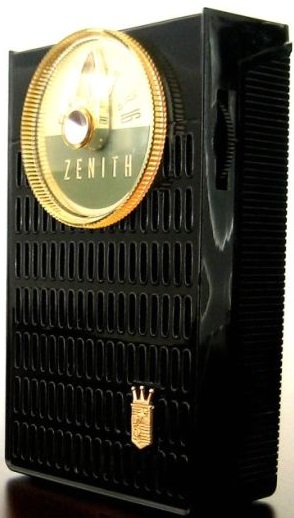

Zenith Transister Radio

My first radio was a Zenith transistor with a little ear piece for one ear. I would go to bed and turn it on under the covers and listen to “the world.” It was all AM radio and after sunset, the DX’ing of the nighttime skywave would always bring a new radio station into my ear to savor.

In the mid-70s the Boombox would be introduced to America and these radios grew both in size and the amount of bass they 1could produce. By the 80s they could be as big as a suitcase and carrying them around on your shoulder was a status symbol.

Go to a beach resort, and whether you were walking the boardwalk or on the beach, radios were blasting music from every direction.

When Y2K didn’t impact our fully computerized radio stations, we all breathed a short-lived sigh of relief because it was quickly followed by a new threat; the iPod and ear buds. Once again listening to music became a very personal activity.

The ear buds would transfer to the iPhone and iPad. The introduction of the iPhone6 may have killed the iPod, but not the use of headphones or ear buds to listen to your audio.

So what exactly are all those people listening to? lady listening with ear buds

The latest research from Edison Research says American Teens are spending more time with streaming audio services from places like Pandora and Spotify, than they are listening to either streaming AM/FM radio or over-the-air radio. Edison reports this finding in their fall 2014 “Share of Ear” report.

Remember it was my generation that grew up hooked on radio & TV that were credited with eroding newspaper readership. (Full disclosure: I read all my news online using my computer, iPad or iPhone.)

It’s not all bad news for AM/FM radio. It is still popular Edison tells us “by a significant margin among all other age groups.” So where did the teens go? Pureplay Internet streamers. What do they love most? The ability to skip a song they don’t like.

That’s really not hard to understand. I love my DVR for a similar reason. Especially when it comes to award shows. I never watch them live anymore. I record them for later viewing and I can watch a 3+ hour awards show in about 20 minutes time. I skip all the bad parts.

In fact, I rarely watch anything on TV live anymore. Everything is recorded so I can control it. So is it any surprise that teenagers once they are given this kind of control will ever want to give it up. A new habit is being formed.

The other aspect about pureplays that AM/FM radio could be addressing is their complete focus on the quality of their streaming product. What I’m hearing is a clean commercial insertion. Nothing gets cut off in the middle or repeated multiple times in the same long break. Pureplays deliver their commercial messages in a style that compliments the music programming; in a way that actually has you enjoying listening to the commercial message.

The teenagers have moved their listening to streaming and podcasts. The spectrum auction being held by the Federal Communications Commission is all about creating more wireless connections for all kinds of mobile devices.

I live in South Central Kentucky. I can stream my iPhone into my car’s seven speaker sound system through Bluetooth and everywhere I drive it’s clean and clear with no dropout or buffering. It’s scary good. It’s as easy to do as turning on my car’s audio system. Nothing to plug in or connect. It happens automatically.

South Central Kentucky is also blessed with some excellent over-the-air radio stations. So they very effectively compete, in my opinion, with streaming. But I wasn’t raised on streaming. I also like a good air personality.

The next generation is being raised on streaming that they have some power over to skip things they don’t wish to hear. Reminds me of the old saying “How are you going to get the kids back on the farm, after they’ve seen New York?”

baby listening to ear buds

2 Comments

Filed under Education, Mentor, Radio

Radio’s NOT Like it Used to Be

Marconi Wireless(Spoiler Alert: It never was, starting with day 2) When I hang out on social media – or imagine this, have a real face-to-face conversation – with my radio contemporaries that grew up listening to radio in the 60s & 70s, the conversation invariably turns to “radio’s not like it used to be.”

From the moment of its birth, radio has been one long experiment.

It took hold when Marconi International Marine Communication Company, Limited began to make money with wireless over-the-air transmissions. Marconi was in it for the money. He really cared little how it all worked. He wanted to build more powerful transmitters and cover greater distances. He didn’t sell his technology but leased it. He also trained and employed the wireless operators who used his equipment.

So, imagine you’re a wireless operator on Christmas Eve 1906 and you’re at sea monitoring your dots & dashes – all that you’ve ever heard come through your headphones – when at 9 PM EST on Christmas Eve you suddenly hear a human voice coming through your headphones. Then singing. Then a violin playing. And finally a man speaks a Christmas greeting. What would you have thought to yourself?

The man who did this was Reginald Fessenden. In addition to being a brilliant scientist, he also sang and played the violin. From his transmitting station in Brant Rock, Massachusetts his first wireless transmissions of voice and music were heard up and down the Eastern seaboard. He would repeat this again on New Year’s Eve.

In the United States the final commercial Morse code transmission was sent on July 12, 1999. The last message sent was the very same as the first message sent by Samuel Morse in 1844, “What hath God wrought”, and the prosign “SK”.

What brought this all to mind was a news item that has been circulating recently about a survey by Morgan Stanley that was released by Quartz.

The survey is a positive for radio. In a survey of 2,016 American adults taken last November, AM/FM radio use was #1 with 86%. Number two was YouTube, number three was Pandora and number four were “TV music channels”.

The first four were all advertising supported and thus free to the user. The fifth on the list was also the first paid service; SiriusXM radio (tied with iHeartRadio).

So one thing that hasn’t changed is that most people would rather access free-with-ads entertainment versus paid-without-ads entertainment when given a choice.

However, this survey has spurred a lot of discussion in the radio world. Broadcasters are divided on what this survey is really telling us. Owners/operators are saying that it shows “radio ain’t dead.” Broadcasters that have been consolidated out of the industry are saying “not so fast.” And to some extent, they’re both right.

As Mark Ramsey pointed out on his blog, “86% of respondents saying its part of their usage routine” is what radio folks would call “reach” and does not really address frequency of usage or “time spent listening;” two key radio metrics.

Conspicuously missing from the Morgan Stanley list is a service I use and enjoy TuneIn radio. I wonder why?

So where does that leave us?

I think it’s a twist on one of Henry Ford’s most famous quotes:

Whether you think radio is or is not, you’re right.

Radio owners/operators have it within their power to create the future for the radio industry. So what’s it going to be?

2 Comments

Filed under Education, Mentor, Radio

New Radio World Column Premieres

Thirty years ago Michael C. Keith entered a small New England college to start a new career. Keith had just spent the past ten years as a professional broadcaster and was now transitioning into the world of teaching. The first thing that he would learn was the only textbooks available at that time were woefully out-of-date. Radio was now format driven and there were no textbooks available in 1986 that were teaching the kind of radio Michael Keith had just left. So, Keith decided to write his own textbook. He called it simply “The Radio Station” and he pitched his manuscript to Focal Press.

If you like to read the entire article, simply click here: Focal Press Updates “Keith’s Radio Station”

This is the premiere of my new column in Radio World that will appear quarterly.

Leave a comment

Filed under Education, Radio

The Paradigm Shift in Auto Mobility

I just finished watching a webinar on “The Paradigm Shift in Auto Mobility” presented by TU-Automotive Detroit 2015 (www.tu-auto.com/detroit). It was fascinating hearing Doug Claus of BMW talk about self-parking cars. Imagine, you pull into a parking garage and get out of your car and your car goes into the garage on its own and seeks out a free parking space and parks. It then patiently waits until you summon it to pick you back up using either your Smartphone or Smartwatch technology.

Doug pointed out that car sharing vs. car ownership is where many young adults see the future. Autonomous vehicles are also on the horizon, though he pointed out that European countries have better painted roads, better road signage and better road maintenance than we do here in the United States. It’s another example of our crumbling infrastructure and how it makes us a less competitive place in the world when it comes to implementing these coming new technologies.

But the reason I attended this webinar was to hear about the future of AM/FM radio in the car dashboard of the future. What Raj Paul of LochBridge calls “Infotainment Systems.”

Raj said that each OEM (Original Equipment Manufacturer) has built a unique proprietary system. He mentioned a couple of them like Honda’s HondaLink, Ford MyTouch, Toyota Entune, Chrysler UConnect, Cadillac Cue and Mercedes mBrace2. There are also the Google Android and Apple iOS systems that are being developed. Expect that every OEM will seamlessly work with their own proprietary system as well as both Android and iOS.

When Raj put up the slide about existing infotainment architecture, you couldn’t help but notice the Pandora button on the screen. The other two symbols were apparently there to represent how Apps from your Smartphone would load into the car’s system.

The next generation integrated infotainment interface was packed with GPS maps, live traffic, navigation, routing, parking locator, gas & price locator, etc. A lot of information displayed in front of the driver. Yes, the Pandora button was once again prominently displayed on this slide, but only to indicate the accessibility of streaming audio services. I was happy to see an AM/FM button there too.

The competition for utilization of each point of access has never been greater. It makes the AM radio with push buttons for favorite radio stations seem quaint by comparison.

You won’t have to set your favorite applications, because your car will learn what you like and what you use and put that configuration up when you sit in the driver’s seat and push the button for your personal seat position. This is what OEM’s call adaptive profiling.

For radio station operators, being at the top of your game has never been more important. Advertising and promoting your brand will be critical to make listeners aware of what you offer and why they should care.

In a way, I see it as history repeating itself. For before there was radio, those early pioneers needed to tell people why they needed to go out and buy one. Then they had to program those radio stations and promote themselves to be the “must listen to” radio station and keep those listeners returning each day. Those days are back, only this time the game has changed to how do you brand your radio product and stand out in an car infotainment world where audio programming options are ubiquitous.

Leave a comment

Filed under Radio

Different or Better?

In education, we measure students by GPA (grade point average). The higher a student’s GPA, the more everyone believes that student is the higher achiever. In school, that measure is usually pretty accurate, but what about when the student graduates?

The best baseball players don’t always become all-stars. The best scientists don’t always win a Nobel Prize; the best known do.

Stanford’s business school once tried to learn what their most successful graduates had in common. They found two things. They all graduated in the lower half of their class and they all were very good at socializing. Being able to work a crowd, it turns out, is a skill-set that leads one to be successful.

Lee de Forest wanted to be called “the father of radio.” He even tried to use the “Miracle on 34th Street” concept having the post office make that determination. Only unlike in the movie, the United States Post Office did not deliver the mail addressed “the father of radio” to de Forest. Worse, de Forest never really understood his own Audion tube that made the radio we know today possible.

Edwin Howard Armstrong, the creator of FM radio (that is also the way the audio on your TV set gets delivered too) did understand the science that made the Audion tube work, but most people don’t know Armstrong.

Armstrong was better than de Forest, but de Forest was different.

Nielsen Audio measures better, something audiences really can’t distinguish. However, different is something that audiences can distinguish.

Think of top rated radio personalities. Were they better or different? Howard Stern? The Real Don Steele? Salty Brine? Dale Dorman? Paul Harvey? Jean Shepherd? Wolfman Jack? Etc.

I’m sure you will say they were better, because they were different. They were also all well promoted; either through self-promotion or a radio company that promoted them.

Today, every streaming audio service calls themselves “radio” and they’ve all copied the best practices of radio stations and one another that eliminate their differences; except one. Pandora. Pandora uses their “Music Genome Project” to put together their stream. Is it better than a music format that a person curates? Probably not. But it’s different.

Radio used to be filled with innovators dreaming up different. We need to let those folks back into the business and turn them loose. It’s why FM radio finally got traction and HD Radio never did.

It’s time for radio, like Steve Jobs did for Apple, to “Think Different.”

Leave a comment

Filed under Education, Radio