Tag Archives: Telcom Act of 1996

Are We Killing the Golden Goose?

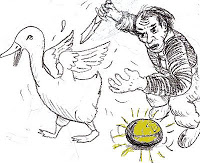
25Do you remember Aesop’s fable of the goose that laid the gold eggs? Let me refresh your memory of this tale. It’s about a farmer that was poor. One day he makes a startling discovery when he finds a golden egg in the nest of his pet goose. Skeptical at first, he has the egg tested and finds that it is indeed made of pure gold. Even more amazing, each day this farmer awakes to find that his goose has laid another golden egg. In very short order, this poor farmer becomes fabulously wealthy. But then his wealth brings greed and impatience. No longer satisfied with just one golden egg per day, the farmer cuts open his goose to harvest all of its golden eggs at once only to find the goose is empty inside. With a now dead goose, there will be no more golden eggs laid.

In remembering this fable, it sounded so familiar to the world of radio broadcasting. A radio station was like a wonderful “goose” that laid daily “golden eggs” for many an owner. It was an industry joke that having an FCC broadcast license was like having a license to print money. It was “golden.”

But broadcasters not wishing to wait for each day’s golden egg, cut open their goose with the Telcom Act of 1996. Twenty years ago, this act deregulated radio and now owners, like the farmer cutting open his goose to get all the eggs at once, now could own as many radio stations as they basically wished.

And how did that work out? Not much better than what the farmer discovered.

The moral of Aesop’s fable is if you focus only on the golden eggs and neglect the goose that lays them, you will soon be without the very asset that produces the golden eggs.

The radio industry’s quest for short-term returns, or results, took their free FCC licenses and ruined them by not maintaining the balance between the production of desired results and the production capacity of the asset.

Aesop’s fable is the very principle of effectiveness. It’s a natural law. Like gravity, you don’t have to believe in it or understand its principles, but you can never escape its effects.

Radio broadcasters probably saw the moral of the fable being the more geese you own, the more spots you add to the hour, the more effective your R.O.I. (Return On Investment) will be. But ironically, it was the principle of “Less Is More” that in the end rules the day.

To be truly effective, you need to maintain the balance of what is produced (golden eggs/revenue) and the producing asset (your goose/radio station).

Stephen Covey wrote extensively about all of this in his book “The Seven Habits of Highly Effective People.”

“When people fail to respect the P/PC Balance in their use of physical assets in organizations, they decrease organizational effectiveness and often leave others with dying geese.”

-Stephen Covey

One could certainly make that case for two of America’s largest radio broadcasters today. They are reaping the results of those who’ve gone before them who’ve in essence liquidated the asset, before they took over and now the accounting system appears to show that they are not performing at the level of their predecessors. But is that really the case? Did they in reality inherit a very sick goose when they took over? The debt problem say many who are more schooled in this area of high finance than I, will probably be addressed with a re-set. And once that happens, it will come back to the people of radio.

Covey says to “always treat your employees exactly the way you want them to treat your best customers.” Herb Kelleher at Southwest Airlines built his company on this very Covey principle.

Covey puts it this way: “You can buy a person’s hand, but you can’t buy his heart. His heart is where his enthusiasm, his loyalty is. You can buy his back, but you can buy his brain. That’s where his creativity is, his ingenuity, his resourcefulness.”

The bottom line is the future of radio will be determined by the vision of the people leading the radio industry. It will also be determined by the hiring decisions they make going forward.

“If you hire people just because they can do a job,

they’ll work for your money.

But if you hire people who believe what you believe,

they’ll work for you with blood and sweat and tears.”

-Simon Sinek

13 Comments

Filed under Education, Mentor, Radio, Sales, Uncategorized

What if…

I had the opportunity to sit in on a webinar on “The Creative Economy” that is considered to be the direction the future of business is headed in compared to the traditional business methods of the past. What is meant by the term “The Creative Economy?” It’s one where business revolves around the customer versus the past where the customer revolved around the business.

The Creative Economy also breaks from tradition in the sense that it means the goal of a company is no longer about making money for the stakeholders but about delighting customers. But, you ask, isn’t “maximizing shareholder value” the mantra of Wall Street? Good question. Listen to what these CEOs have to say about that mantra:

            Jack Welch former CEO of GE: “the dumbest idea in the world”

            Vinci Group Chairman/CEO Xavier Hulliard: “totally idiotic”

            Paul Polman, CEO of Unilever: (has denounced) “the cult of shareholder value”

            Marc Benioff, CEO of Salesforce declared this still-pervasive business theory “wrong”

I guess it’s quickly losing favor with those who should know.

The Internet and “The Cloud” are enabling “The Creative Economy.”

Which brings me back to my initial question, “What if…”. What if radio stations were supposed to be small operations? What if the radio industry wasn’t meant to scale?

When I entered the radio business, companies were limited in the total number of radio stations they could own; in the entire USA. It was known as the 7-7-7 rule. A single company could own not more than 7 AM, 7 FM and 7 TV stations in all of America.

What this created was competition between owners of radio stations in a market. Each station was a team of people working as hard as they could to win the audience in that market. The focus was all about the listener or the viewer. Win the most listeners/viewers and advertisers would soon follow to showcase their wares on that radio or TV station’s airwaves.

Hearing “The Creative Economy” described on this webinar was like radio déjà vu.

In 1996, President William Jefferson Clinton signed the Telcom Act of 1996 into law. That was the moment that the “land rush” for broadcast properties began and Wall Street became heavily invested in the radio industry. Wall Street would bring its “maximize shareholder value” mantra to broadcasting.

This point was really brought home to me in 1999 when my stations were sold to a large radio consolidator. The head of this “big box” radio operator told us that we needed to “sell, sell, sell” that it was all about making money for the company and “maximizing shareholder value.”

This “pump up the troops” speech left me cold. I was brought up in a radio world that was about operating “in the public interest, convenience and/or necessity.” I was brought up in a world where if we treated the members of our team well, our team focused on delighting the listener, the advertisers would flock to our station and the owners would be rewarded for doing everything right. That view of life served me well my entire radio career.

Needless to say, I opted not to remain with this new company.

However, I would find myself playing “musical chairs” going forward as it was getting impossible to not be working for a company that hadn’t adopted this modus operandi.

Steve Denning, who writes for Forbes, lead this webinar and pointed out that economics was driving the change for companies worldwide. He told us that no company is doing it all right. Companies like Apple, Amazon, Google and Salesforce are moving in the right direction. In fact, Tim Cook is better at navigating the change to this style of management than Steve Jobs ever was and it no doubt is contributing to Apple being the most valuable company in the world. To give you an example of what it means to focus on the customer first, consider Tim Cook telling an investor in Apple this:

“If you want me to do things only for ROI reasons, you should get out of this stock.”

That was kind of radio world I grew up in. We always tried to do the right thing for our employees, our listeners, our advertisers and the money would follow.

I’m encouraged that radio people who sold out when Wall Street was buying, are now getting back into the radio business with that same ethic, spirit and sense of innovation that seduced me into a four decade long radio career. They understand the concept of “The Creative Economy” because that’s how they built their radio companies the first time around. They also understand that today, radio is more of a concept of operation than a method of delivery.

I’m excited to be working with the next generation of radio broadcasters at my university knowing that radio’s future has never been brighter.

7 Comments

Filed under Education, Mentor, Radio, Sales

Remember When Radio Was Agile?

Have you heard about the latest management movement?  It’s called “Agile” (but it can also be called “Scrum”).

Actually, to be more accurate, there’s “management” and then there’s “Agile.”  They are not one in the same.  Another way to picture them is one is a vertical style of management and the other is a horizontal style of operating.

The vertical style is familiar to anyone working in one of today’s highly consolidated public radio companies that own hundreds of stations.  The top of the management pyramid says “jump” and the troops respond with “how high?”  You may also find that the company circulates a “Best Practices” manual and wants every station to implement it even though a person on the front lines may wonder if these are “best practices” in their particular case.

The military model was the genesis of the vertical style of management.  New York City’s tall vertical skyscrapers are literal structures of top-down management.

Then I started reading about Agile.  Agile is a horizontal mindset.  Everyone in a company is working towards the same goals and on an equal plane.  The planning and execution is a shared endeavor all designed with one goal in mine and that is to delight a customer.

While both vertical and horizontal styles are business models and the purpose of a business is to create a customer (and ultimately a profit), the radical difference is vertical puts that profit goal front and center and has everyone focused on achieving that goal.  The horizontal style says if we delight our customers, then the profits will follow.  The customer is front and center and the focus of everyone who works at the company.

I’ve worked with couple of the big consolidators and I’ve heard the CEO’s message of how much the stakeholders had invested in the company and how we all needed to be focused on reaching or exceeding our goals.

But that’s not the style of radio I entered.  Back in my early days, the radio station; often owned by folks who lived and were active in the community, the focus was on our listeners and our advertisers.  Everyone in the radio station worked towards the same goals of delighting our two constituencies.

We didn’t call it “Agile” or “Scrum” but doing GREAT radio and operating in the public interest, convenience and/or necessity.  OK, not to get too Pollyanna, there was a vertical structure of sorts – a GM, PD, SM – but we all worked side-by-side in the same building and everyone did whatever was needed to be done to delight our customers.  It was a team effort.  It was a horizontal style of operating.

What changed was the Telcom Act of 1996.  That new law would change the face of radio through massive consolidation of radio stations.  All of these little horizontal operating enterprises would be stacked one on top of another until we had a vertical style of operating.  Now a group of folks would declare they were “the adults in the room” and start passing out thumb drives filled with spreadsheets full of revenue goals.

Nowhere were there discussions of delighting the customers.

Tim Cook, CEO of Apple, has made it abundantly clear that Apple is not always going to do things that simply fatten the bottom line and that if you are an investor in Apple that doesn’t like that way of operating, maybe you should invest your money someplace else.  Apple is going to delight the customer  – as Steve Jobs so simply stated – by making insanely great products.

How’s that focus on the customer working out for Apple?  Very well, thank you.  Apple has posted the largest net quarterly profit in history. Not in just Apple’s history but in the history of the world.

Radio is a fabulous business!  Radio entertains, informs and is there in times of emergencies to hold a community together.  But radio performs best when it is operated horizontally and not vertically.

Mary Meeker in her most recent “Internet Trends report at Re/Code” had a slide in her 180-slide deck that spoke most passionately I think to this concept of operating horizontally.  That slide was titled “Diversity Matters….It’s Just Good Business” and here is what the body copy of the slide said:

            “One of the things I have learned about effective decision making is that the best decisions are often made by diverse groups of people.

Saying or hearing these words is magic…..

‘That’s really interesting.  I had never thought of that way before.  Thank you.’”

That sure sounds to me like Mary was making a plea for companies to re-think how they operate and level the playing field by moving to a horizontal style of operating.

The reason the radio industry was so attractive to Wall Street investors was because it was a high cash flowing business that appeared easy to operate.

My roller skating coach used to tell me “Dick when you make it look easy, then you’re doing it right.”  Radio used to be doing it right.  It’s really a lot harder than it looks.  It’s time to go back to that way of operating.

OR – you can continue doing things the way you did last year and watch “flat revenue growth be the new up.”  Doesn’t sound like the radio industry has much to lose by changing their ways.

The good news is there are radio operators who are returning to the business that see the opportunities in the horizontal approach to radio station operations.  It’s a movement that will not only be good for the radio industry but the listeners and advertisers served by the industry.

It’s called Win-Win-Win.

3 Comments

Filed under Education, Mentor, Radio, Sales