

Commercial radio was born in November of 1920. The first OEM (Original Equipment Manufacturer) car radio came along in 1922 designed by the Chevrolet Motor Company and manufactured by Westinghouse. This first car radio was heavy, cumbersome and expensive; costing $200. In today’s dollars this would be the equivalent of $3,347.00. A 1922 Chevrolet, Superior 5-Touring automobile was priced at only $860, so you can see how expensive it was to buy one with a radio installed.
The good news is the radio worked and would then birth 100-years of innovation in the automobile dashboard.
The 1920s Car Radio Sales Pitch
With a radio in your car, your family could drive anywhere within a hundred miles of a radio station while being entertained, informed and educated.
It’s hard for any Baby Boomer to imagine not having audio entertainment as standard equipment in their dashboard.
1930s
It was radio engineer Paul Galvin that would pioneer more affordable car radios which he manufactured and sold through his new company, called Motorola.
1940s
Midway through the 40s, it is estimated that nine million cars now had radios in their dashboard and people were becoming concerned that they were leading to distracted driving thereby causing more auto accidents. Both broadcasters and radio manufacturers made the case for how having a car radio was useful in emergencies and alerted drivers to bad weather conditions.
Today when the topic of distracted driving comes up, it’s usually about handheld cellphones being used by drivers. But back then, Radio-Craft Magazine told of the battle being waged between state legislatures and radio manufacturers: “Ever since auto-radio installations became popular, a controversy has been going on…as to whether auto radio presented an accident hazard or not.”
The president of the Radio Manufacturers Association made the case that car radios were safe saying:
“Radio is not distracting because it demands no attention from the driver and requires no answer, as does conversation between the driver and passengers. Motor car radio is tuned by ear without the driver taking his eyes off the road. It is less disconcerting than the rear view mirror.”
Several states proposed steep fines for drivers, while others considered making installing a car radio a crime.
The Princeton Radio Research Project was created to study the effects car radios were having on automobile safety. In a paper published by Edward A. Suchman for that project, he reported that his small study found no link between car radios and traffic accidents.
1960s
In 1963, Frequency Modulation (FM) radios were introduced into the automobile for the first time. Radio penetration in cars had now reached 60%.
Along with FM radios, the 60s also gave birth to both eight-track tapes and car stereos, primarily due to the use of transistors, instead of vacuum tubes. Solid state transistors were smaller, drew less power and emitted very little heat.
1970s
If the 60s belonged to the 8-track tape player, the 70s would belong to the stereo cassette tape player. Recording tape manufacturer Maxell promoted these cassettes as nearly indestructible.
1980s
While the Compact Disc (CD) would be introduced in the 80s, it didn’t really become ubiquitous until the late 90s, coexisting with compact cassette players in automobile dashboards for two more decades.

21st Century
Probably the biggest disruption to the automobile dashboard came with the advent of Bluetooth allowing smartphones to interface with a vehicle’s entertainment system.
In 2011, automobile manufacturers stopped offering cassette tape players in their new cars, soon followed by the elimination of CD players/changers.
Today’s new cars come equipped with access to Satellite Radio, and an automatic interface with your smartphone allowing you the ability to stream anything you want to hear into your car’s entertainment system.
In fact, my first article for this blog in 2022 was “Why I Stream ALL My Radio Listening,” which diagrammed how my car radio audio systems are now programmed by my iPhone.
“Radio is not going to be Numero Uno in the dash any longer.”
-Fred Jacobs
AM/FM radio will most likely coexist with other forms of audio access for a period of time, but the writing is on the wall.
The definitive answer to how long over-the-air radio will continue to be used in the automobile really depends on broadcasters and whether or not they offer compelling and attention-getting content that audio consumers demand to hear.
AutoStage
Xperi’s newest in-dash experience is AutoStage. It was demonstrated at CES2022 and it should be noted that this system comes with the following pre-sets: SiriusXM, FM, AM and TuneIn Radio.
I use the TuneIn Radio App for most of my radio listening, but why was it chosen by Mercedes Benz? Turns out the answer is, “TuneIn’s radio stations can be accessed worldwide in 197 countries on more than 200 different platforms and devices.” TuneIn says it “provides the displaced radio listener a connection to home with local, national, and international stations anywhere they go and on any device.”
In other words, why would any audio consumer need DAB (Digital Audio Broadcasting), DAB+, Digital Radio Mondiale, HD Radio, AM or FM when they can receive any radio station in crystal clear audio via streaming?
With the exception of the proprietary content offered by SiriusXM, everything else is available via streaming at no charge.
Waxing Nostalgic
Car radio has come a long way from the day William Lear and Elmer Wavering drove their girlfriends to lookout point high above the Mississippi River town of Quincy, Illinois to watch the sunset and their dates told them how much better this romantic evening would have been had they been able to listen to music in the car.
Lear and Wavering shared their girlfriends’ comments with Paul Galvin who would go on to make Motorola car transistor radios, and then AM/FM radio would dominate the dashboard for the rest of the 20th Century.
So, now moving further into the 21st Century, radio broadcasters really need to follow the advice of Steve Jobs in order to survive and thrive, and that is to:

 I hope you are enjoying this holiday weekend celebration of America’s independence 244-years in the making.
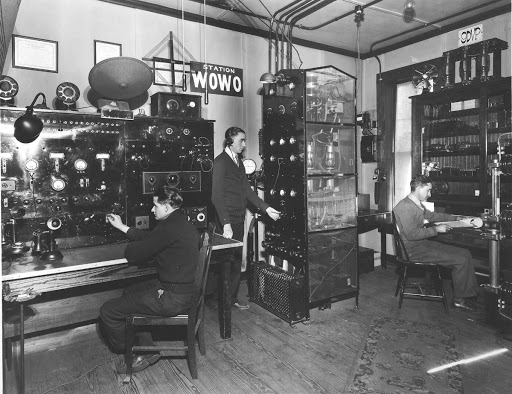 joyous time for the staff and management at that radio station. It was only four years earlier that WOWO signed on the air for the first time in its storied broadcast history, March 25, 1925.
 It was a joint venture between Texas Instruments and Regency Electronics that would produce the world’s first transistor radio, the TR1, in 1954. However, it wasn’t until three years later when SONY would introduce its smaller and cheaper TR-63 transistor radio that this new communication device would become the 1960s/70s mass market success story.

 The successful television sitcom “Seinfeld” debuted on the NBC television network. The show “about nothing” ran for nine years and has grossed more than $4 Billion, making it the most profitable half-hour television program in history.
 Each new generation of technological development has moved media consumers away from traditional broadcast radio’s position as the leader for reaching the masses with new music, news and cultural trends.
 I grew up with TV.
 This was certainly true in the first golden age of radio, that period of time from its birth in 1920 through the mass takeover of television in the 1950s. Once TV came along, radio had to reinvent itself.
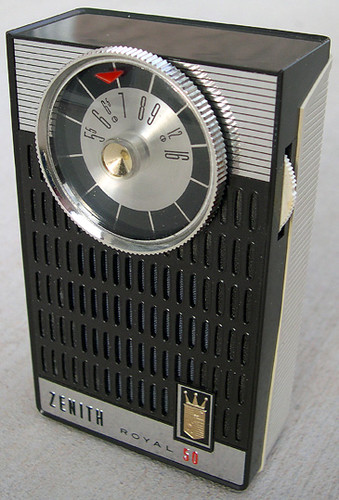 Growing up in western New England, the transistor radio would impact my life and career. Radio has been in my blood as long as I can remember, but it would be my Zenith transistor radio that would first allow me to explore new stations, new music, new personalities and new ways of delivering content without the supervision of my parents. My transistor radio and ear piece would make me the master of my own radio dial.
 DickTaylorBlog