Author Archives: Dick Taylor, CRMC/CDMC

Dick Taylor, CRMC/CDMC's avatar

About Dick Taylor, CRMC/CDMC

I’ve been a “Radio Guy” all of my life. My earliest memories were of building a radio station out of tinker toys and pretending I was a disc jockey. Later I would build a radio station in the basement of my parent’s home and using AM & FM transmitters I bought at Radio Shack I would begin broadcasting to my neighborhood for about a three block radius. I began in commercial radio in the 10th grade in high school. A local radio station in my hometown of Pittsfield, Massachusetts decided to start a Junior Achievement company in radio. This was a really new concept in Junior Achievement as all JA companies at that time were production oriented and a radio station would be a service oriented JA company. I was a member of that first Junior Achievement radio company (WJAC) and it quickly led to a part-time job with that radio station (WBEC). Radio would pay for my college education and graduate degrees, both of which were in education. I loved college and could have very easily become a career student. When I graduated with my Masters Degree, there were no jobs in education to apply my earned degrees but there were radio jobs and I went into the radio business full-time as a program director, operations manager and air personality. Deciding what I’d really like to be is a radio station general manager, I knew that I would need to earn my chops in sales and so I quit my job on the product side of the business and started over at the bottom of the sales ladder as an account executive. I quickly rose to sales manager, station manager and general manager. For 27 years, I operated at the market manager level of the radio industry. I’m a Life Member of the New Jersey Broadcasters Association and Radio Ink Magazine has named me one of radio’s best managers. Former professor of broadcasting at the School of Journalism & Broadcasting at Western Kentucky University (WKU) in Bowling Green, Kentucky. I have a successful track record in sales and people development, growing top line revenues, achieving leading audience ratings, reducing expenses and meeting bottom line goals. I’m a recognized expert in radio and media regulations. I’m a turnaround specialist. I'm the founding director of the KBA WKU Radio Talent Institute coordinating a professional faculty of broadcasters who teach broadcast students who qualify and are accepted to attend a ten-day intensive program that trains tomorrow’s broadcasters in all aspects of radio station operations. My specialties include: dynamic public speaker/presenter and sales trainer. I currently teach classes in the Process & Effects of Mediated Communications, Broadcast/Internet Sales, Broadcast Performance/Production, Broadcast Management and the History of Broadcasting in America. I hold a BA in Physics/Education, an MS in Educational Communications, the Diamond CRMC (Certified Radio Marketing Consultant) and the CDMC (Certified Digital Marketing Consultant) from the Radio Advertising Bureau. I’m a graduate of Roy H. Williams Wizard Academy and Gitomer Sales Training. Note: The picture on my blog is when I was invited to do a guest disc jockey appearance on The Legend - 650AM - WSM in Nasvhille, Tennessee (July 2014). For this "Radio Guy" doing a four-hour air shift on this legendary clear channel signal radio station was a dream come true.

Is AM Radio “Hot or “Not”?

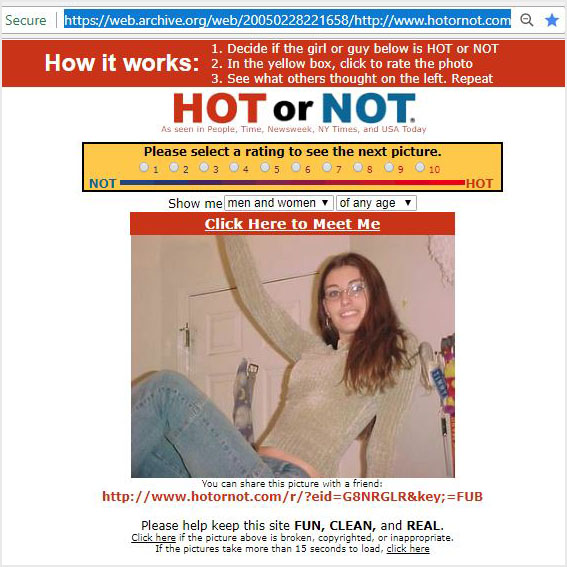
Twenty-four years ago, in October 2000, a new relationship website launched called “Hot or Not.” The premise of the site was for people to submit photos of themselves (or others) to have users of the site rate them on a scale of 1 to 10 on their attractiveness.

Within a month of launching, the site reached around two million page views per day.

Mark Zuckerberg’s original idea was to do something similar with a site he created called FashMash, which became TheFacebook.com in 2004 (now just Facebook.com). Likewise, the founders of YouTube said they originally set out to create a video version of “hot or not” before developing a more inclusive site.

HOT or NOT

It was based on this site that Fred Jacobs presented, the things he did and saw at this year’s Consumer Electronics Show in Las Vegas, aka CES 2024, as being “Hot or Not.”

During the webinar, I asked the smarmy question “Is AM Radio HOT?” in the chat box. (No, I didn’t get an answer.)

However, the bigger question really is, “Is RADIO Hot or Not?”

The answer from everything I’m reading is “Not,” at least in the way things are going.

When it came to radio audience ratings, I never concerned myself with individual ratings, but preferred to study audience trends. Here’s the latest trend lines for both broadcast radio and digital streaming:

Not A Viable Business Anymore

In Canada this month, the chief legal and regulatory officer of Bell Media grabbed the headlines worldwide, when he explained the reason Bell was selling off 45 of its radio broadcast properties, was they were “not a viable business anymore.”

“One man’s trash is another man’s radio stations.”

-Fred Jacobs

So, what do you think the buyers of these radio stations must have thought, after the seller tells the world they think the radio stations they just sold are not a viable business?

Surprise, they are very positive about the radio business. Take a moment to listen to this very positive view from the CEO of My Broadcasting Corporation, one of the seven local broadcast companies that purchased radio stations from Bell.  You can here that CBC interview here: https://www.cbc.ca/listen/live-radio/1-100-ottawa-morning/clip/16041778-local-bell-media-radio-stations-owner

The State of Media 2024

Harker Bos Group https://harkerbos.com/ released new research on the state of media today and here are some of the key takeaways.

What are radio listeners looking to hear?

  • 54% highlight the importance of local coverage
  • 67% sound quality
  • 54% station availability
  • 53% ease of use

When the researchers compared broadcast radio to digital streaming of music, they found that usage of broadcast by younger audiences was losing out to streaming services. Those that are frequent users of streaming music tend to access it via smartphones, computers, smart speakers and tablets preferring on-demand music services with personalized playlists and recommendations. Streaming also provides users global access that is not bound by geographical limitations.

Is The Media Prepared For An Extinction-Level Event?

That headline in the New Yorker caught my attention! The author, Claire Malone, cites “ads are scarce, search and social traffic is dying, and readers are burned out, [which means] the future will require fundamentally rethinking the press’s relationship to its audience.”

The way to become a millionaire in radio,

is to start with a billion dollars.

That’s not something new, that witticism has been around since the end of the 20th Century. I was reminded of it when Claire shared the words of a late-career writer’s advice to the newbies: “You want to make it in journalism, marry rich.”

Last year, 2,681 people were laid off in broadcast, print and digital news media.

In February of this year, after the record-setting viewership to the CBS broadcast of Super Bowl 58, that very network announced it would be cutting 800 jobs.

Significant job cuts have taken place at:

  • NBC News
  • Vox Media
  • Vice News
  • Business Insider
  • Spotify
  • theSkimm
  • FiveThirtyEight
  • The Athletic
  • The New Yorker
  • Sports Illustrated

And some other media outlets closed down:

  • BuzzFeed
  • Gawker
  • Pitchfork
  • The Messenger (this endeavor lasted less than a year)

“Publishers, brace yourselves – it’s going to be a wild ride.

I see a potential extinction-level event in the future.”

-Matthew Goldstein, media consultant

I share these stories with you, not to depress you, but for you to better understand what’s going on, and that it’s not just a radio problem, but a media problem.

As Netflix, Amazon Prime Video and others add advertising to formerly ad-free streaming channels, where will those ad dollars come from; radio, TV, cable, newspapers, magazines? The advertising dollar pie is not infinite; to grow your piece of the pie, means eating someone else’s.

“It’s time for a new revolution.”

-Mark Thompson, CNN’s new CEO/Editor-in-Chief

Sadly, many media folks working in the industry today, have only been part of the culture of decline – where cutting expenses has been the only plan to achieve future success.

What’s always been true, is it takes money to make money.

Netflix, for example, invests a billion dollars in research and development – mostly on data scientists, engineers, and designers who help Netflix subscribers discover content that they will love.

How’s that working out for Netflix? Here’s the latest data:

In 2024, media companies will find media users making decisions on which services they really want – and can afford – to continue subscribing to.

For radio operators, who operate a subscription-free service, the challenge will be:

  • to understand what your listening area’s population wants, needs and desires, and
  • to deliver for your underwriters or advertisers the best R.O.I. (Return On Investment)

The best ratings for advertisers

will always be increased cash register rings.

6 Comments

Filed under Education, Mentor, Radio, Sales

The Future is ON-DEMAND

I just finished reading the public radio research report “An Audience Growth Strategy for Public Media” prepared by Jacobs Media and Mark Ramsey Media for Maine Public radio service. What really stood out to me was how clearly this report shows where the future is for all traditional linear media.

Linear Is In The Rear-view Mirror

Broadcast radio and television – traditional media – was built on a linear program schedule, delivering to the media consumer, information and entertainment on a schedule determined by the broadcaster. The VCR (video cassette recorder) developed in 1956 became widely available in the late 70s and by the early 2000s was in virtually every American household, giving  television consumers the ability to now watch shows on their schedule, not the program provider’s.

“It is painfully obvious neither broadcast radio nor television is growing, especially as it concerns traditional (terrestrial) usage and linear program schedules,” writes Jacobs/Ramsey.

Today’s Media Consumer

America continues to become more diversified: 72% of Baby Boomers are white but only about half of Millennials are white and four-in-ten of Gen Zs are white.

Millennials were born between 1981 and 1994, so VCRs have always been a part of their life and Gen Zs were born 1995 and 2009, which means also having an iPod type device has always been part of their life. Both of these devices contributed to the habit of having what you want, ON-DEMAND.

In 2007, the iPhone introduced us to a media device that made ON-DEMAND media consumption ubiquitous.

Listening Options

Today’s non-radio listeners have a plethora of media options:

  • Spotify
  • Pandora
  • Apple Music
  • Amazon Music
  • Radio Tunes
  • SiriusXM
  • Podcasts
  • Audio Books
  • YouTube
  • Social Media

…just to name a few.

Jacob/Ramsey says “Linear program schedules common to over-the-air [broadcast] stations are not in alignment with new media consumption habits.” Today’s consumer is in control, not the media provider.

ON-DEMAND Digital

In today’s world, the future is “Go Digital, or Go Home.”

Today’s traditional broadcasters (Radio & TV), must take advantage of digital’s ability to serve their audiences with what they want, when they want it and on the media platform they want it on. The same attention given to over-the-air broadcasts will need to be given to all the other ways of content distribution; as each is of equal importance to the media consumer.

“Broadcast radio and television will remain the core business for years to come, but a focus on traditional media can no longer be considered a growth strategy,” writes Jacobs/Ramsey.

Peacock & Netflix

NBC’s Peacock streaming service paid $100 million dollars to exclusively stream the wild-card playoff game between the Kansas City Chiefs and the Miami Dolphins, setting a record for the most-streamed live event in American history. Comcast Chairman & CEO Brian Roberts considered the streaming gamble a success and a very proud moment for the company, but for consumers it will mean having to pay for playoff games in the future.

This week Netflix announced it had struck a 10-year deal with WWE to air “Monday Night Raw” on its streaming service. This program has been on linear television since 1993; 31-years ago.

Peak Listening On Audio Platforms

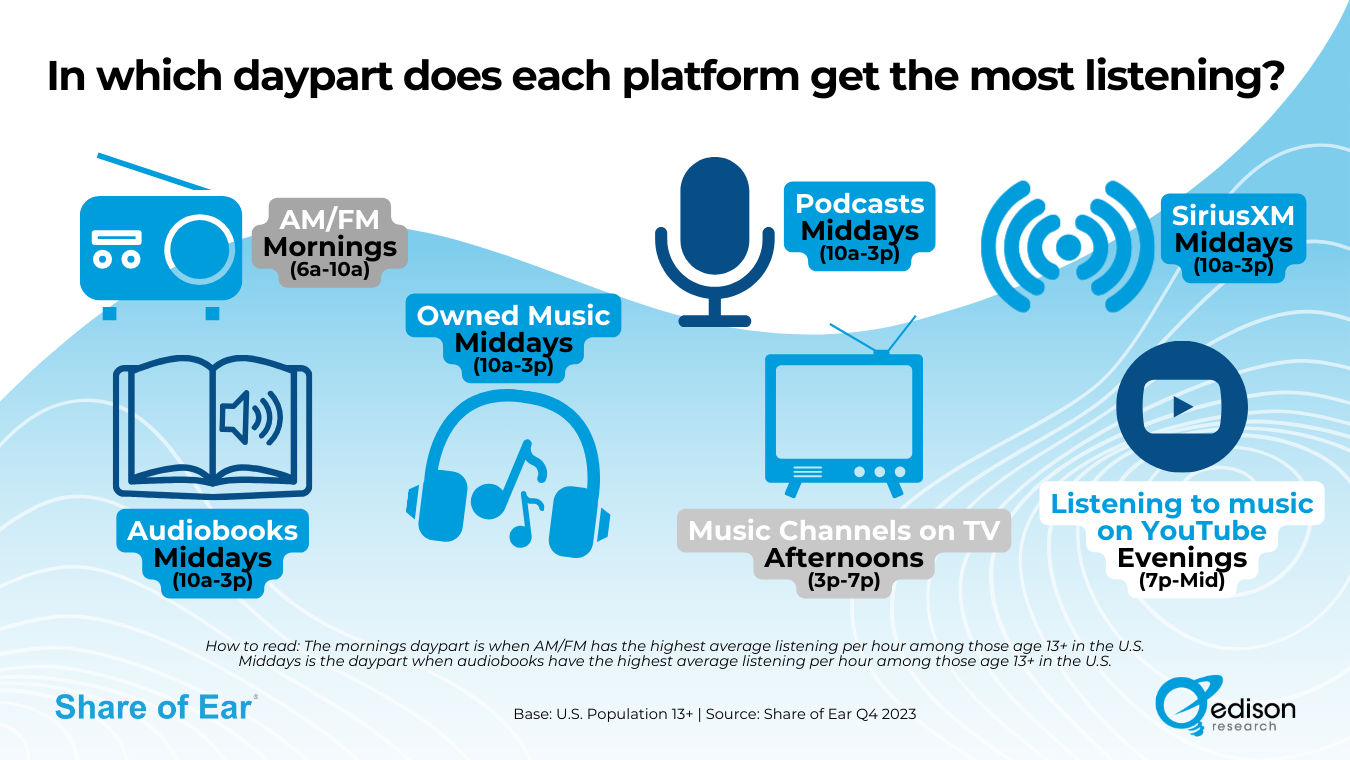
This pat week, when Edison Research published their article on which media platform commands the most listening in different dayparts, it was eye-opening.

The only daypart that broadcast radio commands is morning drive (6-10am), which just happens to be the one daypart the broadcast radio industry still invests in live air personalities. For the rest of the dayparts, consumers utilize streaming audio or previously downloaded content to their media device.

My favorite time to listen to radio growing up was 7pm to midnight. Some of the best known and loved air personalities broadcast during this daypart; Big Ron O’Brien, John Records Landecker, Wolfman Jack, Cousin Brucie among others. However, today the research shows that YouTube is what people listen to at this time of day.

Just before the end of last year, SiriusXM announced the debut of its new streaming App. It offers “discoverability and personalization at the forefront, [so] listeners can quickly and easily find and dive into the content they love across SiriusXM’s 400+ channels and tens of thousands of hours [with] on-demand content and podcasts, [allowing] fans to go deeper into their passions and get closer to their favorite music, artists, personalities and sports; [providing]  a seamless listening experience across streaming devices that reflects listener preferences and interests,  [ensuring] subscribers never miss a moment wherever they are and whenever they want to listen.”

Don’t you wish the NAB (National Association of Broadcasters)

was working on something like this, instead of focusing on linear AM radio?*

*https://www.nab.org/documents/newsroom/pressRelease.asp?id=6916

11 Comments

Filed under Education, Mentor, Radio, Sales

Has Radio Lost Its WHY?

When commercial radio was born in the 1920s, radio’s WHY was thought to be a technology that could provide nationwide communications that would be a unifier for cultural and social systems. Radio’s regulatory guiding principle was to “operate in the public interest, convenience and/or necessity.”

When people were still trying to wrap their minds around what exactly radio would be, there was one common reoccurring theme about what radio broadcasting could do, and that was to unify a nation and create an American identity.

It could accomplish this in several areas:

  • Physical Unity: the ability to unite America from coast-to-coast, border to border, with instantaneous wireless communication.
  • Cultural Unity: through entertainment, news and the spoken word (English); radio could create a kind of national homogeneity.
  • Institutional Unity: corporations and the federal government would come together on a mandate that this new powerful form of communications needed centralized control.
  • Economic Unity: through advertising, radio could now offer national, regional and local opportunities for businesses to expose their products and services and grow our nation’s economy.

Radio vs. The Internet & Artificial Intelligence

Just about every business has found its original business model challenged by a population connected to the internet. Think about the original radio WHY areas and you can easily see how each of them has been overtaken, embellished – and depending on your point of view – improved upon by the world wide web and artificial intelligence.

The internet, it turns out, is a better innovation for addressing those original foundational tenets of radio’s purpose than radio itself. So now what?

Radio needs to re-think its “WHY;” its reason for existing. Then it needs to communicate it, clearly and simply or suffer the consequences.  Bud Walters of The Cromwell Group loves to say, “If you don’t know where you’re going, any road will take you there.” Until the radio industry figures this out, getting new people to listen (or former listeners to return) will be a challenge.

People don’t buy what you do, they buy why you do it.

-Simon Sinek

Two Questions

To help you get started on defining radio’s WHY for the 21st Century, I’d like to share two questions that GOODRATINGS Strategic Services consultant Tommy Kramer asked his clients:

  1. What do you have that I can’t get everywhere else?
  2. What do you have that I can’t get ANYWHERE else?

Tommy says that coming up with the answers to these two questions will decide your future.

I would add that working through these two questions might just uncover your new WHY for your radio station(s) in the 21st Century.

Why do you do, what you do?

5 Comments

Filed under Education, Mentor, Radio, Sales

Best of the Blog 2023

It’s been my tradition since I began this blog nine years ago to look back on the year just past and share with you the Top 5 Most Read articles over the last 52 weeks.

To date, 441 articles have been published and have been viewed over 296,300-times from folks around the world; maybe you missed them or perhaps you’d like to read them again.

Most Read Article of 2023

Radio’s talent pool is shrinking, and those people still working in radio are “wearing more hats” than ever with 54% of radio personalities saying that they are responsible for more than four different areas of their radio stations.

It was this statistic that led me to write “ Is There A Future For Air Personalities.”  Apparently this article struck a nerve with thousands of readers when it was published in September 2023.

Second Most Read Article of 2023

In May 2023, I asked the question “Where Are the Radios?” with an article titled “Radio’s Disappearing Act.”

39% of American homes today no longer have a single AM/FM radio in them, and radio set ownership gets worse for young Americans age 12 to 24, where that number grows to 57%.

AM/FM radios are vanishing from hotels, B&Bs, American homes and big box retailers.

Third Most Read Article of 2023

If people don’t have radios in their homes and workplaces, where are they getting their music fix? Earlier in May, I asked that very question in an article titled “Where People Today Get Their Music Fix.”  

According to research conducted by the International Federation of the Phonographic Industry (IFPI), more 64% of individuals primarily choose to play music over the internet.

Music is personal and the internet allows all of us to hear what we want, when we want to hear it. Knowing this, broadcast radio – now more than ever – needs engaging personalities that make an emotional connection with listeners beyond the music they play.

Fourth Most Read Article of 2023

Forty-six years ago, Johnny Paycheck released a song titled “Take This Job And Shove It.” It was his biggest hit, and as it usually happens with a song like this, it stands out to even non-fans for a reason. Specifically, in this case, it was because it hit home with many dissatisfied workers all across America.

In 2023, the website Careercast.com published a report on the “Top Ten Worst Jobs in America,” three of those jobs listed were reporter, broadcaster and advertising salesperson. Poor pay would be bad enough, but a lack of job growth exacerbates attracting new talent.

Fifth Most Read Article of 2023

Radio listening, is a habit; a habit that is disappearing along with local radio personalities. Radio personalities are a station’s brand, they are unique to your radio station; coach them, grow them and promote them.

If you don’t understand the listener’s needs, from the listener’s point-of-view, then you’re just spinning your wheels. This was the subject addressed in the article “Listeners Don’t Care.” 

Most Read Article The Day It Was Published

Back on September 6, 2015, an article I wrote in the early days of this blog continues to hold the record for the most readers and comments the day it was published. Looking back, I see that it dealt with the same issue eight years ago that has only gotten worse, that being the elimination of the very thing that makes radio great – it’s radio personalities.

We Never Called It Content  is the story of how a radio industry inspired me to make this my life’s career. It’s an article that’s had over 5,000 views.

                  Radio is an art form.

When you remove the artists, there’s not much left.

Why I Blog

I blog for broadcasters, educators and students, to provide media mentorship and to pay-it-forward to the broadcasting industry that I have been a part of for over 56-years. I’m grateful for the more than 221,000-people from all over the world who have visited this blog (https://DickTaylorBlog.com) and have read articles that have caught their interest.

Also every article I’ve written is archived on my blog site and easily accessible.

As I begin my 10th year of blogging, I plan to write new articles when I feel I can add a different perspective to how our media world is changing and evolving, ending the rigor of writing a new article every week.

If you’re a subscriber to my blog – IT’S FREE – then you will automatically receive new articles as they are published.

2 Comments

Filed under Education, Mentor, Radio, Sales

Grateful For Your Readership

Back next week with the year’s most impactful articles

on DTB in 2023.

5 Comments

Filed under Uncategorized

Do You Have A Favorite Radio Station?

Growing up, I had a few favorite radio stations and when I think of the reasons that I was so attracted to them, the top three reasons would have been:

  1. Air Personalities
  2. Station Imaging/Jingles
  3. Music

Favorite Songs

When it comes to music, the number one way most people today access the songs they want to hear is via streaming with YouTube now the top source for streaming people’s favorite songs.

No longer in our “I want it now” world does anyone want to wait until a radio station decides to play their favorite song, we just ask Alexa, Siri or Hey Google to play it.

Gone for radio is the #3 reason on my list above.

Don’t Be Generic

As I spin the radio dial today, all radio sounds much the same; in a word “generic,” and no one ever became attracted to anything generic.

Gone for radio is the #2 reason on my list above.

People Made Radio Attractive

Over the years, radio has had personalities that made the medium special: like Howard Stern, Rush Limbaugh, Dan Ingram, Larry Lujack, Robert W. Morgan, Wolfman Jack, Arnie “Woo Woo” Ginsburg, Dick Biondi, Boom Boom Branigan, Ron Lundy, Dale Dorman, Paul Harvey and many more.

As these people retired or were RIF’d (Reduction In Force), my #1 reason for listing to radio went with them.

People are attracted to people and experiences which stimulate the part of the brain that triggers craving and longing, releasing habit-forming, feel-good chemicals such as dopamine and endorphins.

Your iPhone does that for you.

Your voice activated smart speaker does too.

For radio, great air personalities did it for you.

Radio Is Show Business

Unfortunately, most of today’s radio is focused only on the business part of the equation.

Don’t get me wrong, the business part is important, but without a focus on the show part, the business end will suffer.

Radio’s big advantage is offering advertisers an engaged audience to expose their goods and services to, but without unique air personalities, which attract listeners to tune in every day, radio’s audience will depart, as will those very advertisers that provide the economic engine for the radio industry.

22 Comments

Filed under Education, Mentor, Radio, Sales

They’ve Been Leaving The Light On Since 280 BC

You would think, that a service that’s been around for centuries — and manned by people – wouldn’t be faced with many of the same personnel issues facing broadcast radio today, but it is.

Recorded history tells us that the first lighthouse dates back to ancient Egypt around the year 280 BC. It consisted of an open fire pit, on top of a hill rising 450 feet in the air. It took manpower to keep the fire burning from dusk to dawn.

Creating The Light Source

The history of lighthouses tells us of all the changes that took place creating the light in these sentinels of the coastline, things like:

  • Burned wood
  • Burned coal
  • Burned lard oil
  • Burned sperm whale oil

Electricity Arrives

The invention of the electric light changed how lighthouses operated and with it the duties of the lighthouse keeper. They no longer had to carry fuel up and down the stairs of the lighthouse to keep the light lit. Now the job only required insuring the light bulb wasn’t burned out.

Lighthouse Keepers

In America, the first lighthouse was Boston Light built in 1716 and the United States Congress created the U.S. Lighthouse Service to hire and staff America’s growing population of lighthouses up and down our coastlines.

These were good jobs, and lighthouse keepers could even have their families living with them at their light stations.

We Still Need Lighthouses, Not Lighthouse Keepers

With the advent of LED light sources, automation and the electronic Automatic Identification Systems (AIS), ships could now be tracked and warned when nearing hazardous waters. Technology had eliminated the need for lighthouse keepers, a career that had been around in America for 307 years was now over.

Sally Snowman

On December 31, 2023, the last lighthouse keeper in America will be retiring. Her name is Sally Snowman, and she has been the keeper at Boston Light for more than twenty years.

Sally has little patience for nostalgia and believes the future is for Boston Light to join the rest of America’s lighthouses in the 21st Century, as a fully automated operation.

Is There A Lesson Here For Radio?

Commercial radio in America has only been around for 103 years, and like lighthouses has played a critical role in keeping people safe and aware of their surroundings.

Radio isn’t going away, but is on the same path as lighthouses when it comes to automation and communicating with the people it is there to serve.

Sally Snowman believes in honoring the past and embracing the future.

As stated in the Federal Communication Commission’s (FCC) manual The Public and Broadcasting, that looks like taking advantage of Artificial Intelligence (A.I.), and automated systems to ensure that broadcasting’s mission continues to be serving the public’s interest, convenience and necessity*

No, this isn’t the style of radio broadcasting that I grew up with and spent over five decades in creating. It also wasn’t the style of radio heard before the advent of television. Television changed the way radio stations sounded and operated in the 1960s. The internet, WiFi and A.I. are forcing radio to change again.

Change or Be Changed

* See 47 U.S.C. § 307(a) (“The Commission, if public convenience, interest, or necessity will be served thereby, subject to the limitations of this chapter, shall grant to any applicant therefor a station license provided for by this chapter”)

2 Comments

Filed under Education, Mentor, Radio

Looking Back On My Professional Life

For thirteen years (1984-1997), I was the general manager of WFPG AM/FM in Atlantic City, New Jersey. The stations were successful. I was active in Rotary, the local chambers of commerce, and community social programs in addition to running the radio stations.

We did the state’s first LMA (Local Marketing Agreement) adding a third radio station to our operation.

We had a print division that did zoned coupon mailers and produced an annual calendar for local advertisers.

I was in the zone, my comfort zone.

Success Is a Poor Teacher

When new ownership took over the radio stations in my 13th year of managing them, one of the owners was to be the “managing partner.” He didn’t have the equity stake to invest, so his contribution was to move to Atlantic City and manage the stations for the group. That meant that everyone in the radio stations were needed, but me.

As I set out to find a new radio general manager position, I would be faced with something new that the broadcasting industry had never had to deal with before, consolidation. Consolidation was like a game of musical chairs, only in this game when the music stopped, you were out-of-a-job.

I thought that my long period of success would be a plus in finding my next position, but kept hearing, “you’ve been at the same place for over a decade?” I would soon learn that this wasn’t perceived as a positive.

My Road Trips

Eventually, I would land my next GM position and move to a new state which would lead to a series of moves every two to three years. At that time, consolidation kept changing the landscape of the radio industry as we knew it, whereas today, it’s artificial intelligence and the internet.

Delaware, Maryland, Iowa, Pennsylvania and back to New Jersey a couple of more times would be my life over the next decade.

While I never would have chosen this path, what I would realize was that I learned more over this period of time than being in the same place for the previous decade. That being successful and in your comfort zone is a poor teacher.

College Professor

In 2010, I made a career change. I went from market manager of a cluster of radio stations for Clear Channel to a broadcast professor at Western Kentucky University. I was moving out of my comfort zone BIG TIME.

That first year was a lot of heavy lifting as I created every course, every lesson, every test for each of my classes.

Eventually, I grew to a new comfort zone at the university. I was on university senate and several committees. I graduated from the university’s master advising certification program and advised around 100 students each semester. I graduated from the university’s police academy and my office was a campus “safe space” for students, faculty and staff. And I was active in state broadcast associations along with founding and directing a radio talent institute on campus.

Why Comfort Zones Are Bad for You

Staying in a comfort zone feels peaceful and relaxing. Comfort zones are not challenging. They become limiting and confining. They can produce a sense of boredom.

I know I certainly had the feeling of “Is That All There Is?” https://www.youtube.com/watch?v=3sWTnsemkIs during my long tenure in Atlantic City.

Change is the only constant you can depend on in the world. Nothing stays the same. If you’re not growing then you’ve “gone to seed.” https://painintheenglish.com/case/27

WWJD (What Would Jobs Do?)

When I look at some of the last thoughts of Steve Jobs,* I find it illuminating. Jobs said that in the eyes of others his life had been the symbol of success. However, Jobs found that apart from his work, he regrets how he raised his children.

Steve had stayed in his comfort zone of his business to the sacrifice of his family.

Retirement

In 2017, I retired from the university, moved to Virginia, got married and through marriage found myself in a family of 14 children, 38 grandchildren and 17 great grandchildren.

I continued to write this blog and volunteer with a non-profit radio station (now in my 10th year for both) and feel very blessed.

Once you’ve accumulated enough money for the rest of your life, you need to change your focus to pursuing objectives that are not related to wealth.

Looking Forward to 2024

The new year is traditionally a time when we all look in the mirror of our lives and contemplate where we want to go next.

If you want to grow in 2024, my best advice to you is to decide to get out of your comfort zone.

Remembering that you are going to die is the best way I know to avoid the trap of thinking you have something to lose. You are already naked. There is no reason not to follow your heart.”

-Steve Jobs

*12/3/2023: A correction was made about Steve Jobs “final words;” to read some of his final thoughts. Steve Jobs finals words were: “OH WOW. OH WOW. OH WOW.” Some of his final thoughts expressed regret in how he raised his children. “I wasn’t always there for them, and I wanted them to know why and to understand what I did,” he told his biographer, Walter Isaacson. Thank You Steve Ross for the correction.

17 Comments

Filed under Education, Mentor, Radio

Grateful For All The Times I’ve Been Fired

You might think that’s an unusual thing to be grateful for, so let me explain.

No, I wasn’t immediately grateful any of the times I found myself in the position of being let go by my broadcast employer. I don’t think anyone ever does.

Blessings in Disguise

It takes a little time and space to realize, that being forced to think about your life and where you really want to be, can be the “boot in the butt” we really need at that moment in time.

As I look back on my life, I realize that every time I’ve lost a job, what came next was always better than what I had left behind. The same might also be said about love and relationships.

Always Be Grateful

The life lesson I want to share with you today is, we can’t see how the twists and turns of our lives will play out in the moment they occur, but if we choose to look for the positive in each event, we will find it; guaranteed.

Henry Ford put it this way:

Whether you think you can or think you can’t,

YOU’RE RIGHT.

The simile to those words I would contend are:

Whether you think what happens in your life is good or bad,

YOU’RE RIGHT.

Life is all about choices, and when it comes to how you deal with life’s events, you can choose to either embrace them as being good, or being bad. (Spoiler Alert: Life is better when you look for the positive in every situation.)

Gratitude

On this Thanksgiving 2023, when family and friends come together, let me leave you with this thought from Melody Beattie:

Gratitude

unlocks the fullness of life.

Leave a comment

Filed under Education, Mentor, Radio

Reviving Radio: Embracing Change for a Brighter Future

Today, I invited Dales Whyte, Business Advisor Enterprise Plus (South Coast Of NSW), Charity Founder & Creator Of Businesses, Community Leader, and International Broadcaster to share his perspective on the state of commercial broadcast radio from his home, Down Under.

-0-

Radio, a medium that has been a source of entertainment, information, and connection for generations, is facing a crossroads. As a radio enthusiast who fell in love with this industry in the late ’70s, it pains me to see its decline. The ghost of radio may linger, but its glory days seem to be fading unless we take action now! I refuse to attend its funeral, and I believe that with the right strategies, we can breathe new life into Radio.

Today, I serve as a business advisor for the New South Wales (NSW) Government, working with small to medium-sized clients daily. Ironically, this role has given me a unique insight into the state of the radio industry in Australia.

I’m not advocating a return to the good old days of the ’70s, ’80s, ’90s, and yesteryear’s hits. Instead, I’m championing the use of modern technology and techniques to rejuvenate the industry. The future of radio lies not only in its past but also in its present.

One strategy I often recommend to my clients is reverse engineering the sales process to better serve and adapt their businesses. Radio must apply the same principle to secure its future. We need to focus on two key client bases crucial for our survival.

1.         The Customer:

•          The customer is not just the listener but also the one who pays the bills, keeping the radio station afloat.

•          While streamlining operations and adopting network-centric models can save money, we must not sacrifice localism. If we do that then the customers advertising will be impacted by not having the number of listeners to act on the message of the commercial stop

•          Balancing cost-saving measures with local touch is essential to keep our customers satisfied and our revenue strong.

2.         The Radio Listener:

•          Listeners are the lifeblood of radio. We must provide them with content that meets their needs, wants, and desires.

•          Local radio plays a vital role in informing communities about local events and news, making it an invaluable resource.

•          We need to address the growing disconnect between what listeners want and what we deliver.

 To revive the radio industry, we must consider the following strategies:

1.         Embrace Social Media:

•          Radio has traditionally shied away from social media, but it’s time to change. Social media can enhance the connection between listeners, customers, and radio stations. We have to be the leaders in social media in our marketplaces.

•          Utilize platforms like Facebook, LinkedIn, and Instagram to engage with the audience and expand reach.

•          Use social media for the coverage of events. Radio must now return to the days of turning up to every dog and pony show.

2.         Live Streaming:

•          To cater to today’s audience, we must offer live streaming of radio shows.

•          Interact with the audience in real-time during shows and engage them through video and audio content.

3.         Invest in Talent:

•          Radio’s success hinges on having the best talent in the industry. Not just announcers but for the entire radio station.

•          Encourage people to pursue careers in radio by providing opportunities and training. I have long advocated that nights and mid dawns should be utilised as training/sessions to create a true radio school.

Shared Responsibility: The responsibility for radio’s survival falls on all stakeholders in the industry.

1.         Announcers:

•          Announcers should consider their role as being a dedicated professional, not just a job.

•          They should stay informed about local events, engage with the community, and embrace localism. Announces need to embrace localism!

•          Never miss an opportunity to localise or interact with the community.

2.         Sales Teams:

  • Sales teams should focus on creating successful advertising campaigns that truly benefit clients.
  • The quick sale mentality must be replaced with a client-focused approach.
  • Members of the sales team have to be individual advertising agents understanding and utilising skills in conjunction with creative writers to achieve outstanding results for radio customers,

3.         Station Staff:

•          Every member of the station’s staff plays a critical role in its success.

•          The friendliness and engagement of receptionists, for example, can leave a lasting impression on visitors.

4.         Managers:

•          Managers should lead the way by encouraging new ideas and a change in business practices.

•          Regular positive meetings and staff collaboration are essential for radio station success.

5.         Owners:

•          Owners must be willing to embrace change and enforce ethics in the industry. People must feel safe in their job and part of a living breathing team that is growing and won’t replace them at the drop of a hat.

•          A long-term approach is needed to ensure financial success and maintain radio’s relevance.

Conclusion: The radio industry is at a pivotal moment. We can choose to let it fade into history, or we can take action to revive it. By embracing change, focusing on the needs of both customers and listeners, and using modern technology, radio can continue to be a vibrant and essential part of our lives. It’s time to write a new chapter for radio, one that ensures its survival and success for years to come.

-Dales Whyte

Empowering businesses along the picturesque South Coast of New South Wales as a dedicated Business Advisor under the Enterprise Plus / Business Connect program, I also take pride in my role as a philanthropist, founding charities and nurturing innovative enterprises. As a community leader, I strive to foster growth and collaboration, creating a positive impact locally and beyond. Additionally, my voice extends globally as an international broadcaster, sharing insights and stories that resonate across borders. Together, let’s build a thriving and interconnected world.

16 Comments

Filed under Education, Mentor, Radio, Sales