
 In a lot of ways, the future is here, now.
All of the things we knew were coming back at the turn of the century have become reality.
But the radio industry continues to try to adapt.
Great Companies Don’t Adapt, They Prepare
When I saw that headline on a blog article by Greg Satell two years ago, it resonated with me because it made me realize that the radio industry wasn’t prepared for the 21st Century. It was trying to adapt the past to the present and hoping that it would sustain them going into the future.
Unfortunately, it’s impossible to create the future by focusing on the present.
“The truth is,” writes Satell, “that companies rarely succeed by adapting to market events.”
“Firms prevail by shaping the future…but it takes years of preparation to achieve.
Once you find yourself in a position where you need to adapt, it’s usually too late.”
-Greg Satell
Marconi & Sarnoff
Each generation has its great innovators, so It’s always a challenge to say who makes a greater contribution to changing the world.
Marconi gave us the wireless, a one-to-one form of communications that transformed the world.
Sarnoff innovated the radio as a form of mass communication, giving us a one-to-many instant communication service of news, entertainment and advertising supported radio.
What we can be certain of, each person who creates the future is one who overflows with boundless curiosity.
Investing in Research
All of the Big 5 Tech companies (Amazon, Facebook Microsoft, Google and Apple) invest heavily in research. Each of them, in their own way, has made themselves indispensable from our daily lives.
Recently, a daily newsletter I read called “While You Were Working,” asked its readers which of the Big 5 Tech Companies they could survive without. Here are the results of that survey:
Which Big 5 tech company do you think it would be easiest to live without?
| 70.71% | |
| Apple | 14.14% |
| Amazon | 7.35% |
| Microsoft | 5.74% |
| 2.06% |
Probably not surprising that Facebook was the choice folks said they could live without by a wide margin.
For five weeks, Kashmir Hill, a writer for Gizmodo, decided to see how she would deal with giving up today’s technology by blocking one of the Big 5 from her world. In her sixth and final week, she decided to go cold turkey and blocked them all. How did that go? Well I think the title of her article said it all, “I Cut the ‘Big Five’ Tech Giants From My Life. It Was Hell.”
Hill compared her experience to that of an alcoholic trying to give us booze. And that life without them makes life very difficult as we are so dependent on them.
I’m not sure any of us really understands how married we are to these Big 5 Tech Companies or how hard it would be for us to give up even one of them, let alone to give them all up.
Listening to Radio
One of the interesting side-bars of the article Hill wrote was that by not having Alexa, Spotify audio books, podcasts or other such services on her Nokia feature phone, what she could receive, unlike with her iPhone, were radio broadcasts and that allowed her to listen to NPR while doing her daily run.
But how sad that listening to radio only seems to be an option when all other options are eliminated.
Investing in the Core Product
Some of the differences between the Big 5 Tech companies are what non-core areas they invest their research money into, like self-driving cars. The one thing they all take very seriously, however, is plowing the lion’s share of their research budget into their core competencies.
In my sales class, I used to tell my students that people don’t buy half-inch drill bits because they want them, they buy them because what they want are half-inch holes. In other words, you will be successful when you invest your time solving your customers’ problems.
Radio Research
Most radio research dollars are spent on one thing, audience measurement. Unfortunately, that’s research that studies the past performance of a radio station, not the present moment. Virtually no radio research money is spent on preparing the ground for the future.
We all know that Artificial Intelligence (AI) is the next big thing. Alexa, in your Amazon Echo, is the perfect example.
How is the radio industry preparing its employees to acquire the skills they will need to excel in an AI world? Artificial Intelligence is a force that will impact the communications industry in the years to come.
Broadcasting has been living off of its seed corn for too many years, while the technology industries have been focused on solving our customer’s problems by investing in them for years, even decades.
Broadcasters can’t create the future by continuing to focus on the present.
Innovation, will require investment in research that, imagines new possibilities.
 Roger Miller was a very creative guy. His 1966 hit song, “
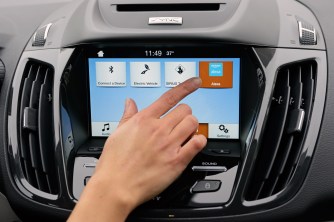 Radio’s last bastion of domination is the automobile (aka SUV, pickup truck etc.). In the home, voice activated devices are replacing AM/FM radios. I own 3 Echos, and Alexa has become a real friend of the family.
 I know that Downton Abbey premiered on PBS back in 2011, but at that time I was doing my own “Mr. Molesley career transition” (more on that in a moment) – from radio management to broadcast professor – in addition to moving from New Jersey to Kentucky, I didn’t have a whole lot of time to watch the series. Amazon Prime changed that for me in 2019 when I noticed it had made available the entire six seasons (52-episodes).
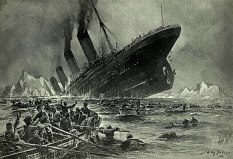 of the Titanic also set in motion more intense regulation of wireless communication for ships at sea. The Wireless Ship Act of 1910 only required ocean-going ships to carry radio equipment when visiting the United States and only required a single radio operator. That was amended after the Titanic sank in 1912 to include vessels traveling on the Great Lakes in addition to those on the oceans, plus requiring two radio operators with the wireless being manned around the clock.
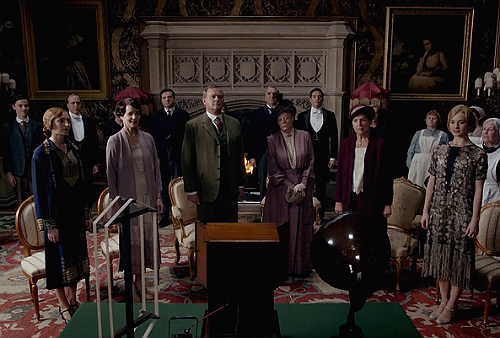 The scene could not be more amazing, seeing everyone gathered around the awkward looking device in the great hall, much as many Americans do for a Super Bowl, waiting to hear the King. When he comes on, the family all stands at attention, in much the same way they would if they were in his presence to hear him speak.
 Getting back to Mr. Moseley, he’s a fine example of what I mean and how we are similar. The downsizing he encountered saw him go from a trained butler to a second footman to a laborer in the streets. He saw his working life as a series of steps down and not one that was advancing in stature and pay. But Mr. Moseley loved learning and once dreamed of being a teacher. An encounter with the local headmaster of the town’s school led Moseley to taking a series of exams which proved him to be an exceptional scholar and he was then awarded a teaching position with the school. Moseley’s life was now moving in a direction he only previously dreamed about.
 Last week I told you about how our world is exploding with media to the point of over-saturation. Not only are we drowning in a plethora of media, the rate of new ways to communicate keeps accelerating at an unfathomable pace.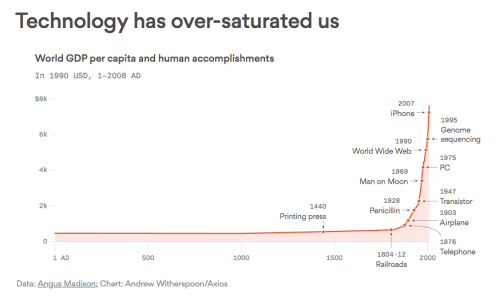
 I was reviewing the last FCC report about the number of broadcast stations in America as of December 31, 2018 and in my head I found myself singing a parody of the Bellamy Brothers song, “Too much is not enough.” Only my version was “too much is way too much.”
 I wasn’t at CES 2019. In fact, I’ve never been to CES.
 In life, more than any other factor, your attitude pretty much determines where you will go… and how far you will go.
 It started by seeing a movie called “
 DickTaylorBlog