Radio, the Same on Every Device, It’s Time

Once upon a time, cars were steered by a stick. The throttle was located on the steering wheel. The high beams switch was located on the floor. And it was different in every car. Computers started off all being different just like the software programs they operated. Today, the only real learning curve is switching between Microsoft and Apple for computers or Apple and Android for smartphones and even they aren’t all that different anymore.

It’s time for radio to standardize.

AM, FM, DAB, DAB+, HD Radio, HD2, HD3, HD4, Streaming….it’s insane. It’s confusing.

Norway, a country about the size of New Mexico has decided to standardize radio around the digital broadcast format. No more AM or FM, just digital. This caused uproar around the globe, but aren’t the Viking folks really doing radio in their country a favor? Standardizing around a single format?

Just imagine if the world operated on a standardized radio platform? All car manufacturers could build a universal radio platform into their vehicle dashboards worldwide and smartphones could all be designed to be used as radios anywhere in the world. Computers, tablets and even radios could all be on the same platform. Less variation in the method of transmission would be more impact.

Likewise, radio programming from any single source should be the same on all devices, not one way over-the-air and another way if you pick up the same broadcast on a stream. If you want to listen to a radio station in Los Angeles and you’re in Boston, you should hear everything being broadcast by that LA radio station. For the incremental dollars, broadcast radio stations degrade their streams with bumpy transitions, high repetition of nonsense filler material and just plain too long breaks; especially compared to commercial breaks on the pureplays.

The pureplays are paying 100% attention to their streams because it’s all they have. Broadcast radio stations handle their streams as an afterthought; if they even give them that much attention.

Hindsight is 20/20. Without changing, historians of broadcasting might one day say “What were they thinking?”

Radio owners and operators need to employ a technique called “premortem.”  What you do is imagine yourself in the future after your project has crashed and burned. In radio’s case, that would be to imagine that AM/FM broadcast radio has ended. The drill is to assume the patient died. You’re screwed. Everything that could go wrong did. You start there and ask “Why?”

Attacking the problem in this manner allows people to freely speak to the reasons things failed without retribution. You can’t kill a patient that’s already dead. See the magic in this exercise?

How could radio be improved on all platforms with this kind of thinking today?

I talk with lots of radio folks every week and in a hushed whisper they will freely share what they know to be wrong with radio today. But they in essence are “winking in the dark” and no one is stepping forward to say “the emperor has no clothes.”

Well here’s a way to do get everyone playing “devil’s advocate” and brainstorming ideas to improve radio programming, delivery and standardization.

If not now, when?

35 Comments

Filed under Education, Mentor, Radio

AM Radio, Streaming Radio, FCC Spectrum Auction & the Future

6Every June, I set-off on a road trip back to New Jersey to speak at the annual New Jersey Broadcasters Convention and Gala in Atlantic City. The roundtrip spans 3-weeks and I drive over 3,000 miles.

This year on the drive up I listened to AM radio and on the drive back I listened to streaming radio. I’d like to share my thoughts with you about what I heard and observed, as well as ponder what the future of both might hold.

Small signal AM radio stations primarily identify themselves with their FM translator dial position (How’s that saving AM radio?). The “pups” are mostly syndicated, automated, religious, sports or Spanish. They aren’t very engaging, which is probably a good thing if you’re driving because you don’t care when you lose the signal. Oh, and just try to hear their translator FM signal; forgetaboutit.

The “big dawg” signals (Bill Bungeroth, former Cumulus Broadcasting president used the term “big dawgs” for those monster signal radio stations and “little pups” for everything else and that’s where I picked it up) on AM like WOWO in Ft Wayne, Indiana, WJR in Detroit, Michigan, WLW in Cincinnati, Ohio and KDKA in Pittsburgh, Pennsylvania are in another universe when it comes to radio programming.

While listening to WOWO, I heard a powerful morning show that was fun, engaging and tuned into the Ft Wayne area. WJR told me about Frankenmuth, Michigan while their midday show was broadcasting live from this unique resort town on the great lakes. WLW was talking about how the Cincinnati police were getting body cameras and how they were loaning them to the news folks in Cincinnati to wear and learn how they work. It was fascinating radio. And KDKA was a potpourri of information about all things Pittsburgh; thoroughly engaging and very enjoyable.

I rode each of these big dawg stations for hundreds of miles and enjoyed listening to them every minute. Each was different, unique, fun, engaging and LOCAL.

The observation I made was that maybe the AM band should be reserved for these high power AM signals that have the bench strength to do great radio.

My drive home started in Albany, New York. I drove back to my hometown in Western Massachusetts following the NJBA Convention and Gala to visit a close family member that had suffered a significant stroke. Thankfully, that situation is improving daily.

I decided my drive back to Kentucky would focus on the other kind of radio available these days; streaming radio. My streaming provider of choice is called Radio Tunes. I like this service because their music formats are curated by people who know and love their genres. Jimi King out of London, England curates the Smooth Jazz channels. Smooth Jazz is a format that has almost completely disappeared from America’s airwaves.

Side Note: WNUA in Chicago, Illinois was a top five radio station playing the Smooth Jazz format. That is until the PPM became the listener measurement currency in Chicago and the other top 48 American metros chasing this format off FM radio. Is Smooth Jazz a PPM unfriendly format for PPM encoding? Might a Voltaire have helped Smooth Jazz? Just asking.

My first day of my 15-hour drive back home allowed me to listen to this streaming radio station through my iPhone4S fed into my car’s audio system with no dropout, no buffering, no disruption of any kind. The audio fidelity beats anything coming out of AM or FM terrestrial radio or SiriusXM too.

On day two of my drive home, I again put on Radio Tunes’ Smooth Jazz channel knowing that Jimi King and Stephanie Sales would be hosting a LIVE 3-hour Smooth Jazz show (they do this every Sunday). This makes Radio Tunes into a real radio station, though I will admit that I love the channel mainly because of all the things it doesn’t do the other 165 hours a week. However, for three of the 7-hours of my second day’s drive, the companionship was really nice.

Again, I experienced no disruption to my listening as I proceeded from Maryland and through the state of West Virginia and into Kentucky. I carried Radio Tunes all the way into Lexington, Kentucky where I stopped to have some lunch.

While eating lunch it occurred to me how well my reception to streaming radio through my smartphone was. It’s scary good when you think about it. Excellent fidelity, no dropout, buffering or other disruptions.

Brian Solis recently spoke at the PromaxBDA Station Summit and told attendees:

“Disruption happens because someone innovated and innovation changes behavior. A good place to start is thinking about a mobile experience. 74% of businesses have no plans to optimize their sites for mobile viewing meaning they don’t have a plan to stay competitive in the increasingly mobile world. If most content experiences are starting here, then that experience needs to be reimagined.”

It wasn’t until I left Lexington that I found gaps in the cell service and finally gave up my experiment of listening to streaming radio through my smartphone in my car.

My observations were cell service is becoming ubiquitous. There are times when having the companionship of LIVE personalities are appreciated versus just streaming music without any talk. Your smartphone gets really hot when you stream on it continuously for a lot of hours. The data use for streaming audio is not huge, like streaming videos or downloading pictures and if all the cell companies make streaming audio free from a person’s data usage plan, it would provide a serious threat to over-the-air radio. Just as Netflix, HBO, Showtime and other OTT (over-the-top) TV services are proving a challenge to cable companies, OTT radio services could be just as challenging to the radio industry.

Then I read this article “Could LTE Broadcast Technology Supersede Over-The-Air Broadcasting?” Listen to what this technology can do:

“LTE Broadcast is based on the eMBMS (Evolved Multimedia Broadcast Multicast Service) point-to-multipoint interface specification developed for delivery of any content received by multiple viewers at the same time, including files and emergency alerts as well as broadcast video. The motive in all cases was to avoid consuming large amounts of bandwidth through transmission of the same data over multiple unicast sessions, which is particularly expensive in the case of HD video.”

Does that get your attention? Then read this second article “Further Consideration of LTE Broadcast”:

“LTE Broadcast is the most efficient mechanism to distribute the same content to many users, and is an important solution to address the 1000x data challenge. Initially focusing on venue-casting, LTE Broadcast can address many other media distribution such as software updates and breaking news. The evolution of LTE Broadcast makes it dynamic and more scalable, and in the long term, takes it even beyond mobile as a solution for next generation terrestrial TV.”

And anything done for TV is even simpler to do for radio.

LinkedIn CEO Jeff Weiner has been reported saying:

“There is a widening skills gap where the existing workforce has been educated and trained to obtain jobs of yesterday and not the jobs of today and tomorrow.”

The broadcast game is rapidly moving to the cellular platform. If you’re wondering why Tim Cook is jazzed about Apple Music it’s because he understands broadcasting is entering a new era. The future belongs to those who can deliver superior content to the global village known as planet Earth.

Now which company do you think has a better chance of winning this race? Apple with $178 billion cash in the bank or, I don’t know, say iHeartMedia with $20.7 billion in debt?

The FCC’s spectrum auction is all about creating more spectrum for the mobile communication platform.

Now do you understand why spectrum is being reallocated?

3 Comments

Filed under Education, Mentor, Radio, Sales

More is Less

In 1994, Dan O’Day was holding one of his famous “PD Grad Schools” in Dallas, Texas. One of the speakers he invited that day – and whose presentation was recorded by “Radio’s Best Friend” Art Vuolo – was a young Randy Michaels. Dan O’Day still sells this video, now on DVD, and labels it “The best radio video ever.” I would agree.

The video is titled “Positioning Your Radio Station by Randy Michaels.”  It addresses the explosion of new FM radio stations after the first round of radio deregulation brought us Docket 80-90. Then the LMA (Local Marketing Agreement) was born. Randy tells the audience:

“This was a fundamental change for the radio business. Just as TV was a fundamental change, duopoly fundamentally changed the radio business. This moved the radio business from being a franchise to being a commodity. McDonalds was once a franchise. Today burger fast-food restaurants are a commodity and we all know how that’s working for the ‘Golden Arches.’”

On May 24, 2004 the Federal Communications Commission (FCC) held a “Broadcast Localism Hearing” in Rapid City, South Dakota. The president, general manager and co-owner of KLQP-FM licensed to Madison, Minnesota (population 1, 767) Maynard Meyer addressed the commission. He told them (I’ve edited his comments. The full text can be found here.):

“Localism in radio is not dead, but it is in dire need of resuscitation in many areas. I have been involved in the radio business in announcing, sales, engineering and management for about 36 years, all of my experience is in communities of 5,000 people or less. We personally live in the communities we serve so we know the ‘issues,’ we work to address them in our programming and have been doing so for the past 21 years. “

“A few years ago, many stations operated this way, but much of that has changed for a variety of reasons. I think the beginning of the end of local broadcast service started in the 1980s when the Federal Communications Commission approved Docket 80-90.”

Mr. Meyer went on to explain to the FCC how many communities that “on paper” had a local radio station actually found that the transmitter was being fed from another location tens of miles away. Mr. Meyer went on to say:

“I don’t think this is the best way to promote local radio service. From what I have seen through my personal experience, as soon as a hometown studio is closed and relocated, the local service is relocated as well.”

Now put another decade plus on the calendar and we find that the FCC has decided that adding even more FM radio stations would fix this problem of local radio service that operates in the public “interest, convenience and/or necessity” by issuing FM licenses for FM translators and Low Power FM radio stations.

The most recent BROADCAST STATION TOTALS AS OF MARCH 31, 2015 issued by the FCC shows that there are 4,702 AM commercial radio stations, 6,659 FM commercial radio stations and 4,081 FM educational radio stations on the air. But wait; there are also 6,312 FM translators & boosters on the air; plus, another 1,029 Low Power FM radio stations. That’s 22,873 radio stations! And they now compete with SiriusXM satellite radio and streaming audio from Pandora, Spotify, Radio Tunes etc.

If Randy was thinking back in 1994 “being a media company today is a really tough business” he was seeing just the tip of the broadcast iceberg.

Randy’s prescription that day in Dallas was as prescient then as it is today; maybe even more so. He told the audience of program directors:

“In a crowded media environment radio needs to super-serve its local community. Be everywhere, all the time. Miss a day, miss a lot. Radio’s BEST when it’s personal.”

“What’s your station’s impact rating? Great radio stations are listener-focused.”

“If you’re smart enough to win in today’s radio, you’re smart enough to have done something legitimate with your life. This is work. This is a real job. It’s the merger of art and science and you’ve got to have both.”

I’m encouraged by my students who have big ideas about the future of radio and a desire to serve the communities they will be moving to and living in. I’m encouraged by some great radio broadcasters getting back into the business who are bringing back the fundamentals of great radio while extending that sense of purpose to the digital component that must be a part of today’s media company.

The pendulum is swinging back and it can’t get back here soon enough.

6 Comments

Filed under Education, Mentor, Radio, Sales

Remember When Radio Was Agile?

Have you heard about the latest management movement?  It’s called “Agile” (but it can also be called “Scrum”).

Actually, to be more accurate, there’s “management” and then there’s “Agile.”  They are not one in the same.  Another way to picture them is one is a vertical style of management and the other is a horizontal style of operating.

The vertical style is familiar to anyone working in one of today’s highly consolidated public radio companies that own hundreds of stations.  The top of the management pyramid says “jump” and the troops respond with “how high?”  You may also find that the company circulates a “Best Practices” manual and wants every station to implement it even though a person on the front lines may wonder if these are “best practices” in their particular case.

The military model was the genesis of the vertical style of management.  New York City’s tall vertical skyscrapers are literal structures of top-down management.

Then I started reading about Agile.  Agile is a horizontal mindset.  Everyone in a company is working towards the same goals and on an equal plane.  The planning and execution is a shared endeavor all designed with one goal in mine and that is to delight a customer.

While both vertical and horizontal styles are business models and the purpose of a business is to create a customer (and ultimately a profit), the radical difference is vertical puts that profit goal front and center and has everyone focused on achieving that goal.  The horizontal style says if we delight our customers, then the profits will follow.  The customer is front and center and the focus of everyone who works at the company.

I’ve worked with couple of the big consolidators and I’ve heard the CEO’s message of how much the stakeholders had invested in the company and how we all needed to be focused on reaching or exceeding our goals.

But that’s not the style of radio I entered.  Back in my early days, the radio station; often owned by folks who lived and were active in the community, the focus was on our listeners and our advertisers.  Everyone in the radio station worked towards the same goals of delighting our two constituencies.

We didn’t call it “Agile” or “Scrum” but doing GREAT radio and operating in the public interest, convenience and/or necessity.  OK, not to get too Pollyanna, there was a vertical structure of sorts – a GM, PD, SM – but we all worked side-by-side in the same building and everyone did whatever was needed to be done to delight our customers.  It was a team effort.  It was a horizontal style of operating.

What changed was the Telcom Act of 1996.  That new law would change the face of radio through massive consolidation of radio stations.  All of these little horizontal operating enterprises would be stacked one on top of another until we had a vertical style of operating.  Now a group of folks would declare they were “the adults in the room” and start passing out thumb drives filled with spreadsheets full of revenue goals.

Nowhere were there discussions of delighting the customers.

Tim Cook, CEO of Apple, has made it abundantly clear that Apple is not always going to do things that simply fatten the bottom line and that if you are an investor in Apple that doesn’t like that way of operating, maybe you should invest your money someplace else.  Apple is going to delight the customer  – as Steve Jobs so simply stated – by making insanely great products.

How’s that focus on the customer working out for Apple?  Very well, thank you.  Apple has posted the largest net quarterly profit in history. Not in just Apple’s history but in the history of the world.

Radio is a fabulous business!  Radio entertains, informs and is there in times of emergencies to hold a community together.  But radio performs best when it is operated horizontally and not vertically.

Mary Meeker in her most recent “Internet Trends report at Re/Code” had a slide in her 180-slide deck that spoke most passionately I think to this concept of operating horizontally.  That slide was titled “Diversity Matters….It’s Just Good Business” and here is what the body copy of the slide said:

            “One of the things I have learned about effective decision making is that the best decisions are often made by diverse groups of people.

Saying or hearing these words is magic…..

‘That’s really interesting.  I had never thought of that way before.  Thank you.’”

That sure sounds to me like Mary was making a plea for companies to re-think how they operate and level the playing field by moving to a horizontal style of operating.

The reason the radio industry was so attractive to Wall Street investors was because it was a high cash flowing business that appeared easy to operate.

My roller skating coach used to tell me “Dick when you make it look easy, then you’re doing it right.”  Radio used to be doing it right.  It’s really a lot harder than it looks.  It’s time to go back to that way of operating.

OR – you can continue doing things the way you did last year and watch “flat revenue growth be the new up.”  Doesn’t sound like the radio industry has much to lose by changing their ways.

The good news is there are radio operators who are returning to the business that see the opportunities in the horizontal approach to radio station operations.  It’s a movement that will not only be good for the radio industry but the listeners and advertisers served by the industry.

It’s called Win-Win-Win.

3 Comments

Filed under Education, Mentor, Radio, Sales

Digital Feudalism

I follow Jeremiah Owyang on Twitter. He’s been observing, writing and talking about the new collaborative or sharing economy for some time now. He says it’s the future and where all business is headed.

You might have heard of Uber (the taxi company that owns no cars) or Airbnb (the lodging company that owns no rooms) etc. and how they are growing by leaps and bounds. The venture capital is flowing into these new business models leveraging this collaborative concept.

So you can imagine my surprise to read this headline: “Jeremiah Owyang just dropped a bomb in Paris.” (Not literally, but figuratively) The “bomb” being the reality that “the driving force behind this disruptive movement isn’t peer relationships with customers,” but “the one percent own the collaborative economy.”

Why was this a stunning announcement? Because the concept of this new value proposition called the Collaborative Economy “is organic, peer-to-peer digital interaction to create opportunities that bypass outmoded processes of brick and mortar businesses.”

Much like I wrote about in my blog post “The Future of Ad Supported Media.

Owyang was revealing the dark side of this new economy. The rich were getting richer and the poor, poorer. While some tried to dress this new sharing economy in the clothes of Ronald Reagan’s “Trickle-Down” economics, the reality is clear; that’s not what’s really happening. The world’s wealth-gap continues to expand and it’s picking up speed.

For media companies, this new economy is seen as sharing of thoughts, ideas, information and creation via the Internet. The result has seen the number of dominant media companies go from somewhere around fifty back in the 1980s to about five around the turn of the century.

The old ways of doing business – printing newspapers & magazines or broadcasting over radio & television – are dying.   The “smart money” is moving into digital marketing and advertising. The party’s over, turn off the lights, it’s time to go home – OR IS IT?

Have you heard about ad blocking?

It turns out this a big deal and growing exponentially. The advertising industry has simply looked the other way as though it didn’t exist, but it does.

While only about 15% or so of the US folks are using an ad blocking extension, other countries around the world are approaching 40%. Gaming sites are reported to be even worse with over 80% of their ads being blocked by gamers. Frederic Filloux goes into a lot more detail in his blog post titled “Ad Blocks’ Doomsday Scenarios.

This could be a real opportunity for radio especially. But it needs to look in the mirror, put its big boy pants on and do what it knows it should have been doing all along.

Barry Drake spells it out better than I ever could in his book “40 Years 40,000 Sales Calls” (which I highly recommend you pick up and read). Barry writes the following prescription for radio’s future:

“…there must be investment, the fuel necessary to attack the four major issues.

In Programming:

  • Fresh content to attract a new generation of listeners, 95 million millennials

  • Promotion and advertising to achieve prominence

In Sales:

  • Severe reduction and limits to inventory  (Not a gimmick, smart business)

  • Contact with the BOSS (calling on decision makers by local sellers)

The very entity that caused so much grief is going to eat its own tail.

This is radio’s next big opportunity to reinvent itself and reassert itself as the powerful medium that it always was.

Leave a comment

Filed under Education, Mentor, Radio, Sales

What if the problem isn’t PPM?

I’ve been reading a lot lately about PPM (Nielsen’s Personal People Meter) and how it may not be capturing all the listening in a radio market.

In Las Vegas at the NAB2015 show, Telos Alliance was demonstrating their Voltair.   This additional “black box” in a radio station’s audio chain will correct for times when the PPM isn’t properly watermarking a radio station’s signal. As I understand it, some formats that have pauses – like talk radio formats, classical formats – aren’t being encoded with the audio watermark the PPM encoder is supposed to transmit to be received by the PPM device a listener in a Nielsen panel carries (or not) with them.

OK – let’s take a time out here.

PPM is now the radio measurement system used in the Top 48 radio markets in the USA. It began being the currency for radio listening in the City of Brotherly Love (Philadelphia) in the spring of 2002. When a measurement system is considered “up-to-snuff” an agency called the Media Ratings Council gives that measurements service its Double Checkmark seal of approval. (The diary method of radio listening measurement has had that seal in all markets it’s used and is still the measurement method used in radio markets from #49 to #273 by Nielsen Audio.)

Now you would think that in the lucky 13-years since PPM was officially launched (it was being tested in England back in the late 90s) that it would have earned that gold standard of ratings methodology approval in all PPM markets by now, but no; it apparently only has it in about 25 markets, leaving another 23 without it. But make no mistake it IS the ratings currency used Double Checkmark or not.

This new PPM device replaced the paper diary methodology in America’s largest radio markets and here are a couple of more interesting twists to the story. There were less PPM meters deployed than the number of paper diaries they replaced. They also raised the costs of measuring these radio markets by something like 60%. (That’s sounds like Clear Channel’s old “Less is More” strategy.) But if the ratings will be more accurate, then everyone should rally around this newer system and it will be worth what they’re paying for, right?

That’s what makes the Telos Alliance Voltair black box so disturbing. Its seller’s claim it fixes a problem that no one (or not a lot of people) knew even existed. It made the PPM encoder do a better job of encoding a radio station’s signal so PPM receivers could decode the audio watermark and give that radio station its due. And to implement this “fix” to your radio signal, all it would cost you is $15,000.00 per Voltair.

I’ve had the pleasure to actually visit a station in a major metro and watch the Voltair work. The telemetry it displays appears to be doing just what its sellers claim. So maybe it IS fixing things. But what about all those formats that are no more? What about all those PDs and air personalities that are gone because a new measurement device was not giving them the proper credit they should have been getting? A lot has changed in those 13-years since the first PPM market went online.

Another manufacturer points out that this additional black box in your audio chain designed to capture more PPM receivers will actually make your radio station sound worse and drive listeners away from your station. And I know some radio engineers that would agree with that analysis.

So what’s a radio broadcaster to do?

Dick Harlow thinks he knows. He’s in PPM market #46. He’s dropping Nielsen Audio’s PPM measurement service. He’s not spending $15,000.00 on a Voltair. And he’s not going without audience ratings like Saga has done (and is still doing in some of its markets). He’s hired Mike Gould’s Eastlan ratings to measure the Greensboro/High Point/Winston-Salem market for his radio stations; WKRR-FM Rock 92 and Top 40 WKZL 107.5 FM.

Mr. Harlow says “enough is enough.”

Eastlan will reportedly deploy a sample size that’s triple the number PPM meters currently used in this radio market using its proprietary ratings estimate methodology.

And no it isn’t MRC Double Checkmark approved, or as far as I can see, under review by the MRC.   But then again, there appears to be a lot of ratings currency being used that lacks this approval.

A quick check of the Greensboro/High Point/Winston-Salem market shows that PPM is also not receiving the MRC Double Checkmark seal of approval for that market, so there’s no loss for Mr. Harlow on that metric either.

I studied the Eastlan reports back in the early part of the 21st Century when I was running radio stations. At that time it was Arbitron and Eastlan that were battling it out in a few radio markets where we could examine how each company ranked the stations. What I saw at that time was they could both agree on the Big Dawg stations, but Eastlan found those little pups that super-served a niche audience and that was the eye-opening difference to me, for at that moment in time I was running some low powered AM radio signals and needed a ratings company that could drill down a market deeper and uncover more of the radio listening that was actually occurring.

My gut tells me that Dick Harlow will find that too. And if he’s smart, he will take the cost savings by switching to Eastlan and pour it back into advertising and promotion of his radio stations; for if he does, he will not only win in Eastlan’s audience estimates, but in those done by Nielsen too. But the real win will be for his listeners, advertisers, employees and his company, for he will be investing his resources where they will pay the biggest dividends for the community he’s licensed to serve.

To sum this all up, the problem isn’t PPM. It’s that PPM has taken radio broadcaster’s eyes off the ball. The game is programming radio stations with great content. It’s hiring great talent. It’s crafting commercials for advertisers that get results and don’t annoy the listener. It’s super-serving the community you’re licensed to operate in. In other words, it’s doing all the right things, all of the time. Ratings are a by-product of doing it all fabulously well. And profits are the reward that the stakeholders receive for investing and believing in their radio team.

21 Comments

Filed under Education, Mentor, Radio, Sales

3 Leadership Lessons

Being a leader today is not for faint of heart. Gone are the good old days of simply planning your work for your business and then working your plan. Today, leaders need to solve problems and think creatively. They need to, as Wayne Gretsky so eloquently put it “skate to where the (business) puck is going to be, not where it is.”

Leadership today is all about inspiring people and empowering them to believe in themselves, their company and the path that lies ahead.

Whether that business is a radio station or a university (where I now work), the task is the same.

Lesson #1: Don’t run your business poorly

Leaders lead by example. People will follow more what you do than what you say. If you misuse your expense account or run your personal mail through the office mail machine, others will follow your example regardless of what the “official policy” is on personal use of the mail machine or what qualifies as a legitimate business expense.

In a radio station, sales people aren’t programmers and program people don’t sell. So sales people don’t have a say in programming decisions and programming people don’t set advertising rates.

Leadership means getting the people who are skilled at what they do to “Just do IT” not somebody else’s “it.”

I worked for a radio station owner who had a favorite phrase, “Money makes honey.” He knew that you needed to have money coming in the door to pay for everything his radio stations did and so he took the sales aspect of running radio stations VERY seriously.

Walt Disney put it this way “I don’t make movies to make money; I make money to make movies.”

Lesson #2: A Unified Vision is Key

 I used the words “unified vision” for a reason. Most folks would have said “mission statement.” I am not a fan of mission statements for a couple of reasons. They are often crafted by committees. Like the old joke about what’s a camel, it’s a horse created by a committee. So most mission statements are too unwieldy and no one can remember them much less carry them in their heart as a guiding star.

Leaders like Steve Jobs create a vision for their company. Steve’s was to create “insanely great products.” He didn’t say make the world’s best computer, iPod, tablet or iPhone. He just said whatever Apple is committed to making, it would be insanely great.

Lesson #3: Your Product is Job One

 In higher education, the product is the quality of your teachers, facility and the success of your graduates. In radio, it’s the quality of your air personalities, content, facility and the success of your property to serve the community, advertisers and listeners.

American broadcasting executive, Randy Michaels, once said at a conference I attended “you give me a poorly programmed radio station with a great sales force and I’ll lose you money, but if you give me an excellent programmed radio station with a mediocre sales force, I’ll make you money.” Randy was always clear that the way to make money in radio was making the radio product job one. (Sounds like Walt Disney, doesn’t it)

Look at any successful company and you will see that the product comes first; always.

The challenge in a digital world is that things are changing more quickly than at any time in history. Innovation isn’t a luxury; it has to be an integral part of your business plan. The only constant is change.

The trick for both radio and higher education is to innovate without tinkering with the core product in the process. You also don’t fear cannibalizing your core product either.

Again, Jobs didn’t tinker with his iPod while developing his iPhone, but never worried that his iPhone and later his tablet would cannibalize his iPod and MAC in the future. (Note: the era of the iPod ended in 2014 with the introduction of the iPhone6. Over 400 million iPods have been sold.)

But when you have instilled in your people a unified vision like to make insanely great products, you have sowed the seeds of success into the very fabric of your organization.

3 Comments

Filed under Education, Mentor, Radio, Sales

Will Programmatic Buying Help Radio?

My good friend Pierre Bouvard circulated an article on LinkedIn that was published in Ad Age titled “Programmatic TV: Lots of Talk Lately, Not Much Real Action.”  We know what happens in TV land trickles down to radio. That’s what got me thinking about the impact that programmatic buying might make on the radio industry.

First, if you haven’t heard the term, programmatic buying is letting computers buy advertising time. This type of advertising placement is already pretty commonplace in the online world. It can take the form of data-driven real-time purchasing, online auctions or private exchanges, with transactions handled by machines according to Rino Scanzoni, chief investment officer at GroupM. It’s fast, efficient and needs no human sellers.

The large radio companies have been trimming the work force since the beginning of the “Great Recession.” Don’t waste a good crisis was the way one radio industry leader put it at a meeting I attended. Meaning, when the economy is in the dumper and all companies are trimming their expenses to survive, you can use this type of environment to make lots of cuts; especially through RIFs (Reduction In Force).

Computer automation equipment, voice-tracking, syndication, and networking has all replaced live and local radio program origination. However, when it came to ad revenue, the personnel has largely remained intact. Could programmatic buying do to radio sales staffs what the aforementioned computerization did to programming staffs?

The short answer is yes.

At the end of the last decade I watched Google’s ad insertion system place ads onto my radio stations in the very early morning hours. Google’s hardware recorded air checks of every ad they placed on my stations and Google was able to give their advertisers not just a paper verification of the ad running but air checks of every ad, run on every station. Something my local sellers could not do for their clients. It was impressive.

The downside was Google had no idea where anything was in my state and so many of the ads were not appropriate to be airing on my stations for any number of reasons; the most important reason was that business was a hundred miles or more away.

Now while I realize that what I’m talking about here is more programmatic ad placement than programmatic ad buying, I’m making the assumption that the selling of those ads were executed in a similar manner; via automation like Google sells online.

The Ad Age article stated that one big reason that programmatic buying of TV would be a ways off was due to “TV networks also still need to approve the ads before they run, both for standards and to make sure they fit with the surrounding programming. That step doesn’t exist in programmatic ad sales online.”

Remember when radio stations had program directors that listened to everything that would go out over their airwaves to make sure that it met their standards and made sure it fit with the surrounding programming? Ah, the good old days of radio. That attention to detail is why radio sounded so good.

The Google experience taught me that even as a market manager, I no longer had any control over what might be heard over my air. Automated ad insertion is why streaming commercial breaks might air the same commercial multiple times during the same break. It’s a reason that many listeners find listening to over-the-air radio stations online so annoying. (I know I do)

ESPN’s Eric Johnson put it this way: “Programmatic buying means a lot of things to a lot of people. It includes providing some automation to the buying and selling process.”

For radio, only one thing has ever mattered; what comes out of the listener’s speaker. My fear is that as radio continues to abandon this critical aspect of its product in the pursuit of saving money it will kill the goose that lays the golden egg. No one is looking out for the radio listener and in a world of infinite choice, the listener will simply go elsewhere.

You can’t save your way to success.

1 Comment

Filed under Education, Mentor, Radio, Sales

Radio’s Challenge

David Goldberg pa1ssed away on Friday, May 1st at the age of 47; too soon to be sure. He was an Internet radio pioneer having created LAUNCHcast in 1999 which evolved into Yahoo! Music Radio. Until his passing he was CEO of SurveyMonkey and he was married to the Chief Operating Officer of Facebook. He was very savy about our Internet connected world.

Brad Hill in RAIN wrote that in 2005, Goldberg was the RAIN keynote speaker. To put his words into perspective, you should know he spoke just before the iPhone was first launched. For it was the iPhone that really launched what we now refer to as the smartphone and mobile music revolutions, that would provide Pandora with its launchpad. Hill wrote that Goldberg said:

“We hope that 10 years from now almost no one is accessing Yahoo services on a PC. It needs to be in my living room, in my car, on my cellphone. This will affect the change in replacing the CD, as well as moving music off of broadcast radio which is also what we believe will happen.”

Fast-forward to Pandora’s latest earnings call and Hill reports that Pandora execs said:

“We really want to replace broadcast radio for music discovery. We believe music will migrate off of terrestrial radio to the services we are offering because we can deliver the music consumers want, when they want it, where they want it. CDs will be replaced by on-demand subscription services. ‘Personalization’ and ‘community’ features will be key ways we’ll be able to deliver the right music to people at the right time, on devices, on a global basis.”

And Pandora is not alone in this quest. Spotify recently reported a market cap more than twice that of Pandora’s in the neighborhood of $8 billion to pursue their quest of being the world’s music provider. (Contrast that to America’s largest radio group iHeartMedia $20+ billion in debt.)

The world is also watching Apple. It made a $3 billion acquisition of Beats and is working on its iTunes streaming audio product. More about Apple in a moment.

Then Fred Jacobs authors a column talking about “Moodstates.” Jacobs’ latest Techsurvey continues to find how much emotion plays a role in broadcast radio listening. Jacobs writes:

“While consumers enjoy hearing their favorite songs, personalities, and information, mood plays a role why they continue to come back to AM/FM radio stations. In our research, it is often in the form of companionship, mood elevation, and escape.”

I’m a big fan of Rewound Radio and their weekly Saturday feature “The DJ Hall of Fame.” What I’ve personally found is that I’m not so enamored with just listening to old tapes of radio broadcasts from the 60s & 70s – I can hear this music anywhere, including my own CD library – but hearing the air personalities that provided me with hours of companionship, mood elevation and escape. And I’m not alone in feeling this way. I’m a member of a couple of DJ groups on Facebook and we all experience these same emotions.

This fact evidently hasn’t been lost on Apple. Apple has been raiding the talent at the BBC. Zane Lowe was their first hire. Lowe is known as a trend-spotter. He’s also a presenter (they don’t call them disc jockey’s in jolly old England) that builds a strong rapport with his listeners. At least three more folks from this BBC talent tank have announced they are joining Lowe at Apple.

Unlike Pandora or Spotify, it appears that Apple plans to put the personality into their streaming. Could Apple be the first to do for today’s generation what Dan Ingram, The Real Don Steele, John Records Landecker, Bob Dearborn, Ron Lundy etc did for my generation? Put the personality front and center in music presentation?

Horizon Media undertook a comprehensive study on the impact mood plays in effective audio advertising. As the results of what they’ve learned are implemented, the placement of those advertising dollars under Horizon’s control will be affected.

Back to Goldberg’s 2005 RAIN Keynote, he predicted that over-the-air radio would be reduced to a mostly-talk medium.

            “We don’t believe music will continue to be broadcast on analog radio,” Goldberg said.

A survey that I conducted with the 300 radio stations in Kentucky showed that local radio stations planned to take their talk programming more locally originated and less national syndicated talk. It also showed that no local music research was being done, but that national charts were being relied upon along with consultants and music programming service providers.

All of this comes at a time when the CEO’s of public radio companies report they’re facing strong headwinds on their advertising revenues. Radio is being attacked from all angles.

Not since the introduction of television back in the 50s has the radio industry faced such a big challenge. We are living in revolutionary times in the communications industry.

Commercial radio is 95 years old. When television presented its challenge it was only in its 40s. Still a young medium with lots of new blood entering its doors with a vision for a new kind of radio.

Boss Radio was born on 930AM-KHJ in Los Angeles and News Radio was born on 1010AM-WINS in New York City both in 1965. But even the new radio formats that were born in that era are now 50 years old.

I challenge my broadcast students to create the radio that will be meaningful for them and their generation. But for those students to have that chance, the owners of radio stations will need to open their doors and let them innovate.

Will radio pick up the challenge?

1 Comment

Filed under Education, Mentor, Radio

Are We Losing the Next Generations?

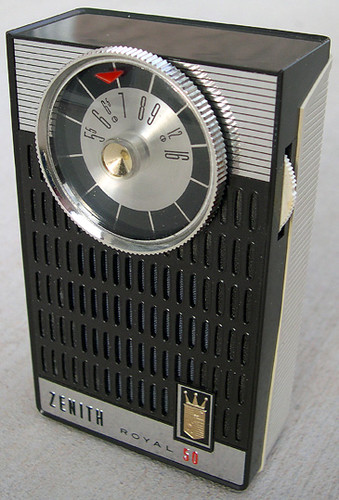
Growing up in western New England, the transistor radio would impact my life and career. Radio has been in my blood as long as I can remember, but it would be my Zenith transistor radio that would first allow me to explore new stations, new music, new personalities and new ways of delivering content without the supervision of my parents. My transistor radio and ear piece would make me the master of my own radio dial.

Growing up, it seemed like most radio markets had two radio stations battling for the teenage ear. WPTR and WTRY out of Albany, New York’s capital district would be mine. Each of those radio stations would bring their mobile studios to our county shopping center and broadcast LIVE. It was such a thrill.

Hartford had WDRC and WPOP. Boston had WMEX and WRKO. Philadelphia had WIBG and WFIL. Chicago had WLS and WCFL.

New York City would finally be a battle between WMCA and WABC for the Top40 crown in the Big Apple.

What made traveling around in my folk’s car so exciting was that each of these radio markets and radio stations were special and different. The personalities, the promotions, the station jingles and yes, even some of the music was unique to each station and market. Local and regional bands could be heard hoping to be discovered and go national with their music.

Radio stations all did music research back then and printed weekly surveys charting how the hits were doing from week to week with local listeners.

That was then, this is now. Larry Rosin at Edison Research says that today “virtually no radio stations perform formal research for music among teens nor target teens directly in their marketing strategy.”

I’ve sold “old people radio formats” where the presentation was quick to point out that what advertisers should be focused on is not the age of the audience but the amount of money they control and have as discretionary to spend as they wish.

I’ve also sold “young people radio formats” where we pointed out that kids are the masters of convincing their parents and grandparents to get them anything they wanted, so please don’t focus on how young they are. I mean once my boys were out of the house, I no longer went to Mickey D’s and ordered “Happy Meals.” (That made me very happy!)

Radio has always focused on the “family reunion demo” aka 25-54 adults; though that demo is shifting upwards with the aging baby boomers to 35-64 adults.

When Radio Disney was born and focused on little tykes, it appeared there was now a radio operator ready to pick up the torch for young people listening to radio. But then radio was shocked the day Disney announced it was selling all but one of its owned and operated Radio Disney stations. Radio Disney basically operated on AM radio. AM radio is no longer used for music listening by the public and so was Disney just abandoning AM radio for FM radio? No. Radio Disney had established a strong beach front on two audio delivery mediums; SiriusXM and online listening. (It also benefits from the Disney TV Channel on cable, satellite and streaming via the Net.)

It should also be noted that around the time Radio Disney was coming into existence that the radio ratings company known at that time as Arbitron began to measure listening audiences down to age 6+ with their new PPM device where as the diary previously only measured “adults 12+.” When Nielsen bought Arbitron and rebranded the radio ratings service Nielsen Audio it kept the 6+ listening metric. Nielsen also now is trying to establish a listening service that will measure all audio listening consumption across all platforms. Can you see where this is going?

Radio listening is a habit. My father never acquired it. I was raised on it. My sons were raised on it. But I see my grandchildren are holding iPad-like devices and easily navigate their parents’ iPhones.

You would have thought that with more radio stations on-the-air in America than at any time in history there would be more variety than at any time in our history, but that’s not the case. There’s actually less variety.

After launching two Smooth Jazz formatted radio stations and falling in love with the artists and their music I now can only hear this music streamed online. So like my grandchildren, I’m forming a listening habit that doesn’t require a radio; just my iPad or iPhone.

I believe the future is going to be all about being the best at something, not necessarily garnering the most people. Radio was always about getting the most ears. Everything was based on CPP (cost per point), but in a world of infinite choice, the best will dominate.

Radio can play in this world if programming is turned back over to people who program their passions to others just like themselves.

Steve Jobs made Apple into the world’s most valuable company by focusing on design (in radio, that’s programming) and making products that he and his team wanted to have for themselves (building a radio station that you not only own, but love to listen to yourself).

Radio is either going seize the day or have a seizure.

4 Comments

Filed under Education, Mentor, Radio