Tag Archives: NPR

Radio’s Most Pressing Issues

This past week, Radio/TV state broadcast associations were in our nation’s capital meeting with their elected representatives in both the House and Senate about issues that are important to them. It’s the annual National Association of Broadcasters (NAB) State Leadership Conference.

More than 500 radio broadcasters from across America assembled to hear Senator Ted Cruz (R-TX) speak on his support of the “AM Radio for Every Vehicle Act,” and advocating for a level playing field in the advertising market.

Cruz is the new Chairman of the Senate Commerce Committee and he pledged a proactive approach to support broadcasters, create jobs and uphold free speech.

Free Speech

Brendan Carr is the new Chairman of the Federal Communications Commission (FCC) and in only a couple of weeks, since taking this leadership position, his actions have caught the attention of some members of Congress, who were alarmed by recent moves impacting broadcasters.

Representative Jerold Nadler (D-NY) expressed his concern over the Carr’s FCC assault on a media organization’s free speech.

“Exploiting his asserted ‘unitary executive’ powers, [President] Trump is unleashing his sycophant FCC Chairman, Brendan Carr, on every newsgroup whose news stories he does not approve of — actually threatening to pull the broadcast licenses for ABC, CBS, NBC, PBS, and NPR,” said Rep. Jamie Raskin (D-MD). “Is this North Korea?”

The President of Free Press Action, Craig Aaron, in testimony said that threats and opening investigations into broadcast outlets by the FCC is out of the norm.

“The FCC usually talks about licenses on very narrow terms, such as if an owner has committed a major crime,” Aaron said. “The idea that a news organization would be threatened because they asked a tough question of the President, or because they tried to fact check him during a debate, or because they edited their own news content before putting it out over the airwaves is preposterous, and it’s dangerous.”

DEI

Diversity, Equity and Inclusion (DEI) has been terminated by Carr at the FCC and he’s been signaling that the agency might go after FCC licensees over their own DEI programs.

Are DEI programs good for business? Apple’s shareholders think so, so do Costco shareholders, and Hyundai’s marketing executive, Erik Thomas, credits its DEI programs with driving the automobile manufacturer’s bottom line.

SiriusXM

Nine years ago I wrote an article with a title that sounded like click bait titled “SiriusXM Radio is Now Free,” which speculated when the FCC licensed satellite broadcaster would start offering ad-supported channels for free.

Four years later, I wrote that “Could 2021 Be the Year SiriusXM Adds FREE Channels?” speculating that new SiriusXM CEO, Jennifer Witz, would be pursuing revenue growth by  leveraging the 132 million cars the service was available in. SiriusXM, like commercial radio over-the-air (OTA) broadcasters, knows that the competition for listener ears is in the car. The advantage the satellite broadcaster has over AM/FM radio operators is they know exactly what their listeners are listening to, and don’t have to rely on audience estimates that may or may not be accurate in today’s media saturated world.

Last year, what I have been predicting since 2016, became a reality, as I wrote in:  “Ad-Supported SiriusXM Requires No Paid Subscription.”

Monopoly

One of the radio industry’s most respected researchers, Dr. Ed Cohen, wrote “The direct-to-consumer satellite radio business is a monopoly,” shortly after my 3rd article on this subject was published. Originally, the FCC offered only two satellite broadcast licenses, one went to a company called “Sirius” and the other to a company called “XM,” with the idea being they would be competitors and that the consumer would benefit by not having a single company – a monopoly – control satellite radio and what it could charge.

The two companies were supposed to never be able to merge, but in August of 2008, by a 3 to 2 vote of the FCC, that changed. Dr. Cohen does a really good deep dive into explaining how this all came about in his article “SiriusXM and the FCC: Is the Camel’s Nose Under the Tent?” Which is an allusion to a story that takes place in Arabia, with this metaphorical moral:

If the camel once gets his nose in the tent, his body will soon follow.

What the FCC never took into consideration was, how much damage might occur to local AM/FM radio stations, if and when, the new combined SiriusXM ever decided to provide an ad-supported free radio service.

Dr. Cohen believes that while this new free service from SiriusXM is limited in scope, like the proverbial camel, it won’t be long before the whole service becomes real competition for audio listeners and advertisers.

People Love Free

AM Radio vs SiriusXM

Dr. Cohen makes an excellent case for commercial radio broadcasters to be demanding, the FCC revisit the SiriusXM merger decision in light of this change by the satellite broadcaster.

By the way, public broadcasters also have a horse in this race, as NPR Now is part of the new free SiriusXM service.

“While the NAB is busy with getting Congress to force OEMs (Original Equipment Manufacturers) to include AM in every vehicle, the battle with SiriusXM’s ad-supported venture is probably more important to the industry in the long run,” says Dr. Cohen.

It’s The Economy Stupid

But the most important issue facing the commercial radio industry are the financial fears that have been generated by the Trump tariffs and fire hose of government regulatory changes that seem to come at us on an hourly basis. I wrote about this concern in February with an article titled “The Cost of Uncertainty to Radio.”

Now BIA Advisory Services this week updated its local advertising revenue forecast for 2025. Cameron Coats, in Radio Ink, reports that “over-the-air revenue [for radio] takes the largest hit, falling by 6%.” Digital radio, says Coats, shows a slight increase of 0.1%.

SiriusXM has enjoyed growth through the sale of new cars, but with the high tariffs Trump has announced, it wouldn’t be a surprise if people hang onto their current vehicles a little longer, which also means that AM radio will still be accessible. Without an economic downturn, the average life of a car in America is 12-years, up from 8.4-years in 1995. Progressive Insurance says that a well-maintained car will reach 300,000 or more miles, and those cars have both AM/FM radios as well as SiriusXM.

The radio industry’s most pressing issue is who wins in the car, and in that arena AM radio – a hundred year old medium is not our industry’s best play –

stopping satellite radio’s FREE ad-supported service is.

When the pie isn’t growing,

the game becomes who can cut the biggest slice.

5 Comments

Filed under Uncategorized

The Waiting for Godot Fallacy

I know many people who come to this blog and post comments about the articles I write pine for radio to return to the way it was twenty years ago. They’re hoping that one day the big consolidators will move on to new business ventures and will sell their radio stations back to radio people who will run those stations correctly. Sadly, wishing for that to happen is like Waiting for Godot .

But that doesn’t mean there’s not a future for radio. One of my readers, a multi-decade broadcast manager, engineer and consultant wrote the perfect prescription for making radio healthy again. Today, I would like to share with your those thoughts.

It’s Not About Being Local

“Local” being the savior of radio is a canard and always has been. The beauty of social media is that it is a rich media experience that is personalized expressly for one person: you. Radio cannot hope to be so “local” that it can beat that.

Serve Your Tribe

The secret to radio’s survival is not localism but “tribalism.” Providing not just a service but an experience. An experience that joins numerous people together, regardless of geography. Hence the success of right-wing talk radio, the success of NPR (which is rarely less than 21 or 22 hours of national progamming out of every day on virtually every “member station”) and most informatively, the success of K-Love, which has near zero local content at all yet has grown a huge and profitable audience.

These outlets’ content has precious little to do with the local community, but they all share a powerful defining aspect: listeners self-identify as being proud to listen (and prouder to donate to) the outlet in question.

Commercial Radio’s Tribal Leadership Vacuum

Most commercial radio outlets have achieved this tribalism on the backs of longevity of a given host: KISS 108 has been top-rated in Boston for decades because that audience has tuned in to hear Matty Siegel every morning for over forty years. Rush Limbaugh had his legions of Ditto Heads for nearly as long.

And therein lies the rub. Most of those hosts are in their 70s or older…or dead…and the pipeline to replace them has been sealed off thanks to post-1996 consolidation. Non-commercial radio operators, like K-Love and NPR, have succeeded in finding a content/style niche but there’s only room for so many of those.

It All Comes Down to Your Talent — Growing & Retaining It

So, to put it another way: it’s not localism that’ll save radio; it’s talent. And radio has worked very hard to drive good talent out of the business.

“Talent hits a target no one else can hit.

Genius hits a target no one else can see.”

-Arthur Schopenhauer

3 Comments

Filed under Education, Mentor, Radio

You Can’t Make an Elephant into a Giraffe

Let’s face it, somethings in life are what they are. Giraffe’s have long necks and elephants have big ears, big feet and trunks. Just as pickup trucks were designed for a different purpose than speed boats. So, why do we think that radio can somehow defy the natural order and become something that it was never designed to be?

Work on Your Strengths, Not Your Weaknesses

One of the lessons I learned in classes at Clear Channel University* was how people often focus on their weaknesses and try to improve them. However, studies have shown that when we focus on our strengths, we grow faster than when we try to improve our weaknesses. Added benefits to focusing on our strengths are that we become happier, less stressed and more confident.

The cure for constantly falling short of your goals is to work on improving where you’re already strong, rather than on areas where you are weak.

Why Doesn’t Radio Focus on Its Strengths?

Entercom changed its name to Audacy, saying:

“We have transformed into a fundamentally different and dramatically enhanced organization and so it is time to embrace a new name and brand identity which better reflects who we have become and our vision for the future. Audacy captures our dynamic creativity, outstanding content and innovative spirit as we aspire to build the country’s best audio content and entertainment platform.”

-David Field, CEO

Audacy is the fourth largest radio company in America (based on the number of radio stations owned) and just like the top three radio operators ahead of them, none use the word “radio” in their name.

It was in 2010, that National Public Radio announced that it would be using “NPR” as its brand name, even though its legal name remains the same. NPR celebrated its 50th birthday in 2020, the same year that American commercial radio turned 100.

What is it about the name “radio” that has radio station owners and operators distancing themselves from this word?

Finding Your Strengths

If you want to grow your strengths, first you need to identify them. This week, Pierre Bouvard, Chief Insights Officer at Cumulus Media/Westwood One, did a pretty good job of that in his blog. While Pierre was trying to correct some misperceptions about broadcast radio, he also gave us a good place to start with identifying some of its strengths. Here are five Pierre cites:

  1. Radio reaches 88% of persons 18 years of age and older each week in America.
  2. Radio reaches the 60% of Americans who are back in their cars commuting to work every day. (The Radio Advertising Bureau says radio’s reach in the car is 83% in 2021, making it the dominate form of media on-the-road.)
  3. Radio’s audience shares are twenty-one times larger than ad-supported Pandora and ten times that of ad-supported Spotify, according to Edison Research.
  4. Radio delivers an impressive Return On Investment (ROI). Pierre says “for example, for every $1 invested in an auto aftermarket AM/FM radio campaign, there is a $21 sales return.”
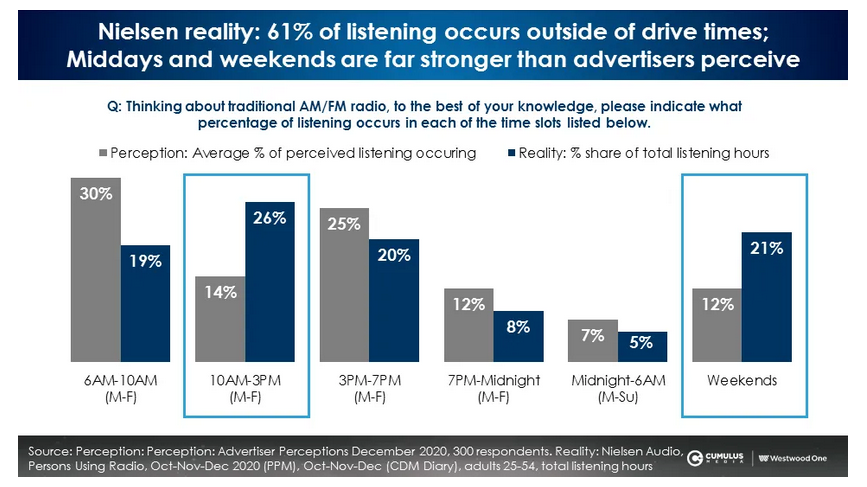
5. Radio delivers listeners at all hours of the day, seven days a week.

Radio’s Analog Audience

Lee Abrams posted a short YouTube video back in August 2020 that you might have missed explaining his “PSYCHOGRAPHIC CHART.” If you’re in radio, you should watch it now.   

View the full twelve-minute presentation HERE What I’d like to focus on is the two quadrants that Lee has labeled as “Analog Generation/Culturally Sophisticated & Culturally Unsophisticated.” These people are radio listeners. They were born with and are comfortable with analog media.

Lee makes clear that you can’t satisfy more than one quadrant. Pick one and super serve those people to the point of making what you do appalling to people in the other three quadrants.

The bottom line is that you can’t be all things to all people, but you can be everything to some people. This is really Marketing 101.

But the Future is Digital

Yes, the future of media is digital and it can’t be ignored. But you can’t make radio into something it’s not and never will be. It’s a powerful one-to-many media entity; leverage that.

The Australian Radio Network’s Neuro Lab is doing some interesting research into how a listener’s brain responds to audio, whether it’s coming from the radio, a podcast or streamed.

What should make all radio owner/operators sit-up and take notice is the fact that “radio showed the strongest ability to engage listeners and for extended periods of time, racking up 60% more neural engagement than any other audio format.” Podcasts showed higher levels of memory encoding and streaming was noted for promoting positive attitudes towards brands. You can read the full report HERE

All Audio is Not Created Equal (in the Brain)

Dr. Shannon Bosshard, the neuroscience specialist who conducted this groundbreaking research said, “This is the first time that anyone has demonstrated, from the perspective of the brain, that radio, podcasting and music streaming are processed differently and should be treated differently, in the same manner that audio and audio-visual mediums have been.”

Radio Financed TV

It was the incredible revenue streams produced by broadcast radio that were used to build out the medium of commercial television. TV also stole radio’s stars and programs, leaving the radio industry to reinvent itself and compete with television for advertising.

Today, radio is once again finding itself the “money mule” charged with funding the buildout of digital initiatives, having to sacrifice the very thing that makes radio unique in the process; its personalities. And then, just like with TV, radio has to compete with digital for advertising.

Fred Jacobs in his TechSurvey 2021 revealed how important the Radio Personality is to today’s radio listener.

But this shouldn’t come as a surprise. For generations, the radio personality has been the primary attraction drawing audiences to one radio station over another. At his peak, Dan Ingram on WABC in New York was said to be more popular to the station’s listeners than The Beatles.

Great Radio

In the end, great radio isn’t any one element, it’s all of them – personalities, jingles, promotions, station imaging, community involvement and companionship – that makes a radio station part of a listener’s family. People have favorite movies, but not a favorite movie theater; they have favorite television programs, but not a favorite television station; however, people DO HAVE favorite radio stations.

Remember that. Leverage that. Make money knowing that.

*Clear Channel University was closed in 2009

2 Comments

Filed under Education, Mentor, Radio, Sales

First Things, First

covid-19If someone had asked you, “Where do you see yourself in 5-years?” I seriously doubt anyone could have imagined they would be smack dab in the middle of a global pandemic. But that’s where we find ourselves at this moment in time.

No matter what you may think will return us to the life we had before COVID-19, nothing even begins to change until we have two things: therapeutics to cope with this novel coronavirus and a better understanding of how this dastardly disease can be squashed like a bug. In the meantime, everything else we try is merely a Band-Aid on the problem.

TRUST

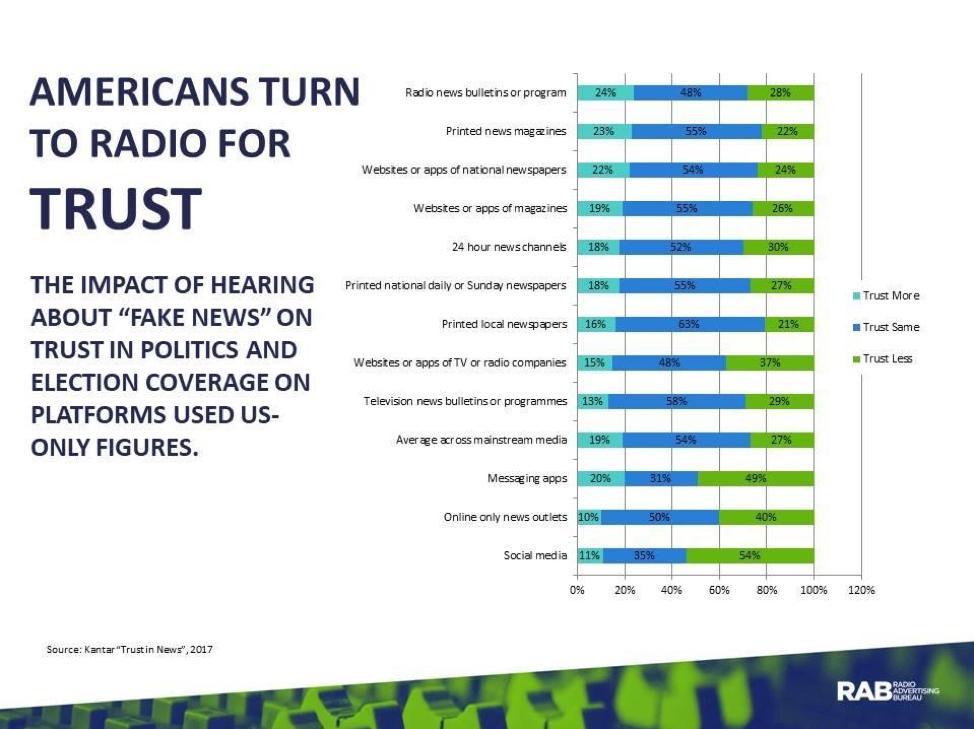
A good radio friend posted on LinkedIn a graphic from the Radio Advertising Bureau (source: Kantar 2017)  “Trust in News” purporting radio to be the medium, Americans turn to for trust.

Radio & Trust

Well, we are now half-way through 2020, and I wonder what relevance that this research conducted in 2016 and published in 2017 has in a COVID-19 world. Probably, slim and none.

In fact, the NRRC (Network Radio Research Council) is recommending that all network/national buying and selling be based on the Fall 2019 Nationwide survey, and not those surveys conducted since the start of COVID-19, saying “the impact of the COVID-19 pandemic has caused unprecedented divergence of traditional patterns of media consumption, including AM/FM listening and the streaming of audio.”

If we can take to the bank anything from the world we are living in now, it’s that anything pre-COVID-19 is now FUBAR*.

How COVID-19 Has Changed Our Media Consumption

Since the onset of this global pandemic, the home broadband bundle has significantly been changed. Most consumers are adopting a stand-alone broadband service and not bundling it with Pay-TV or home phone or even their mobile phone. Why is this happening? Researchers say with another recession looming, people are watching all of their pennies.

With people working from home (WFH) and driving less, Out-Of-Home (OOH) media has been clobbered. Revenue projections for the Billboard industry show it will be down over 19% in 2020, compared to radio (down 13.7%) and local television (down 12.4%), according to MAGNA. Before COVID-19 hit, OOH was one of the fastest-growing and most stable linear media channels. Zenith thinks that OOH revenue will be down even more, predicting it to be down 25% in 2020.

Nieman Lab writes “Radio listening has plummeted. NPR is reaching a bigger audience than ever. What gives?” And the answer is, 2020 is the year that NPR will make more money from underwriting on its podcasts than it will from its radio programs.

Follow the Money

Local radio is very dependent on Main Street, but Main Street is in the cross-hairs for defaults, bankruptcies and evictions due to COVID-19.

Much like NPR is experiencing with its online products, retailing is becoming an online activity with American consumers. Economists knew that many cities had a retail footprint that was too big for the local consumer economy to support. COVID-19 merely accelerated things.

In fact, COVID-19 has created a quantum leap for e-commerce in 2020. What was projected to take place over years, has been compressed into a few months.

The United States Census Bureau reports that in the second quarter of 2020, e-commerces retail sales in America rose 31.8% from the first quarter and were 44.5% above the same period in 2019. The Census Bureau says that compared to the share of total retail sales, e-commerce sales grew as much in three months as it had over the past five years.

We are living a period of rapid technological change. Columbia Business School economist Laura Veldkamp says, “We are changing the way business is getting done, we’re changing the way we’re shopping and the way we’re eating – we’re changing the way we’re having meetings.” She points out that:

“the pandemic, like the Depression and World Wars I and II, is fundamentally altering people’s tastes. Some businesses will be left behind, as consumers get accustomed to videoconferencing instead of commuting, and buying groceries and other goods online instead of braving stores, malls and restaurants.”

Unemployment Tsunami Ahead

Economists are worried what’s ahead when it comes to unemployment in America. They see exponential growth in claims for the Pandemic Emergency Unemployment Compensation (PEUC) program and a weakening U.S. labor market. The PEUC has grown from 27,000 people on April 11, 2020 to 1.3 million as of August 1, 2020. Worse, the number of PEUC recipients has stayed at over 1 million people for four straight weeks and has actually been increasing each week.

“The real tsunami is coming,” says Mark Zandi, chief economist at Moody’s Analytics. “My guess is at this point hiring in the industries that have been hit hard is going to abate.” Plus we know that United Airlines plans to furlough 3,900 pilots, Delta 2,000 pilots and American Airlines are alerting their employees to furloughs of 19,000 companywide.

The Conference Board Consumer Confidence Index declined in August for the second consecutive month hitting a new pandemic low. Consumer optimism, along with their financial prospects also declined. Both are continuing on a downward path.

The Long Road Back

Economists see a long road back for the United States economy. A National Association for Business Economies (NABE) survey of 235 members July 30-August 10, 2020 showed that 60% predict that it will not be until the second quarter of 2022 (or later) that our economy may finally rebound to where it was in 2019, pre-COVID-19.

Economy Rebound

The Party’s Over

When you’re having a good time, it’s hard to call it a night and leave a party. Sometimes it’s due to FOMO (Fear Of Missing Out) and other times, it’s because no one likes to see good times come to an end.

The Oracle of Omaha – Warren Buffett, puts it this way:

‘They know that overstaying the festivities — that is, continuing to speculate in companies that have gigantic valuations relative to the cash they are likely to generate in the future — will eventually bring on pumpkins and mice. But they nevertheless hate to miss a single minute of what is one helluva party. Therefore, the giddy participants all plan to leave just seconds before midnight. There’s a problem, though: They are dancing in a room in which the clocks have no hands.’

Commercial broadcasters, by and large, have enjoyed the radio broadcasting party of the 60s a little too long. So many of the programming models haven’t really changed since the days when I was still a disc jockey, yet the world has changed, and changed exponentially.

Radio broadcasters, like NPR, that have embraced a vision of where media consumption is headed, are seeing their investments paying off.

Those that haven’t changed, are finding today’s environment extremely challenging.

Local radio’s fortunes have always been tied to Main Street, not Wall Street.

COVID-19 has disrupted Main Street’s business model.

The old rules don’t apply any longer, but, we don’t really know yet if this is another giant bubble or the future of our world.

Realizing that the time horizon for answers could be two years out, one wonders, will you be able to survive till we have the answers?


*A military term defined as F’d Up Beyond All Recognizability

1 Comment

Filed under Education, Mentor, Radio, Sales

Radio’s GEN-Z Challenge

GEN ZI recently sat in on the Edison Research webinar about people born between 1996 and 2012, known as GEN-Z.

If you read about this webinar in the radio trades, you would have learned that 55% of these young people listen to AM/FM over-the-air radio. What’s not to like about that?

The reality was, this daily radio listening was only to Over-The-Air FM radio, none of these GEN-Z people ever mentioned listening to AM radio. That’s still a positive, right?

It is, if your only focus is on the immediate future, not future trends.

Generation Z

Today, people aged 8 to 24 make up over 65-million Americans. They are the first truly digital natives, not having known a world without full digital access to content. GEN-Z people are also often called “ZOOMers.” They would rather create their own content than curate other people’s content.

Edison Research points out that Generation Z has only known a world where everything is ON DEMAND, and it’s the growing up in an ON DEMAND world that makes ZOOMers a challenge for OTA radio.

ZOOMer Trends

  • Their smartphones are the center of their media world.
  • 53% of ZOOMers listen to audio streaming daily.
  • They spend 98% more time than the rest of the population watching videos and listening to music on YouTube.
  • Spotify is their go-to music streaming service.
  • Their radio listening is mostly in the car, some at work, but none of it occurs in the home.
  • If they listen to OTA radio, it is on a device that only receives OTA radio signals, not with a digital streaming device.

When Edison Research ran clips of people in this age group talking about their media habits, it was clear FM radio wasn’t their first choice, but the fact that it was available in the car they were riding in or it was playing on a radio that everyone listened to while they were working.

Things Radio Can Do to Attract ZOOMers

Edison suggested that these programming ideas might be a way to attract the GEN-Z audience:

  • News & Information is important to GEN-Z, it’s their social currency.
  • Remind ZOOMers that radio is available on their digital streaming device.
  • GEN-Z wants to change the world, their local communities for the better and OTA radio could be a catalyst for helping them do this.
  • Surprise and delight ZOOMers with your content.

This last point is really about engaging the listener, and showing them you really care. In reality, 74% of your listeners probably don’t care* if your FM radio station disappears, because they don’t think you really care about them. Radio needs to create shared experiences for this age group. Radio needs to show they care.

Shared Values and Shared Purpose

Christian broadcasters and NPR both understand the shared values and purpose of their listeners and base their programming decisions on them. These broadcasters understand that their mission is not to attract everyone to their programming, but to build a loyal audience with those who share their vision of the world.

Using the Edison Research on GEN-Z, how can your radio station inspire and empower the ZOOMers in your community?

How do you learn what the shared values and purposes of the GEN-Z listeners are?

Ask them.

Form a GEN-Z advisory board to learn what’s on their minds and what their vision for the future is. Be willing to focus every aspect of your radio station on what’s important to THEM.

Change doesn’t begin with a slogan, it begins with shared values and purpose, which then inspires people to come together and create a world that is better than they found it.


*based on book “Know What You’re For” by Jeff Henderson

10 Comments

Filed under Education, Mentor, Radio, Sales

Great Expectations

OR FMI read with great interest the five part series by Matt Bailey on “The Alexa Effect.” In the 5th and final installment Matt shared what he called the “radio weapon Spotify will never have.” What is it? The radio personality. He wrote:


  • “A radio personality can tell you the backstory of a breakthrough artist that makes you want to hear her work.”

  • “A radio personality can point out that crazy line in the second verse to stay tuned to hear.”

  • “A radio personality can engage you to smash or trash a song on the station’s social media.”

  • “A radio personality can give you the chance to be among the very first to hear a new song by a star artist.”

“A radio personality can add context that will make listeners excited to hear a song that otherwise would simply be weird and unfamiliar. It’s a deeply personal and emotionally engaging weapon no algorithm can match. When we stifle their voices and their role in introducing new music simply to avoid potential tune-out, we might win a few tenths of a point in the PPM battle, but we will lose the new music war to Spotify.”

Consolidation & Voice Tracking

I don’t disagree with Matt, but I lived through the ramifications of the Telcom Act of 1996 and the consolidation of radio stations, along with the rollout of voice tracking.

Clear Channel called it “Premium Choice,” and we were told it would replace our local personalities with big market talent.

I watched in market after market as radio personalities, who were like members of the radio listener’s family, were sent to the unemployment lines. Relationships that took years, even decades to establish, wiped out in an instant.

Early Media Expectations

I grew up at a time when the family television set received a signal from a couple of antennas on the roof. We had two channels, which meant we received two television networks, CBS and NBC. If you wanted to change the channel, you had to get off the couch and change it. There was no remote control.

Our radios had both the AM and FM bands, but I remember wondering why. I often scanned the entire FM band to hear nothing at all with only the AM band picking up radio signals.

My early media expectations were two TV channels and AM radio stations. The radio provided a lot more variety, plus I had a radio in my room and our family had a single TV located in the living room. I controlled my radio, my parents controlled the family TV.

Media Expectations Change

In time, I would come to expect television to be in color, to be connected to a cable and have a remote control to easily change the multitude of channels I could now receive, from the comfort of my couch.

Radio would expand to the FM band and a whole new type and style of radio was born. The one thing that connected AM and FM radio was the radio personality. Every station had them and the decision to listen to one station over another was because of the radio personality.

In fact, I wrote an article on the power of the radio personality back in 2015 entitled “We Never Called It Content.”

I wrote this article after reading about the latest round of “forced retirements” in the radio industry.

And if you thought this type of downsizing was only occurring in large radio metros, the movie “Corporate FM” told the story of how in the 80s, ninety percent of mass media in America was owned and controlled by about fifty different companies, but after the Telcom Act of 1996 it was down to just six corporations.

New Media Brings New Expectations

Let’s fast-forward to today. I cut the cord on cable TV two years ago and all of my television viewing is streamed. Netflix, Amazon Prime, Sling TV and YouTube provide me with more hours of television entertainment and information than I could ever have time to watch, and I’m retired.

Amazon Echo provides me with all of my audio entertainment and I do mix it up between stations via TuneIn and the pureplays like Pandora and Amazon Music.

I also read a lot and subscribe to several online newsletters that all link to the original source of the material.

Which leads me to this conclusion, my calendar age did not cement my media habits. They’ve been fluid all of my life.

My 21st Century Great Expectations

  • I expect NPR to open up my world to things I should be aware of, that I might not have been. I expect them to also provide me with more depth to the stories in the news. I expect them to have all of this posted online for almost immediate access. They don’t disappoint.
  • I expect my television viewing to be On Demand and commercial free.
  • I expect my music listening to match my mood and be there by simply asking Alexa to play my favorite channels when I want to hear them.
  • Finally, I expect I’m not alone in these “21st Century Great Expectations.”

Rewound Radio DJ Hall of Fame

On Saturdays, I enjoy asking Alexa to play Rewound Radio so I can hear another fabulous radio personality featured in the weekly “DJ Hall of Fame.” The other weekend they featured WOR-FM out of New York City and the air personality was Johnny Donovan. OR-FM air checks are all in stereo and the music mix has plenty of variety. It was a time when Music Radio 77 – WABC dominated the world’s airwaves on the AM band. But the one thing I notice in these weekly trips down memory lane is how integral the radio personality was in the total program. They were a constant companion. They really were radio’s “secret weapon” to attracting faithful listeners.

The question I ponder often is, was this period of radio history akin to the vaudeville period of theater. It filled the right hole at the right time but won’t ever be coming back again.

I welcome your thoughts.

17 Comments

Filed under Education, Mentor, Radio, Sales

Is Radio Prepared for The Future

Radio & CobwebsIn a lot of ways, the future is here, now.

All of the things we knew were coming back at the turn of the century have become reality.

But the radio industry continues to try to adapt.

Great Companies Don’t Adapt, They Prepare

When I saw that headline on a blog article by Greg Satell two years ago, it resonated with me because it made me realize that the radio industry wasn’t prepared for the 21st Century. It was trying to adapt the past to the present and hoping that it would sustain them going into the future.

Unfortunately, it’s impossible to create the future by focusing on the present.

“The truth is,” writes Satell, “that companies rarely succeed by adapting to market events.”

“Firms prevail by shaping the future…but it takes years of preparation to achieve.

Once you find yourself in a position where you need to adapt, it’s usually too late.”

-Greg Satell

Marconi & Sarnoff

Each generation has its great innovators, so It’s always a challenge to say who makes a greater contribution to changing the world.

Marconi gave us the wireless, a one-to-one form of communications that transformed the world.

Sarnoff innovated the radio as a form of mass communication, giving us a one-to-many instant communication service of news, entertainment and advertising supported radio.

What we can be certain of, each person who creates the future is one who overflows with boundless curiosity.

Investing in Research

All of the Big 5 Tech companies (Amazon, Facebook Microsoft, Google and Apple) invest heavily in research. Each of them, in their own way, has made themselves indispensable from our daily lives.

Recently, a daily newsletter I read called “While You Were Working,” asked its readers which of the Big 5 Tech Companies they could survive without. Here are the results of that survey:

Which Big 5 tech company do you think it would be easiest to live without?

Facebook  70.71%
Apple  14.14%
Amazon  7.35%
Microsoft  5.74%
Google  2.06%

Probably not surprising that Facebook was the choice folks said they could live without by a wide margin.

For five weeks, Kashmir Hill, a writer for Gizmodo, decided to see how she would deal with giving up today’s technology by blocking one of the Big 5 from her world. In her sixth and final week, she decided to go cold turkey and blocked them all. How did that go? Well I think the title of her article said it all, “I Cut the ‘Big Five’ Tech Giants From My Life. It Was Hell.”

Hill compared her experience to that of an alcoholic trying to give us booze. And that life without them makes life very difficult as we are so dependent on them.

I’m not sure any of us really understands how married we are to these Big 5 Tech Companies or how hard it would be for us to give up even one of them, let alone to give them all up.

Listening to Radio

One of the interesting side-bars of the article Hill wrote was that by not having Alexa, Spotify audio books, podcasts or other such services on her Nokia feature phone, what she could receive, unlike with her iPhone, were radio broadcasts and that allowed her to listen to NPR while doing her daily run.

But how sad that listening to radio only seems to be an option when all other options are eliminated.

Investing in the Core Product

Some of the differences between the Big 5 Tech companies are what non-core areas they invest their research money into, like self-driving cars. The one thing they all take very seriously, however, is plowing the lion’s share of their research budget into their core competencies.

In my sales class, I used to tell my students that people don’t buy half-inch drill bits because they want them, they buy them because what they want are half-inch holes. In other words, you will be successful when you invest your time solving your customers’ problems.

Radio Research

Most radio research dollars are spent on one thing, audience measurement. Unfortunately, that’s research that studies the past performance of a radio station, not the present moment. Virtually no radio research money is spent on preparing the ground for the future.

We all know that Artificial Intelligence (AI) is the next big thing. Alexa, in your Amazon Echo, is the perfect example.

How is the radio industry preparing its employees to acquire the skills they will need to excel in an AI world? Artificial Intelligence is a force that will impact the communications industry in the years to come.

Broadcasting has been living off of its seed corn for too many years, while the technology industries have been focused on solving our customer’s problems by investing in them for years, even decades.

Broadcasters can’t create the future by continuing to focus on the present.

Innovation, will require investment in research that, imagines new possibilities.


15 Comments

Filed under Education, Mentor, Radio, Sales

Whatever happened to…

Red Sox CapThe other day, we took two of our grandchildren to a wildlife safari park here in Virginia. It was a simply magical day. But that’s not the part of the story I want to share. It is that both kids were wearing their Boston Red Sox baseball caps.
As we were getting ready to leave we met one of the animal caretakers who screamed “YES!” Then a second later, she exclaimed, “They’re both Red Sox Fans!” Instantly, there was a bond between complete strangers.

Purple People

Minnesota Vikings Mower

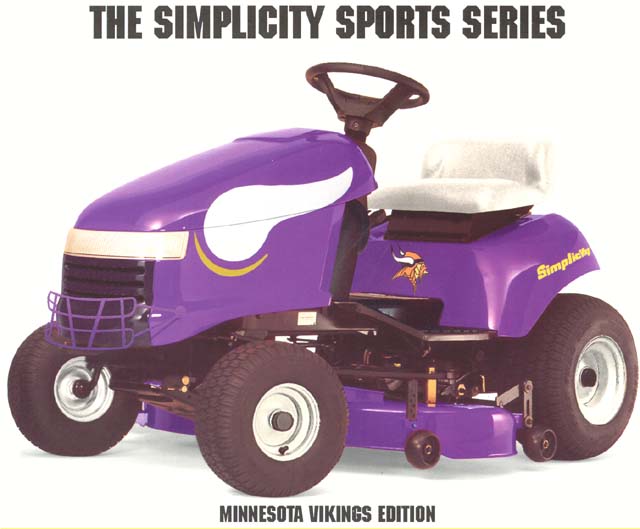
I’m convinced that Minnesota Vikings fans bleed purple. I know one whose whole wardrobe is virtually branded with Vikings colors and logos; even his lawn mower.

Sports franchises truly understand the power of their brand and building their fan base.

So, whatever happened to this sort of thing with radio stations?

Eazy 101

Eazy 101 receiverJerry Lee recently sold his only radio station, WBEB in Philadelphia, Pennsylvania. It was 55-years ago this past May that Jerry and his partner David Kurtz put the station on the air. It signed on as WDVR. In the 1980s the call letters were changed to WEAZ and the station was branded as “EZ 101.” The station brand was not only well known, but fixed tuned FM radios were given out by the radio station to area businesses to play the station in their stores and offices.

B101 Bee

When the station updated its format, and changed its call letters again, this time to WBEB and branded itself as “B101.1,” giant bees appeared at events all over the “City of Brotherly Love.”

The End of an Era

Marlin Taylor (no relation) was there from the beginning and recently blogged about the station’s sale to Entercom. His article was titled “End of an Era.” You can read it HERE 

Marlin wrote:

“While I pretty much grew up with a ‘Can Do’ attitude…seeing Jerry in action confirmed that staying pro-active and constantly on the offensive were keys to a meaningful and effective life! If you need proof, just take a look at the 55-year track record of the station at 101.1 on the FM dial in Philadelphia.

There’s no question that Jerry was and is a promoter, pure and simple! And, yes, he’s a Futurist…a person who studies the future and makes predictions about it based on current trends and conditions. I would also add…always looking down the road to see what challenges and opportunities lay ahead, then utilizing (his) assets to most effectively counter-act or benefit from them.”

Familiarity

As Jerry changed his brand over the years to keep his station’s programming and image in vogue with the times and his target listeners, he understood the power of familiarity in attracting and keeping a radio audience tuned to his radio station. Mark Ramsey suggests that “familiarity IS preference.”

morefm rebrandingMost recently, Jerry rebranded his station as “101.1 MoreFM.” This change, like all the others, was promoted in every imaginable way and became familiar to listeners virtually overnight.
wobm bumper sticker

Bumper Stickers

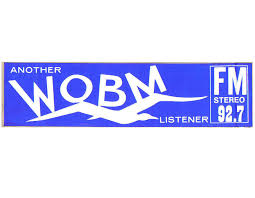
Once upon a time, you couldn’t drive in New Jersey without seeing a WOBM-FM bumper sticker on the car driving in front of you. They were everywhere. They made this station VERY familiar and Paul Most, a former GM of WOBM-FM, always used to say “When you can’t be heard, you’ve got to be seen.”

Arbitron Diary

arbitron diaryOnce upon a time, all radio listening was recorded using a diary, kept by a listener for seven days. Years of diary reviews at the Arbitron headquarters in Maryland proved to me that the radio stations most familiar to their listeners got the most “votes” from their fans.
When PPM measurements were introduced, the importance of unaided recall seemed to take a back seat with radio operators. Best Practices in large radio companies replaced the old tried and true ways of doing things. Radio promotion, except for over a station’s own airwaves, was cut from station budgets.

New Media Platforms

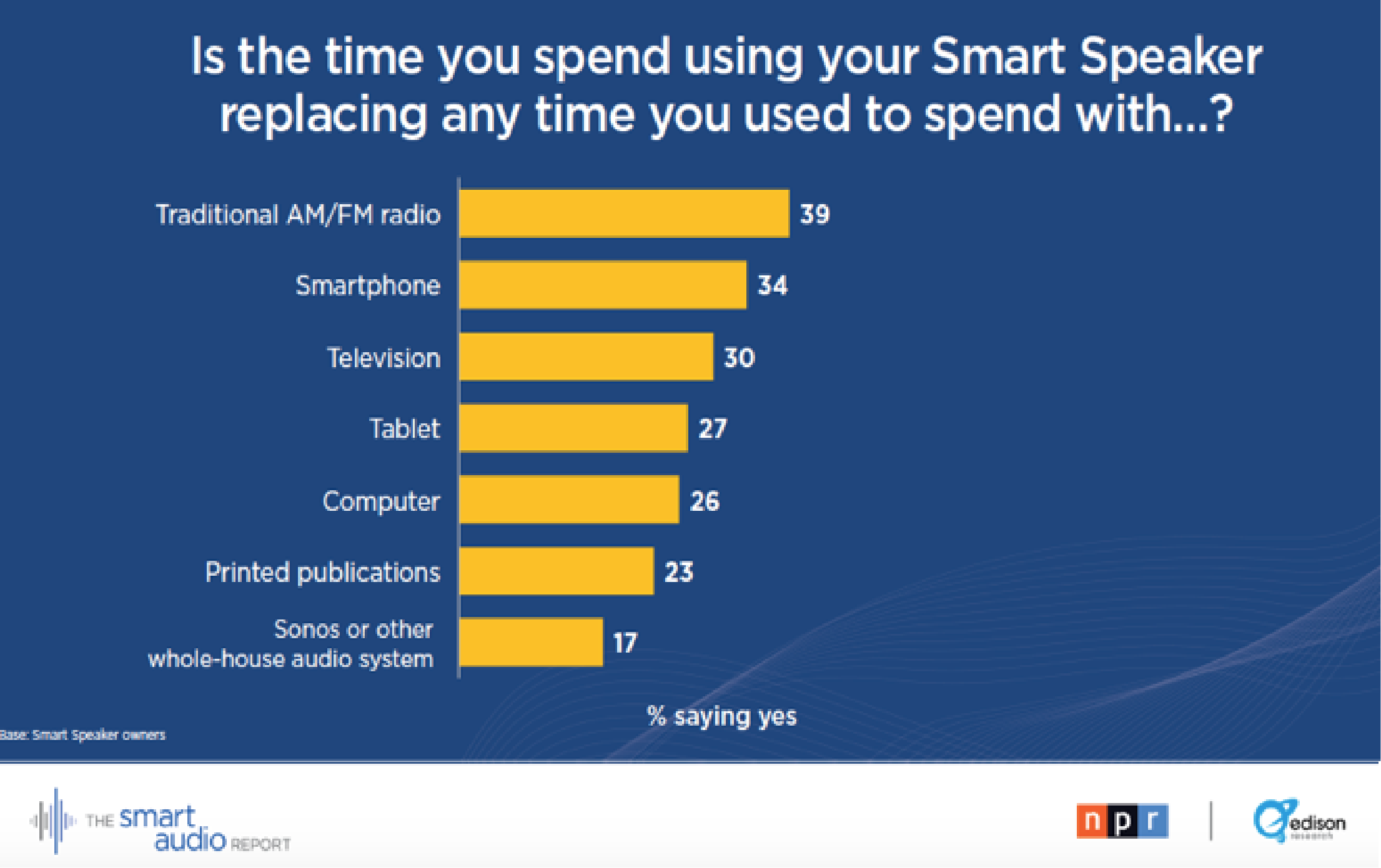
The shiniest new media platform on the block is the smart speaker. A recent research study, “The Smart Audio Report” from NPR and Edison Research, showed that traditional OTA radio was seeing the time people spent with radio, being the most disrupted. smartaudio-chartPeople in the survey said traditional AM/FM radio was the thing most replaced by audio listening via their smart speaker.echo

Having now owned three Amazon Echo smart speakers for six months, I can tell you Alexa is very addictive. But she’s also very precise. To have her serve up what you want to hear, you need to say it correctly, in the exact way she is programmed to understand, or else she will serve up some really bizarre things.

My household pretty much matches the research on why audio consumers love their smart speakers: 1) it’s fast, 2) it’s convenient and 3) it provides great choice.

Brand Promotion

In an interactive voice world, if people are familiar with your brand, they will ask for it by name. If not, the digital assistant will make that choice for you. That will make branding more critical than ever.

This means that the way radio promoted itself to its listeners back before PPM – the unaided diary days – will be the way it will need to promote itself in a world of voice control devices.

“Brands are a risk of being marginalized in a voice driven world, so brand marketing may matter even more.” -Bryan Moffett, COO, National Public Media

branding“Brands now have a chance to behave like human beings, talking, understanding, guiding, empathizing…voice is the single biggest vector of emotion, emotion is the biggest driver of preference. This is a true 1:1 marketing opportunity and a chance to build relationships like never before.” -Mark Paul Taylor, Chief Experience Officer, Global DCX Practice, Capgemini

Jerry Lee never deviated from his proven path of spending on promotion and delivering a quality product.

Everything old is new again, when it comes to branding a winning radio operation.

3 Comments

Filed under Education, Mentor, Radio, Sales

Radio Stations Aren’t Performing Like it’s 1999

Calendar 1999Remember when spot loads were small, rates were high, profit margins were 30% to 50%+ and revenue growth was double digit. I do.

What Happened?

Change happened.

FM radio replaced AM radio.

And AM radio stations are adding FM translators in an attempt to stay relevant.

An Abundance of Listening Options

Today there are too many radio stations playing the same program features, repeating the same positioning liners and doing the same things that we used to do 30 to 35 years ago.

Pureplay streamers are relentlessly competing for our listeners’ ears.

Listening options are infinite.

The Internet Tore Down the Gate

Traditional media was born when the “gates” to being a media property were very high. For newspapers those high gates consisted of having to buy large printing presses, paper, ink, etc. For radio & TV those high gates were things like having a broadcast license, a transmitter, studios, etc.

Traditional media enjoyed being gatekeepers for news, information and entertainment because there was no place else to go.

Legacy media enjoyed attracting huge audiences, huge margins and lots of cash flow.

The Gatekeepers of the 21st Century

The new gatekeepers are called listeners, readers and viewers of media.

The new gatekeepers are accessing their media via their smartphones, tablets, computers, smartTVs and now voice activated devices such as Alexa, Google, Apple and Cortana.

Bottom Line

Long stop sets no longer need to be tolerated by listeners or advertisers. Every element that goes out over-the-air needs to be thoroughly vetted from the listener’s perspective.

And your streaming product cannot be an afterthought. It’s your future and if you expect it to grow into your new revenue source, you need to give it your full attention.

Listener Supported

Have you noticed the growth of Christian formatted radio stations? Have you noticed the growth of NPR and public radio?

These radio stations depend on listener support as well as business underwriting.

If your station stopped selling commercials and asked its listeners to donate money to support it, would they?

Our Challenge

The challenge for broadcasters is to build audio brands that our audience doesn’t just casually listen to but feels they can’t live without. To do that, your media property needs to know your listener so well, that you are creating a product that they find engaging in every way.

It’s time to play to win again versus a decade of trying not to lose.

Consumers Have a Choice

Here’s the reality of today. Consumers of media have lots of choices for how they want to spend their time. They don’t need us. It’s up to us to create a reason for them to want us, to need us.

NAB Radio Show 2009

Now here’s the ear-opening part of this article.

Most of these points were made during an NAB Radio Show presentation I attended almost a decade ago.

It’s 2018, how many of these issues are the same today?

Why is that?

I’d love to hear your thoughts.

28 Comments

Filed under Education, Mentor, Radio, Sales

The Power of the Human Voice

The Last Jedi

Finn, Rey and new character Rose in Star Wars: the Last Jedi Credit: Press

I recently saw the latest Star Wars movie “The Last Jedi.” It was powerful in many ways, not the least of which was because it was the final film for actress Carrie Fisher, who was excellent.

In film, the way to connect with the theater goer is with close-ups of the faces of the actors. It’s powerful and we respond, as human beings, to another person’s face.

When radio was born, people could not see faces, and the connection radio listeners would make would be with people’s voices.

Radio People’s Memories

I belong to a bunch of radio groups on Facebook, LinkedIn and Twitter. One of the things these groups have in common is a desire to have things be the way they used to be, like they were when they were growing up. (Spoiler Alert: Ain’t gonna happen)

The other thing that they share, is that the memories everyone has that are the most vivid about radio, are about the people’s voices they listened to.

What made their favorite radio station(s) so loved, were the personalities.

What Makes a Voice Attractive?

In the early days of radio, microphones and everything they were connected up to, to transmit the human voice, were by today’s standards, pretty crude. Men with deep, strong, resonating voices were preferred for traveling through the ether.

As technology improved, other voices entered.

Listeners would now find themselves attracted to people who sounded more like they sounded. Research shows that the reason apparently is because it makes us feel like we’re part of a certain social group.

“The voice is an amazingly flexible tool that we use to construct our identity,” says Dr. Molly Babel, a linguistics professor at the University of British Columbia.

Is a Pleasing Voice More Attractive than a Pleasing Face?

When we hear an appealing voice, our feelings of attraction are heightened. Attractive voices cause us to perceive those individuals with more pleasing personalities.

So, while the real emotion in movies is transmitted via close-ups of the face, on the radio it is the human voice.

So, which is more dominate? A face or a voice?

Turns out, researchers tell us, that “the effects of vocal attractiveness can actually be stronger than the effects of physical attractiveness when each dimension appears alone” (Zuckerman et al., 1991).

Alexa, Siri, Cortana

I’m sure the power of the human voice was not lost on Amazon, Apple or Microsoft as they developed their AI digital voice assistants.

My fiancé Susan gifted me an Echo Dot for Christmas. (I already have been using Siri on my iPhone.) The ease with which it sets up and you begin using it, is remarkable. It quickly becomes a member of the family.

When going to bed our first evening with Alexa in our home, Sue said “Alexa, Good Night.” And Alexa responded with “Good Night, Sweet Dreams.”

Sue came into the bed room walking a cloud beaming how real, how sweet, how comforting it made her feel.

And I knew exactly what she meant.

Anyone who has one of the devices will too.

Radio Voices

The power of the personalities on your airwaves are critical to your station’s future success in 2018. How do their voices make your listeners feel?

It can happen in many different ways.

Let me offer a couple of examples: It can be via stationality like the JACK format, (done very well in Nashville) or it can be like the voices and style cultivated by NPR.

It just doesn’t happen by accident.

It takes planning and continuous execution of the plan.

The Battle for Attention

In the end, every form of media is battling for attention.

And to paraphrase the lesson taught in “The Last Jedi,” radio needs to stop trying to defeat what it hates about the competition and save what it loves about radio.

5 Comments

Filed under Education, Mentor, Radio