Author Archives: Dick Taylor, CRMC/CDMC

Dick Taylor, CRMC/CDMC's avatar

About Dick Taylor, CRMC/CDMC

I’ve been a “Radio Guy” all of my life. My earliest memories were of building a radio station out of tinker toys and pretending I was a disc jockey. Later I would build a radio station in the basement of my parent’s home and using AM & FM transmitters I bought at Radio Shack I would begin broadcasting to my neighborhood for about a three block radius. I began in commercial radio in the 10th grade in high school. A local radio station in my hometown of Pittsfield, Massachusetts decided to start a Junior Achievement company in radio. This was a really new concept in Junior Achievement as all JA companies at that time were production oriented and a radio station would be a service oriented JA company. I was a member of that first Junior Achievement radio company (WJAC) and it quickly led to a part-time job with that radio station (WBEC). Radio would pay for my college education and graduate degrees, both of which were in education. I loved college and could have very easily become a career student. When I graduated with my Masters Degree, there were no jobs in education to apply my earned degrees but there were radio jobs and I went into the radio business full-time as a program director, operations manager and air personality. Deciding what I’d really like to be is a radio station general manager, I knew that I would need to earn my chops in sales and so I quit my job on the product side of the business and started over at the bottom of the sales ladder as an account executive. I quickly rose to sales manager, station manager and general manager. For 27 years, I operated at the market manager level of the radio industry. I’m a Life Member of the New Jersey Broadcasters Association and Radio Ink Magazine has named me one of radio’s best managers. Former professor of broadcasting at the School of Journalism & Broadcasting at Western Kentucky University (WKU) in Bowling Green, Kentucky. I have a successful track record in sales and people development, growing top line revenues, achieving leading audience ratings, reducing expenses and meeting bottom line goals. I’m a recognized expert in radio and media regulations. I’m a turnaround specialist. I'm the founding director of the KBA WKU Radio Talent Institute coordinating a professional faculty of broadcasters who teach broadcast students who qualify and are accepted to attend a ten-day intensive program that trains tomorrow’s broadcasters in all aspects of radio station operations. My specialties include: dynamic public speaker/presenter and sales trainer. I currently teach classes in the Process & Effects of Mediated Communications, Broadcast/Internet Sales, Broadcast Performance/Production, Broadcast Management and the History of Broadcasting in America. I hold a BA in Physics/Education, an MS in Educational Communications, the Diamond CRMC (Certified Radio Marketing Consultant) and the CDMC (Certified Digital Marketing Consultant) from the Radio Advertising Bureau. I’m a graduate of Roy H. Williams Wizard Academy and Gitomer Sales Training. Note: The picture on my blog is when I was invited to do a guest disc jockey appearance on The Legend - 650AM - WSM in Nasvhille, Tennessee (July 2014). For this "Radio Guy" doing a four-hour air shift on this legendary clear channel signal radio station was a dream come true.

What Business is RADIO In?

This question was last asked at the NAB (National Association of Broadcasters) Show in 2019, before a two year shutdown of the world due to a global pandemic. I don’t remember what answer they came up with back then, but no one foresaw the changes that COVID-19 would bring into our lives.

The question was visited again in one of the opening sessions at this year’s NAB Show in Las Vegas and the answer can be boiled down to two words, “very different.”

New Media Behaviors

COVID changed the nature of how people do their jobs, and this got me thinking how my own life changed with my retirement.

From my high school days in the 60s until 2010, I worked six to seven days a week in the radio industry. If I wasn’t listening to my own radio stations, I was listening to the competition.

In 2010, I transitioned into my second career as a college broadcast professor, teaching the process and effects of mediated communications, the history of broadcasting, broadcast sales, on-air radio production and the program’s Capstone management course.

My radio listening was mainly in my car, as my college building wasn’t conducive to receiving over-the-air radio signals, so when I was working in my office I streamed smooth jazz from my iPad to the aux input on my radio.

When I retired from my second career, got married and moved to Virginia, my radio habits would change again, as well as my television habits. Now all of my media would be accessed via streaming on the internet.

The Future of Work Impacts the Future of Radio

Without evening thinking about it, as the nature of my work changed, my media habits were greatly impacted by those changes.

Looking at the future of radio, new studies done by CivicScience really opened my eyes. Their studies have found that 44% of people who listen to radio have changed their habits over the past 12 months.

People are now listening to more audio content via internet streaming, they’re listening at different times of the day, their consumption of podcasts have increased, and while 20% say they are listening more often, a whopping 34% say they are listening less often.

Listening More or Listening Less

When CivicScience looked deeper into the reason people are listening less to radio, they found that the location of where people worked played a big role. Of the 51% that said they listened to radio less, they also were part of the group that was working remotely (i.e. from home) or were unemployed.

Since so much of today’s radio consumption occurs in the vehicle, people who work from home are spending less time in their cars and therefore less time listening to radio.

Post-Pandemic Work Choices

When CivicScience asked people what their future work preferences were after COVID, only 24% said they wanted to return to their office full-time. 37% wanted to work from home full-time and 40% said a mix of in office and at home would be their preference going forward.

These findings present radio operators with a real dilemma. The radio industry depends on a working age population all moving to and from work at the same time, hence the reason that both morning and after drive radio time sales have always commanded more dollars than middays, nights, overnights and weekends.

Moreover, people who stream their audio content are the people who prefer to either work entirely from home or have some kind of hybrid office/work-from-home situation. They represent 75% of the workforce in this study.

Global Supply Chain Disruptions

The global pandemic and the war in Ukraine have caused major disruptions to the global supply chain. For example, GM announced they would be having a two week shutdown at its plant in Fort Wayne, Indiana (it produces the popular Chevrolet Silverado and GMC Sierra pickup trucks) due to a shortage of computer chips. While Russia and Ukraine don’t produce any of the computer chips that are in such short supply, Ukraine is the world’s leading supplier of neon, a gas used in the production of computer chips.

Company business models work on the premise that resources of materials and goods move freely across geography. Both COVID and a war have totally disrupted the way the world was operating. Long term, we will adapt, but the immediate future won’t be pretty.

Now, take this one example and apply it to virtually every area of our lives and you can see how complex things have become.

An Ecosystem-Driven World

Radio used to be such an easy business, just beat the other radio station in town and steal as many advertising dollars from the local newspaper as possible.

Every radio station was like its own little fiefdom, but now in 2022 every radio station is part of a very large media ecosystem and the competitive advantage is no longer how efficient you can run your operation but how connected you are to your listeners on all devices and via all platforms; connections that go far beyond your FCC license to operate an AM or FM radio service to your local community.

For me, Apple is not my iPhone, iPad, MacBook Air, Mac or Apple TV, it’s the ecosystem that all of my devices operate on. For me, that’s what is most important.

What makes our ecosystem-drive world so hard to navigate is that everything is in a continuous state of flux. This makes our deciding what we should pursue unclear, and whether other media properties are opponents or an ally.

“Competitive Advantage” is no longer the sum of all efficiencies, but the sum of all connections.

  Strategy, therefore, must be focused on deepening and widening

networks of information, talent, partners and consumers.

-Greg Satell

6 Comments

Filed under Education, Mentor, Radio, Sales

P E R S O N A L I T Y

In 1959*, Lloyd Price released the song “Personality.”

It was about a girl and what made her special.

Here’s a sample:

            ‘Cause you got personality

            Walk, with personality

            Talk, with personality

            Smile, with personality

            Charm, with personality

            Love, with personality

With the exception of a daypart or two, it’s what most radio lacks today – PERSONALITY.

Rewound Radio

Every Saturday, Rewound Radio, a streaming-only radio station features its “DJ Hall of Fame.” They are air checks of some of America’s best radio personalities, like Dan Ingram, Ron Lundy, Robert W. Morgan, Charlie Tuna, The Real Don Steele and so many more. While everyone of the personalities I just mentioned are now in radio heaven, their recorded radio shows sound as vibrant and exciting as ever. That’s why people from all over the globe dial in to hear them, and not just radio people, radio listeners who grew up with them.

People like me.

Techsurvey 2022

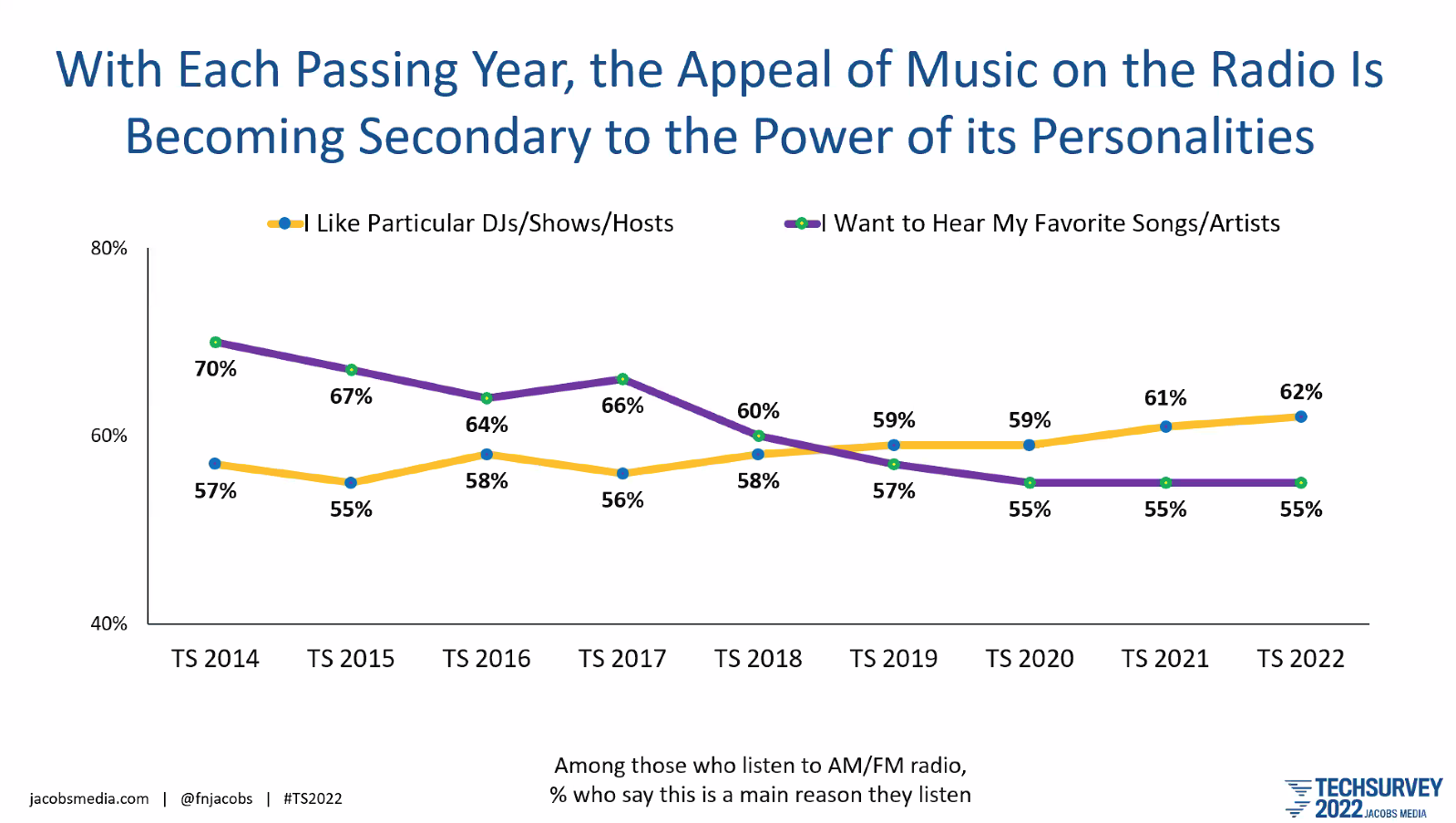
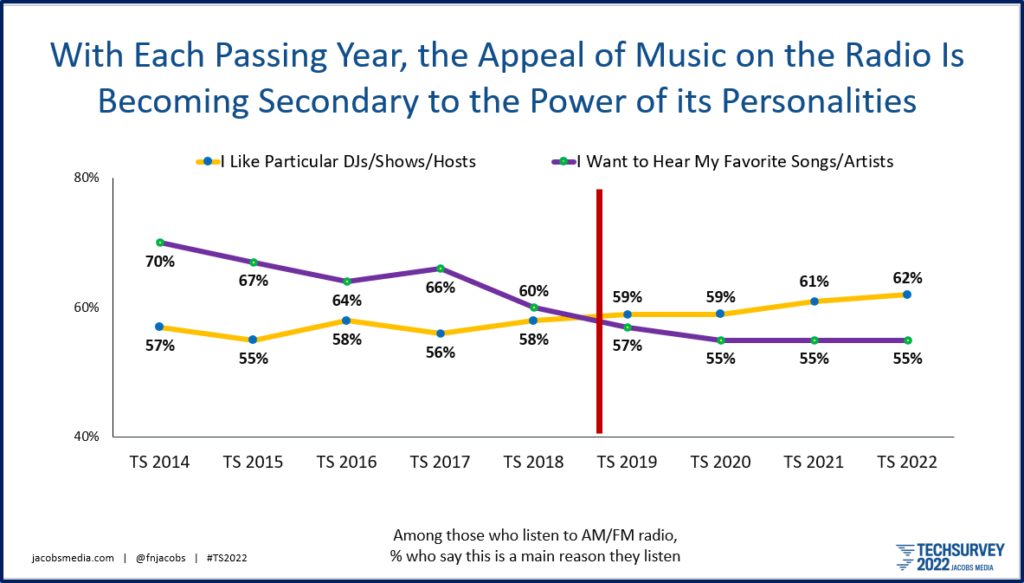
So, it wasn’t really a surprise when Fred Jacobs gave us a sneak preview of his latest research on why people listen to over-the-air (OTA) radio.

People today listen to OTA radio for the very same reason that they always have, to hear their favorite radio personality. The unfortunate thing is, the radio industry talks the talk, but doesn’t really walk the talk.

Radio’s ultimate strength as a medium is dependent

on the power and popularity of its personalities.

-Fred Jacobs

Club DJs

When I walk the boardwalks in New Jersey, Delaware or Maryland in the summertime, you can’t help but be very aware of how important it is for each club to have a popular DJ. Club DJs get people dancing, having fun and spending their money in that particular club for hours.

The longer club patrons stay, the more money club owners make.

The reality is the role of a Club DJ could be easily automated and the music would be non-stop, but it is the special magic a live personality delivers that makes all the difference. Great performers make people feel things. They deliver an emotional experience that can’t be duplicated by automation.

“People are always neglecting something they can do

in trying to do something they can’t do.”

-Edgar Watson Howe

Living in a VUCA World

The world today is volatile, uncertain, complex and ambiguous; it’s a VUCA existence. Many businesses are told they must innovate or die.

In radio’s race to stay relevant, it tries to compete with streaming audio services, where at best it can only be second best when it plays on their terms. What OTA radio should be heavily investing in is the development and promotion of outstanding, compelling, relatable radio talent.

“Treat talent with respect.

They are the reason radio remains so important.”

-Lori Lewis

Family Feud

Sue & I love watching Family Feud with Steve Harvey. This TV game show debuted on ABC on July 12, 1976 with host Richard Dawson. It would be broadcast for nine years before the network pulled the plug,  but would continue to air periodically over the following decades. The show has had six hosts, but only its original host and the current host have seen the show be an audience hit.

In fact, it was when Steve Harvey took over as host in 2010, that Family Feud was finally resuscitated. His hosting abilities with his stand-up comedy and radio background has the audience always wondering what he will say next and almost always producing laugh-out-loud moments on the game show. It also doesn’t hurt that Steve Harvey is as nice as he seems. Being genuine is always an asset in the media world.

I said there were six hosts of this show over the years, Richard Dawson was the first and Steve Harvey is the current host, but you probably can’t name the other four without looking it up on Google. And that’s my point.

Personalities are the difference maker.

Radio leaders talk a good game when it comes to telling us how important local talent is to the power of great radio, but it’s time they put their investment monies where their mouths are, by hiring and training the next generation of radio performers.

It’s time for the radio industry to focus on a change that matters.

Family Feud Hosts: Richard Dawson, Ray Combs, Louie Anderson, Richard Karn, John O’Hurley and Steve Harvey.
*Note: an earlier version of this post stated the date of Lloyd Price’s hit record “Personality” as 1957. It was updated to 1959 after a reader pointed out this error.

8 Comments

Filed under Uncategorized

Happy Glorious and Radiant Easter Morning

Dick has again asked me to share with you the beauty of this day through my word, and the spoken word.

My offering to you this day is definitely not radio, but more of a fire side reality chat of the heart.

“We have been created for greater things, to love and be loved”

– Mother Teresa

PASSION

Each and every one of us has a passion, a desire, a love.  This is something that you are born with, and if pursued- develops and grows with you in life.   It begins with a “word”- a spirited desire- It is the offing of many children’s books- “you can be anything or anyone that you want to be”. Starting with -“I want to be a fireman, policeman, garbage man, fisherman, teacher, president, doctor, lawyer, nurse, musician, or mom, the possibilities are endless.  If this path is followed, an energetic zeal develops into another category, something that ultimately joins forces with a degree, a certification or powerful idea.  These can then be put into action and move toward what and who you were born to be. With this sticktoitiveness the outcome always, always equals – “the want to care for someone other than yourself.” But whenever or wherever it is found, it is the influential entity of who you are, where your thoughts live, what you think and also the people you associate with that now is leading you to fulfilling – who you were meant to be. 

“If you can’t figure out your Purpose, figure out your passion.

For your Passion will lead you right into your Purpose.”

-T.D. Jakes

You most assuredly will find confusion in your own wants and thoughts, as the people around you try to direct and steer you toward “their” path of what’s best for you, where you should live, and what you should do in this life. But…

Do not abandon yourselves to despair.

You have been selected by a force greater than yourself

to step into your God given calling, listen and hear the conversation of your silent heart –

and then proceed.

IMAGINE

Now, take another “word” out of your pocket and put it in front of or behind your quiet inner passion-“Imagine.”                 

This is where “Passion” grows.

The following are just a few names of individuals who have walked thru many centuries of God’s time portal with a passion and a purpose to helping others and making a difference.  They took their “Imagine” and wrapped it in a “Passion.”

Bill Gates, Steve Jobs, Alexander Graham Bell, Grace Hopper (Pioneer of Computer Programming), Larry Page (co-founder of Google), Albert Einstein(Quantum Theory of Light), Thomas Edison (sound recordings, mass communication, motion pictures), Ben Franklin, Thomas Jefferson, Nikola Tesla(1st alternating current-AC motor, AC generation and transmission technology), Gutenberg (printing press), Henry Ford (auto manufacturer also developing the assembly line), Leonardo da Vinci (inventor), Robert Fulton (Steamboat Inventor), Samuel Morse (Inventor of telegraph and Morse Code), the Lumiere Brothers (devised early motion picture camera and projector- known as the Cinématographe), George Washington Carver (known for inventing crop rotation), Marie Curie(discovery of Radium and Polonium), Louis Pasteur (Pasteurization), Oskar Schindler (credited with saving  the lives of 1,200 Jews during the Holocaust), Tom Jennings (first black man to receive a patent – Dry Scouring or Dry Cleaning), The Wright Brothers (aviation pioneers), Mother Teresa (dedicated her life to caring for the less fortunate), Jonas Salk (developed the polio vaccine), Tsukamoto (inventor and stem cell researcher) and Peter Tsai (inventor of N95 Mask).

“Not all of us can do great things. But we can do small things with Great Love.”

-Mother Teresa

Gratitude

This past year, we as God’s children, have been wrapped deep in the reality of a global pandemic, on the East coast the release of a 17 year cicada & lantern fly bug infestation, a drought in the West, environmental devastation by climate change, food insecurities, political unrest and now a senseless war in the Ukraine. If we are not actually living and experiencing these things, we are witnessing our fallen world through the news.

In spite of all these negatives, we should be so grateful for the other side of the coin, those that have come forward with their positive “Imagine” word. These people have put their “Passions” to work finding solutions and cures, bringing food and shelter to the homeless, defending and standing up for the weak and meek. These are God’s children in action. People with great passion can make the impossible happen. They choose not to yell, as yelling silences the message, they speak and move quietly so that one hears God’s voice.

“Yesterday is gone. Tomorrow is not promised. We have only Today. Let us Begin”

-Mother Teresa

Imagine Your Passion

People of the world engaged in social media tend to post lovely quotes that sometimes make your heart sing with emotion. But why can’t we take God’s Hand and step into a different journey, by getting out there and actually trying to imagine a passion of serving, and stirring the pot of change. What is stopping us?

Do it quietly, be that walking sermon; one thing, each day, just one. Our time on this planet is getting shorter and shorter, and even though we are one person, we have been given this gift to change one life. Do this not for the benefit of your ego, but for walking the path that we have actually been directed to follow. Ask yourself, why not, and DO IT.  Find and discover the person you were created to be – If you can find the God inside yourself, you will be able to find the God inside every living creature.

“Spread Love Everywhere you go. Let no one ever come to you without leaving happier.”

-Mother Teresa

Reach for the Hand of God, see His beauty, develop your Imagined Passion to soar and reverberate throughout the ages.

“WE are all the Easter People and Hallelujah is OUR Song”

-Pope John Paul 11

Susan Towley is a graduate of Concordia University with a degree in Family Life Education, is a Certified Grief Counselor and Guided Imagery Therapist. God joined us together in 2018.

2 Comments

Filed under Uncategorized

Less Is More

When I was a market manager for Clear Channel, the company president introduced a new concept for reducing our commercial load, he called it “Less Is More.” It sounded good on the surface, however instead of reducing on-air clutter it introduced shorter length commercials. Each of my radio stations now aired ads that were as short as 5-seconds down to 1-second in length. This meant more ads could be run in a spot break. For example, the time it would take to run four minute length commercials, with Less Is More stations could now run six half-minute commercials or twelve 15-second commercials etc. Listeners don’t consider the length of a commercial break, but the number of different elements that air in a break.

Radio Commercials

If there’s one thing radio listeners tend to always agree on, when it comes to improving the radio listening experience, it’s reducing the number of commercials. That means the number of ads that air in a single commercial break, as well as the total number ads broadcast each hour.

Clear Channel recognized this listener issue, but by introducing shorter length ads, the “Less Is More” initiative added more elements to each stop-set. To the radio listener, the amount of clutter increased and in essence, made their favorite radio stations less listenable.

Commercial Free Radio

It was in 2008, when New York’s CD 101.9 WQCD dropped its Smooth Jazz format to switch to playing rock music with the new call letters WRXP.  Not finding any radio station in the greater New York City area that programmed the Smooth Jazz format, I would search online and discover Sky.FM.

They offered more than one flavor of Smooth Jazz music programming and it quickly filled my appetite for this musical genre. They only stopped the music twice an hour, once to tell me that I could hear this music without interruption by becoming a premium subscriber and the other announcement was about how they were looking to hire more IT personnel.

Those were the only two announcements and they lasted about 30-seconds in length, but over time, it was like Chinese water torture; so, I went online to find out how much it would cost to become a premium subscriber, learning it would cost me only $49/year. But that wasn’t all, that fee also increased the audio quality of the stream .

I was hooked and remained a subscriber, only leaving the service when I got my first Amazon Echo and Radio Tunes (formerly known as Sky.FM) wasn’t available on the service.

Recently a reader of this blog, told me that he listened to commercial free Radio Tunes on his Amazon smart speakers and I’m a subscriber once again.

My wife Sue loves Pandora and for Valentine’s Day 2022, I bought her Pandora Premium. This is their top service, it’s commercial-free and offers listeners the ability to ask for any song and immediately hear it. Plus she still can listen to any of Pandora’s wonderfully curated channels and skip any songs she doesn’t like.

Repetition Breeds Acceptance

I often hear people say they get tired of hearing the same songs over and over. Yet, successful radio stations often employ strategies that can seem counter-intuitive. They achieve the more variety music position by playing fewer songs. They reach a larger audience by targeting and focusing on a more narrowly defined audience.

By subscribing to Pandora and Radio Tunes we didn’t eliminate music repetition, we eliminated the programming elements that interrupted the music. It’s the music repetition of our favorite songs that actually attracts us.

In fact, I remember when Sirius and XM were still two separate subscription satellite radio entities, the most listened to commercial free music channels on both of them were HITS 1 and Top 20 on 20; both of which had the highest music repetition.

Dave Van Dyke, the President & CEO at Bridge Ratings Media Research, said that globally there are 3.6 music streamers for every paid subscriber. So, don’t completely count commercially supported radio out yet.

Great Radio Ads

When I was managing radio stations in Iowa back in 1999, my two sons came to visit. Before they left, they made what you might think is an unusual request, they wanted to know if I could make copies of the radio commercials my stations aired and put them on a cassette to bring back with them to New Jersey.

I also remember being at a house party and the radio station providing the music entertainment was largely background, until they stopped the music to play some commercials, and everyone would hush the conversation so they could listen. Yes, the radio ads this station created were that good.

I’m a graduate of The Wizard of Ads Wizard Academy in Austin, Texas. Roy H. Williams has been teaching radio folks for years about what makes an effective radio ad. Following Roy’s lessons, my advertisers have been very successful.

Radio commercials aren’t bad.

Bad radio commercials are.

Radio’s secret ingredient is the radio personality. Great radio talent has been effectively telling their listeners about all types of businesses, products and services for decades.

I need go no further than radio’s greatest salesman, Paul Harvey.

I own two BOSE Wave Radios because of Paul Harvey. What makes this so amazing is that I listened to him broadcasting on an AM radio station, but Paul was selling me a radio that would play FM stereo and CDs with the highest fidelity.  

While Paul Harvey was a news commentator, he called himself a salesman. His audience knew that he used the products and services he advertised. Harvey personally wrote the radio commercials he would broadcast.

Among his many accolades, the one Paul Harvey was most proud to have received was being named “Salesman of the Year.”

Paul Harvey loved his advertisers, saying “I am fiercely loyal to those willing to put their money where my mouth is.”

Creating great radio, means leveraging the power of the medium to deliver an engaged audience for its advertisers. That means reducing the number of ads in a commercial cluster and reducing the number of ads per hour, making sure every ad is about the listener and their life.  

Tomorrow has always been better than today.

And it always will be.

-Paul Harvey

9 Comments

Filed under Uncategorized

Subscription Media

The inspiration for this week’s article came from a blog written by Fred Jacobs titled “When will ‘Netflixification’ Come To Radio?” Fred’s article revolved around Netflix’s innovation of a subscription model for its entertainment offerings, which got me to thinking about when the subscription business model for media began.

The Subscription Model

We would have to journey back to the 17th century to find the earliest records of book and periodical publishers pioneering a subscription business model for print media.

The subscription business model is one where the customer

pays a recurring price

at regular intervals to access a product of service.

Most recently, Apple is said to be working on a subscription model for its hardware; iPhones, iPads, computers etc. Why? Well customers are good, but it turns out that subscribers are even better. Emarsys’s Chris Gooderidge writes that over the last nine years, “the subscription economy has grown nearly 6x (more than 435%),” with subscription businesses growing five to eight times faster than those with a traditional business model. The two years the world closed down due to COVID only served to accelerate companies’ and consumers’ digital transformation.

On Demand & Subscriptions

What most of us want, as consumers, is convenience. We want what we want, when we want it. The subscription business model fulfills this desire. It enables us to listen to music or play games, as well as watch TV shows and movies.  

The more customers gain a taste

of truly personalized repeat services,

tailored specifically to them…

they won’t want to go back to what they had before.

-Chris Gooderidge

Subscription Radio

In 1923, in Dundee, Michigan, an early radio entrepreneur offered subscribers a wired radio system, that would provide radio programs from several radio stations for $1.50 a month; which would be $24.75/month in 2022. While it didn’t succeed, it was the precursor to what later would become the cable television industry.

Subscription Television (STV)

Back in the 60s, over-the-air television experimented with a subscription model. Companies in Connecticut and California each found themselves in court with theater owners when they developed a subscription business model that offered recent movies to be viewed in the home. The battle in Hartford, Connecticut made it all the way to the Supreme Court.

In the end, the pay television model was taken over by cable television, which learned in addition to providing a community antenna to receive distant broadcast television signals, could also create original programming. These new program channels could be offered on a subscription basis, like CNN, ESPN, The Weather Channel etc.

Is a Subscription-Based Business Model Right for You?

Like most questions along these lines, the answer is: it depends.

The subscription model is dependent on products and services that have a high perceived value to the consumer. (Note: things offered for “FREE” often don’t have a high perceived value)

On the blog, Billing Platform, they list four common successful subscription based business models:

  1. Consumables and Retail Models in Subscription Billing: companies like Dollar Shave Club and Blue Apron
  2. As-a-Service Subscription Billing Models: companies like Microsoft with their Office 365 and Dropbox
  3. Digital Entertainment Subscription Billing Models: companies like Netflix, Disney+, Apple TV+, Amazon Prime, Hulu, Peacock etc for video and Spotify, Pandora, Radio Tunes etc for audio
  4.  Maintenance and Repair Subscription Billing Models: companies like landscaping, pest control, heating & cooling, as well as other common maintenance needs

Peak Subscription

Which brings us to the million dollar question, when do we max out on all of these monthly/annual subscriptions? When do we reach, “peak subscription;” that light-bulb moment when we realize we need to start eliminating some of these expenses.

It was that very question that finally got me to sit down and review our monthly household subscriptions and total things up. It’s something I’ve been meaning to do anyway, but Fred’s blog was the spark that put me in action.

Here’s our entertainment subscription list:

  • Amazon Prime
  • Frndly TV
  • Netflix
  • Disney+
  • Apple TV+
  • Washington Post
  • Time Magazine
  • The Atlantic
  • Consumer Reports
  • Radio Tunes
  • Pandora Premium
  • Sling TV

Now, to make most of these digital entertainment subscriptions work, we need to subscribe to an internet service and since we use many of these services on our iPhones, we also need to add in our monthly call/text/data plan too.

Our monthly cost is $228 or $2,736 annually.

Fred reveals that in the upcoming Techsurvey 2022, two-thirds of the people in his survey now agree with the statement, “I am concerned about the growing number of subscription fees I’m paying for media content.”

I urge you to sit down with your bills and do an audit of your household’s entertainments subscription expenses. If you are like us, you didn’t subscribe to all of them at the same time, but added them one-by-one over a period of years.

Sophie’s Choice

The problem for all of us, comes to making a “Sophie’s Choice” of our media subscriptions. We love them all and trying to decide which ones to eliminate is NOT an easy decision.

What one learns when they are faced with this decision is that we are “happily hooked” on all of them.

Commercial radio and TV operators also need to realize as the subscription economy for entertainment continues to grow, the number of hours in a person’s day is finite, and our time with subscription media means little is left over for OTA radio/TV.

People will spend their time, on those media services

they spend their money with.

4 Comments

Filed under Education, Mentor, Radio, Sales

What Makes Your Radio Station Unique?

In teaching broadcast sales at the university, one of the things I taught my students was to help their advertising clients to identify their unique selling position in the marketplace. In other words, what was the one thing that made them different than everyone else in their specialty.

Something For Everyone

The answer you most often hear when you ask an advertiser what makes them unique is, “well, we have something for everyone.”

Something for everyone is nothing special for any one. To the radio listener, it’s like blah, blah, blah. It’s meaningless. Why? Because every other advertiser selling everything from soup to nuts says the same thing and the listener has become trained to tune out these advertising clichés.

Plumbers

Plumbers are probably not something you ever give much thought about, UNTIL you need one. That’s true for lots of repair services when you think about it.

What’s the one thing you hate about calling a home repair company? Knowing that you will be kept waiting and waiting and waiting for their arrival at the time when they said they would.

“It takes many good deeds to build a good reputation and only one bad one to lose it.”

Benjamin Franklin

Benjamin Franklin Plumbing could have said a lot of things about the services they provide, but instead they decided what would make them unique in the ears of future customers would be being punctual.

Benjamin Franklin

The Punctual Plumber

They built their whole franchise around the realization that people hate to be kept waiting. In fact, they promise when you don’t have time to wait around, you can count on them to be punctual plumbing professionals, but if they are ever late, they will pay YOU for every minute they’ve made you wait. Doesn’t that resonate with you? It does for me.

Give Your Radio Station a Diagnostic

When is the last time you pulled out the Advertiser Diagnostic sheet and used it on your own radio station(s)?

What makes your station unique? Not the music, that’s for sure. The songs you play were carefully crafted by composers, producers and talented artists, who have record labels that have worked relentlessly to get those songs played on as many radio stations, pure play streamers, movies, TV shows and any other place that uses music to entertain people.

Is your brand name unique? Well, if you branded your radio station KISS you are one of 78 radio stations in America that call themselves that, along with radio stations in Ireland, United Kingdom, France, Italy, Poland, Ukraine, Romania, Moldova, Iceland, Greece, Spain, Sweden, Germany, Brazil, Canada and Australia. It’s no different than calling your radio station HOT, Jack, Bob, Alice or some other cute name that dozens upon dozens of other radio stations are doing, especially in a world where voice commands increasingly are the way people are accessing audio on their smart devices.

But if your brand is 650AM -WSM, you are the only one in the world that has that brand. You have set yourself apart from the estimated 44,000 radio stations currently on-the-air in the world. WSM is the Home of the Grand Ole Opry. I don’t expect this historic radio station to ever call itself by any other name, but by the one it owns exclusively: WSM.

Streaming Radio

In a world where you can receive virtually any radio station on an App like TuneIn, being unique and one-of-a-kind has never been more important.

If a person tries asking Alexa, Siri or Google to play the KISS radio station, I have no idea which one she will play. However, I don’t have to wonder for a second, if I ask my smart speaker to play WSM, I will hear any other radio station, but the one from Music City USA, in Nashville, Tennessee.

What Makes Your Radio Station Unique?

If you stake your radio station’s future on things created by others, like music, talk shows, network news, syndicated programs, jingles – things every other radio station in America has access to – then your radio station is NOT unique.

When other providers are able give your listeners more of what they want while eliminating the things they dislike, your days as a broadcaster are numbered.

Another way to think about this is, if you were to eliminate all of your commercials – the thing radio listeners say they object to most – would you be able to sustain your radio station by listener support, like public radio and Christian radio does? Or the way that Netflix or SiriusXM does?

If a listener hasn’t heard of your radio station,

wouldn’t choose your station or recommend it,

your brand is dead.

<Picture: The Fuse Vert is a premium vertical vinyl audio system which can also play FM radio>

5 Comments

Filed under Education, Mentor, Radio, Sales

Hiking Time

Taking the weekend off to go hiking in the mountains of West Virginia, where it truly is “almost heaven.”

Back next Sunday with a new blog article on “What Makes Your Radio Station Unique?”

Leave a comment

Filed under Uncategorized

The Car Radio is 100

Commercial radio was born in November of 1920. The first OEM (Original Equipment Manufacturer) car radio came along in 1922 designed by the Chevrolet Motor Company and manufactured by Westinghouse. This first car radio was heavy, cumbersome and expensive; costing $200. In today’s dollars this would be the equivalent of $3,347.00. A 1922 Chevrolet, Superior 5-Touring automobile was priced at only $860, so you can see how expensive it was to buy one with a radio installed.

The good news is the radio worked and would then birth 100-years of innovation in the automobile dashboard.

The 1920s Car Radio Sales Pitch

With a radio in your car, your family could drive anywhere within a hundred miles of a radio station while being entertained, informed and educated.

It’s hard for any Baby Boomer to imagine not having audio entertainment as standard equipment in their dashboard.

1930s

It was radio engineer Paul Galvin that would pioneer more affordable car radios which he manufactured and sold through his new company, called Motorola.

1940s

Midway through the 40s, it is estimated that nine million cars now had radios in their dashboard and people were becoming concerned that they were leading to distracted driving thereby causing more auto accidents. Both broadcasters and radio manufacturers made the case for how having a car radio was useful in emergencies and alerted drivers to bad weather conditions.

Today when the topic of distracted driving comes up, it’s usually about handheld cellphones being used by drivers. But back then, Radio-Craft Magazine told of the battle being waged between state legislatures and radio manufacturers: “Ever since auto-radio installations became popular, a controversy has been going on…as to whether auto radio presented an accident hazard or not.”

The president of the Radio Manufacturers Association made the case that car radios were safe saying:

“Radio is not distracting because it demands no attention from the driver and requires no answer, as does conversation between the driver and passengers. Motor car radio is tuned by ear without the driver taking his eyes off the road. It is less disconcerting than the rear view mirror.”

Several states proposed steep fines for drivers, while others considered making installing a car radio a crime.

The Princeton Radio Research Project was created to study the effects car radios were having on automobile safety. In a paper published by Edward A. Suchman for that project, he reported that his small study found no link between car radios and traffic accidents.

1960s

In 1963, Frequency Modulation (FM) radios were introduced into the automobile for the first time. Radio penetration in cars had now reached 60%.

Along with FM radios, the 60s also gave birth to both eight-track tapes and car stereos, primarily due to the use of transistors, instead of vacuum tubes. Solid state transistors were smaller, drew less power and emitted very little heat.

1970s

If the 60s belonged to the 8-track tape player, the 70s would belong to the stereo cassette tape player. Recording tape manufacturer Maxell promoted these cassettes as nearly indestructible.

1980s

While the Compact Disc (CD) would be introduced in the 80s, it didn’t really become ubiquitous until the late 90s, coexisting with compact cassette players in automobile dashboards for two more decades.

21st Century

Probably the biggest disruption to the automobile dashboard came with the advent of Bluetooth allowing smartphones to interface with a vehicle’s entertainment system.

In 2011, automobile manufacturers stopped offering cassette tape players in their new cars, soon followed by the elimination of CD players/changers.

Today’s new cars come equipped with access to Satellite Radio, and an automatic interface with your smartphone allowing you the ability to stream anything you want to hear into your car’s entertainment system.

In fact, my first article for this blog in 2022 was “Why I Stream ALL My Radio Listening,” which diagrammed how my car radio audio systems are now programmed by my iPhone.

“Radio is not going to be Numero Uno in the dash any longer.”

-Fred Jacobs

AM/FM radio will most likely coexist with other forms of audio access for a period of time, but the writing is on the wall.

The definitive answer to how long over-the-air radio will continue to be used in the automobile really depends on broadcasters and whether or not they offer compelling and attention-getting content that audio consumers demand to hear.

AutoStage

Xperi’s newest in-dash experience is AutoStage. It was demonstrated at CES2022 and it should be noted that this system comes with the following pre-sets: SiriusXM, FM, AM and TuneIn Radio.

I use the TuneIn Radio App for most of my radio listening, but why was it chosen by Mercedes Benz? Turns out the answer is, “TuneIn’s radio stations can be accessed worldwide in 197 countries on more than 200 different platforms and devices.” TuneIn says it “provides the displaced radio listener a connection to home with local, national, and international stations anywhere they go and on any device.”

In other words, why would any audio consumer need DAB (Digital Audio Broadcasting), DAB+, Digital Radio Mondiale, HD Radio, AM or FM when they can receive any radio station in crystal clear audio via streaming?

With the exception of the proprietary content offered by SiriusXM, everything else is available via streaming at no charge.

Waxing Nostalgic

Car radio has come a long way from the day William Lear and Elmer Wavering drove their girlfriends to lookout point high above the Mississippi River town of Quincy, Illinois to watch the sunset and their dates told them how much better this romantic evening would have been had they been able to listen to music in the car.

Lear and Wavering shared their girlfriends’ comments with Paul Galvin who would go on to make Motorola car transistor radios, and then AM/FM radio would dominate the dashboard for the rest of the 20th Century.

So, now moving further into the 21st Century, radio broadcasters really need to follow the advice of Steve Jobs in order to survive and thrive, and that is to:

Think Different

12 Comments

Filed under Education, Mentor, Radio, Sales

College Radio Stands With Ukraine

After two years of dealing with a novel coronavirus and just when we thought life was returning to a different form of normal, Russia invaded the Ukraine.

This war has sent over a million people fleeing their homeland or picking up arms to defend themselves against Russian aggression.

For college students in the Ukraine, their classes have been suspended as the dormitories are under attack by rockets, forcing them into bomb shelters – or fleeing the country – or taking up arms.

What’s happening in the Ukraine, is impacting college students around the world.

College Radio Foundation

The College Radio Foundation (CRF) was founded in 2014. Its mission is to promote and support college radio. CRF works to raise the profile of college radio and “accelerate the professional development of gifted student broadcasters, inspiring them to reach their exceptional potentials.”

It all began in 2011 by Dr. Rob Quicke with the idea to bring college radio stations together and celebrate college radio as an important training ground for all sorts of careers, creating an event called College Radio Day. Presidents Barack Obama and Joe Biden have officially proclaimed and recognized the importance of this annual event, which in its first three years quickly grew to over 700 participating college radio stations in 43 countries.

In 2021, CRF held its 11th annual College Radio Day and announced that October 1, 2021 would be the inaugural World College Radio Day open for all college and university radio stations around the world.

February 24, 2022

On the 24th of February, Russia launched a military invasion of Ukraine, the largest such conventional military attack in Europe since World War II.

On that same day, Dr. Rob Quicke sent out an email to all the college radio stations in the CRF database.

Dear friends,

We are emailing you to please ask for your support and solidarity for the people of Ukraine during this time, and especially the students in the country. We need your urgent participation!

The College Radio Foundation has reached out to college radio in Ukraine, and we made contact with OstRadio at National University Ostroh Academy, Ostroh, Ukraine. They are located to the west of the capital city Kyiv. We are sharing their message:

“I would like to start this letter with the words “Good afternoon”, but I cannot say that this day is good for Ukraine. Thank you for your support and wishes, it is very valuable for us. Our university teaches online. Teachers and the administration keep in touch with students, advising read only official sources.
The only thing left for us is to remain calm and not to panic, to pray to God, to believe in the army that protects us, to protect our health and life. Ukraine wants a peaceful sky over its head!”

We only have a limited window of time to show our support, so that is why we are asking all student radio stations around the world to record a quick message of support and solidarity for the students at OstRadio as well as the entire Ukraine. You can record in your native language. They also said this:

“We will be happy to share your voice message with words of support… Students of our university will be able to hear it there. In this difficult time, we really need to know that we are not alone and we have support. We hope that your words will calm people’s hearts.”

Please send an attached mp3 to rob@collegeradioday.com 

We only have 24 hours to do this. We do not know how long the students will have access to social media and/or tools to communicate with us.

Stand with Ukraine, tell them that you are thinking of them and supporting them. Send us your message asap. We will then compile and send as one audio piece tomorrow.

Many thanks,

Dr. Rob Quicke
Founder, College Radio Day
The College Radio Foundation

Two days later, over 50 college radio stations had responded from around the world, producing audio content and letting their fellow college students and the people of Ukraine know that they stood with them.

You can hear their voices, their emotion and see a full list of participating college radio stations by clicking on this link: https://soundcloud.com/collegeradioday/college-radio-stands-with-ukraine-full-version?utm_source=clipboard&utm_medium=text&utm_campaign=social_sharing

“Thank you on behalf of all Ukrainian students.

We have already posted this link.

We want all our students to hear it.

We would like to play this audio on our radio.

We send the audio to all UA universities.”

-Roman Zajac, Head of STUD Radio, Ukraine

March 2, 2022

Roman Zajac said that students were unable to enter their radio station and had been using their cell phones to communicate with each other and the outside world, however as the Russian army continued their invasion, the students have dispersed and he no longer is in contact with them. Some of them are rooted in the city, some of them have left the country and are all uncontactable. Zajac says he simply no longer knows where any of his students are.

Dr. Quicke told me he knew they had a very short window to get Ukrainian students recorded and let the world hear these voices. One of the college students from the Ukraine that can be heard in the audio presentation is only 17 years old.

While you may not know or understand some of the languages heard on the audio presentation, you can’t help but be moved by their bravery and their emotion in listening to them. Dr. Quicke said he’s learned through World College Radio Day that there are times when he cannot understand the language but it’s almost not a requirement to comprehend what is being communicated, the emotion comes through very, very clearly. “I am very moved by the bravery of the students in the Ukraine to keep going and to make the effort to send a message to the world in such difficult circumstances,” said Dr. Quicke. “College radio stands with Ukraine and we must not forget them.”

“I’ve learned that people will forget what you said,

people will forget what you did,

but people will never forget how you made them feel.”

-Maya Angelou

“It was a small thing that we did,” said Dr. Quicke, “but what we’ve heard back from the students (in the Ukraine), from hearing all the different voices of college students from all over the world was that it had an especially powerful impact in this moment…war is there now…and it redefines their reality in a very shocking way, when they see and hear bombs falling, people dying…any gesture can become crucially important for maintaining spirit and morale…letting them know, ‘we hear you, we support you.’”

One of the last messages Rob said he received from the Roman Zajac at STUD college radio in the Ukraine was, “when the war was over, maybe we can record together.”

“All war is a symptom of man’s failure as a thinking animal.”
― John Steinbeck

UPDATE 3/4/2022

College Radio Update from Ukraine. March 4, 2022(multilingual).

“We ask international community for help because we are fighting not only for our freedom, but also we are fighting for Europe, and we are fighting for the whole democratic world.” -Roman Zajac

Dr. Quicke added: In extremely challenging circumstances, the students in Ukraine have put together an audio update for us. This time it’s in multiple languages for the world to hear. We were told that would probably not hear from the students again, as the situation in Ukraine is dire, so we are grateful to hear from them again.

Have a listen, it’s just under 2 minutes:

https://soundcloud.com/collegeradioday/college-radio-update-from-ukraine?utm_source=www.collegeradio.org&utm_campaign=wtshare&utm_medium=widget&utm_content=https%253A%252F%252Fsoundcloud.com%252Fcollegeradioday%252Fcollege-radio-update-from-ukraine

We are also planning a day/time when we can play the content together as a community at the same time. We are planning for Thursday, March 10 at 10 am ET / 4 pm CET. More info coming on Monday.

To stay update to date, be sure to check back with the CRF website often.

Produced by Roman Zajac at STUD Radio (Lviv, Ukraine) and Rob Quicke, the College Radio Foundation. (c) 2022.

Leave a comment

Filed under Education, Mentor, Radio

The Waiting for Godot Fallacy

I know many people who come to this blog and post comments about the articles I write pine for radio to return to the way it was twenty years ago. They’re hoping that one day the big consolidators will move on to new business ventures and will sell their radio stations back to radio people who will run those stations correctly. Sadly, wishing for that to happen is like Waiting for Godot .

But that doesn’t mean there’s not a future for radio. One of my readers, a multi-decade broadcast manager, engineer and consultant wrote the perfect prescription for making radio healthy again. Today, I would like to share with your those thoughts.

It’s Not About Being Local

“Local” being the savior of radio is a canard and always has been. The beauty of social media is that it is a rich media experience that is personalized expressly for one person: you. Radio cannot hope to be so “local” that it can beat that.

Serve Your Tribe

The secret to radio’s survival is not localism but “tribalism.” Providing not just a service but an experience. An experience that joins numerous people together, regardless of geography. Hence the success of right-wing talk radio, the success of NPR (which is rarely less than 21 or 22 hours of national progamming out of every day on virtually every “member station”) and most informatively, the success of K-Love, which has near zero local content at all yet has grown a huge and profitable audience.

These outlets’ content has precious little to do with the local community, but they all share a powerful defining aspect: listeners self-identify as being proud to listen (and prouder to donate to) the outlet in question.

Commercial Radio’s Tribal Leadership Vacuum

Most commercial radio outlets have achieved this tribalism on the backs of longevity of a given host: KISS 108 has been top-rated in Boston for decades because that audience has tuned in to hear Matty Siegel every morning for over forty years. Rush Limbaugh had his legions of Ditto Heads for nearly as long.

And therein lies the rub. Most of those hosts are in their 70s or older…or dead…and the pipeline to replace them has been sealed off thanks to post-1996 consolidation. Non-commercial radio operators, like K-Love and NPR, have succeeded in finding a content/style niche but there’s only room for so many of those.

It All Comes Down to Your Talent — Growing & Retaining It

So, to put it another way: it’s not localism that’ll save radio; it’s talent. And radio has worked very hard to drive good talent out of the business.

“Talent hits a target no one else can hit.

Genius hits a target no one else can see.”

-Arthur Schopenhauer

3 Comments

Filed under Education, Mentor, Radio