

 On November 9, 1965, around 5:21pm in the afternoon, WABC listeners heard something unusual coming through the speakers on their battery powered transistor radios. WABC was playing Jonathan King’s “Everyone’s Gone to the Moon,” but it sounded different. It sounded like it needed a shot of Geritol, as the recording turned slower and slower. Even WABC’s famous chime was off key, and popular afternoon personality Dan Ingram tried to make fun of what was happening. You can hear that moment by clicking HERE.
The 1965 Northeast Blackout
As it was happening what no one knew, was that the power grid was collapsing. Inside Dan Ingram’s studio, the lights were flickering, the music cartridges were playing at slower and slower speeds and the journalists in the WABC newsroom were beginning to see the wire services report that city after city along the Eastern seaboard were going dark.
From Maine to New Jersey, America was experiencing a regional power grid failure. Many radio stations without emergency generators were silenced, but WABC was still on the air due to the station’s transmitter facility being located in Lodi, New Jersey. New Jersey was on a different power grid than New York City.
WABC would rush Dan Ingram to Lodi with a stack of records and have him continue his show from there.
Rick Sklar & Building Resilience
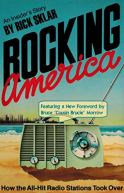 Rick Sklar wrote in his book “Rocking America” that the blackout helped him to focus his attention on technical reliability. “A station can have the best mix of music and the top jingles, but if the tapes break, the cartridges jam, or the music fidelity is off, the ratings (aka audience) begin to evaporate,” Sklar wrote.
Early in his tenure as the program director at WABC, Sklar would be frustrated by the technical obstacles that got in the way of his building Music Radio 77 into the #1 radio station in The Big Apple.
Lessons Learned at NASA
When America was ready to put a man on the moon, Sklar decided he wanted to be there for that significant moment in history.
He was fascinated by the confidence of NASA that they would land men on the moon and bring them back home safely. He was envious of their certainty and of their equipment and systems to get the job done. He wanted to attain that same kind of certainty for WABC when he returned home to New York.
In drilling down mission control’s engineering confidence, he learned that NASA used triple measurement and triple backup on everything. Sklar would learn from Walter Häusermann, the man who designed the guidance systems for the V-2 rockets, and those of the Apollo command module, “If two of the three readings on any measurement agree, we assume that it is the third meter and not our readout that is at fault.”
WABC Builds Resilience
When Rick Sklar got back home, he began to implement what he had learned at NASA, in the operations at WABC. He built two identical main control rooms and made sure a production studio could act as an air studio if needed. He built the studios with eight cart machines, instead of the previous five, three being ready in case of a failure of any of the primary five machines. He had every one of the two thousand-odd cartridges that made up the WABC sound, duplicated for each studio. The studio to transmitter broadcast land lines were broken into a northern and southern route from the main studios to the transmitter site in Lodi, with a microwave link as the third method for delivering programming to the transmitter.

George Michael at WABC in NASA inspired air studio (photo by Frank D’Elia)
Rick Sklar had thoroughly reviewed every element of the operation and implemented ample redundancy to insure a consistent and reliable delivery system for his programming.
Resiliency in People
There’s only so much repetition in equipment that can protect you from disruptions, in order to truly have a “fail-safe” operation, you must have good backup people.
And there’s the real rub in today’s radio world. Where are the people?
As I wrote in last week’s blog, Good Money After Bad, the need to build efficiency in my Sussex, New Jersey radio property saw the elimination of not only full-time employees but the backup people so critical in providing the over-the-air and online services so necessary during times of winter storms.
Global Pandemic
COVID19 is revealing the tradeoffs between building operating systems for efficiency, versus resiliency. These tradeoffs have been occurring in all areas of corporate America, not just broadcasting. This pandemic presents us all with opportunities to rethink of how prepared we are to handle a Black Swan Event. It also has shown us ,simply doing things the way they’ve always been done, isn’t necessarily how they can be done or should be done going forward.
Resiliency and efficiency are polar opposites and every business needs to mind its bottom line and deliver a profit to stay in business. The leaders will learn to invest in resilience efficiently.
Look for that to be the in demand skill in all companies as we digest the lessons of this global event.
 Would you invest more money in a company that takes your money and won’t refund it during a global pandemic, instead preferring to hide behind policies designed for the way things used to be before COVID19?
 In August 2015, the high school classes of PHS, THS and SJHS held their 45th class reunion. The weather was spectacular and members of all three high schools traveled back to The Berkshires to laugh, reminisce and enjoy good times together. We parted knowing that our next reunion, would be the milestone golden reunion.
 through a new Junior Achievement program, I would take my first steps into a commercial radio station. I would pass my FCC broadcast license exam six months later, landing a position as a commercial broadcaster.
 Growing up telling mom or dad that I wanted something now, got the usual response of “you will have to work for it” or “you’ll get it when it’s ready.” Learning that good things come to those who wait was part of my maturing process.
 Is there a lesson for radio broadcasters from what I just shared about television viewing habits? I think there is. Programmer Steve Goldstein puts it this way, “Traditional radio – by design – is a lean-back business. Podcasting is a lean-in business.” That perfectly describes the difference between Netflix (lean-in) and broadcast (lean-back) commercial television.

 A reader of this blog recently asked me if things would one day return to “normal.” They said that over the past ten years, they’ve moved beyond wondering “why” there have been so many massive changes and disruptions in our lives, pondering now if things will ever settle down.
 The other evening, I re-watched the excellent Tom Hanks movie about Fred Rogers, “

 COVID-19 will change our world in so many ways. Dr. Anthony Fauci said he hopes the world will end the custom of handshakes going forward. It’s a custom that dates back to the 5th century B.C. in Greece. It was a symbol of peace and a way to demonstrate that neither person was carrying a weapon.
 The current pandemic is not a sporting event. We are either all winners or we are all losers. Unlike anything in our lifetime, we are all in this together, at the same time, on every continent.
 The headline read, “The Price of Wine is Dropping Fast.” Being a wine drinker, I wondered what was the reason for this downward price spiral and it turns out that it’s due to a surplus of California grapes. (Note: this story broke before the COVID-19 Pandemic. I’ll have an update on how that’s impacting wine sales at the end of this article.)
 DickTaylorBlog