Category Archives: Sales

The Day the “Dumbest Idea” Invaded the Radio Industry

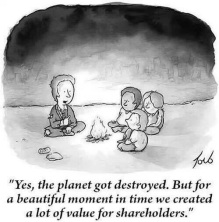
shareholder valueLast week I wrote about killing the goose that lays the golden eggs. It was my way of comparing the Aesop fable to the world of American radio. It got a lot of discussion. But I felt that while I touched on how radio operators twenty years ago wanted to harvest all the golden eggs immediately versus waiting to get one each day, by virtue of a last minute insertion into the Telcom Act of 1996 that basically removed the ownership caps on radio, there was – as Paul Harvey used to intone – ‘the rest of the story’ to be told.

The rest of the story involves “the dumbest idea.” I grew up about a decade after World War Two ended. This was the period when America enjoyed an extended period of economic growth and a shared prosperity. By “shared prosperity” I mean it was a time when the workers who produced a product or service shared in the profits produced by the company. Managers and workers would see their income grow together. As everyone’s pay increased, there was more discretionary income to spend. This was the rise of the middle class in America. All boats were rising with the economic tide.

In 1968, I started on-the-air at one of my hometown radio stations while in the 10th grade in high school. I was paid the minimum wage; $1.60 per hour. Did you know that 1968 was the year when someone making the minimum wage had the most buying power for that rate of pay? The equivalent in 2012 dollars is $10.34 per hour. So what happened?

Somewhere in the 1970s things changed. Firms began to focus on themselves. The productivity gains produced by the workers were no longer shared with the workers. Since no one complained, this new way of doing business continued.

The 1980s really saw this new operational style take hold. And as it did, incomes for the middle class stagnated. When the middle class incomes stop growing, the ramifications on the rest of the economy are magnified. Workers no longer have discretionary income to spend. This was initially covered up by women entering the workforce producing two wage-earner incomes. Then when that ran its course, credit cards, second mortgages would keep the party going under false pretenses.

Today we are in a vicious cycle of decline.

What changed in the 1970s was a new idea about what metric should be used to measure the success of a business. Before this new idea was born, Peter Drucker’s measure was the rule. The purpose of a business, said Drucker, was to create a customer. But that went out with leisure suits, the new crop of business wizards would proclaim. What replaced it was something that even GE’s Jack Welch has called “the dumbest idea in the world.”

What was this dumb idea? Increasing shareholder value.

In an effort to offset declining profits and performance, a new operating modus operandi was conceived that the purpose of a corporation is to maximize shareholder value. To make sure the captains of industry got the message, boards of directors would change their compensation packages to cause these business leaders to focus on increasing the company’s stock price. What could possibly go wrong?

Everything!

The concept was embraced by both America’s business schools as well as industry. Unfortunately, the new policy not only didn’t solve the problem it was supposed to address but by unintended consequences created a myriad of new problems no one foresaw.

Tell me if any of these “unintended consequences” sound familiar to you: short-term decision making, relentless cost cutting, staff reductions (RIFs), less investment in the business, virtually no innovation, low workforce morale, no raises in pay, reduced benefits, non-stop mergers, increased debt, lost ability to compete, declining R.O.I., and economic stagnation. I’m sure you can add to this list based on your own experiences. For a more detailed look at this, you should read Steve Denning’s “Why ‘The System’ Is Rigged And The U.S. Electorate Is Angry,” the inspiration behind today’s blog post.

So twenty years ago, in 1996, President Bill Clinton signed into law the Telcom Act of 1996. This would bring “the dumbest idea in the world” to the radio industry. Wall Street jumped into the new shiny investment opportunity; radio. Everything that every other industry was experiencing from this new operational style was now rearing its ugly head in the broadcasting industry. All with the same negative impacts.

Not all organizations adopted this dumb idea of operating. They stuck with Drucker’s rule. And it’s the same with the radio industry. The smaller radio operations do operate differently. Their success has others sitting up and taking notice.

However, most organizations – and not just in broadcasting – are still in denial. The evaporating middle class is not good for an industry that lives off of advertising. Advertising is pitched to the masses who are the consumers that drive over seventy percent of the American economy. I wrote about the future of ad supported media last year after I read Thomas Piketty’s book “Capital in the 21st Century.” You can read that blog post here.

Based on the tumultuous presidential election season we’ve seen so far, it would appear that the American society has awakened and is now “as mad as hell and not going to take it anymore.” Cue Howard Beal here.

Steve Denning writes: “We are now at an ‘emperor has no clothes’ moment.” It’s now clear that this way is not working and is not only leading to systemic value destruction but an economy that no longer works for the middle class.

If we’ve ever needed real leadership in America, it’s now — and from all directions.
29 Comments

Filed under Education, Mentor, Radio, Sales, Uncategorized

Are We Killing the Golden Goose?

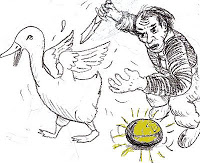
25Do you remember Aesop’s fable of the goose that laid the gold eggs? Let me refresh your memory of this tale. It’s about a farmer that was poor. One day he makes a startling discovery when he finds a golden egg in the nest of his pet goose. Skeptical at first, he has the egg tested and finds that it is indeed made of pure gold. Even more amazing, each day this farmer awakes to find that his goose has laid another golden egg. In very short order, this poor farmer becomes fabulously wealthy. But then his wealth brings greed and impatience. No longer satisfied with just one golden egg per day, the farmer cuts open his goose to harvest all of its golden eggs at once only to find the goose is empty inside. With a now dead goose, there will be no more golden eggs laid.

In remembering this fable, it sounded so familiar to the world of radio broadcasting. A radio station was like a wonderful “goose” that laid daily “golden eggs” for many an owner. It was an industry joke that having an FCC broadcast license was like having a license to print money. It was “golden.”

But broadcasters not wishing to wait for each day’s golden egg, cut open their goose with the Telcom Act of 1996. Twenty years ago, this act deregulated radio and now owners, like the farmer cutting open his goose to get all the eggs at once, now could own as many radio stations as they basically wished.

And how did that work out? Not much better than what the farmer discovered.

The moral of Aesop’s fable is if you focus only on the golden eggs and neglect the goose that lays them, you will soon be without the very asset that produces the golden eggs.

The radio industry’s quest for short-term returns, or results, took their free FCC licenses and ruined them by not maintaining the balance between the production of desired results and the production capacity of the asset.

Aesop’s fable is the very principle of effectiveness. It’s a natural law. Like gravity, you don’t have to believe in it or understand its principles, but you can never escape its effects.

Radio broadcasters probably saw the moral of the fable being the more geese you own, the more spots you add to the hour, the more effective your R.O.I. (Return On Investment) will be. But ironically, it was the principle of “Less Is More” that in the end rules the day.

To be truly effective, you need to maintain the balance of what is produced (golden eggs/revenue) and the producing asset (your goose/radio station).

Stephen Covey wrote extensively about all of this in his book “The Seven Habits of Highly Effective People.”

When people fail to respect the P/PC Balance in their use of physical assets in organizations, they decrease organizational effectiveness and often leave others with dying geese.”

-Stephen Covey

One could certainly make that case for two of America’s largest radio broadcasters today. They are reaping the results of those who’ve gone before them who’ve in essence liquidated the asset, before they took over and now the accounting system appears to show that they are not performing at the level of their predecessors. But is that really the case? Did they in reality inherit a very sick goose when they took over? The debt problem say many who are more schooled in this area of high finance than I, will probably be addressed with a re-set. And once that happens, it will come back to the people of radio.

Covey says to “always treat your employees exactly the way you want them to treat your best customers.” Herb Kelleher at Southwest Airlines built his company on this very Covey principle.

Covey puts it this way: “You can buy a person’s hand, but you can’t buy his heart. His heart is where his enthusiasm, his loyalty is. You can buy his back, but you can buy his brain. That’s where his creativity is, his ingenuity, his resourcefulness.”

The bottom line is the future of radio will be determined by the vision of the people leading the radio industry. It will also be determined by the hiring decisions they make going forward.

“If you hire people just because they can do a job,

they’ll work for your money.

But if you hire people who believe what you believe,

they’ll work for you with blood and sweat and tears.”

-Simon Sinek

13 Comments

Filed under Education, Mentor, Radio, Sales, Uncategorized

Evolve or Lose Relevance

23In two months, the world’s largest radio meeting will once again be taking place in Las Vegas; the 2016 NAB Show. Ironically, since leaving the radio industry and entering academia at Western Kentucky University, I attended my very first NAB show in 2011 and have every year since. So as visions of massive crowds and very sore feet dance in my head, I thought I’d look back over those past years and see how the theme of these meetings has evolved.

In 2011, the NAB highlighted that media consumption had become more digital and connected. TV everywhere strategies, mobile TV, the connected TV and the use of social media dominated the show.

In 2012, everyone was shouting about 4K video, ISP content delivery and the evolution of special effects technology. Everywhere you went you were shown 3DTV (I didn’t care for it, personally.)

In 2013, the NAB show hosted its first ever 2nd screen Sunday and the impact of more than one screen (the television set) vying for the viewer’s attention was fully recognized if not totally embraced by broadcasters.

In 2014, the NAB show wasn’t so much memorable for what it had but for what it didn’t have 3DTV. What had once been prolific throughout all the convention halls was now nowhere to be seen. 4K video & TV was now all the rage with Japan’s NHK demonstrating 8K video & TV. NHK said they will be recording the Rio Olympics in 8K and plans to televise (in Japan only) the 2020 Olympics in 8K. When you see TV pictures this detailed, you can instantly see why 3DTV bit the dust. 4K and 8K feels three dimensional and you don’t need any funky glasses.

Which brings me up to last year’s NAB show in 2015 where the theme was “Evolve or Lose Relevance” voiced by NAB President/CEO Gordon Smith. Smith urged broadcasters to embrace the new technologies like ASTC 3.0 & 4K for TV, and NextRadio’s mobile app for FM radio on mobile devices. Smith also talked about the spectrum auction which begins in March 2016 and characterized the auction as both “exciting and daunting.”

What may have been most daunting and certainly not exciting was to have been an AM broadcaster at this meeting – or any of the meetings of the last five years. Move along guys and gals, there’s nothing for you to see here. HDRadio was there every year and I think they had more cars outside of their convention hall than any previous year featuring their spiffy HDRadios, a technology that has been better embraced by the automakers than radio broadcasters for the most part. And of course, there were drones. Lots & lots & lots & lots of drones. Big drones, little drones…a drone for every size and budget. I’m wondering if the FAA will start coming to these meetings along with their friends from the FCC.

The only thing I haven’t seen addressed over these past five years is what seems to me to be the elephant in the room. Everything is supported on a business model that has been around since commercial broadcasting began in 1920, that being the selling of advertising. The covenant with the consumer of radio/TV programs was we will give you the programming for free if you allow us to expose you to our advertisers; a business model that worked extremely well through the birth of the Internet and dial-up connections. It would be the introduction of broadband and its rapid expansion that would challenge everything.

Blockbuster vs. Netflix is a good example. 2004 Blockbuster has 9,000 stores and almost $6 billion in revenue and only 4.4% of American homes had broadband. Netflix was mailing DVDs to its customers. 2010 Blockbuster files for bankruptcy, 68% of American homes have broadband and Netflix had been streaming to their customers for three years. Today Netflix has a market cap of almost $33 billion.

That really brings home the concept of “evolve or lose relevance” doesn’t it?

So what will the business model for media be evolving to? That’s the billion dollar question. Nobody knows. But what we do know is that Apple gave up its free iTunes music streaming at the end of January 2016 and now will only offer a paid subscription model. Disney’s ESPN is suffering the “agony of defeat” as more consumers cut their cable bundle (for which it’s reported that ESPN gets $7 per sub) and is causing this revenue stream to dry up while the cost of bidding for live sports events continues to escalate. Everything appears to be moving in a direction of asking the consumer to pay for what they want – like they do for HBO, Showtime, and Netflix etc.

So what’s the plan Stan for broadcast radio and TV? Or for any advertising supported medium for that matter? I think about this a lot.

8 Comments

Filed under Education, Mentor, Radio, Sales, Uncategorized

Radio Would Be a Great Business… If It Weren’t For the Employees

21I’m sure the title of this week’s post caught your attention. If you’ve ever been a manager, quite possibly this thought has crossed your mind on more than one occasion. Unfortunately, technology has provided many a radio company the opportunity to give this concept a whirl.

The reality is radio is a people business. Take away the people and do you really have radio anymore?

My best sales people were a pain in the derriere. My best air talents were likewise. And I mean that in the nicest possible way. The fact of the matter is, great talents are always a handful to manage, but they are the engine that creates great radio.

Managing great talent is the art of keeping them from killing one another. Managing great talent is respecting that they are outstanding at what they do and at the same time looking them in the eye and under no uncertain terms letting them know that their talent doesn’t transcend to every other aspect of their life.

Very talented people often think that because they are outstanding in one area, they are in all areas and this is often what leads to their downfall.

Managing great talent is like keeping a nuclear reactor under control. You need to know when to push the control rods in to calm things down and when to pull them out to create a powerful, positive reaction.

Managing great talent will exhaust you. Managing great talent will frustrate you. Managing great talent will challenge you. Managing great talent will be the greatest experience of your life.

I’ve had the honor of running some great radio stations over my radio career and I’ve been fortunate to have worked with some incredibly talented people in every area of radio station operations. I credit my success to them and doing my best to clear the field of obstacles that might prevent them from performing at their highest personal best.

Since I started teaching, I’m finding a similar scenario with students. Great students will get every piece of knowledge they can out of you. They are self-motivated to excel. And yes, they too, can be a handful. But the greatest reward a teacher can experience is having students who want to learn and then apply what they’ve learned to grow and excel at whatever they put their mind too.

Warren Buffett’s “3 Qualities to Look for in Hiring:”

Integrity, Intelligence & Energy.

If you don’t have the first one, the other two will kill you.

To sum it all up, the most important thing any business or school can do is pay attention to how it recruits the people it will work with. You can’t teach attitude. You hire attitude. Everything else can be taught.

Radio is a great business if you will do these three things: 1) focus on hiring great employees, 2) make sure everyone is focused on the same goal and 3) let your people know you really care about them.

Just remember, like a high performance automobile will command a lot of attention, the finest race horses will command a lot of attention, so will high performance talent. Anything that performs at the highest levels of its field will command a lot of attention.

If you like winning, then everything it takes to get there will be worth it.

14 Comments

Filed under Education, Mentor, Radio, Sales, Uncategorized

Jacobs’ Four Questions

15Fred and Paul Jacobs are prolific bloggers; they blog five days a week. Recently, their blog asked four questions about the future of radio. I found them interesting and thought I’d give you my answers to their questions. I’ve provided a link to their original blog post here.
  1. What is radio? I guess I’d have to say my earliest exposure to radio was of the amplitude modulation kind; AM radio. My first radio was a Zenith transistor AM radio with a single earphone. In junior high school, I would build an AM & FM radio station in the basement of my parent’s home and broadcast to my neighborhood. When I went to the FCC field office in Boston to take my FCC license exam when I was in high school the license I would receive said “Radio Telephone Third Class Operator Permit (Restricted Radiotelephone Certificate).” I remember thinking the day I received it, “Why does it say telephone on it?” Nathan Stubblefield, a Kentucky melon farmer and inventor, invented the first radio (many would say). Nathan invented it because he wanted to be able to talk to his wife at home while driving his car. Maybe Nathan and the FCC were just ahead of their time, for today RF goes through the air to our smartphones giving us the ability to send and receive voice, pictures, and data. Today’s pocket computers – smartphones – have synthesized every form of mass communication into a single device. When Apple was putting together the launch of their Beats 1 stream, Zane Low said they spent three months trying to come up with a name to call what they were about to launch. They couldn’t come up with a better name than radio. And that’s what I find teaching at the university. My students basically call everything audio sourced “radio.” Every semester when I poll my students as to what media device they would keep, if they could only keep one, the overwhelming winner is their smartphone. The reason is simple; it allows them to do everything while every other media devices can only do a single application or two. The History Channel did a program on the 100 Best Inventions of all time. Radio was number two. The smartphone was number one. Today’s smartphone is the “transistor radio” of my youth.
  2. What are ratings? I’m a graduate of the Roy H. Williams Wizard Academy and Roy believes that any radio station with about thirty thousand listeners has more than enough to drive business for any advertiser. So what’s the defining measure of a radio station? The quality of the content of its advertising. Ratings were only created for one purpose, to sell advertising. Initially a concept called “applause cards” was used by radio operators. These were simple post cards that could be picked up by consumers at local retailers, filled out, and mailed in. The Association of National Advertisers would hire Archibald Crossley to create a way to discern what people were actually listening to on the radio. Crossley would produce reports from his Cooperative Analysis of Broadcasting (CAB) system. CAB used telephone recall much like Tom Birch did with his Birch Ratings reports. Today, everyone’s hung up on the measurement systems of clicks and clacks of the Internet. Ad Blocking is going to put a real dent into this system that really doesn’t tell advertisers what they wanted to know anyway. The simple fact is no one is measuring what counts. Great creative content gets results and radio needs to invest in employing dedicated copywriters once again.
  3. What is content? I wrote a whole blog post on content that went viral. I won’t re-plow that ground again in this post. If you’d like to read what I wrote, go here.
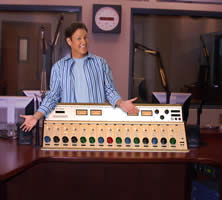
  4. What is in-car entertainment? I remember when buying a car, one of the options was adding a rear speaker to your AM radio for passengers riding in the back seat. Those were simpler times. I’ve lived through every new device that was going to be the death of radio in the car: 8-track tapes, cassette tapes, CB radios, CDs, CD changers, MP3 players, smartphones, streaming audio. Nothing has. However, the new digital dashboards appear to be so complicated, I fear for the folks who could never stop the blinking 12:00 on their VCRs. The new learning curve to find the radio on new cars might be a problem. My Honda Accord has lots of digital components to my entertainment system, but what I love most is Honda left the volume control knob I can turn. Rick Dees loves rotary pots on his control consoles and will not work a board that has slider pots. 19Crank it up means turning a knob. Radio people are going to have to make sure their car dealers demonstrate, or even set-up for their new car customers, how to find and lock in their local radio stations on these new digital dashboards. If the radio listener can easily find their favorite hometown companion, then they will default to what they know and love best. The reason radio has retained over 92% of its listeners is because all those new media devices mostly took out the new media device that came before it. Free over-the-air radio is unique and special. Let’s all work to keep it that way.

And so that’s my take on Fred and Paul Jacobs “Four Questions for Radio.” What are yours? Please share them with me by writing them into the comment section of this blog. I can wait to read what you have to say.

13 Comments

Filed under Education, Mentor, Radio, Sales, Uncategorized

Day of Reckoning

20There’s an old saying “Nothing lasts forever.” Do you remember flying on TWA or Pam Am? How about shopping at Woolworths? Broadcasters will remember names like Group W Westinghouse Broadcasting, or Taft Broadcasting, or Nationwide, or RKO General that would put the successful Bill Drake Top 40 format (with the non-stop innovations & promotions of 93-KHJ’s Ron Jacobs) in major cities across North America. They’re all now a memory.

In a time of limited radio signals, radio could control its inventory and increase stakeholder ROI by raising rates as it increased the size of its audience. That’s now a memory.

Next came the Local Marketing Agreement (LMA) to soak up all those Docket 80-90 FM signals that were squeezed into the FM band but found themselves economically challenged. More signals meant a new way to make more money. That’s now a memory.

LMAs were “training pants” for the Telcom Act of 1996 that would unleash a consolidation of radio and television ownership like the world had never seen. Companies would rush to acquire as many radio signals as they could as fast as they could. And do what with them? They would figure that out later was the common response. Owning more stations was a way to make more money, until it wasn’t. That’s now a memory.

You might have thought that would have sent a message that there are limits. It didn’t.

Today the game is translators. And the number of radio signals continues to grow, all seeking funding through advertising, just like every other form of media out there today.

So is the ad pie growing? Not according to Adam Levy at Motley Fool who saw advertising drop nearly 4 percent in the second quarter of 2015.

When the advertising pie isn’t getting bigger, two things usually happen: 1) budgets get cut and people lose their jobs and 2) more spots are added to the hour. Unfortunately, all through consolidation and the Great Recession radio companies have been doing both. They are like the Federal Reserve wondering what you do when you already have cut the interest rate to zero to stimulate the economy. Not a fun place to be.

Suggested Solutions

 Not to be all doom and gloom on you, I think there are some things that can be done to turn things around. The first thing is to focus on something and own it. Steve Jobs would put it this way “Just get rid of the crappy stuff and focus on the good stuff.” The way Jobs took Apple from near extinction to the world’s most valuable company was by his relentless focus on creating a small number of simple and elegant products.

Seth Godin calls it finding and serving your tribe. Radio needs to give up the quest to be all things to all people and learn to be something some people can’t live without.

Some stations can be the national brand in town, but everyone can’t. Likewise if people can get what you do someplace else, then why do they need you? This is the secret of “less is more.”

Radio stations need to have the agility to make decisions on the front line. Top down management is out, front line management is in. Mary Berner, the new CEO of Cumulus gets it. She has been reported in the trades saying “Cumulus will rely less on top-down management and more on letting managers do the job they were hired for.”  She also understands that while IoT (Internet of Things) is the future, it’s not the place Cumulus needs to focus on today. It’s about changing the culture and the way the company operates first. Getting the programming right and improving sales of those radio programs next.

I remember when I starting working for Clear Channel and hired to turn things around in my market, the company had a big push on selling the web and developing that component. I told my sales manager after the conference call ended that was not going to be the case for us. First we needed to get the programming and radio sales on fire and then – and only then – would we begin tackling our web based program. It worked too.

The hardest thing sometimes is not doing things, but figuring out what to stop doing. Jobs was good at this at Apple. You need to invest some serious thought about what you need to stop doing in your radio property. Again, less IS more if done right.

And the last suggestion I have is directed at colleges and universities. We need to be focused on the business model of radio and putting more of a focus on the business side of radio and radio sales. Radio owners and operators I talk with aren’t clamoring for more DJs or news people like they are for more sales people and innovators that will create the next revenue stream for their property.

In the end, your audience size won’t matter if you don’t have a business model to monetize it.


15 Comments

Filed under Education, Mentor, Radio, Sales, Uncategorized

Have We Been Here Before?

19As the clock was approaching midnight and people were anxiously waiting to ring in the New Year, many others were just anxious over the future of their streaming radio stations. Live365 put out a press release titled “Live365, Internet Streaming Leader, Downsizes and Looks to New Options in 2016.”

What Live365 said was that due to the new Copyright Royalty Board rates for 2016-2020 its small to mid-size Internet broadcasters would now be faced with “prohibitively expensive” fees for legally streaming copyrighted musical content. Live365 also said that it was losing the support of its investors as well, forcing it to significantly reduce staff. Live365’s Director of Broadcasting, Dean Kattari, said “The true value of Live365 lies in its diversity of content – it’s a sanctuary where you can hear music and other content that is so unlike the template broadcasting that is heard on most terrestrial radio. It would be a great loss for this to all go away.”

History doesn’t repeat itself, but it does rhyme. –Mark Twain

 I’m sure that Hugo Gernsback and Hiram Percy Maxim could empathize with the plight of Live365. Back before big business and government created the broadcast system we use today, amateur radio operators controlled the airwaves. It was an open medium allowing individual access, little centralized control, not all that different than the way the Internet began.

Early amateur radio operators had this vision for radio and for more than a decade this was the dominant model for the medium. What ended this form of radio was big business and government coming together and crafting a highly centralized, one-way, restricted-access system that became the broadcasting we know today.

The past actually happened. History is what someone took the time to write down.–A. Whiteney Brown

 Early radio was two-way communication. Learned men were invited to give speeches on important issues of the day. People shared information about their community, as well as reported news, sports and weather. The first disc jockeys were amateur radio operators that played records.

The American Radio Relay League (www.arrl.org) published an editorial in its magazine QST in 1921: “Do you realize that our radio provides about the only way by which an individual can communicate intelligence to another beyond the sound of his own voice without paying tribute to a government or a commercial interest?” Hugo and Hiram were making the case for airwaves that belonged to the public and would be minimally controlled, available to every citizen and allow for the two-way exchange of ideas and communication. Good behavior would be enforced by the community of broadcasters using the medium. This is virtually the same way the Internet was conceived by its innovators.

When businessmen saw a commercial, money-making opportunity in radio, things changed.

I believe that the more you know about the past, the better you are prepared for the future. –Theodore Roosevelt

 Amateur radio would end the way it had been operating in 1922 when big business and the American government implemented new regulations for radio broadcasting that would benefit the business broadcaster. Among the changes were prohibiting amateur radio operators from broadcasting music, talk, weather, news or sports; the very things amateurs pioneered for over a decade of operation.

It is history that teaches us to hope. –Robert E. Lee

 I never knew the radio of Hugo and Hiram. I also missed the “Golden Age” of radio before the introduction of television. I was a child of the transistor, disc jockey, Top 40 era of radio. To me (and many others of my generation) this was radio’s magic moment.

As we approach 2020 and radio’s 100th birthday, the birthday we are celebrating is that of big business radio and not the radio of Hugo Gernsback and Hiram Percy Maxim. I’m sure they would say there’s nothing to celebrate, only morn.

But I would respectfully disagree.

I love the radio I grew up with. I wish it had never changed. But change is life’s only constant.

My broadcast students are in love with the radio they are learning, will soon take over operating, and make their own. They’re also using all the digital tools available to create it.

If radio is to prosper and continue to play a role in the society of tomorrow, it’s important that the next generation be given a chance to innovate the medium.

Understanding the past is an important part of media mentoring the broadcasters of tomorrow.

2 Comments

Filed under Education, Mentor, Radio, Sales, Uncategorized

Looking Back at My 1st Year of Blogging

635867993253266683346579856_blog4Hard to believe I started this blog one year ago. It seems like only yesterday. Ironically, it was Sunday, January 3rd – the same date as today’s date.

Those early days were pretty lean when it came to readership, only a couple of folks to a couple of dozen in those first cold and blustery winter months of 2015. Most blogs – like most diet/exercise programs begun with a new year – last about four months. This blog is celebrating its 1st birthday and its readership has grown dramatically. Thank YOU for being a reader.

 Here were my top 3 most read blog posts of 2015:

We Never Called It Content

Larry Lujack, The Real Don Steele, Robert W. Morgan, Dale Dorman, Ron Lundy, Salty Brine, Bob Steele, and so many, many more. These names I’ve dropped are all no longer on the radio. Terrestrial radio anyway. We radio geeks like to think they are now Rockin’ N Rollin’ the hinges off the pearly gates. https://dicktaylorblog.com/2015/09/06/we-never-called-it-content/

Top 3 In-Demand Radio Jobs

What is the future for jobs in radio in our digitally connected world? Three jobs in particular stand out as being in demand right now and look to be still in demand as radio celebrates its 100th Anniversary in the year 2020. The first won’t surprise anyone, the second is a job that only recently became critical and the third is a job that’s been a part of radio since day one. https://dicktaylorblog.com/2015/02/22/top-3-in-demand-radio-jobs/

Why I Fired My Top Salesperson

My students are always stunned when I tell them about the time I fired my top salesperson. “Why would you do that?” they always ask. Today, I’m going to share that story with you.

In today’s competitive world, top performers are usually cut a little slack. There’s nothing really wrong with that, unless it breaks a culture of honesty, fairness and trust.   https://dicktaylorblog.com/2015/11/01/why-i-fired-my-top-salesperson/

-0-

I learned that my readers, while coming from all over the world, are mainly located in the United States, Canada and United Kingdom. My readership has grown to near 18,000.

Some of the posts I consider to be some of my most insightful you might have missed, the links are posted below:

https://dicktaylorblog.com/2015/03/15/the-future-of-ad-supported-media/

https://dicktaylorblog.com/2015/09/13/is-radio-ready-for-a-black-swan/

https://dicktaylorblog.com/2015/10/25/the-limitations-of-a-spreadsheet/

https://dicktaylorblog.com/2015/04/05/attention-to-detail/

https://dicktaylorblog.com/2015/10/18/how-do-you-measure-employee-performance/

Posts from this blog have been re-published in Tom Taylor’s NOW – Radio’s Daily Management Newsletter, radioINSIGHT, North American Radio Network, Radio Ink, James Cridland’s newsletter, and RAIN among many others (I know I’m leaving some wonderful publications and people out, my apologies in advance). Thank You for sharing my thoughts.

I’ve been invited to appear on Vlogs and podcasts by Owen Murphy, Ryan Wrecker and Larry Gifford as a direct result of my blog. Thank You too.

Next week I will begin a new year of blogging my thoughts about radio, education and the changes each is working through during the communications revolution caused by the Internet of things (IoT).

I hope you will continue to enjoy reading my posts and learning something from what I share. You’re always invited to share your thoughts in the comments section. I learned at the Wharton School that while no one can predict the future, it is amazing when minds come together and share their perspective of what the future holds, how close to what will happen can be revealed.

Let’s grow together in media mentorship.

-0-

Next week, I will take a look at the plight of the small to mid-size Internet streaming broadcasters’ dilemma in light of the Copyright Royal Board’s rates for 2016-2020 and why what’s happening is not new. It’s déjà vu.

4 Comments

Filed under Education, Mentor, Radio, Sales, Uncategorized

Radio – America’s #1 Mass Reach Medium

radio-reaches-245-million-americans-2015-2This was certainly true in the first golden age of radio, that period of time from its birth in 1920 through the mass takeover of television in the 1950s. Once TV came along, radio had to reinvent itself.
 

That reinvention came in the form of Rock ‘N’ Roll, the transistor radio and the car radio. Radio was portable, TV was not. TV took over the living room, but radio took over every other place.


In my life, I’ve lived through every new form of technology that was going to be the death of radio. The 8-track tape, the cassette tape, the CB radio, the CD player, the CD changer, the cell phone, the MP3 player, and most recently, the World Wide Web, Internet streaming and wireless broadband.


So you might be surprised to learn that at the 2015 annual meeting of the Association of National Advertisers Masters of Marketing Conference in Orlando, Florida attendees learned that when it comes to adults 18+, RADIO reaches 93% of them every week. That’s more than TV, more than smart phones, more than PCs and more than tablets.

8

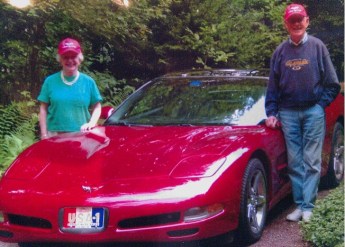
I remember when I got my first GM position. It was a daytime radio station that featured Al Ham’s “Music of YOUR Life” format, big band music for those not familiar with the programming. Yes, my audience was old. But only according to the calendar, but not the way they thought about themselves. Nampa and his corvette

It was always a tough putt with new advertisers, getting across this concept that you are as young as you think. So I wasn’t surprised to learn that one of the sessions talked about “APT.” APT was all about the “Age People Think” not demographics.


I’m not sure that lumping people by demographics was ever a sound marketing idea, but like a lot of bad ideas (buying radio on a Cost Per Point basis) in advertising, people do what’s always been done and ignore if it’s a sound way to place advertising.


A lot of my radio stations over my career have focused on an older demo. When Ken Dychtwald’s book “Age Wave” came out in 1990, I read it with enthusiasm. Dychtwald told of the massive population and cultural shifts that would be taking place because of the Baby Boom Generation. He put forward how the boomers would shift the epicenter of consumer activity from a focus on youth to the needs, challenges, and aspirations of maturing consumers. Those predictions are playing out today.


So again, I wasn’t surprised to read that at the ANA gathering attendees were told that old people were a growth market. In light of the trillion dollars in student loan debt, the millennials are cash challenged in a way that the Boomers are not.


I grew up in a Chevy family. Remember those days of yore? Chevy families and Ford families competing for bragging rights as to which drove the better cars?


Many marketers would have you believe that we are now stuck in a rut with our product choices and only the young are pliable enough to be swayed to try or change brands. So let’s see how that plays out in my family. I have two older brothers; one drives a Honda and the other a Toyota. How about our kids? Well we have a BMW, Mercedes Benz, Hyundai and Honda. In my case, I drove a Hyundai for the past eight years before switching to a Honda Accord; so much for that concept that once you are stuck in a brand, you stay there for life. Even my toothpaste is not the brand I grew up using.


Everything has changed about the world with the exception the way marketing is created and advertising is bought.


One of the big changes is that RADIO is back! It’s the massive reach medium that advertisers seek to expose their products and services on, except that they don’t know it.


Radio needs to use some frequency and repetition to get the word out.


Willie Sutton said he robbed banks because that’s where the money was.


If you’re an advertiser, you need to advertise where the people are and that’s today’s RADIO.

1 Comment

Filed under Education, Mentor, Radio, Sales, Uncategorized

Building Trust

trust-building-big-sizeA couple of weeks ago, I wrote about “Why I Fired My Top Salesperson.” And it all came down to a single reason, trust. I can’t think of one thing a successful leader needs to do more in a business than establish a culture of trust.


Leaders influence people. Trust is the foundation upon which the ability to influence others is built.


Simon Sinek puts it this way: “Being a good leader is like being a good parent. You catch glimmers of hope when you catch them doing something right, but you really don’t know if you’ve done a good job for like 30-years.”


Trust is comprised of two basic components: character and competence. Character means you make decisions that go beyond your own self-interests. Certainly, in firing my top salesperson, that wasn’t going to help my month or quarter. It wasn’t in my own self-interests for the present moment. But knowing that the long-term good of my radio stations was the value I was protecting, and maintaining the trust of the people who I worked with every day, made doing the right thing clear albeit difficult. Competence doesn’t mean having all the answers. Competence means having the experience and knowledge to make decisions that positively impact the performance of the enterprise and the courage to ask for help when you need it. (I always tell people I have an awesome contact file full of brilliant people to call when I need help.)


When your people trust your character and believe in your competence, they will follow you wherever you lead them.


Being a trusted leader is done with love.


I attended Weight Watcher meetings for the first time in my life this year. Like everyone else on the planet I wanted to drop a few pounds, but I also wanted to see if I could pick up any new information about nutrition and living a healthy lifestyle. What I learned was that change occurs by what you consistently do every day. That message was shared by others in the room that had lost lots of weight, all taking the same journey and it was shared with love. Simon Sinek also says when we are surrounded by people who believe what we believe and we feel loved, trust develops.


10,000 Hours


Malcolm Gladwell wrote in his book “The Tipping Point” that it takes about 10,000 hours of practice to get really good at something. You can’t rush trust building anymore than you can rush how long it takes to make a baby. Babies are born when they are good and ready. And you can’t build trust via email, Facebook, Twitter or any other form of modern day communication. You build trust when people come together through human contact. It’s why webinars lose one of the main benefits of seminars, that being people coming together and meeting one another. (Besides, I don’t know about you, but I’m always doing at least two other things when I’m on a webinar.)


Again, when we’re surrounded by people who believe what we believe trust develops.


Be Like Ed Koch


Ed Koch was a three-time mayor of New York City. Mayor Koch was famous for asking people everywhere he went “How Am I Doing?” He got in their faces and asked. Over and over and over; Mayor Koch asked “How Am I Doing?”


You build trust by being consistent.


The best teachers teach by sharing their mistakes and what they learned. People don’t connect with perfection. People connect with people who’ve been there, screwed it up, learned from it and shared the experience. Real courage is being able to share your mistakes with others and like who you are in the process of doing that.


When you reveal yourself in this way, you demonstrate what you believe and value.


In other words, you build trust.

2 Comments

Filed under Education, Mentor, Radio, Sales, Uncategorized