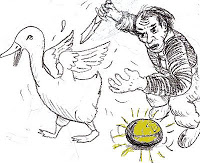
Out, damn’d spot!

28Lady Macbeth says this line in Act 5, scene 1. The line has made for ironic jokes and marketing schemes. The Bard’s lady, where the blood spot becomes dyed into her conscience and where the king and queen persist in imagining that physical actions can root out psychological demons, Shakespeare’s Macbeth is an exposition of how wrong they are.

This all came back to me when I read about former CBS Radio President Dan Mason speaking at Radio Ink’s Hispanic Radio Conference in March about how many radio spots should run in a typical hour of radio programming; his answer was 8 to 10 units. Whereas the typical radio station these days is running 14, 16, 17 (or more) units every hour and Mason says that’s probably too much.

On Twitter Radio Ink tweeted “Is Dan Mason correct? You should be playing 8-10 units per hour.” I tweeted back “YES.” To which Dan Mason tweeted back “@DickTaylor @RadioInk not easy to execute in today’s environment but this is the goal we have to work toward!” And to which I then responded, “@radiodanmason @RadioInk Agreed. No one ever said it would be easy. But moving in this direction needs to be the industry goal.”

Then the next day Radio Ink printed this headline as their lead story “We Would Pay More For Shorter Stopsets,” from ad agency executives Blair Overesch and Jeff Chase of Walz Tetrick Advertising in Kansas City. Their clients include the World Champion Kansas City Royals and Dairy Queen. They bemoan how their clients become lost in long horrible-sounding commercial clusters.

The Birth of the Radio Ad

When the commercial radio was born in 1920 the only way operators of radio stations could figure out to support the expenses that came with running a radio station was by the sale of radio advertising. They copied the model of newspapers and magazines of that time. And here we are almost a hundred years later and nothing has really changed in this business model, except the birth of the Internet. The Internet of Things (IoT) has been the big disruptor of just about every business model.

Look Outside Your Industry for New Ideas

It’s said that Henry Ford came up with the idea of the automobile assembly line when he visited the meat packing plants of Chicago. There he witnessed how cows were disassembled. It was done on a disassembly line. And so the story goes that Ford had an “Ah hah moment.”

Radio needs an “Ah hah moment” when it comes to its business model. But what could it possibly be? Where would we go, as an industry, to find this new business model? Not in the world of ad supported media, that’s for certain.

Casino Gambling & Changing Business Models

Casinos in America started in Nevada in 1931. New Jersey would be the second state in America to legalize casino gambling in 1978. So for almost half a decade, Nevada – Reno & Las Vegas – had a monopoly on this type of gambling activity. New Jersey would also enjoy a boom from casino gambling during the 80s and early 90s as the seaside resort saw a new casino opening up every year. Casinos made money on gambling. Period.

What changed was the wave of states legalizing casino gaming all across America in their search for new revenue sources. Vegas and Atlantic City would find that trying to live off of just gambling handles was quickly eroding. Their business model was being disrupted.

The Most Profitable Resort in Las Vegas

Can you guess which Las Vegas casino makes the most money? It’s not located in the heart of the “The Strip” where thousands of visitors walk by every day. It’s actually Wynn Resorts.

Billions of dollars move through Las Vegas every year. Casino operators do everything they can think of to have visitors gamble away as much of their money as possible while they are in Vegas. But Wynn changed the casino business model for his properties. Steve Wynn decided that with the explosion of casinos across America, he needed to move in a new direction. He needed to become less dependent on high rollers sitting at gaming tables for the bulk of his revenue. Non-gaming activities at Wynn’s Wynn & Encore Casinos account for 67% of the company’s revenues.

Focused On the User Experience

Steve Wynn is totally focused on the visitor or user experience when he builds a casino. He gives his full attention to every detail. This type of focus can be seen in the Bellagio, a casino Steve Wynn built over 16 years ago and has since sold. It’s number two in revenues in Vegas.

Becoming Less Dependent on Advertising

The smart radio operator will take a chapter from Steve Wynn’s playbook and move their stations off of full dependency on the ad supported business model. Steve Price at Townsquare Media appears to be doing just that with ad supported radio at the hub of their strategy. Price said he wants Townsquare to be the largest local digital content business, the largest live event business, and the largest digital marketing services business in their radio markets. Chairman and CEO Steven Price says, “We believe our diversified strategy remains sound, demonstrated by the stability of our local advertising business and the outsized growth in our other businesses.  In addition, we further diversified our business, with approximately half of revenue now derived from sources other than the sale of terrestrial radio advertising.”

Monetizing a Media Company Beyond Advertising

It’s not about throwing the baby out with the bath water. Steve Wynn didn’t abandon gambling. In fact, Steve Wynn makes more money than every other casino operator in Vegas by doing everything just a little bit better than his competitors – both in Vegas as well as elsewhere. He just unhitched his properties from total dependence on gambling revenues. I believe Steve Price is pursuing a similar path as Wynn with his media company. I believe that Townsquare can run 8 to 10 radio ads in an hour and make money. Moreover, make money for his advertisers by putting them in a radio spotlight and increase TSL and audience ratings by making his listeners happy with the proper balance of advertising and entertainment. Done in this way it is a win-win-win.

What’s your plan?

21 Comments

Filed under Education, Mentor, Radio, Sales, Uncategorized

Radio is Going to HAL

22You remember HAL? The HAL 9000 is a fictional character from Arthur C. Clarke’s Space Odyssey series. HAL’s name stood for Heuristically programmed Algorithmic computer. HAL was the future of artificial intelligence. HAL always spoke in a soft, calm voice and in a conversational manner. HAL was born in the 90s according to Clarke.

I remember computerizing my radio station’s traffic and billing system around that same time. Computers would quickly invade every part of my radio station operations. It was scary. I remember looking at that computer box and thinking, if that darn thing “dies” there goes the whole enchilada. It wasn’t like losing a phonograph needle or a cart machine or a CD player. Computers changed the game to an all or nothing model. Computers also introduced another concept foreign to radio broadcasters, planned replacement schedules while they were still fully operational. Radio always used to run every piece of equipment until it could run no more. But you couldn’t play that game with computers.

More Dead Air

Programming great, George Johns, recently posted this thought on his blog: “Is it just me or are there a lot more pauses on the radio now than there was when we were using carts.”   And I wrote back to Geo that I noticed the same thing. I figured it was because today, the people charged with running radio stations are not listening to them. Not because they don’t want to, but because they can’t. They are busy – very busy – multi-tasking.

When computers were introduced into radio, I thought it would be great because it would allow air talent to spend more time working on show prep, interacting with the listeners and being focused on their show and not about cuing up records, pulling carts etc. For small market radio stations, it meant that air talent would have an engineer just like the big city radio stations had always had for their air talent. But that’s not what happened.

The radio industry had a different idea in mind. Computers would allow air talent to do more.

After the Telcom Act of 1996, the radio industry began to rapidly consolidate. General Managers became Market Managers. (GMs usually were charged with overseeing an AM/FM broadcast property. MMs would oversee multiple AMs, FMs and in many cases, multiple markets of AMs & FMs.) Computers were quickly seen as a way to do more with less. More work with less people that is.

Multi-tasking Kills Your Brain

Air personalities now could be on multiple radio stations at the same time. They could multi-task. The unfortunate part of this is research now shows that multi-tasking will kill your brain. Turns out our brains were not built to multi-task.

MIT neuroscientist Earl Miller quoted in Inc. magazine says that our brains are “not wired to multi-task well and when people think they are multi-tasking, they are actually just switching from one task to another very rapidly. And every time they do, there’s a cognitive cost.” This constant switching actually produces bad brain habits. Worse, multi-tasking actually lowers your work quality and your efficiency. It actually lowers a person’s IQ like if you were to skip sleeping or use drugs. So if you wonder why today’s air talent isn’t connecting with listeners like they used to, it really isn’t their fault. The deck has been stacked against them by an industry that is using computers and voice tracking to enable their air talent to multi-task. Multi-tasking is not a skill to add to resume. It’s a bad habit to quit doing.

Computers Change College Radio

Erik O’Brien wrote in an article in Radio Survivor about how automation was introduced into his college radio station and how it changed the way college radio was now done and not for the better in his opinion.

KUTE adopted the ENCO DAD radio automation software. What had been a college radio station comprised of student radio enthusiasts, experimenting, having fun – sometimes producing radio greatness and sometimes not – would turn into a more “professional” operation through the use of computerized software. A radio station that had live radio personalities around the clock could now operate without any DJs.

Everything that goes on the air goes through DAD (Digital Audio Delivery). If it’s not in the computer, it won’t go on-the-air. This standardization now allowed for KUTE to begin monetizing their programming. KUTE had an AM signal, licensed by the FCC, but when the transmitter broke down and there was no money to repair it, it became an online only station. Now it was not subject to FCC rules that embraced a community-driven model of radio. It also could now support advertising that could be scheduled and aired that its non-commercial FCC license did not allow.

The new computerized system meant the station was now stable and standardized and predictable. Except when the computer loaded programs didn’t air and other operator errors would plague the station’s on-air sound. What used to be a fun college experience now was a stressful chore.

The Bottom Line

What it all comes down to, whether we’re talking about college radio or commercial radio, is what value are we offering to our listeners by the technology we employ? What do we want the listener experience to be? If we use technology to allow our air talent to be more focused on the station’s mission, radio will be great but if we use it in other ways, probably not.

9 Comments

Filed under Education, Mentor, Radio, Sales, Uncategorized

Radio Doesn’t Get Any Respect

24I remember the first radio station I worked for doing an experiment with one of their best clients, a men’s clothing store, to prove the power of radio advertising. Back in the 60s the dominant advertising vehicle in my hometown was the newspaper. This clothing store used both radio and newspaper, but felt it was the paper that drove their sales.

What the radio station did was create an imaginary character, a store mascot, using radio’s “theater of the mind.” The plan was to have the store’s clerks ask listeners where they learned about the store’s character when they shopped the store. This imaginary character was only featured in radio advertising.

What shoppers gleefully told the clerks when asked where they learned of their store’s mascot was “in the newspaper.” Virtually no one said they heard about the character on the radio.

What the store learned was how powerful their radio ads really were. What the radio station learned was how BIG the problem was in the perception of the customer as to what influenced their shopping decisions.

Fast-forward to today. Sean Luce moderated a panel at Radio Ink’s Convergence 15 conference in San Jose in May 2015. Sean shared the radio industry’s gross revenue estimates as compiled by Borrell Associates for 2008 ($14.9 billion), projected 2015 ($10.6 billion) and the projected 2019 ($9.5 billion). For an advertising medium that today can claim not only the best advertising frequency for advertiser messages, but now claim to be number one in reach in America too, this is a very disconcerting trend line.

Meanwhile, the online industry’s gross revenue looks like this for the same period of time: 2008 ($12.2 billion), projected 2015 ($50 billion) and the projected 2019 ($94 billion). Yikes!

As Mark Twain remarked, “History doesn’t always repeat itself, but it does rhyme,” I believe what we are seeing is the problem my hometown radio experienced in the 60s only now instead of the newspaper getting all the credit it’s Google or some other online search algorithm or App.

People learn of your product or business over-the-air and then make a mental note to find out more later. They don’t need to remember your phone number (most can’t anyway, so why do radio ads still include them?). They don’t need to remember much of anything but your name. And the next opportunity they have to go online they Google your name to learn more. And Google gets the credit.

Great radio ads will engage the listener, cause them to see themselves doing or using the product or service you envision. Effective ads will stimulate people to know more and they immediately go online and Google you. (Google is now 18 years old. Google dot com was registered in September 1997. It just seems like it’s been around forever.)

Sophisticated advertisers will know what kind of traffic they were getting before they began their radio campaign and when the traffic through online increases they automatically credit your radio station, right? Wrong.

Unfortunately, doing things like “tell them you heard it on WXXX” or “mention this ad and get 10% off” are ineffective because so many variations on these types of Pavlov-type tricks are only confusing and annoying radio listeners.

Radio is intrusive advertising that, used effectively, tells stories, builds brands and makes your business something people will want to go online and search for.

Create radio ads that are unique, like Bud Lite’s “Real Men of Genius” (http://budlight.whipnet.com/) and you will never have to ask if they heard about you on the radio. And maybe that’s the real problem. Radio’s copywriting. It can’t be an afterthought done by your sales reps or one-armed-paperhanging production person who’s banging out spots for multiple stations and the web. Creating great radio commercial content is a specialized skill (don’t try this at home) and done right will not only benefit your advertisers, but your radio station’s TSL and the advertising rates you can charge for your service.

It’s time radio spent as much time worrying about the content of everything that isn’t considered entertainment as it does its personalities, its records, its news/talk programming.

We don’t have a minute to waste.

27 Comments

Filed under Education, Mentor, Radio, Sales, Uncategorized

Dream Along With Me…………………. (My Plan to Save AM Radio)

26I’ve been reading all the opinions about the FCC’s proposal to change the rules regarding America’s 77 Class A (formerly known as clear channel) licensed radio stations. Supposedly, all being done to “revitalize” the AM broadcast band. Like giving AM radio stations an FM translator does nothing to revitalize AM radio listening, neither – in my honest opinion – does this bright idea either.

The FCC’s plan is to allow AM radio stations to retain their daytime power at night, politically correct though it may be the laws of physics play by no such rules. And we don’t have to wonder about the consequences, because to some extent this type of thing has already been initiated with 1,000/250 licensed stations maintaining a full 1,000 watts day and night, and it didn’t work.

First, I don’t have a dog in this fight. So what I’m about to say is not to benefit one side or another. These are my own opinions.

My first GM job was running a daytime 1,000 watt radio station with no pre-sunrise or post-sunset authorization. We signed on with local sunrise (7:15am in the winter) and signed off at local sunset (4:15pm in the winter). I was at my desk before my radio station went on the air about half the year and I remember writing commercial copy for an advertiser I’d sold that day as my radio station was playing the Star Bangle Banner to sign-off for the day.

When that carrier was turned off, WBT from Charlotte, NC would come booming in.

I know the pain of being a small radio operator.

Today, such a radio station has probably obtained a 250-watt FM translator and has its programming appearing on local FM radios in addition to their AM signal. Ever listen to any of these radio stations? I have, when I take road trips. I’m listening to their AM signal but they only identify themselves by their FM dial position.

The History of Clear Channel Signal Radio Stations

The clear channel signal designation goes back to the Radio Act of 1927 and the creation of the Federal Radio Commission (FRC). The FRC immediately went about creating a number of national “clear channel” AM radio stations that would be superior in quality broadcast content and with enough power to be heard over an entire region. Their signal would be on a frequency that would have no competition. Lower power AM radio stations would be relegated to a complex system of frequency sharing.

The FRC was later replaced by the Communications Act of 1934 and the establishment of the Federal Communications Commission (FCC). The FCC was put in place to be the “cops” of the people’s airwaves and protect those airwaves from being misused or interfered with in any way.

Less Is More

The FRC operated under the belief that it would be better for America to have fewer radio stations of higher quality than lots of radio stations that were mediocre.

The FCC, mainly through deregulation, has lost that mission. For broadcasters it meant less oversight – which they didn’t mind – but it also meant that the FCC wasn’t looking out for their interests when it came to policing things that might interfere with the AM broadcast band. You see the FCC regulates (or not) those things that now are the bane of AM radio. Things that, like Mother Nature’s lightning, interfere with AM radio signals – light bulbs, power lines, computers etc.

I Grew Up On AM Radio

By the way, it was lightning’s interference with AM radio that was the impetus for Edwin Howard Armstrong to invent frequency modulation or FM radio. FM is how the audio gets to your TV set.

It was AM radio that I grew up on. It was AM radio that attracted me to a radio career that spanned over forty years. And I believe that AM radio should be preserved, because it is low tech and is the signal most likely to be around after some event that takes out everything digital – which today is just about everything.

However, I also ran a news/talk AM radio station once that people depended on in emergencies and that was the problem. They didn’t think about it any other time. So I’m very aware that to be viable, a radio station needs to program something that people want/need even when there’s no emergency affecting their lives.

How To Save AM Radio

So here’s my “bright idea” to save AM radio. Eliminate Class B, C and D AM radio stations, sign these signals off and let them make their current FM translators their whole radio station. First, they will be able to liquidate the land their AM antenna farm sits on and at the same time reduce their operational costs. They already are identifying by their FM translator’s dial position and local residents have most likely made the switch.

For America’s Class A (formerly known as clear channel class stations), I proposed a HUGE power increase, like to 250,000, 500,000, 750,000 or a million watts for these current 77 stations. I would also propose a study be done of AM radio stations, not currently licensed as Class A being reviewed for such a designation, but with a power of say only 50,000 or 100,000 watts to deal with specific geographies and locations of America.

I’m Not a Radio Engineer (But I’ve Stayed at a Holiday Inn)

There’s simply no way to put the “noise genie” back in the bottle that causes AM radio such grief. My hope would be (and you radio engineers feel free to weigh in here and set me straight) is that by removing a lot of the AM radio clutter caused by other AM radio stations and increasing the power of the few remaining stations, we might cause these stations to be really listenable in more (most?) situations.

I would also regulate these new high power radio stations in the same way that the FRC proposed when they established them. These would be stations that would create original programming. They would be operated by entities that would operate in the public interest, convenience and necessity. They would be a low tech backup in a high tech world. They would have the scarcity of competition that should make them economically viable because of their attractiveness to advertisers. They would tie the country together in the event of a disaster. If a local dominant AM radio station was taken out by a disaster, the other high power stations, not similarly affected would be able to be heard and assist the affected area.

This situation happened years ago in Kentucky when floods put Louisville under water and Nashville’s 650AM-WSM stepped in to provide residents with the information they needed.

AM radio that provides solid information and yes, even entertainment, would get listeners. But even more importantly, it would provide America with a life-line in times of emergencies that digital communications has been shown to fail.

35 Comments

Filed under Education, Mentor, Radio, Sales, Uncategorized

A Little R&R

24I’m away for Spring Break. It’s a chance for me to take a “media fast” and play with my grand kids.
I will be back next Sunday with my plan to save AM radio.

Thank You for your readership of this media mentorship blog.

1 Comment

Filed under Uncategorized

The Day the “Dumbest Idea” Invaded the Radio Industry

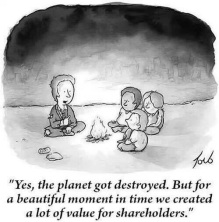
shareholder valueLast week I wrote about killing the goose that lays the golden eggs. It was my way of comparing the Aesop fable to the world of American radio. It got a lot of discussion. But I felt that while I touched on how radio operators twenty years ago wanted to harvest all the golden eggs immediately versus waiting to get one each day, by virtue of a last minute insertion into the Telcom Act of 1996 that basically removed the ownership caps on radio, there was – as Paul Harvey used to intone – ‘the rest of the story’ to be told.

The rest of the story involves “the dumbest idea.” I grew up about a decade after World War Two ended. This was the period when America enjoyed an extended period of economic growth and a shared prosperity. By “shared prosperity” I mean it was a time when the workers who produced a product or service shared in the profits produced by the company. Managers and workers would see their income grow together. As everyone’s pay increased, there was more discretionary income to spend. This was the rise of the middle class in America. All boats were rising with the economic tide.

In 1968, I started on-the-air at one of my hometown radio stations while in the 10th grade in high school. I was paid the minimum wage; $1.60 per hour. Did you know that 1968 was the year when someone making the minimum wage had the most buying power for that rate of pay? The equivalent in 2012 dollars is $10.34 per hour. So what happened?

Somewhere in the 1970s things changed. Firms began to focus on themselves. The productivity gains produced by the workers were no longer shared with the workers. Since no one complained, this new way of doing business continued.

The 1980s really saw this new operational style take hold. And as it did, incomes for the middle class stagnated. When the middle class incomes stop growing, the ramifications on the rest of the economy are magnified. Workers no longer have discretionary income to spend. This was initially covered up by women entering the workforce producing two wage-earner incomes. Then when that ran its course, credit cards, second mortgages would keep the party going under false pretenses.

Today we are in a vicious cycle of decline.

What changed in the 1970s was a new idea about what metric should be used to measure the success of a business. Before this new idea was born, Peter Drucker’s measure was the rule. The purpose of a business, said Drucker, was to create a customer. But that went out with leisure suits, the new crop of business wizards would proclaim. What replaced it was something that even GE’s Jack Welch has called “the dumbest idea in the world.”

What was this dumb idea? Increasing shareholder value.

In an effort to offset declining profits and performance, a new operating modus operandi was conceived that the purpose of a corporation is to maximize shareholder value. To make sure the captains of industry got the message, boards of directors would change their compensation packages to cause these business leaders to focus on increasing the company’s stock price. What could possibly go wrong?

Everything!

The concept was embraced by both America’s business schools as well as industry. Unfortunately, the new policy not only didn’t solve the problem it was supposed to address but by unintended consequences created a myriad of new problems no one foresaw.

Tell me if any of these “unintended consequences” sound familiar to you: short-term decision making, relentless cost cutting, staff reductions (RIFs), less investment in the business, virtually no innovation, low workforce morale, no raises in pay, reduced benefits, non-stop mergers, increased debt, lost ability to compete, declining R.O.I., and economic stagnation. I’m sure you can add to this list based on your own experiences. For a more detailed look at this, you should read Steve Denning’s “Why ‘The System’ Is Rigged And The U.S. Electorate Is Angry,” the inspiration behind today’s blog post.

So twenty years ago, in 1996, President Bill Clinton signed into law the Telcom Act of 1996. This would bring “the dumbest idea in the world” to the radio industry. Wall Street jumped into the new shiny investment opportunity; radio. Everything that every other industry was experiencing from this new operational style was now rearing its ugly head in the broadcasting industry. All with the same negative impacts.

Not all organizations adopted this dumb idea of operating. They stuck with Drucker’s rule. And it’s the same with the radio industry. The smaller radio operations do operate differently. Their success has others sitting up and taking notice.

However, most organizations – and not just in broadcasting – are still in denial. The evaporating middle class is not good for an industry that lives off of advertising. Advertising is pitched to the masses who are the consumers that drive over seventy percent of the American economy. I wrote about the future of ad supported media last year after I read Thomas Piketty’s book “Capital in the 21st Century.” You can read that blog post here.

Based on the tumultuous presidential election season we’ve seen so far, it would appear that the American society has awakened and is now “as mad as hell and not going to take it anymore.” Cue Howard Beal here.

Steve Denning writes: “We are now at an ‘emperor has no clothes’ moment.” It’s now clear that this way is not working and is not only leading to systemic value destruction but an economy that no longer works for the middle class.

If we’ve ever needed real leadership in America, it’s now — and from all directions.

29 Comments

Filed under Education, Mentor, Radio, Sales, Uncategorized

Are We Killing the Golden Goose?

25Do you remember Aesop’s fable of the goose that laid the gold eggs? Let me refresh your memory of this tale. It’s about a farmer that was poor. One day he makes a startling discovery when he finds a golden egg in the nest of his pet goose. Skeptical at first, he has the egg tested and finds that it is indeed made of pure gold. Even more amazing, each day this farmer awakes to find that his goose has laid another golden egg. In very short order, this poor farmer becomes fabulously wealthy. But then his wealth brings greed and impatience. No longer satisfied with just one golden egg per day, the farmer cuts open his goose to harvest all of its golden eggs at once only to find the goose is empty inside. With a now dead goose, there will be no more golden eggs laid.

In remembering this fable, it sounded so familiar to the world of radio broadcasting. A radio station was like a wonderful “goose” that laid daily “golden eggs” for many an owner. It was an industry joke that having an FCC broadcast license was like having a license to print money. It was “golden.”

But broadcasters not wishing to wait for each day’s golden egg, cut open their goose with the Telcom Act of 1996. Twenty years ago, this act deregulated radio and now owners, like the farmer cutting open his goose to get all the eggs at once, now could own as many radio stations as they basically wished.

And how did that work out? Not much better than what the farmer discovered.

The moral of Aesop’s fable is if you focus only on the golden eggs and neglect the goose that lays them, you will soon be without the very asset that produces the golden eggs.

The radio industry’s quest for short-term returns, or results, took their free FCC licenses and ruined them by not maintaining the balance between the production of desired results and the production capacity of the asset.

Aesop’s fable is the very principle of effectiveness. It’s a natural law. Like gravity, you don’t have to believe in it or understand its principles, but you can never escape its effects.

Radio broadcasters probably saw the moral of the fable being the more geese you own, the more spots you add to the hour, the more effective your R.O.I. (Return On Investment) will be. But ironically, it was the principle of “Less Is More” that in the end rules the day.

To be truly effective, you need to maintain the balance of what is produced (golden eggs/revenue) and the producing asset (your goose/radio station).

Stephen Covey wrote extensively about all of this in his book “The Seven Habits of Highly Effective People.”

When people fail to respect the P/PC Balance in their use of physical assets in organizations, they decrease organizational effectiveness and often leave others with dying geese.”

-Stephen Covey

One could certainly make that case for two of America’s largest radio broadcasters today. They are reaping the results of those who’ve gone before them who’ve in essence liquidated the asset, before they took over and now the accounting system appears to show that they are not performing at the level of their predecessors. But is that really the case? Did they in reality inherit a very sick goose when they took over? The debt problem say many who are more schooled in this area of high finance than I, will probably be addressed with a re-set. And once that happens, it will come back to the people of radio.

Covey says to “always treat your employees exactly the way you want them to treat your best customers.” Herb Kelleher at Southwest Airlines built his company on this very Covey principle.

Covey puts it this way: “You can buy a person’s hand, but you can’t buy his heart. His heart is where his enthusiasm, his loyalty is. You can buy his back, but you can buy his brain. That’s where his creativity is, his ingenuity, his resourcefulness.”

The bottom line is the future of radio will be determined by the vision of the people leading the radio industry. It will also be determined by the hiring decisions they make going forward.

“If you hire people just because they can do a job,

they’ll work for your money.

But if you hire people who believe what you believe,

they’ll work for you with blood and sweat and tears.”

-Simon Sinek

13 Comments

Filed under Education, Mentor, Radio, Sales, Uncategorized

Evolve or Lose Relevance

23In two months, the world’s largest radio meeting will once again be taking place in Las Vegas; the 2016 NAB Show. Ironically, since leaving the radio industry and entering academia at Western Kentucky University, I attended my very first NAB show in 2011 and have every year since. So as visions of massive crowds and very sore feet dance in my head, I thought I’d look back over those past years and see how the theme of these meetings has evolved.

In 2011, the NAB highlighted that media consumption had become more digital and connected. TV everywhere strategies, mobile TV, the connected TV and the use of social media dominated the show.

In 2012, everyone was shouting about 4K video, ISP content delivery and the evolution of special effects technology. Everywhere you went you were shown 3DTV (I didn’t care for it, personally.)

In 2013, the NAB show hosted its first ever 2nd screen Sunday and the impact of more than one screen (the television set) vying for the viewer’s attention was fully recognized if not totally embraced by broadcasters.

In 2014, the NAB show wasn’t so much memorable for what it had but for what it didn’t have 3DTV. What had once been prolific throughout all the convention halls was now nowhere to be seen. 4K video & TV was now all the rage with Japan’s NHK demonstrating 8K video & TV. NHK said they will be recording the Rio Olympics in 8K and plans to televise (in Japan only) the 2020 Olympics in 8K. When you see TV pictures this detailed, you can instantly see why 3DTV bit the dust. 4K and 8K feels three dimensional and you don’t need any funky glasses.

Which brings me up to last year’s NAB show in 2015 where the theme was “Evolve or Lose Relevance” voiced by NAB President/CEO Gordon Smith. Smith urged broadcasters to embrace the new technologies like ASTC 3.0 & 4K for TV, and NextRadio’s mobile app for FM radio on mobile devices. Smith also talked about the spectrum auction which begins in March 2016 and characterized the auction as both “exciting and daunting.”

What may have been most daunting and certainly not exciting was to have been an AM broadcaster at this meeting – or any of the meetings of the last five years. Move along guys and gals, there’s nothing for you to see here. HDRadio was there every year and I think they had more cars outside of their convention hall than any previous year featuring their spiffy HDRadios, a technology that has been better embraced by the automakers than radio broadcasters for the most part. And of course, there were drones. Lots & lots & lots & lots of drones. Big drones, little drones…a drone for every size and budget. I’m wondering if the FAA will start coming to these meetings along with their friends from the FCC.

The only thing I haven’t seen addressed over these past five years is what seems to me to be the elephant in the room. Everything is supported on a business model that has been around since commercial broadcasting began in 1920, that being the selling of advertising. The covenant with the consumer of radio/TV programs was we will give you the programming for free if you allow us to expose you to our advertisers; a business model that worked extremely well through the birth of the Internet and dial-up connections. It would be the introduction of broadband and its rapid expansion that would challenge everything.

Blockbuster vs. Netflix is a good example. 2004 Blockbuster has 9,000 stores and almost $6 billion in revenue and only 4.4% of American homes had broadband. Netflix was mailing DVDs to its customers. 2010 Blockbuster files for bankruptcy, 68% of American homes have broadband and Netflix had been streaming to their customers for three years. Today Netflix has a market cap of almost $33 billion.

That really brings home the concept of “evolve or lose relevance” doesn’t it?

So what will the business model for media be evolving to? That’s the billion dollar question. Nobody knows. But what we do know is that Apple gave up its free iTunes music streaming at the end of January 2016 and now will only offer a paid subscription model. Disney’s ESPN is suffering the “agony of defeat” as more consumers cut their cable bundle (for which it’s reported that ESPN gets $7 per sub) and is causing this revenue stream to dry up while the cost of bidding for live sports events continues to escalate. Everything appears to be moving in a direction of asking the consumer to pay for what they want – like they do for HBO, Showtime, and Netflix etc.

So what’s the plan Stan for broadcast radio and TV? Or for any advertising supported medium for that matter? I think about this a lot.

8 Comments

Filed under Education, Mentor, Radio, Sales, Uncategorized

Radio Would Be a Great Business… If It Weren’t For the Employees

21I’m sure the title of this week’s post caught your attention. If you’ve ever been a manager, quite possibly this thought has crossed your mind on more than one occasion. Unfortunately, technology has provided many a radio company the opportunity to give this concept a whirl.

The reality is radio is a people business. Take away the people and do you really have radio anymore?

My best sales people were a pain in the derriere. My best air talents were likewise. And I mean that in the nicest possible way. The fact of the matter is, great talents are always a handful to manage, but they are the engine that creates great radio.

Managing great talent is the art of keeping them from killing one another. Managing great talent is respecting that they are outstanding at what they do and at the same time looking them in the eye and under no uncertain terms letting them know that their talent doesn’t transcend to every other aspect of their life.

Very talented people often think that because they are outstanding in one area, they are in all areas and this is often what leads to their downfall.

Managing great talent is like keeping a nuclear reactor under control. You need to know when to push the control rods in to calm things down and when to pull them out to create a powerful, positive reaction.

Managing great talent will exhaust you. Managing great talent will frustrate you. Managing great talent will challenge you. Managing great talent will be the greatest experience of your life.

I’ve had the honor of running some great radio stations over my radio career and I’ve been fortunate to have worked with some incredibly talented people in every area of radio station operations. I credit my success to them and doing my best to clear the field of obstacles that might prevent them from performing at their highest personal best.

Since I started teaching, I’m finding a similar scenario with students. Great students will get every piece of knowledge they can out of you. They are self-motivated to excel. And yes, they too, can be a handful. But the greatest reward a teacher can experience is having students who want to learn and then apply what they’ve learned to grow and excel at whatever they put their mind too.

Warren Buffett’s “3 Qualities to Look for in Hiring:”

Integrity, Intelligence & Energy.

If you don’t have the first one, the other two will kill you.

To sum it all up, the most important thing any business or school can do is pay attention to how it recruits the people it will work with. You can’t teach attitude. You hire attitude. Everything else can be taught.

Radio is a great business if you will do these three things: 1) focus on hiring great employees, 2) make sure everyone is focused on the same goal and 3) let your people know you really care about them.

Just remember, like a high performance automobile will command a lot of attention, the finest race horses will command a lot of attention, so will high performance talent. Anything that performs at the highest levels of its field will command a lot of attention.

If you like winning, then everything it takes to get there will be worth it.

14 Comments

Filed under Education, Mentor, Radio, Sales, Uncategorized

Jacobs’ Four Questions

15Fred and Paul Jacobs are prolific bloggers; they blog five days a week. Recently, their blog asked four questions about the future of radio. I found them interesting and thought I’d give you my answers to their questions. I’ve provided a link to their original blog post here.
  1. What is radio? I guess I’d have to say my earliest exposure to radio was of the amplitude modulation kind; AM radio. My first radio was a Zenith transistor AM radio with a single earphone. In junior high school, I would build an AM & FM radio station in the basement of my parent’s home and broadcast to my neighborhood. When I went to the FCC field office in Boston to take my FCC license exam when I was in high school the license I would receive said “Radio Telephone Third Class Operator Permit (Restricted Radiotelephone Certificate).” I remember thinking the day I received it, “Why does it say telephone on it?” Nathan Stubblefield, a Kentucky melon farmer and inventor, invented the first radio (many would say). Nathan invented it because he wanted to be able to talk to his wife at home while driving his car. Maybe Nathan and the FCC were just ahead of their time, for today RF goes through the air to our smartphones giving us the ability to send and receive voice, pictures, and data. Today’s pocket computers – smartphones – have synthesized every form of mass communication into a single device. When Apple was putting together the launch of their Beats 1 stream, Zane Low said they spent three months trying to come up with a name to call what they were about to launch. They couldn’t come up with a better name than radio. And that’s what I find teaching at the university. My students basically call everything audio sourced “radio.” Every semester when I poll my students as to what media device they would keep, if they could only keep one, the overwhelming winner is their smartphone. The reason is simple; it allows them to do everything while every other media devices can only do a single application or two. The History Channel did a program on the 100 Best Inventions of all time. Radio was number two. The smartphone was number one. Today’s smartphone is the “transistor radio” of my youth.
  2. What are ratings? I’m a graduate of the Roy H. Williams Wizard Academy and Roy believes that any radio station with about thirty thousand listeners has more than enough to drive business for any advertiser. So what’s the defining measure of a radio station? The quality of the content of its advertising. Ratings were only created for one purpose, to sell advertising. Initially a concept called “applause cards” was used by radio operators. These were simple post cards that could be picked up by consumers at local retailers, filled out, and mailed in. The Association of National Advertisers would hire Archibald Crossley to create a way to discern what people were actually listening to on the radio. Crossley would produce reports from his Cooperative Analysis of Broadcasting (CAB) system. CAB used telephone recall much like Tom Birch did with his Birch Ratings reports. Today, everyone’s hung up on the measurement systems of clicks and clacks of the Internet. Ad Blocking is going to put a real dent into this system that really doesn’t tell advertisers what they wanted to know anyway. The simple fact is no one is measuring what counts. Great creative content gets results and radio needs to invest in employing dedicated copywriters once again.
  3. What is content? I wrote a whole blog post on content that went viral. I won’t re-plow that ground again in this post. If you’d like to read what I wrote, go here.
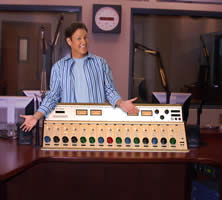
  4. What is in-car entertainment? I remember when buying a car, one of the options was adding a rear speaker to your AM radio for passengers riding in the back seat. Those were simpler times. I’ve lived through every new device that was going to be the death of radio in the car: 8-track tapes, cassette tapes, CB radios, CDs, CD changers, MP3 players, smartphones, streaming audio. Nothing has. However, the new digital dashboards appear to be so complicated, I fear for the folks who could never stop the blinking 12:00 on their VCRs. The new learning curve to find the radio on new cars might be a problem. My Honda Accord has lots of digital components to my entertainment system, but what I love most is Honda left the volume control knob I can turn. Rick Dees loves rotary pots on his control consoles and will not work a board that has slider pots. 19Crank it up means turning a knob. Radio people are going to have to make sure their car dealers demonstrate, or even set-up for their new car customers, how to find and lock in their local radio stations on these new digital dashboards. If the radio listener can easily find their favorite hometown companion, then they will default to what they know and love best. The reason radio has retained over 92% of its listeners is because all those new media devices mostly took out the new media device that came before it. Free over-the-air radio is unique and special. Let’s all work to keep it that way.

And so that’s my take on Fred and Paul Jacobs “Four Questions for Radio.” What are yours? Please share them with me by writing them into the comment section of this blog. I can wait to read what you have to say.

13 Comments

Filed under Education, Mentor, Radio, Sales, Uncategorized