

We have programmatic buying for sales, software for programming music, algorithms that can scrub social media to tell us what people are talking about and computerized spreadsheets that monitor revenues and expenses, making all areas of today’s radio operations fully computerized. Some are even using computers to generate faux air personalities. So, with all of this technology, why isn’t commercial broadcast radio doing better?
There Are Limits to What We Can Engineer
Our world is a messy place. For every rule, there can be a myriad of exceptions, which is usually why our technology crashes.
“To err is human but to really foul things up requires a computer.”
-Paul Ehrlich , American scientist
It’s really time for the radio industry to think less like engineers overseeing technology and more like gardeners who grow and nurture their crops.
Artificial Intelligence (A.I.)
This past week I’ve sat in on two different webinars dealing with A.I. Both of them stressed how important artificial intelligence is right now, in all facets of our daily lives, and how it will only become more so in the days, weeks and months ahead.
Artificial intelligence (A.I.) technology could be bigger
than the advent of fire and electricity for humanity.
– Sundar Pichai, Google CEO
I believe Sundar is right, but with a caveat.
The Human Brain
No matter how much technology accelerates, you and I will continue to move, think and process our day at a human pace. Babies will still take nine months to grow in a mother’s womb, and muscle memory will still require repetition that over time will be able to perform without our brains having to think about it.
Farmers/Gardeners know that when they plant a wheat crop, they won’t see a harvest for 120 days, and if they plant winter wheat, it will take 240 days.
Doing radio, much like gardening, is about nurturing and supporting; whether it be growing its listening audience or growing its revenue.
A Place For A.I. in Radio
Artificial Intelligence has a place in radio, today and in the future, as the winners will employ this technology in a transformative way, to reduce operational costs and increase revenues. The winners will invest in people where the industry connects with other people; air personalities that connect with listeners, and sales people who can connect with advertisers.
Here’s an example of what I’m talking about from Worldcast Systems, a company that designs and develops innovative radio and television broadcasting equipment worldwide:
“ Through A.I., an algorithm is implemented that can adapt the broadcasting power in real time according to different variables of the signal entering the transmitter. With this new technology it’s possible to improve the listening experience for listeners and reduce energy costs by 10 to 40%.”
Using A.I. in this way makes dollars and sense.
“Despite all the innovations, traditional radio seems irreplaceable,” says Issac Moreno, president of the Hybrid Radio Forum.
Elena Selgas Carvjal writes in Telefónica Tech, “Many experts agree that, although Artificial Intelligence and new technologies can bring many improvements and innovations to radio, human presence is, and will always be, fundamental in this media when it comes to connecting and achieving empathy with the listener.”







 A lot of people think that a new decade began in 2020, but the reality is, it’s the last year of the current decade. 2021 begins the next decade.
 If your job can be replaced by a mathematical equation, a logarithm if you will, consider your future employment to be at risk.
 I often wonder if today’s youth would gravitate to the style of radio that attracted me to make radio broadcasting my career for five decades. Would they be attracted to a Dan Ingram, Robert W. Morgan, Dave Maynard, Ron Lundy, The Real Don Steele, Big Ron O’Brien, Larry Lujack or any of the countless other personalities that so influenced me as I was growing up?
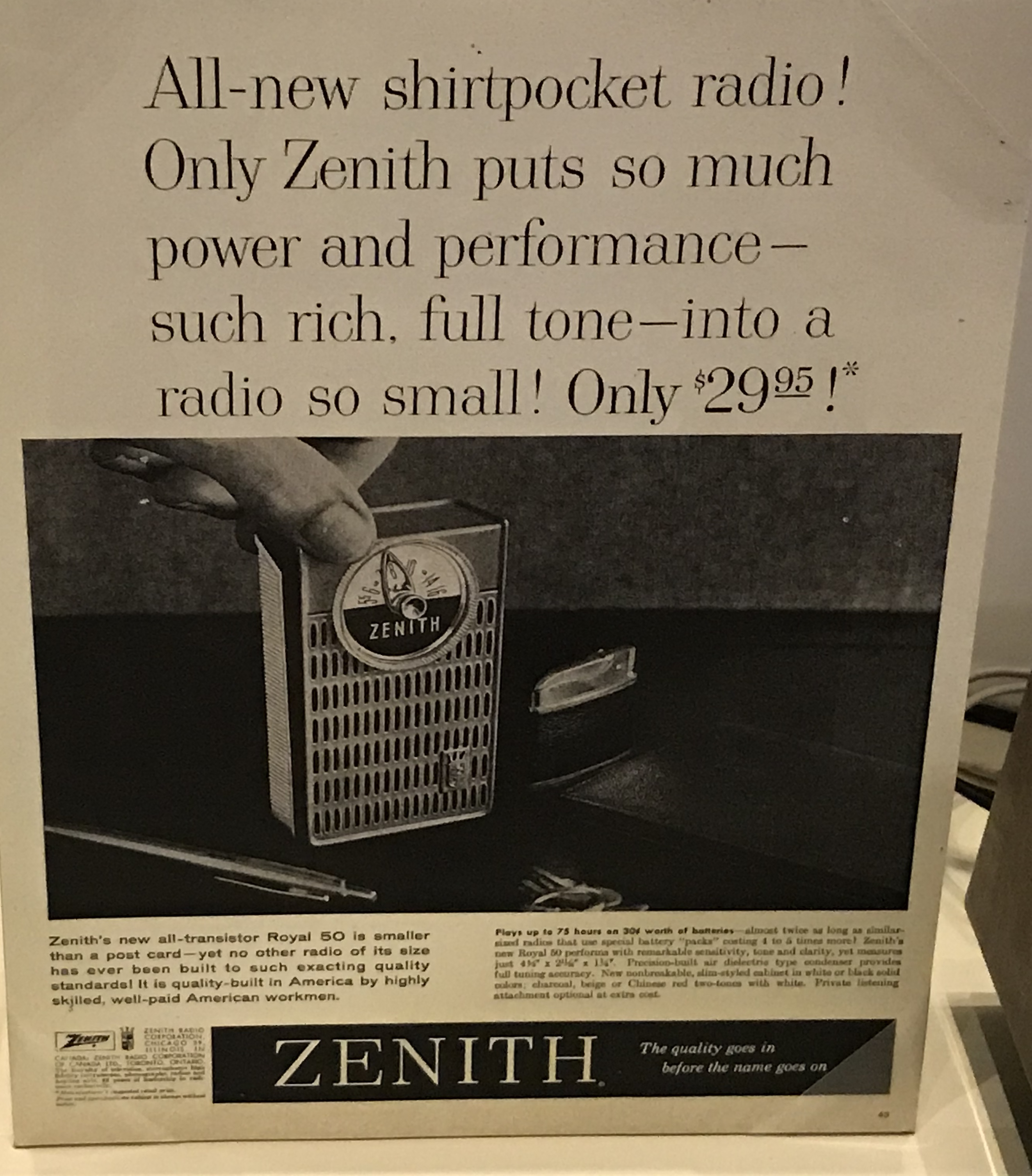 AM radio. Mine was a Zenith Royal 50 that came with an ear phone, that allowed me to listen to the Red Sox while in elementary school or to radio stations from far, far away after it was ‘lights out’ and I was supposed to be asleep.
 That got me to thinking that maybe a new radio format could be created bringing back deceased personalities like Robert W. Morgan, Dan Ingram, The Real Don Steele, Big Ron O’Brien, Ron Lundy, Larry Lujack among other greats by using the power of artificial intelligence. These incomparable radio personalities would “live again” via talented writers and programmers who would tell them what to say. Can you imagine how it might sound?
 DickTaylorBlog