Tag Archives: social media

The Future is ON-DEMAND

I just finished reading the public radio research report “An Audience Growth Strategy for Public Media” prepared by Jacobs Media and Mark Ramsey Media for Maine Public radio service. What really stood out to me was how clearly this report shows where the future is for all traditional linear media.

Linear Is In The Rear-view Mirror

Broadcast radio and television – traditional media – was built on a linear program schedule, delivering to the media consumer, information and entertainment on a schedule determined by the broadcaster. The VCR (video cassette recorder) developed in 1956 became widely available in the late 70s and by the early 2000s was in virtually every American household, giving  television consumers the ability to now watch shows on their schedule, not the program provider’s.

“It is painfully obvious neither broadcast radio nor television is growing, especially as it concerns traditional (terrestrial) usage and linear program schedules,” writes Jacobs/Ramsey.

Today’s Media Consumer

America continues to become more diversified: 72% of Baby Boomers are white but only about half of Millennials are white and four-in-ten of Gen Zs are white.

Millennials were born between 1981 and 1994, so VCRs have always been a part of their life and Gen Zs were born 1995 and 2009, which means also having an iPod type device has always been part of their life. Both of these devices contributed to the habit of having what you want, ON-DEMAND.

In 2007, the iPhone introduced us to a media device that made ON-DEMAND media consumption ubiquitous.

Listening Options

Today’s non-radio listeners have a plethora of media options:

  • Spotify
  • Pandora
  • Apple Music
  • Amazon Music
  • Radio Tunes
  • SiriusXM
  • Podcasts
  • Audio Books
  • YouTube
  • Social Media

…just to name a few.

Jacob/Ramsey says “Linear program schedules common to over-the-air [broadcast] stations are not in alignment with new media consumption habits.” Today’s consumer is in control, not the media provider.

ON-DEMAND Digital

In today’s world, the future is “Go Digital, or Go Home.”

Today’s traditional broadcasters (Radio & TV), must take advantage of digital’s ability to serve their audiences with what they want, when they want it and on the media platform they want it on. The same attention given to over-the-air broadcasts will need to be given to all the other ways of content distribution; as each is of equal importance to the media consumer.

“Broadcast radio and television will remain the core business for years to come, but a focus on traditional media can no longer be considered a growth strategy,” writes Jacobs/Ramsey.

Peacock & Netflix

NBC’s Peacock streaming service paid $100 million dollars to exclusively stream the wild-card playoff game between the Kansas City Chiefs and the Miami Dolphins, setting a record for the most-streamed live event in American history. Comcast Chairman & CEO Brian Roberts considered the streaming gamble a success and a very proud moment for the company, but for consumers it will mean having to pay for playoff games in the future.

This week Netflix announced it had struck a 10-year deal with WWE to air “Monday Night Raw” on its streaming service. This program has been on linear television since 1993; 31-years ago.

Peak Listening On Audio Platforms

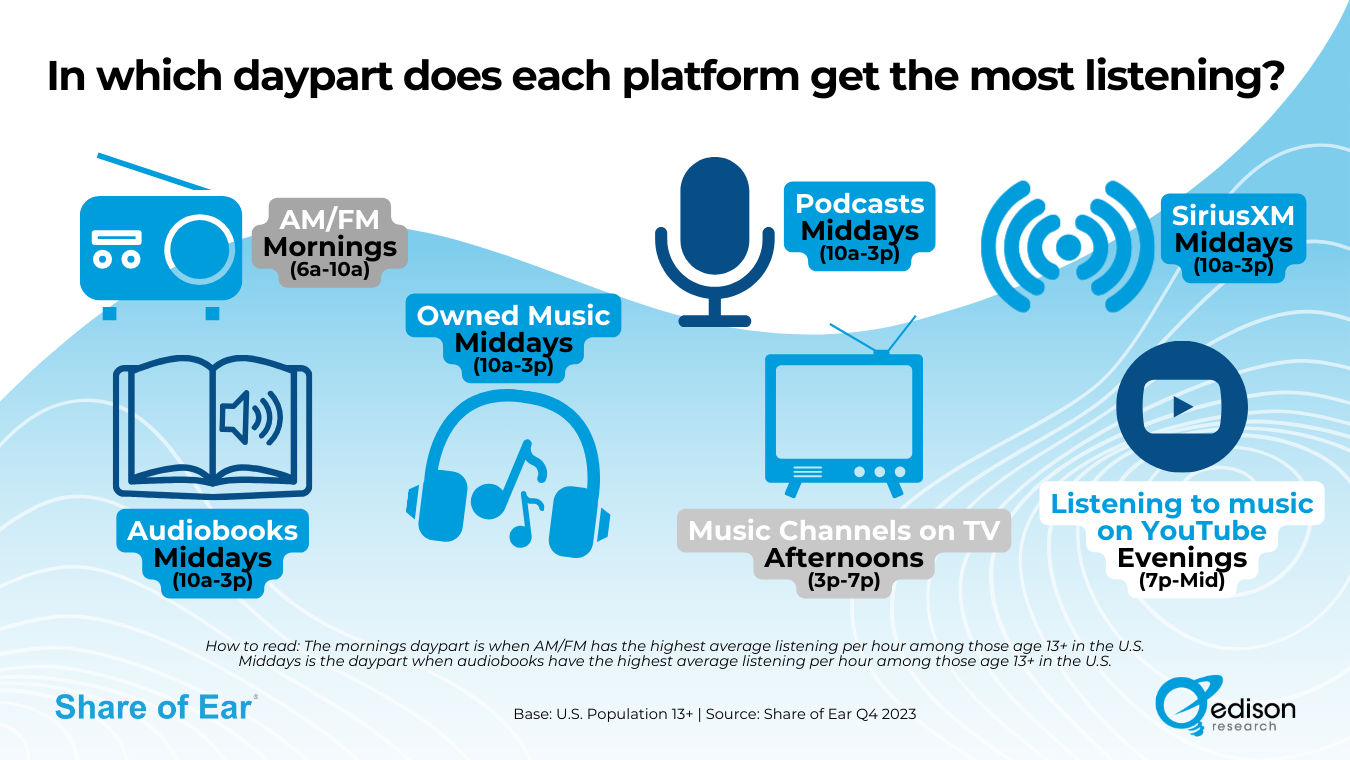
This pat week, when Edison Research published their article on which media platform commands the most listening in different dayparts, it was eye-opening.

The only daypart that broadcast radio commands is morning drive (6-10am), which just happens to be the one daypart the broadcast radio industry still invests in live air personalities. For the rest of the dayparts, consumers utilize streaming audio or previously downloaded content to their media device.

My favorite time to listen to radio growing up was 7pm to midnight. Some of the best known and loved air personalities broadcast during this daypart; Big Ron O’Brien, John Records Landecker, Wolfman Jack, Cousin Brucie among others. However, today the research shows that YouTube is what people listen to at this time of day.

Just before the end of last year, SiriusXM announced the debut of its new streaming App. It offers “discoverability and personalization at the forefront, [so] listeners can quickly and easily find and dive into the content they love across SiriusXM’s 400+ channels and tens of thousands of hours [with] on-demand content and podcasts, [allowing] fans to go deeper into their passions and get closer to their favorite music, artists, personalities and sports; [providing]  a seamless listening experience across streaming devices that reflects listener preferences and interests,  [ensuring] subscribers never miss a moment wherever they are and whenever they want to listen.”

Don’t you wish the NAB (National Association of Broadcasters)

was working on something like this, instead of focusing on linear AM radio?*

*https://www.nab.org/documents/newsroom/pressRelease.asp?id=6916

11 Comments

Filed under Education, Mentor, Radio, Sales

Reviving Radio: Embracing Change for a Brighter Future

Today, I invited Dales Whyte, Business Advisor Enterprise Plus (South Coast Of NSW), Charity Founder & Creator Of Businesses, Community Leader, and International Broadcaster to share his perspective on the state of commercial broadcast radio from his home, Down Under.

-0-

Radio, a medium that has been a source of entertainment, information, and connection for generations, is facing a crossroads. As a radio enthusiast who fell in love with this industry in the late ’70s, it pains me to see its decline. The ghost of radio may linger, but its glory days seem to be fading unless we take action now! I refuse to attend its funeral, and I believe that with the right strategies, we can breathe new life into Radio.

Today, I serve as a business advisor for the New South Wales (NSW) Government, working with small to medium-sized clients daily. Ironically, this role has given me a unique insight into the state of the radio industry in Australia.

I’m not advocating a return to the good old days of the ’70s, ’80s, ’90s, and yesteryear’s hits. Instead, I’m championing the use of modern technology and techniques to rejuvenate the industry. The future of radio lies not only in its past but also in its present.

One strategy I often recommend to my clients is reverse engineering the sales process to better serve and adapt their businesses. Radio must apply the same principle to secure its future. We need to focus on two key client bases crucial for our survival.

1.         The Customer:

•          The customer is not just the listener but also the one who pays the bills, keeping the radio station afloat.

•          While streamlining operations and adopting network-centric models can save money, we must not sacrifice localism. If we do that then the customers advertising will be impacted by not having the number of listeners to act on the message of the commercial stop

•          Balancing cost-saving measures with local touch is essential to keep our customers satisfied and our revenue strong.

2.         The Radio Listener:

•          Listeners are the lifeblood of radio. We must provide them with content that meets their needs, wants, and desires.

•          Local radio plays a vital role in informing communities about local events and news, making it an invaluable resource.

•          We need to address the growing disconnect between what listeners want and what we deliver.

 To revive the radio industry, we must consider the following strategies:

1.         Embrace Social Media:

•          Radio has traditionally shied away from social media, but it’s time to change. Social media can enhance the connection between listeners, customers, and radio stations. We have to be the leaders in social media in our marketplaces.

•          Utilize platforms like Facebook, LinkedIn, and Instagram to engage with the audience and expand reach.

•          Use social media for the coverage of events. Radio must now return to the days of turning up to every dog and pony show.

2.         Live Streaming:

•          To cater to today’s audience, we must offer live streaming of radio shows.

•          Interact with the audience in real-time during shows and engage them through video and audio content.

3.         Invest in Talent:

•          Radio’s success hinges on having the best talent in the industry. Not just announcers but for the entire radio station.

•          Encourage people to pursue careers in radio by providing opportunities and training. I have long advocated that nights and mid dawns should be utilised as training/sessions to create a true radio school.

Shared Responsibility: The responsibility for radio’s survival falls on all stakeholders in the industry.

1.         Announcers:

•          Announcers should consider their role as being a dedicated professional, not just a job.

•          They should stay informed about local events, engage with the community, and embrace localism. Announces need to embrace localism!

•          Never miss an opportunity to localise or interact with the community.

2.         Sales Teams:

  • Sales teams should focus on creating successful advertising campaigns that truly benefit clients.
  • The quick sale mentality must be replaced with a client-focused approach.
  • Members of the sales team have to be individual advertising agents understanding and utilising skills in conjunction with creative writers to achieve outstanding results for radio customers,

3.         Station Staff:

•          Every member of the station’s staff plays a critical role in its success.

•          The friendliness and engagement of receptionists, for example, can leave a lasting impression on visitors.

4.         Managers:

•          Managers should lead the way by encouraging new ideas and a change in business practices.

•          Regular positive meetings and staff collaboration are essential for radio station success.

5.         Owners:

•          Owners must be willing to embrace change and enforce ethics in the industry. People must feel safe in their job and part of a living breathing team that is growing and won’t replace them at the drop of a hat.

•          A long-term approach is needed to ensure financial success and maintain radio’s relevance.

Conclusion: The radio industry is at a pivotal moment. We can choose to let it fade into history, or we can take action to revive it. By embracing change, focusing on the needs of both customers and listeners, and using modern technology, radio can continue to be a vibrant and essential part of our lives. It’s time to write a new chapter for radio, one that ensures its survival and success for years to come.

-Dales Whyte

Empowering businesses along the picturesque South Coast of New South Wales as a dedicated Business Advisor under the Enterprise Plus / Business Connect program, I also take pride in my role as a philanthropist, founding charities and nurturing innovative enterprises. As a community leader, I strive to foster growth and collaboration, creating a positive impact locally and beyond. Additionally, my voice extends globally as an international broadcaster, sharing insights and stories that resonate across borders. Together, let’s build a thriving and interconnected world.

16 Comments

Filed under Education, Mentor, Radio, Sales

Follow The Media Money

You’ve probably heard the catch phrase, “follow the money,” first popularized in the movie about the Watergate scandal, that detailed the work of Washington Post reporters Bob Woodward and Carl Bernstein.

Since the 1970s, “follow the money” has seen extensive use by investigative journalists, and that’s what the most recent Borrell webinar looked at for 2023 with respect to media advertising dollars.

Media Spending Forecast

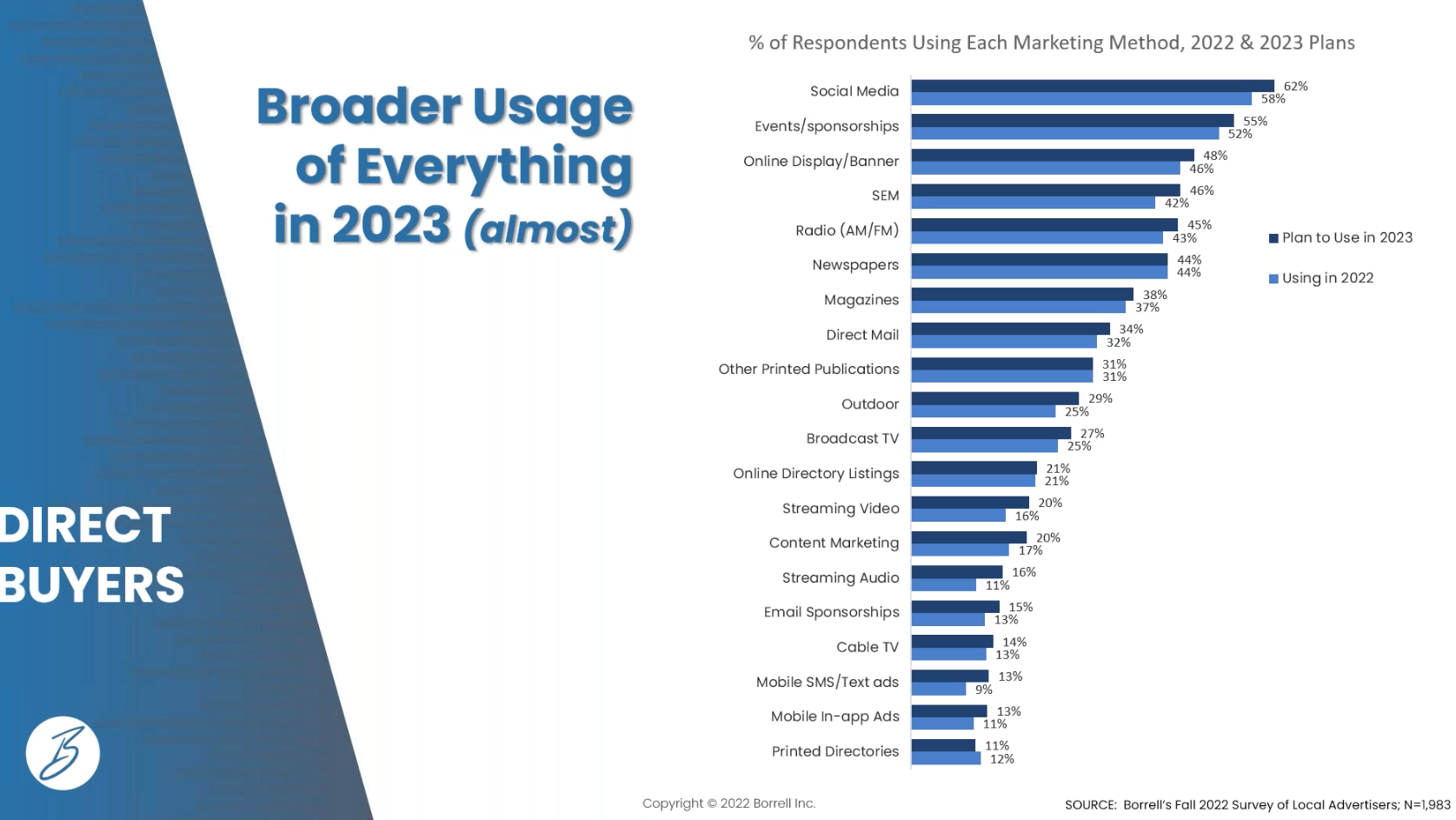
On November 29th Gordon Borrell and Corey Elliott presented Borrell’s Fall 2022 Fall Survey of Local Ad Agencies. Here’s how I interpreted the information they shared starting with the Top 5 types of media that agencies said their clients are planning to invest more money into next year, and also the 5 they will be cutting:

            Investing More $$$                Planning to Eliminate

            Streaming Video                     Printed Directories

            Social Media                           Newspapers

            Search Engine Marketing        Other Printed Publications

            Streaming Audio                     Magazines

            Website Ads                            Cable TV

At first blush, things don’t look so rosy for print media, however, wrapped into that media category “Website Ads” are the digital versions of newspapers and magazines, to name just two.

I’ve been a digital subscriber to the Washington Post newspaper for a couple of years now and I also read Atlantic Magazine digitally.

When it comes to radio, the number of advertisers who say they will buy more radio ads about equals the number who say they will buy less. In other words, broadcast radio advertising looks to be treading water in 2023.

High Usage, High Effectiveness

When it came to what types of media direct buyers say are the best, we find five of them:

  • Social Media
  • Search Engine Marketing
  • Events
  • Banner Ads
  • Radio

OTT, Streaming Audio & ???

During the webinar I asked the following question:

“Streaming video is called Over-The-Top (OTT),

podcasts & other digital audio is called Streaming Audio,

what are digital newspapers and magazines called?”

Turns out the answer was both newspapers and magazines are included in the media category “Banner Ads” in this research.

So, while advertisers may not be interested in those paper and ink publications, they are interested in their digital products, and their digital offerings compete for the same ad dollars as broadcast radio and TV.

Broadcast TV was rated higher in effectiveness than radio by advertisers, but saw lower usage as one can assume it was most likely due to the cost of television advertising.

Streaming Audio

You can’t help to look at the high interest in “Streaming Audio” and not wonder why it doesn’t command more advertising dollars. Corey Elliott said the answer to this question of why they weren’t spending more ad dollars on streaming audio was simply that “no one pitched them.”

Search Engine Marketing #1

For direct buyers of advertising, Gordon Borrell pointed out that “for the first time in 13 years of surveying, broadcast TV doesn’t occupy the top spending spot, falling to roughly half of what it was in prior surveys.”

What beat broadcast TV was “Search Engine Marketing.”

Search Engine Marketing is a form of Internet marketing that involves

the promotion of websites by increasing their visibility

in search engine results pages primarily through paid advertising.

-Wikipedia

In 2023, DIGITAL will account for $7 of every $10 spent on local advertising and 45% of local ad buyers will purchase their advertising from fewer than 3 media companies.

2023 is forecast to see broader usage of virtually everything.

The media companies that are positioned to enjoy success in 2023, are:

  1. The companies that have invested in training and retaining their sales people in the area of all things digital, and
  2. Focused their company to deliver media products consumers want and enjoy on every digital media platform.

Leave a comment

Filed under Education, Mentor, Radio, Sales

HD Radio – The Answer to the Question No One Was Asking

I was reading about how HD Radio was celebrating its 15th birthday recently and that had me scratching my head as HD Radio is older than that. In checking the records, I saw that the Federal Communications Commission selected HD Radio as America’s digital standard in 2002. By comparison, Steve Jobs introduced Apple’s iPod in October 2001, XM Satellite Radio began service in 2001 and Sirius Satellite Radio in 2002.

Radios Go High-Definition

This was the headline that appeared in the Baltimore Sun on January 7, 2004. Unfortunately, unlike HDTV (High Definition Television) HD Radio never stood for “High Definition.” And possibly that was the first mistake. HD Radio was simply a name they chose for the digital radio technology, but even today, many people still think it means “High Definition” or “Hybrid Digital.”

Sadly, by 2004, America’s digital radio was late to the party and if the industry is now marking the date of 2006 as its moment of birth, it was really late!

Remembering 2006

In 2006, Facebook opened up its social network to everyone in the world. The original requirement that you be a college student enrolled at a specific university was eliminated and the only requirement now was that you were over the age of 13 and had a valid email address.

In just 15-years, Facebook has grown to over 2.85 billion active monthly users.

Let’s look at what else was born in 2006 that competes for our attention:

  • Twitter was launched in 2006 and today enjoys 199 million monetizable daily active users.
  • Wii game system was introduced with its handheld motion controller that got families off the couch and in motion doing all kinds of sports in front of the TV.
  • PlayStation 3 came online to provide strong competition to XBOX 360. (Video gamers spent about eight hours and 27 minutes each week playing games, which is an increase of 14% over 2020. The video gaming industry predicts revenues of $100.56 billion by 2024)
  • Google bought YouTube in 2006 and now has over 2 billion users, the channel grosses over $19.7 billion in revenue and users are uploading videos at the rate of 500 videos per minute with over a billion hours/day spent watching videos on the platform.
  • The one billionth song was purchased from Apple’s iTunes, the dominate source for music lovers in 2006. (Two years later Spotify would arrive and not only disrupt how music was sold but how it was listened to in general.)

When we look at 2006, it becomes easier to understand why HD Radio wasn’t such a big deal to the average media consumer.

Solving a Problem That Didn’t Exist

What HD Radio did for FM radio stations was solve a problem that listeners to FM didn’t feel existed. No one who listened to FM radio was complaining about the quality of the sound, they were complaining about other things, like too many commercials. And for AM radio stations, it meant people buying radios for a service that didn’t offer anything they really wanted to hear or couldn’t get elsewhere. AM radio was now the service of senior citizens who already owned AM radios, who grew up with AM radio’s characteristics and whose hearing was not the best now anyway. So, HD Radio for AM wasn’t anything they were asking for and worse, AM radio stations that put on the new digital signal found it lacked the benefits of skywave and often interfered with other company AM radio stations as the industry quickly consolidated radio ownership.

Industries Most Disrupted By Digital

In March 2016, an article published by Rhys Grossman in the Harvard Business Review listed “Media” as the most disrupted by the growing digital economy. Turns out, if you’re a business-to-consumer business, you’re first being most disrupted by digital. The barriers to be a media company used to be huge, but in a digital world they are not, meaning that the business model that media companies depend on has not adapted well to the digital economy.

Elephant in the Room

But the elephant in the room remains the broken media business model. Newspapers, magazines, radio, and television – any media that is ad supported – will be challenged to find a way to capture revenue to continue operating.

Walt Disney famously said “We don’t make movies to make money, we make money to make movies.”

Broadcasters of my generation had that same attitude about creating great radio.

Do the people owning and operating today’s radio stations still embrace that concept?

* In 2021, it’s estimated there are 3.78 billion social media users worldwide.

8 Comments

Filed under Education, Mentor, Radio, Sales

Can Algorithms Be Fair?

A while back, I wrote a blog article about “The Fairness Doctrine.” After the January 6th siege on Capitol Hill, many people began wondering if this policy, originally enacted by the Federal Communications Commission (FCC) in 1949, but then eliminated under President Ronald Reagan, should be re-instated.  

To review, this doctrine required the holder of a broadcast license to both present controversial issues of public importance, and to present these issues in a manner that was honest, equitable, fair and balanced.

In other words, broadcasters were supposed to not only uncover what the people in their broadcast service area should be aware of, but also to present both sides of the issue.

The Fairness Doctrine only applied to radio and television licensees and no other form of media. Even if it was still in place today, it wouldn’t have applied to Facebook, Snapchat, Twitter, Instagram or any other forms of non-broadcast communication. The problem with social media is that what we read, see, and hear is all controlled by algorithms.

The Challenge of Controlling Algorithms

Unlike most innovations that human beings have designed, algorithms are not static and easily defined. You can’t say that one algorithm is good and the other is evil. They are like a living organism, in that they can learn, adapt and change over time.

Cornell University online behavior scholar, J. Nathan Matias, put it this way:

“If you buy a car from Pennsylvania and drive it to Connecticut, you know that it will work the same way in both places. And when someone else takes the driver’s seat, the engine is going to do what it always did.”

With an algorithm, it changes with each human behavior it comes in contact with and that’s what makes trying to regulate it, from a government standpoint, such a challenge.

Broadcast radio and television was an unknown when it appeared, and government was challenged to regulate it. It used as a model, the regulations that had been developed to oversee America’s railroads. In fact, that’s where the concept of requiring radio and TV stations to operate in the “public interest, convenience and/or necessity” comes from. It’s also why no one has ever been exactly sure of what this phrase actually means when it comes to broadcast regulation.  

Closing the Barn Door

The old saying “It’s too late to close the barn door, once the horse is gone,” might be the type of problem facing regulators trying to bring fairness to today’s internet dominated world.

The European Union’s first go at trying to regulate Google Shopping, demonstrated how the slow moving wheels of justice are no match for the high speed technology of today. By the time regulators issued their decision, the technology in question had become irrelevant.

20th Century Solutions Don’t Work on 21st Century Problems

We all learned in school how America’s Justice Department, and in some cases individual states, broke up monopolies in oil and the railroads. Historically, what government was trying to do was breakup price-setting cartels, and lower prices for consumers. But with entities like Facebook and Google, no one pays to use their service; it’s free!

Promising Technology or Dystopian Reality?

When commercial radio was born a hundred years ago, it was greeted with the same exuberance that the internet was and people thought radio would connect people, end wars and bring about world peace.

Then American radio would give a voice to Father Charles Coughlin, a Detroit priest who eventually turned against American democracy itself through his nationwide radio broadcasts, opening the door for the FCC’s Fairness Doctrine coming into regulatory existence.

A Collaborative Solution

Media regulation in the 21st Century with algorithms that act like living organisms maybe should be regulated in the same way we protect our environment.

As an example, how would you go about improving a polluted river?

“To improve the ecology around a river, it isn’t enough to simply regulate companies’ pollution. Nor will it help to just break up the polluting companies. You need to think about how the river is used by citizens—what sort of residential buildings are constructed along the banks, what is transported up and down the river—and the fish that swim in the water. Fishermen, yachtsmen, ecologists, property developers, and area residents all need a say. Apply that metaphor to the online world: Politicians, citizen-scientists, activists, and ordinary people will all have to work together to co-govern a technology whose impact is dependent on everyone’s behavior, and that will be as integral to our lives and our economies as rivers once were to the emergence of early civilizations.”

-Anne Applebaum and Peter Pomerantsev, The Atlantic, “How to Put Out Democracy’s Dumpster Fire

Now you know why bringing back “The Fairness Doctrine” will not work in a communications world controlled by algorithms.

We need to think differently.

Albert Einstein said it best,

“We cannot solve our problems with the same thinking we used when we created them.”

6 Comments

Filed under Education, Mentor, Radio, Sales

Only Change is Here to Stay

Every night, the music of Enya lulls us off to dreamland. One of our favorite songs is “The Humming.” A line from that song is “only change is here to stay.”

I’ve often written in this blog about the only constant in life is change, and that if you’re not changing your life for the better, you’re changing it for the worse, for nothing stays the same. Nothing.

Changes in Communication

Watching the Ken Burns documentary on “Country Music” it was very clear the important role that radio played in spreading the popularity of this musical genre. But that was then, today the smartphone is at the center of everyone’s life.

Smartphones

The latest from Edison Research now says that 88% of Americans over the age of 12 own and use a smartphone; 250 million, to be exact.

The wireless phone companies will tell you that today we use our smartphones primarily for data. Edison Research tells us that 82% of Americans are now active on social media platforms, the top three being Facebook, Instagram and Twitter.

Smart Speakers

While 32% of homes in the U.S. don’t have a single AM/FM radio in them, 47% now have a smart speaker.

Today, 193 million Americans – or 68%  of adults 12 years of age and older – digitally consume audio using one of these smart devices.

Car Radio

AM/FM radio’s last place of dominance is the vehicle dashboard. WFH (Work From Home) eliminated the need to commute for a lot of people, thereby causing them to spend less time with traditional radio in their cars.

McKinsey Global Institute says at least 20% of people currently in the WFH mode won’t ever be returning to an office after the pandemic ends. Just as alarming for radio station owners is the recent report by Edison Research that shows the percentage of people who listen to audio on their smartphone in their cars is now at 50%.

“We’re recovering to a different economy.”

-Jerome H. Powell, Federal Reserve Chairman

ZOOM

Before COVID-19, we already were doing video conferencing and phone calls on platforms like Go To Meeting, Face Time, WebX, or Skype. But then the world was shut down by a novel coronavirus and it was ZOOM that suddenly became the dominant platform for teaching school, conducting government, running our courts, attending church, working from home, celebrating our weddings and birthdays, and just about everything else we used to do in person.  

ZOOM is the best example of how fast our world changed when COVID-19 struck.

How did ZOOM do it? By investing the time to know what their video conferencing customer wanted, knowing it better than anyone else and then delivering it best when the critical moment – a global pandemic – arrived.

“Spend a lot of time talking to customers face-to-face. You’d be amazed how many companies don’t listen to their customers.”

– H. Ross Perot

Your listeners are changing, your advertisers are changing, your world is changing. So, you’d better be listening carefully to understand how you must change to be relevant to their wants, needs and desires.

Because as Enya sings “only change is here to stay.”

Leave a comment

Filed under Education, Mentor, Radio, Sales

Why Make Radio Advertising Harder to Buy?

The headline in Radio Ink proclaimed, “No More Free Ride For Non-Subscribers.” It was a news story about how Nielsen Audio was no longer going to provide buyers with any data pertaining to non-subscribing radio stations through their ratings service.  It will be as if these radio stations vanished from their markets.

Ratings Gathering Costs Money

I can understand the perspective of both Nielsen Audio subscribers, as well as Nielsen itself as an audience ratings provider. If there weren’t subscribers there would be no money to pay Nielsen to gather this data in the first place. Subscribers don’t wish to see those radio companies not paying and then enjoying the benefits of data gathered. Likewise, Nielsen wants to be able to garner the biggest bang for their ratings gathering dollar by trying to force all radio operators to be a participant in the process.

So, on the surface, why would anyone object to this change coming in January 2021?

Winners & Losers

The reality is that even if everyone pays to have access to the data, only the very top performing radio stations will enjoy the benefits. Stations placing out of the top five or ten– often any station not rated number one or number two – will be paying for data that in the end only helps the market’s “big dawgs.” For many stations, it’s paying big money for nothing.

Nielsen vs. Eastlan

In those markets where both Nielsen and Eastlan measure radio listening, we see all the stations in the Eastlan report’s cover page giving a total radio listening perspective for that  market, but with a Nielsen Audio report, we only see subscribing stations. In 2014, Nielsen ceased reporting non-subscribing radio stations from the “topline” numbers it provides to the radio trade publications and newspapers.

For anyone who grew up in radio, having radio stations that are impactful in their market not be listed seems sacrosanct; like not seeing 650AM WSM appear in the ratings for Nashville. When this became Nielsen’s policy, I stopped looking at their ratings reports, since I knew they were incomplete and I’m sure I’m not alone.

Eastlan Ratings, on the other hand, includes every radio station in their topline numbers in every market they do audience measurement. However, if anyone wanted to drill down the data to a more granular level, then they would need to subscribe to the report, and that seems fair.

Of these two radio ratings companies, I find Eastlan’s philosophy to be more valuable to the radio industry and the selling of radio advertising.

Subscriber First

Nielsen is calling their new policy “Subscriber First.” But will the result be a positive for Nielsen subscribers if it makes radio advertising more difficult for people to buy?

Radio ratings are, after all, only estimates. Estimates of what people ages 6 and older are listening to on their radios, smartphones and other audio devices.

Unlike my subscription to Netflix, Amazon Prime, PBS, or The Washington Post, where I am actually counted as paying for a service that I receive, radio ratings are attempting to estimate listening based on a small sample of people, and then extrapolate those results as the habits of an entire marketplace population.

Radio listening estimates  are not perfect, and as a radio manager, some of my radio stations have taken a “ratings bullet” and seen a precipitous drop in reported listening, even when nothing in the market changed to cause such a drop. History taught me that patience was in order and that things would return in the next ratings period; which they always did.

Radio Station Owners vs. Radio Advertising Buyers

It’s radio’s buyers who really want to know who’s listening to what, and when, and for how long etc. And it appears that radio buyers, as a group, are none too pleased with this change in ratings reporting. I’m reading quotes like “as a long-time client, not being consulted before a final decision was made is quite troubling,” and “ we feel like we will no longer be receiving the data we originally contracted for – a full view of radio listening in measured markets.”

Radio station owners, on the other hand, feel that non-subscribing radio stations should not have anyone know the true impact their radio station is having in a measured market. Those stations should be made to “pay to play,” or simply disappear.

Customer Friendly?

It seems like the timing of this change could not come at a worse time for the radio industry. With so much of its business impacted by COVID-19, making radio’s reach more transparent instead of opaque should be the order of the day.

I’ve read that Nielsen estimates two thirds of its agency subscribers won’t have access to any data regarding non-subscribing radio stations. Might these agencies just also cease being subscribers to radio ratings? Is this really the direction we want things to head in?

I think not.

Nielsen’s change, from my vantage point, will potentially reduce the level of confidence buyers will have about buying radio advertising. It’s a path of erosion that could negatively impact the entire radio industry.

The Better Advertising Mousetrap

Ralph Waldo Emerson is said to have coined the phrase: “Build a better mousetrap, and the world will beat a path to your door.” When it comes to advertising, social media has built the better mousetrap, and you and I are helping them to improve it every day.

I wrote a blog article on social media’s ability to manipulate our attention, wants and desires for the benefit of their advertisers. It should give any radio broadcaster pause. You can read that article HERE

The reality is, today the internet is a more efficient way to sell our attention to advertisers.

When radio makes buying the medium more difficult, buyers have other choices, and once they invest more heavily in them, they may never return.

“There are only two industries that call their customers ‘users’:

illegal drugs and software.”

-Edward Tufte

14 Comments

Filed under Uncategorized

The Biggest Threat to Local Radio

The latest survey from the RTDNA (Radio Television Digital News Association) shows how precarious the advertising revenue stream that sustains your local radio station is during these global pandemic times.

Of 350 radio managers surveyed, declining revenues were cited by almost 40% of them as the biggest threat to their continued existence.  

Ad Market Recovery Coming in 2021

We’re a little over six months into a global shutdown caused by a novel coronavirus, that is expected to impact our world directly for almost two years, and have lasting impacts that may stay with us for the rest of our lives. It could be very tenuous for local radio stations to be able to survive until a recovery starts sometime in 2021.

As you can see, MAGNA sees most of the recovery occurring with online videos, mobile, social media and search. Traditional media like radio, print and local TV will still find themselves in the fight of their lives.

Last week, I wrote about “The Better Advertising Mousetrap” and how, due to the internet, combined with powerful computers and algorithms, social media was able to sell advertisers, “certainty.” I wrote how the internet had created a new marketplace, that of human futures, at scale, and this was producing trillions of dollars for these internet companies, making them the richest companies in the history of humanity. The real advantage social media has over traditional media is their development of persuasive technology that exploits a vulnerability in human psychology, which even when you know how it works doesn’t inoculate you from its power to change you.

You can read that article HERE

Other Threats to Radio

Radio people, both past and present, bemoan how corporate cuts and consolidation have cut deep into the industry’s ability to innovate its programming. Also, the plethora of media options available to today’s radio listener is overwhelming, especially with the advent of the smart speaker and audio streaming.

Expect that growth in advertising will be in the digital realm, while traditional media like AM/FM radio and TV, barely stabilize.

Gordon Borrell and his associates concur with this outlook in their latest sneak peak of their research.

Social Media

Hootsuite and Altimeter just published their latest report titled: “The Social Transformation.” In it, they say “executives often underestimate social’s economic, cultural, and transformational value. Understanding the true value and potential of social media has become more imperative as organizations look for new possibilities in the post-pandemic economy.”

  • 77% of CEOs report digital transformation efforts have significantly accelerated
  • 70% of CEOs are prioritizing changes to customer behavior as the most important factor setting their future direction (Source: Deloitte)

This report lists three main areas that businesses need to focus on to truly realize the value of social media:

  1. Learn how to tap into social media’s unique ability to develop and deepen relationships across multiple stakeholders.
  2. Realize and extend social media’s ability to drive efficiency and value beyond marketing and communications.
  3. Leverage social media’s existing organizational structure and processes to catalyze digital transformation.

Radio personalities were the industry’s “secret sauce” that help local radio to build deep relationships with its listening audience. Likewise, tenured sales people built similar relationships with local radio advertisers. Sadly, both areas of the business have seen a Reduction In Force (RIFs) that has severed these important relationships forever. Into that vacuum has come social media and its addictive powers to build strong relationships with its users.

Deep Relationships Require Sustain Engagement

The report also reveals that respondents (64%) using social media have found it helps their business to build strong relationships with their customers. Through in-depth interviews, Hootsuite and Altimeter found that “relationships develop with sustained engagements that lead to conversations across multiple channels, not just on social media.”

Holding All the Aces

Traditional media is looking down the barrel of an advertising juggernaut. It’s hard to win when your opponent is holding all the aces.

In 50-years of working in the radio industry, not one of my favorite radio stations knows anything about me. After just 10-years on social media, there’s virtually nothing that these companies don’t know about me.

See the problem?

6 Comments

Filed under Uncategorized

The Better Advertising Mousetrap

Ralph Waldo Emerson is said to have coined the phrase: “Build a better mousetrap, and the world will beat a path to your door.” When it comes to advertising, social media has built the better mousetrap, and you and I are helping them to improve it every day.

The Social Dilemma

There’s a new documentary on Netflix called “The Social Dilemma” about how social media is impacting our lives, and is truly eye-opening. I encourage you to watch this documentary if you subscribe to Netflix, but especially if you’re in advertising and marketing. In fact, it would pay you to subscribe to Netflix just to view this documentary; it’s that important!

This blog won’t be about many of the important social issues raised in the documentary, but instead I plan to focus on how traditional media, like AM/FM radio broadcasting, is fighting a battle for advertising with the internet companies that isn’t a fair fight. Broadcasters are in essence coming to a gun fight, wielding a knife.

This shouldn’t come as a surprise to regular readers of my blog, because back on February 25, 2018, I wrote an article titled “Radio Has an Addiction Problem,” that quoted MIT professor Sherry Turkle’s 1995 book “Life on the Screen, Identity in the Age of the Internet” saying “computers don’t just do things for us, they do things to us, including ways we think about ourselves and other people.” Turkle said that computers weren’t just a tool, but were sneaking into our minds and changing our relationship with the world around us.

Monetizing Social Media

Social media quickly realized that in order to sustain itself it needed to monetize its service. Google’s search engine business was a Silicon Valley marvel for not only harnessing the power of the internet but simultaneously building a revenue engine that grew right along with it. Tim Kendall, now CEO of Moment, was one of the early people at Facebook, charged with coming up with a way to make money. He said that he decided that the “advertising model was the most elegant way.”

Advertising

The advertising business has always been about selling exposure to the people who use the product. Newspapers sold access to its readers, radio sold access to its listeners and television sold access to its viewers.

“Half the money I spend on advertising is wasted;

the trouble is, I don’t know which half.”

-John Wanamaker

Businesses have always wanted to get the biggest bang for their advertising buck, but realized that in the world of advertising, there were no guarantees, that is until social media came along. Mel Karmazin, former broadcasting and satellite radio CEO put it this way when he met with the founders of Google: “You’re messing with the magic of sales.”

Jaron Lanier, who wrote the book “Ten Arguments for Deleting Your Social Media Accounts Right Now,” explains that what social media is doing more effectively than traditional media is “changing what you do, how you think and who you are…it’s a gradual, slight, imperceptible change in your behavior and perception.” It’s similar to a magician performing slight-of-hand tricks, and making you believe things that aren’t real.

“This is what every business has always dreamt of, to have a guarantee that if it places an ad it will be successful. That’s (social media’s) business, they sell certainty. In order to be successful in that business you have to have great predictions. Great predictions begin with one imperative, you need a lot of data.

The internet has given us a new kind of marketplace that never existed before, a marketplace that trades exclusively in human futures. Just like there are markets for pork belly futures, or oil futures, we now have markets that trade in human futures, at scale, and those markets have produced the trillions of dollars that have made the internet companies the richest companies in the history of humanity.”

-Shoshana Zuboff, PhD, Harvard Business School

Author of “The Age of Surveillance Capitalism”

“Any sufficiently advanced technology

is indistinguishable from magic.”

-Arthur C. Clarke

Getting Your Attention

Every company whose business model is to sustain itself through the selling of advertising is competing with other companies for your attention. Traditional media is competing with every social media company to get as much of your time and attention to their platform as they possibly can. Remember, when you’re not paying for the product, you are the product.

The advantage social media has over traditional media is their development of persuasive technology. It’s designed to intentionally apply to the extreme behavior modification in the user, and cause them to take a desired action. It does this through the use of positive intermittent reinforcement, just like a casino slot machine lures you into thinking the next pull of the handle will release its fortune. Social media works to create an unconscious habit, programming you for a deeper level of control than you even realize is happening.

Social media has learned how to exploit a vulnerability in human psychology, which even when you know how it works doesn’t inoculate you from its power to change you.

No longer is social media a tool we use, but is a tool that uses us, creating this technology based environment designed for mental addiction through psychological manipulation.

“There are only two industries that call their customers ‘users’:

illegal drugs and software.”

-Edward Tufte

Most concerning about this change is that it’s being driven by a technology that’s advancing exponentially. In contrast, our human brain has not really advanced at all over the same period of time. The rate of change is beyond our human comprehension, even for the very people who are designing and building these computer networks.

“The race to keep people’s attention by social media isn’t going away. Our technology is going to become more integrated into our lives, not less. The AI’s (artificial intelligence) are going to get better at predicting what keeps us on the screen.

How do you wake up from the matrix when you don’t know you’re in the matrix?”

-Tristan Harris, Center for Humane Technology Co-Founder

“Whether it is to be utopia or oblivion

will be a touch-and-go relay race

right up to the final moment…”

-Buckminster Fuller

Today, the internet is a more efficient way to sell our attention to advertisers.

Now you know why.

16 Comments

Filed under Uncategorized

Where Have All the Baby Boomers Gone?

Baby BoomerBill Thomas, a media and branding idea expert and broadcast & radio veteran (@BillThomas), shared a link on Twitter to an Ad Week article about three brands that bought ads in Super Bowl 54, targeting the 50+ demo. It’s not surprising, as the author of the article points out, that this is the age group that is most active and ready to spend online. Any guess on what the three brands are, that were targeting this Baby Boomer age group? Do you think it was iHeartMedia, Cumulus, and Entercom? Stay tuned.

Citizen Insight Academy

The City of Winchester holds a Citizen Insight Academy annually, and I signed my wife Sue and I up for the 2020 edition. We’re only nine weeks into this 16-week program and Citizen Insight Academyit’s been illuminating learning about our city and the way it operates. The other evening, we had a session with the city’s Emergency Management and E-911 departments.

You can imagine my reaction when the head of the E-911 department began her talk with “People don’t listen to the radio anymore, but they’re really into social media.” She went on to say how she grew up listening to the radio but how other forms of communication, like social media, have replaced that habit. Much like smartphones have replaced people’s landline telephones.

She told us that most calls into the city’s 911 switchboard come from wireless phones versus landlines. The percentage was something like 75% wireless to 25% landline. I myself have been a cellphone only household for over a decade, and our class of 35 had only about four people who still have a landline.

Traditional Radio Stations Have Lost Faith of Listeners

If I thought our city’s 911 Director was tough on radio, the BBC’s head of radio and education, recently said “Radio as we’ve always known it, has lost the faith of listeners.” He explained that “where once it was everything, now it is not. In fact, for many listeners, it is no longer their default.”

BBC Chief

BBC Radio Chief, James Purnell

In 1920, when commercial radio service began in America, you were lucky if you had a single choice for wireless communication. In many localities, you might have only had radio service after sunset via the AM skywave phenomena.

As more radio stations came on the air, Americans began to develop a radio habit. Radio listening was something we did while working, riding in the car or while we were at play. It provided the audio accompaniment to our lives. But everything’s changed. Now radio stations need to create an experience that earns a place in someone’s day.

NuVoodoo on Media Addictions

I wasn’t surprised to see NuVoodoo releasing some data from their latest research that shows all age groups today are addicted to their Smartphones. But what caught my eye was how Millennials, Gen X and Gen Z groups were more addicted to a favorite FM or AM radio station than Baby Boomers.

NuVoodoo Addiction to Media 2020

Which got me to thinking, why were the very people who grew up with radio and few other choices, be the age group least engaged with the medium today?

Boomers Know Great Radio When They Hear It

Real Don Stelle

The Real Don Steele

Baby Boomers grew up during a time when great radio personalities dominated the airwaves. Broadcasters like Harry Harrison, Robert W. Morgan, Larry Lujack, Dan Ingram, The Real Don Steele, Ron Lundy and so many more filled our lives with information, entertainment, community and companionship. It was a time when radio stations had local news teams, great promotions, exciting radio jingles, stationality and air personalities. Personalities, so important in our lives that we wanted to meet them more than the recording artists that created the music they played.

Radio for Baby Boomers isn’t like that anymore, so they’re moving on.

The boomer generation now embraces smartphones, smart speakers and social media with a vengeance, taking all their dollars to spend right along with them. Baby Boomers hold around 70% of the disposable income in the United States and they make up 50% of sales for all consumer package goods.

The Big Three

So, who were the media companies that want to gain a larger share of the 50+ demo? The ones that know that Baby Boomers are the most active and ready to spend their dollars online?

Google, Amazon and Facebook, that’s who.Facebook Amazon Google Logos

Facebook advertised during a Super Bowl television broadcast for the very first time in 2020. They hired as pitchmen, Chris Rock (54) and Sylvester Stallone (73). Both men are iconic celebrities and are part of this powerful consumer demographic, the 50+ audience.

Meanwhile, radio continues to jettison the very people that connects them with their local audience, the radio personality.

7 Comments

Filed under Education, Mentor, Radio, Sales