Tag Archives: National Association of Broadcasters

Radio’s Most Pressing Issues

This past week, Radio/TV state broadcast associations were in our nation’s capital meeting with their elected representatives in both the House and Senate about issues that are important to them. It’s the annual National Association of Broadcasters (NAB) State Leadership Conference.

More than 500 radio broadcasters from across America assembled to hear Senator Ted Cruz (R-TX) speak on his support of the “AM Radio for Every Vehicle Act,” and advocating for a level playing field in the advertising market.

Cruz is the new Chairman of the Senate Commerce Committee and he pledged a proactive approach to support broadcasters, create jobs and uphold free speech.

Free Speech

Brendan Carr is the new Chairman of the Federal Communications Commission (FCC) and in only a couple of weeks, since taking this leadership position, his actions have caught the attention of some members of Congress, who were alarmed by recent moves impacting broadcasters.

Representative Jerold Nadler (D-NY) expressed his concern over the Carr’s FCC assault on a media organization’s free speech.

“Exploiting his asserted ‘unitary executive’ powers, [President] Trump is unleashing his sycophant FCC Chairman, Brendan Carr, on every newsgroup whose news stories he does not approve of — actually threatening to pull the broadcast licenses for ABC, CBS, NBC, PBS, and NPR,” said Rep. Jamie Raskin (D-MD). “Is this North Korea?”

The President of Free Press Action, Craig Aaron, in testimony said that threats and opening investigations into broadcast outlets by the FCC is out of the norm.

“The FCC usually talks about licenses on very narrow terms, such as if an owner has committed a major crime,” Aaron said. “The idea that a news organization would be threatened because they asked a tough question of the President, or because they tried to fact check him during a debate, or because they edited their own news content before putting it out over the airwaves is preposterous, and it’s dangerous.”

DEI

Diversity, Equity and Inclusion (DEI) has been terminated by Carr at the FCC and he’s been signaling that the agency might go after FCC licensees over their own DEI programs.

Are DEI programs good for business? Apple’s shareholders think so, so do Costco shareholders, and Hyundai’s marketing executive, Erik Thomas, credits its DEI programs with driving the automobile manufacturer’s bottom line.

SiriusXM

Nine years ago I wrote an article with a title that sounded like click bait titled “SiriusXM Radio is Now Free,” which speculated when the FCC licensed satellite broadcaster would start offering ad-supported channels for free.

Four years later, I wrote that “Could 2021 Be the Year SiriusXM Adds FREE Channels?” speculating that new SiriusXM CEO, Jennifer Witz, would be pursuing revenue growth by  leveraging the 132 million cars the service was available in. SiriusXM, like commercial radio over-the-air (OTA) broadcasters, knows that the competition for listener ears is in the car. The advantage the satellite broadcaster has over AM/FM radio operators is they know exactly what their listeners are listening to, and don’t have to rely on audience estimates that may or may not be accurate in today’s media saturated world.

Last year, what I have been predicting since 2016, became a reality, as I wrote in:  “Ad-Supported SiriusXM Requires No Paid Subscription.”

Monopoly

One of the radio industry’s most respected researchers, Dr. Ed Cohen, wrote “The direct-to-consumer satellite radio business is a monopoly,” shortly after my 3rd article on this subject was published. Originally, the FCC offered only two satellite broadcast licenses, one went to a company called “Sirius” and the other to a company called “XM,” with the idea being they would be competitors and that the consumer would benefit by not having a single company – a monopoly – control satellite radio and what it could charge.

The two companies were supposed to never be able to merge, but in August of 2008, by a 3 to 2 vote of the FCC, that changed. Dr. Cohen does a really good deep dive into explaining how this all came about in his article “SiriusXM and the FCC: Is the Camel’s Nose Under the Tent?” Which is an allusion to a story that takes place in Arabia, with this metaphorical moral:

If the camel once gets his nose in the tent, his body will soon follow.

What the FCC never took into consideration was, how much damage might occur to local AM/FM radio stations, if and when, the new combined SiriusXM ever decided to provide an ad-supported free radio service.

Dr. Cohen believes that while this new free service from SiriusXM is limited in scope, like the proverbial camel, it won’t be long before the whole service becomes real competition for audio listeners and advertisers.

People Love Free

AM Radio vs SiriusXM

Dr. Cohen makes an excellent case for commercial radio broadcasters to be demanding, the FCC revisit the SiriusXM merger decision in light of this change by the satellite broadcaster.

By the way, public broadcasters also have a horse in this race, as NPR Now is part of the new free SiriusXM service.

“While the NAB is busy with getting Congress to force OEMs (Original Equipment Manufacturers) to include AM in every vehicle, the battle with SiriusXM’s ad-supported venture is probably more important to the industry in the long run,” says Dr. Cohen.

It’s The Economy Stupid

But the most important issue facing the commercial radio industry are the financial fears that have been generated by the Trump tariffs and fire hose of government regulatory changes that seem to come at us on an hourly basis. I wrote about this concern in February with an article titled “The Cost of Uncertainty to Radio.”

Now BIA Advisory Services this week updated its local advertising revenue forecast for 2025. Cameron Coats, in Radio Ink, reports that “over-the-air revenue [for radio] takes the largest hit, falling by 6%.” Digital radio, says Coats, shows a slight increase of 0.1%.

SiriusXM has enjoyed growth through the sale of new cars, but with the high tariffs Trump has announced, it wouldn’t be a surprise if people hang onto their current vehicles a little longer, which also means that AM radio will still be accessible. Without an economic downturn, the average life of a car in America is 12-years, up from 8.4-years in 1995. Progressive Insurance says that a well-maintained car will reach 300,000 or more miles, and those cars have both AM/FM radios as well as SiriusXM.

The radio industry’s most pressing issue is who wins in the car, and in that arena AM radio – a hundred year old medium is not our industry’s best play –

stopping satellite radio’s FREE ad-supported service is.

When the pie isn’t growing,

the game becomes who can cut the biggest slice.

5 Comments

Filed under Uncategorized

I Propose the “Speedometers in Every Car Act”

When my wife Sue & I are driving, locally or on one of our road trips, we’ve noticed that drivers have no idea how fast they’re going. Speed Limit signs are no longer even considered a suggested “speed limit,” but more like something that should be considered a minimum speed.

Speedometers

In 1902, German engineer Otto Schulze patented the speedometer and Oldsmobile would be the first American car company to factory install them into their vehicles. However, speedometers were originally considered an option, that owners could buy.

It wasn’t until 1910 that speedometers started becoming standard equipment in American automobiles.

How to Become a Road Hazard

If you really want to put your life in jeopardy, try traveling the posted speed limit. We have, and there’s not a single vehicle that will follow us. NOT ONE.

The Drive Rite Academy says: Speed limit signs serve as a guide for drivers to maintain a safe and appropriate speed, based on the type of road, traffic, and environmental conditions. They are designed to protect both drivers and pedestrians by reducing the risk of accidents and ensuring smooth traffic flow.

            KEY POINTS:

  • The number on the sign represents the maximum speed you’re legally allowed to drive, under ideal driving conditions.
  • Ideal driving conditions include clear weather, dry roads, and low traffic.
  • It’s important to note that the posted speed limit is NOT a target speed. Drivers should adjust their speed based on traffic and weather conditions, even if it means driving below the posted limit.

Does Your Car Have a Speedometer?

The question posed at the beginning of this section is rhetorical. Every vehicle built and sold for use on our highways and byways in America comes equipped with a speedometer, but we’re beginning to wonder if today’s drivers know how to use them.

Speed Limit signs are the law on our roadways.

Once upon a time, Americans believed no one was above the law. But those days are now in the rearview mirror. 99% of today’s drivers believe that speed limit signs don’t apply to them.

And don’t get me started on drivers who don’t come to a full-stop at STOP SIGNS.

AM Radio

It’s why I chuckle when the National Association of Broadcasters (NAB) will try again in the 119th Congress to pass their “AM Radio in Every Vehicle Act.”

Personally, I believe, it’s more important that every vehicle come equipped with an FM radio, as that’s what the majority of Americans use – if they listen to broadcast radio at all.

Just Because…

Just because a vehicle has an AM radio – or speedometer for that matter – doesn’t mean anyone will use them for their safety, or that of their passengers.

I rest my case.

9 Comments

Filed under Education, Mentor, Radio

Best of the Blog 2024

2024 marked my 10th year of writing this blog, and while I reduced the number of articles I would write this year to focus more on faith, family and friends, here are the Top 5 Most Read articles from the past year.

To date, 508 articles have been published over the decade since the blog began, with over 314,215 views from folks around the world; maybe you missed them or perhaps you’d like to read them again.

Most Read Article of 2024

In 2016, Winchester, Virginia’s WINC AM/FM celebrated its 75th anniversary; eight years later this historic radio station and its 37-year morning man, Barry Lee, would be “Gone in a WINK.

As the radio industry continues to eliminate radio personalities that have become a part of the fabric of the communities they broadcast to, this story about the end of one local radio station resonated with readers.

Second Most Read Article of 20214

How important is it to have AM radio in cars, if the majority of the people on the roads don’t listen to any AM radio stations, with the subject of “Use It or Lose It.”

While I became attracted to a career in broadcasting due to AM radio and even had the opportunity to be an air personality on “The Air Castle of the South, 650AM-WSM” the reality in the 21st Century is that AM radio is the past and digital is the future.

Third Most Read Article of 2024

In the 1970s, listening to FM radio stations was pretty much equal to that of AM radio stations. However, FM radio gradually surpassed AM in popularity throughout the late 1970s, with the shift largely attributed to the introduction of FM stereo broadcasting and the FCC’s “non-duplication rule” that encouraged FM stations to offer unique programming compared to their AM counterparts.

The article “Are We Helping or Hurting by Giving AM Radio a Piggyback Ride on the Power of FM Radio” did a deep-dive into the subject of why AM radio stations can’t compete for ears with FM radio stations.  

Fourth Most Read Article of 2024

Radio station operators – commercial, public and religious – don’t play by the same rules. Readers were surprised to learn that the largest radio broadcaster deals with fewer regulations in “What If Every Radio Station in America Could Operate Like EMF?

Fifth Most Read Article of 2024

It became quite clear as I reviewed the list of articles written in 2024 and what most readers both read and shared (over 13,000 times), that AM radio stories dominated the list.

While the National Association of Broadcasters (NAB) tried to get Congress to pass the “AM Radio in Every Vehicle Act” – and failed to do so – the number of AM radio stations in America (and indeed around the world) continued to sign-off. That was the subject of “AM Radio in Retreat.”

Why I Blog

I blog for broadcasters, educators and students, to provide media mentorship and to pay-it-forward to the broadcasting industry that I have been a part of for over 56-years. I’m grateful for the more than 233,000-people from all over the world who have visited this blog (https://DickTaylorBlog.com) and have read articles that have caught their interest.

Also, every article I’ve written is archived on my blog site and easily accessible.

As I begin my 11th year of blogging, I plan to continue writing new articles when I feel I can add a different perspective to how our media world is changing and evolving; but just not on a weekly schedule.

If you’re a subscriber to my blog – IT’S FREE – you will automatically receive new articles as they are published.

8 Comments

Filed under Education, Mentor, Radio, Sales

AM Radio in Retreat

While the National Association of Broadcasters (NAB) is still pursuing its goal of getting Congress to pass the “AM Radio in Every Vehicle Act*,” the number of AM radio stations on-the-air continues to shrink.

How Many Radio Stations Are There?

Inside Radio published the latest FCC radio station count and the number of AM radio stations on-the-air continues to shrink.

In 1968, I passed my 3rd Class Radiotelephone FCC License, Broadcast endorsed, it was also the year that the Federal Communications Commission (FCC) began publishing its Broadcast Station Totals reports.

At that time the FCC said that 4,236 AM radio stations and 2,306 FM radio stations were on the air.

In December 1990, the next report the FCC published became available showing 4,987 AM radio stations and 5,832 full power FM radio stations were now on the air; plus, another 1,866 FM translator/boosters.

It’s worthy to note that the general public cannot tell the difference between a:

  • Full power FM
  • FM booster
  • FM translator signal

as to the FM listener they all are received on a standard AM/FM receiver. Only broadcasters, broadcast engineers and the FCC are concerned about such distinctions.

So, in just the first two decades of my radio career, FM signals outnumbered AM signals by 2,711.

Telecommunications Act of 1996

On February 8, 1996, President William Jefferson Clinton signed into law what is commonly referred to as “The Telcom Act of 96.” The intent of the legislation was to allow more companies to operate in the communications space, but what actually happened was a flurry of mergers and acquisitions as corporate media giants bought out small, local broadcasters.

The FCC reported that as of February 29, 1996 there were:

  • 4,906 AM stations
  • 7,151 FM stations
  • 2,527 FM translators/boosters on-the-air

almost two FM signals beating the airwaves to every AM signal.

A year after the Telcom Act of 96, the number of AM signals began its decline to:

  • 4,840 (a loss of 66 AM signals in one year)
  • full power FM signals increased to 7,295 (up 144 FM signals)
  • FM translator/booster signals grew to 2,744 (up 217 FM signals)

While AM radio signals were signing off, FM radio signals were growing by an additional 361.

Ten Years After Passage of the Telcom Act of 96

On March 31, 2006, ten years after the Telcom Act became law, and the consolidation of the radio industry began, the FCC Broadcast Station Totals report listed:

  • 4,759 AM signals
  • 8,989 full power FM signals
  • 4,049 FM translator/booster signals

and now something new began appearing, Low Power FM signals (LPFM) which numbered 712,  meaning the radio listening consumer could now access 13,750 FM signals versus 4,759 AM signals.

Wall Street investors were clearly showing more interest in FM signals than AM signals as their money poured into the radio industry.

Twenty Years After Passage of the Telcom Act of 96

Twenty years after President Clinton signed the Telcom Act and consolidation continued squeezing out the mom and pop broadcasters, the FCC Broadcast Station Totals report listed:

  • 4,680 AM signals (down 307 signals from the day I began my broadcast career)
  • 10,811 full power FM signals
  • 6,582 FM translator/booster signals
  • 1,516 LPFM signals

AM signals totaled 4,680 and FM signals totaled 18,908.

Radio Broadcast Signals 2024

Which brings us to the present day report, March 31, 2024. The FCC Broadcast Station Totals report now lists:

  • 4,427 AM signals
  • 10,983 full power FM signals
  • 8,913 FM translator/booster signals
  • 1,960 LPFM signals

Remember, the radio listening public DOES NOT distinguish between the different classifications of FM signals, as they all appear on the same FM radio receiver they are using.

To the radio listener, they have

4,427 AM signals compared to 21,856 FM signals

they can access. Almost 5 times as many FM signals as AM signals, and each year we witness those AM signals either reducing their power or just signing off-the-air and turning in their FCC broadcast license.

Radio Dominates in Vehicles

The latest research from Quu ( www.quureport.com ) shows that in 2023 model vehicles:

  • 100% of them have an FM radio
  • 98% of them have an AM radio
  • 98% of them have Android Audio
  • 98% of them have Apple CarPlay
  • 92% have SiriusXM
  • 70% have HD Radio

What surprised me about this research report, was that this was the first time I’ve ever seen separate AM and FM numbers listed. All reporting about radio usage should list AM and FM listening separately. I feel it is disingenuous to give the false impression that AM and FM broadcast signals contribute equally when that’s clearly NOT the case.

Having access to an audio service does not equate to usage.

Fred Jacobs in his TechSurvey 2023 for example, revealed how HD Radio was only listened to by 16% and SiriusXM was only listened to by 28%, which shows that despite their high availability numbers in vehicle dashboards, usage is still low. Unfortunately, AM/FM is never broken apart, but listed together so can they can garner 86% of the listening.

I’m thinking that both HD radio and SiriusXM usage might eclipse AM radio listening, if we were allowed to see AM and FM usage shown separately.

Vehicles On The Road in America Today

According to S&P Global Mobility, there are 284 million vehicles on our roadways and the average age of them continues to rise to a new record of 12.5 years. About 23% of all passenger cars now are 20 years or older with the bulk of them made between 2015 and 2019.

By 2050, when electric vehicles are projected to make up 60% of new sales, the majority of vehicles on America’s highways will still be powered by gasoline, because most vehicles today last twenty years meaning AM radio will still be in most cars, but the bigger question is how many AM radio stations will still be on-the-air.

Radio Needs To Look Forward

In ten to twenty years, AM radio will be at best a niche way to listen to audio.

Where the radio industry and the National Association of Broadcasters should be focusing their time is keeping FM radio viable, in all vehicles and FREE!

Sadly, the FM band is becoming overcrowded with signals and this, I believe, needs to be seriously addressed.

Finally, I would like to believe, as does Scott Shannon, that radio can still succeed in the 21st Century if it will just be “authentic, local, magical, and deliver an audio product with passion.” Or as radio programming consultant and author Valerie Geller puts it:

Great radio is interesting people communicating with listeners

by telling the truth, making it matter and never being boring.

14 Comments

Filed under Education, Mentor, Radio, Sales

The Future is ON-DEMAND

I just finished reading the public radio research report “An Audience Growth Strategy for Public Media” prepared by Jacobs Media and Mark Ramsey Media for Maine Public radio service. What really stood out to me was how clearly this report shows where the future is for all traditional linear media.

Linear Is In The Rear-view Mirror

Broadcast radio and television – traditional media – was built on a linear program schedule, delivering to the media consumer, information and entertainment on a schedule determined by the broadcaster. The VCR (video cassette recorder) developed in 1956 became widely available in the late 70s and by the early 2000s was in virtually every American household, giving  television consumers the ability to now watch shows on their schedule, not the program provider’s.

“It is painfully obvious neither broadcast radio nor television is growing, especially as it concerns traditional (terrestrial) usage and linear program schedules,” writes Jacobs/Ramsey.

Today’s Media Consumer

America continues to become more diversified: 72% of Baby Boomers are white but only about half of Millennials are white and four-in-ten of Gen Zs are white.

Millennials were born between 1981 and 1994, so VCRs have always been a part of their life and Gen Zs were born 1995 and 2009, which means also having an iPod type device has always been part of their life. Both of these devices contributed to the habit of having what you want, ON-DEMAND.

In 2007, the iPhone introduced us to a media device that made ON-DEMAND media consumption ubiquitous.

Listening Options

Today’s non-radio listeners have a plethora of media options:

  • Spotify
  • Pandora
  • Apple Music
  • Amazon Music
  • Radio Tunes
  • SiriusXM
  • Podcasts
  • Audio Books
  • YouTube
  • Social Media

…just to name a few.

Jacob/Ramsey says “Linear program schedules common to over-the-air [broadcast] stations are not in alignment with new media consumption habits.” Today’s consumer is in control, not the media provider.

ON-DEMAND Digital

In today’s world, the future is “Go Digital, or Go Home.”

Today’s traditional broadcasters (Radio & TV), must take advantage of digital’s ability to serve their audiences with what they want, when they want it and on the media platform they want it on. The same attention given to over-the-air broadcasts will need to be given to all the other ways of content distribution; as each is of equal importance to the media consumer.

“Broadcast radio and television will remain the core business for years to come, but a focus on traditional media can no longer be considered a growth strategy,” writes Jacobs/Ramsey.

Peacock & Netflix

NBC’s Peacock streaming service paid $100 million dollars to exclusively stream the wild-card playoff game between the Kansas City Chiefs and the Miami Dolphins, setting a record for the most-streamed live event in American history. Comcast Chairman & CEO Brian Roberts considered the streaming gamble a success and a very proud moment for the company, but for consumers it will mean having to pay for playoff games in the future.

This week Netflix announced it had struck a 10-year deal with WWE to air “Monday Night Raw” on its streaming service. This program has been on linear television since 1993; 31-years ago.

Peak Listening On Audio Platforms

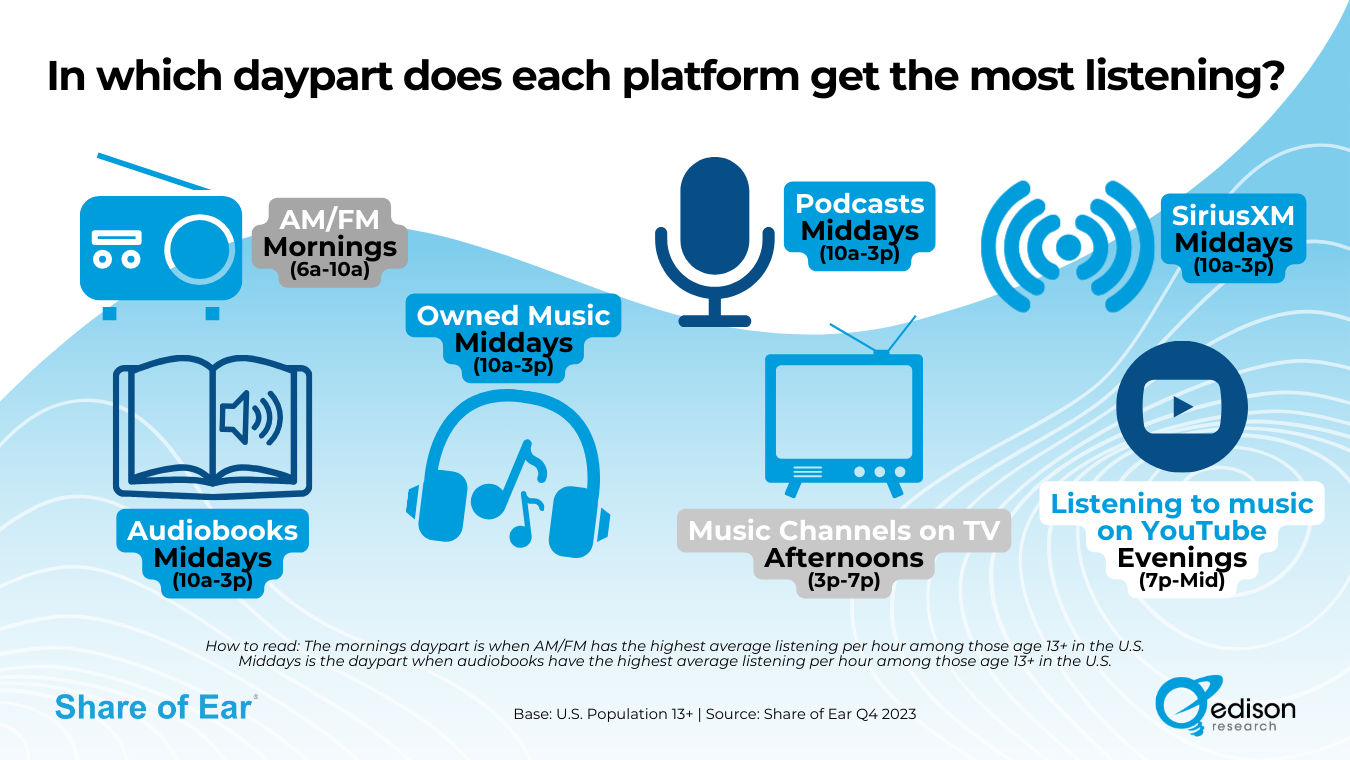
This pat week, when Edison Research published their article on which media platform commands the most listening in different dayparts, it was eye-opening.

The only daypart that broadcast radio commands is morning drive (6-10am), which just happens to be the one daypart the broadcast radio industry still invests in live air personalities. For the rest of the dayparts, consumers utilize streaming audio or previously downloaded content to their media device.

My favorite time to listen to radio growing up was 7pm to midnight. Some of the best known and loved air personalities broadcast during this daypart; Big Ron O’Brien, John Records Landecker, Wolfman Jack, Cousin Brucie among others. However, today the research shows that YouTube is what people listen to at this time of day.

Just before the end of last year, SiriusXM announced the debut of its new streaming App. It offers “discoverability and personalization at the forefront, [so] listeners can quickly and easily find and dive into the content they love across SiriusXM’s 400+ channels and tens of thousands of hours [with] on-demand content and podcasts, [allowing] fans to go deeper into their passions and get closer to their favorite music, artists, personalities and sports; [providing]  a seamless listening experience across streaming devices that reflects listener preferences and interests,  [ensuring] subscribers never miss a moment wherever they are and whenever they want to listen.”

Don’t you wish the NAB (National Association of Broadcasters)

was working on something like this, instead of focusing on linear AM radio?*

*https://www.nab.org/documents/newsroom/pressRelease.asp?id=6916

11 Comments

Filed under Education, Mentor, Radio, Sales

What’s Wrong With The Clock?

This past week the National Association of Broadcasters (NAB), along with owners and operators of AM radio stations, were all taking bows when the Ford Motor Company reversed its decision to remove AM radio from ALL of its vehicles in 2024.

I don’t mean to rain on AM radio’s parade but something just doesn’t feel right about this quick change of heart. Let’s review the last five weeks.

April 1, 2023

News broke in the Detroit Free Press that Ford Motor Company planned to stop putting AM radio in both new gas-powered vehicles as well as electric vehicles beginning in 2024.

This sounded like it was an April Fool’s joke. However, Ford executives explained that “a majority of U.S. AM stations, as well as a number of countries and automakers globally, are modernizing radio by offering internet streaming through mobile apps, FM, digital and satellite radio options.” Ford said they planned to offer all of these alternatives for their vehicle owners so they could continue to hear their favorite AM radio station stations.

The Push-back

Alex Siciliano, senior vice president for communication at the NAB quickly responded to the news by saying, “we are certain that Ford does not want to alienate the nearly 48 million Americans who listen to AM radio, and we’ll continue to work closely with the Alliance for Automotive Innovation and individual manufacturers to keep this important service in cars.”

The NAB was joined by Massachusetts Senator Edward Markey and Federal Communications Commission (FCC) Commissioner Nathan Simington in urging automakers to keep AM radio in all vehicles, whether they be gas-powered or electric.

Then seven former administrators of the Federal Emergency Management Agency (FEMA) wrote a letter to the Secretary of Transportation, Pete Buttigieg, about how the removal of AM radio from cars will represent a grave threat to future local, state, and federal disaster response and relief efforts.

Ford Is Not The First OEM Who Thinks AM is Past Its Use-By Date

Original Equipment Manufacturers (OEMs) around the world are always looking towards the future, building cars and trucks equipped with what demands will be three to five years from now.

BMW, Mazda, Polestar, Rivian, Telsa, Volkswagen and Volvo have all removed AM radio from their electric vehicles.

FM vs AM Listening

AM (Amplitude Modulation) radio was invented the early 1900s. FM (Frequency Modulation) radio was invented in the 1930s. The shift in listening from AM to FM started in the early 1960s and by the late 70s, FM radio listenership eclipsed AM.

In June 2015, I wrote on this blog about AM Radio & Streaming Radio. I completed a 3,000 mile road trip consisting of listening to AM radio for the first 1,500 miles, and streaming radio the second 1,500 miles. I wrote:

Small signal AM radio stations primarily identify themselves with their FM translator dial position (How’s that saving AM radio?). The “pups” are mostly syndicated, automated, religious, sports or Spanish. They aren’t very engaging, which is probably a good thing if you’re driving usually because you don’t care when you lose the signal. Oh, and just try to hear their translator FM signal; forgetaboutit.

The 50,000 watt signals on AM, like WOWO in Ft Wayne, Indiana, WJR in Detroit, Michigan, WLW in Cincinnati, Ohio and KDKA in Pittsburgh, Pennsylvania are in another universe when it comes to radio programming.

While listening to WOWO, I heard a powerful morning show that was fun, engaging and tuned into the Ft Wayne area. WJR told me about Frankenmuth, Michigan while their midday show was broadcasting live from this unique resort town on the great lakes. WLW was talking about how the Cincinnati police were getting body cameras and how they were loaning them to the news folks in Cincinnati to wear and learn how they work. It was fascinating radio. And KDKA was a potpourri of information about all things Pittsburgh; thoroughly engaging and very enjoyable.

I rode each of these big signal radio stations for hundreds of miles and enjoyed listening to them every minute. Each was different, unique, fun, engaging LIVE and LOCAL.

The observation I made was that maybe the AM band should be reserved for these high power AM signals that have the bench strength to do great radio.

On my drive home I decided to see how easy it is to listen to streaming radio. Here’s what I wrote about that experience six years ago:

The day of my 15-hour drive home allowed me to listen to a streaming radio station through my iPhone4S, fed into my car’s audio system with no dropout, no buffering, and no disruption of any kind. The audio fidelity beats anything coming out of AM or FM terrestrial radio, and even SiriusXM.

On day two of my drive, I again streamed the Radio Tunes’ Smooth Jazz channel knowing that Jimi King and Stephanie Sales would be hosting a LIVE 3-hour Smooth Jazz show (they do this every Sunday). This turns Radio Tunes into a real live radio station, and I will admit that I love the channel mainly because of all the things it doesn’t do the other 165 hours a week. However, for three of the 7-hours of my second day’s drive, the companionship was really nice.

Again, I experienced no disruption to my listening as I proceeded from Maryland and through the state of West Virginia and into Kentucky. I carried Radio Tunes all the way into Lexington, Kentucky where I stopped to have some lunch.

While eating lunch it occurred to me how well my reception to streaming radio through my smartphone was. It offers excellent fidelity, no dropout, buffering or other disruptions.

Ford Decides to Keep AM Radio on All Its Vehicles

On May 23, just about five weeks after announcing that Ford would remove AM radio on all its vehicles in 2024, it reversed course and said it would not only continue to offer AM on both its gas-powered lineup but also its electric powered fleet as well.

That was an incredibly fast change of heart, but what really left people scratching their heads was that Ford also said it would restore AM radio to other Ford vehicles, via a software update, that never had AM radio in them to begin with.

About that clock…

I titled this blog article “What’s Wrong With The Clock?” and here’s why, Herb Cohen was called the world’s best negotiator and he wrote a New York Times bestseller called “You Can Negotiate Anything.” At a conference, I remember hearing Herb speak about his book and telling the story about a couple buying a grandfather clock.

As I remember it, Herb said this couple always wanted to own a grandfather clock but they were too expensive, until one day they found a grandfather clock in a store priced at $1,000. The couple had not seen a grandfather clock priced that low before and were planning to buy it at that price, when the husband thought he’d try and see if he could negotiate the price down a little. So, he said to the merchant behind the counter, “I will give you $500 for that grandfather clock.” The merchant quickly responded with “SOLD!”

The couple then wondered, what was wrong with the clock.

Negotiation is a process, that involves some back and forth, however when the process, as in the clock story, gets short-circuited, it’s human nature to wonder about your victory. That’s how I feel about the Ford reversal decision.

Moral Victory

What AM broadcasters have won in their battle with the Ford Motor Company is a moral victory. AM radio listening is in decline and there’s nothing in the cards that will change that.

If you say that someone has won a moral victory,

you mean that although they have officially lost

a contest or dispute,

they have succeeded in showing they are right about something.

-Collins Dictionary

Color me skeptical, but I sense that Ford has decided that with every AM radio station in America working to obtain an FM translator and then identifying ALL of their programming with their FM dial position, AM radio will put themselves out of business.

It’s not a beachhead Ford wishes to defend.

I also wonder how listenable AM radio will be in vehicles that don’t have the antenna systems and electrical shielding to insure good reception.

“It is much better to lose a battle and win the war

than to win a battle and lose the war.

Resolve to keep your eyes on the big ball.

-David J. Schwartz, The Magic of Thinking Big

19 Comments

Filed under Education, Mentor, Radio, Sales

Saving AM Radio

The radio trades have been full of headlines about saving AM radio, especially in the dashboard of America’s cars and trucks. Here’s some of the most recent ones I’ve seen:

NAB launches campaign for AM radio

State Broadcasters Group Ask AM Stations for Help

Can The Industry and Congress Keep AM Radio in the Dashboard?

Detroit Newspaper Looks at Loss of AM Radio in New Ford Vehicles

The National Alliance of State Broadcasters Associations (NASBA) even put out an online survey “to more accurately craft the AM broadcaster owner’s message and to develop actionable items to keep AM [radio] in the dash.”

Let me tell you why everything I’ve read in the broadcasting newsletters, magazines and websites seems to be focused 180-degrees in the wrong direction.

What Features Do New Car Buyers Want?

Keeping AM or FM radio in vehicle dashboards has nothing to do with what broadcasters want, it has everything to do with what car buyers want. The lists from various sources I’ve found are all pretty much the same, though ranking positions may vary a little from publication to publication.  Here is what car buyers want:

  1. Proximity Key – a key fob that allows you to unlock (and lock) your vehicle’s doors and start it without having a physical key in your hand
  2. Apple CarPlay and Android Auto – smartphone connectivity is as important as a steering wheel to today’s car buyers*
  3. USB Outlets – lots of places to charge or run tablets, laptops and other electronic equipment
  4. Blind-Spot Monitoring and Rear-Cross-Traffic Alert – to keep you informed of what’s going on around your car while you’re driving
  5. Adaptive Cruise Control – systems that adjust your car’s speed while maintaining a safe distance from the vehicle in front of you.
  6. Surround-View Camera Suite – this puts the backup camera on steroids and allows a driver to see a 360-degree view of everything around their vehicle
  7. Wireless Smartphone Charging – a place you can put your cellphone to charge while you’re driving
  8. Rain-Sensing Windshield Wipers – a step-up from intermittent wipers, these blades automatically adjust to the amount of road spray or rainfall coming at you to keep your windshield clean
  9. Automatic High Beams – No need to raise and lower your headlight power manually, these systems do it automatically for you, so you always have the most light your vehicle is capable of producing shining on the road in front of you
  10. Heated, Ventilated Seats and a Heated Steering Wheel

What you don’t find on any of these lists are people asking for a radio, let alone an AM radio to be in their next vehicle.

What Features Do New Car Buyers Feel They Can Skip?

It surprised me to find that ‘Navigation’ topped lists, but then when Sue & I rented a car a couple of years ago, I learned that rental cars no longer offer a navigation system option. What they do offer is Apple CarPlay and Android Audio that automatically connects to your smartphone and displays the navigation software you enjoy using to the car’s video screen. (And yes, that arrangement worked for us perfectly, while driving cross-country.)

So, let’s look at the features car buyers don’t mind not having:

  1. Navigation
  2. Premium Audio System – most feel the hefty costs to upgrade the standard audio system the car comes with is not worth the money
  3. Onboard WiFi Hotspot – like Satellite Radio (which most new car buyers are also OK with skipping) WiFi Hotspots require a monthly subscription fee and are deemed not worth the added expense

Your Baby’s Ugly

The real problem the radio industry has is that it lives in a reality distortion field that has it thinking it’s still 1960s/70s. In other words, it needs to put on a pair of headphones and hear it for what it is.

John Frost’s most recent Frost Advisory email, told the story of a small AM radio station that broadcast a financial talk show that he occasionally tunes into hear. John says “it’s terrible radio, but the guys are really smart, they cough a lot, have lots of room noise and give insightful advice.”

On Good Friday, the show was a repeat of Thursday’s show and so what the listener heard on Friday were invitations to call in (which they could not because the show wasn’t live), announcements that Friday’s show would be a repeat of Thursdays show (but this was Friday) and commentary about the current day’s stock market prices (the market was closed on Good Friday) and nothing is more meaningless than yesterday’s stock prices.

Sadly, this kind of thing isn’t an isolated incident, but standard operating procedure on both AM and FM radio stations across America.

No one wants to hear their baby is ugly,

but for today’s radio industry, that’s the truth.

What Should Be The Focus of the Radio Industry

What keeps running through my mind is,

if the radio industry spent as much time, money and effort on producing a great product on AM radio stations across America, might their radio listeners be leading the charge with the auto industry to keep AM radio in the dashboard?

Let’s look at what fans make happen when a favorite TV show gets cancelled. The first television program to be saved by its fans was Star Trek in 1968. The franchise began in 1966 and 57 years later, it is still going strong.

More recently, fans of the FOX series Friday Night Lights organized a Facebook group with online petitions to show the network their support for this show, having it continue for five seasons despite its less than stellar audience ratings.

In both cases, it was not a television network that tried to convince an audience to watch a program, it was the audience that convinced a network NOT to cancel a program. That’s how it’s suppose to work.

AM radio isn’t coming back, so what the radio industry should instead be focused on is making FM radio the best that it can be and insuring that it won’t suffer the same fate befalling AM radio.

To win in today’s media marketplace, you must have a product that listeners want to hear;

today’s audio consumer has an infinite number of choices available.

When it comes to what new car buyers want in their next vehicle, broadcast radio is not on their list of wants, needs or desires.

That’s a real wake-up call,

if there ever was one.

*On April 1, 2023, General Motors plans to phase out widely used Apple (AAPL) CarPlay and Android Auto technologies that allow drivers to bypass a vehicle’s infotainment system, shifting instead to built-in infotainment systems developed with Google (GOOG) for future electric vehicles. It made me wonder if this was an April Fools prank, but apparently GM is that tone death. 

27 Comments

Filed under Education, Mentor, Radio, Sales

Whatever Made Auto Manufacturers Think AM Radio Is Over?

The CEO of the National Association of Broadcasters touted that 47 million people listen to AM Radio every week during a fireside chat at the Country Radio Seminar in Nashville this past week.

“It’s short-sighted for the automotive industry to consider

dropping AM Radio (from the dashboard).”

-Curtis LeGeyt, CEO, National Association of Broadcasters

Putting that number of listeners into perspective, the current population of the United States, according to the U.S. Census Bureau is 334,233,854 people and AM radio reaches 47 million of them or about 14%.

Saving AM Radio

In 2013, the chairman of the Federal Communications Commission (FCC), Ajit Pai, said he was going to make it his mission to save AM radio.

“The digital age is killing AM radio, an American institution

that brought the nation fireside chats, Casey Kasem’s Top 40

and scratchy broadcasts of the World Series.

When I was born (1973), AM radio accounted for approximately half of all listening.

Today it’s less than twenty percent.

The number of AM station is declining,

and every day it seems harder to receive a quality AM signal.”

-Ajit Pai, FCC Chairman

So, where are we, a mere ten years later?

Pai’s Plan to Save AM Radio

I never understood the wisdom of trying to save amplitude modulation (AM) by using low power frequency modulated (FM) transmitters, but Pai said this in his speech delivered during lunch at the RAB/NAB Radio Show in Orlando, Florida on September 20, 2013:

“We should make it easier for AM stations to get and use FM translators.”

-Ajit Pai, FCC Chairman

Do you think the automotive industry was listening to this plan for broadcasting in America?

What Happens When an AM Radio Stations Gets an FM Translator?

In market after market, when an AM radio station got an FM translator, two things usually happened, it changed its format from news/talk/information to a music based programming one along with re-branding itself as an FM radio station; even though it had to continue its AM service.

An example would be WNTW 610AM in Winchester, Virginia. In 1994, the station’s programming was news-talk-sports with newscasts from CNN. In 2014, an FM translator was acquired by the station, and in 2015 the station rebranded as “102.9 Valley FM” featuring a classic hits format.

WTOP’s Big Change

It was on January 4, 2006, that the owner of WTOP 1500AM in Washington, DC announced that it would be moving its successful news franchise from the AM radio band to the FM band. Bonneville International accomplished this by eliminating its classical programming on co-owned WGMS 103.5FM and putting all of WTOP’s programming on that signal.

The results were impressive, as WTOP has been the dominant radio station in the 25-54 demographics since moving to FM and has been the nation’s top billing radio station in America since 2014.

The Future of AM Radio in the United Kingdom

AM radio in the UK is in terminal decline with audiences vanishing and AM transmitters shutting down. The current forecast for AM in the British Isles is for the majority of the remaining transmitters to be shut down by the end of 2027; four short years from now.

AM radio was the dominant listening medium in the United Kingdom until the mid 1980s when it was overtaken by FM.

In America, when the number of FM radio signals equaled the number of AM signals, 75% of all radio listening was to FM. Today, there are 21,858 FM radio signals broadcasting in America compared to only 4,484 AM radio signals.

FM Radio Ends in Norway

Norway was the first European country to shutdown its national broadcasts of its FM network, switching to digital audio broadcasting or DAB; and that happened six years ago. Other countries that say they will be doing the same include Switzerland, Britain and Denmark.

BBC & CBC

Both the British Broadcasting Corporation (BBC) and the Canadian Broadcasting Corporation (CBC) have said they are both planning for the day, in the next decade, when they will be turning off both their radio and television transmitters, to become an online-only service.

Which came first, the Chicken or the Egg?

So, while the radio industry in America is up in arms over auto manufacturers eliminating AM radio in their Electric Vehicles (EVs), we need to be honest with ourselves about

who started down this path first.

You can’t save the AM radio band by moving it programming to the FM radio band. All the FCC and broadcasters succeeded in doing was to send out a signal to listeners and vehicle manufacturers alike that it was time to say goodbye to AM radio.

Actions speak louder than words.

31 Comments

Filed under Education, Mentor, Radio, Sales

Touring a Transmitter Manufacturer

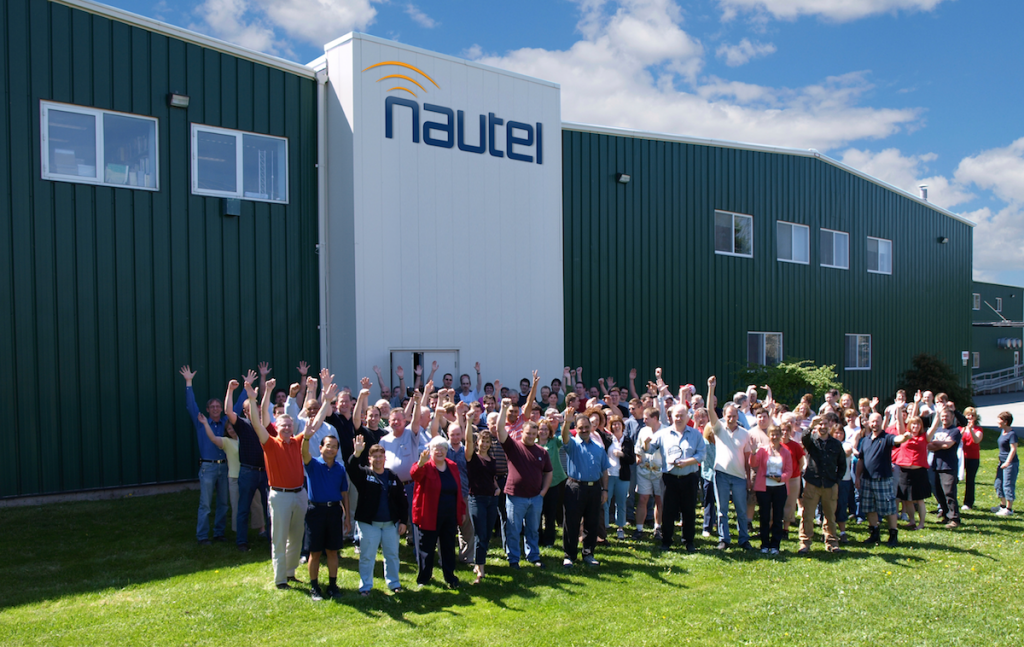
I started in professional radio in 1968. A transmitter company in Hackett’s Cove, Nova Scotia was founded in 1969. That company was Nautel, and both of us have been in the radio business for over 50-years.

Nautel initially began as a company that would build and supply solid state navigation beacons for the Canadian government. These solid state transmitters replaced ones built using tubes and proved to provide greater reliability and longevity; in fact, many of these early models are still in service today.

In the early 80s, Nautel would apply their knowledge and experience in building solid state beacon transmitters to radio broadcast transmitters, introducing 10,000 and 50,000 watt solid state AM transmitters.

Jeff Welton

One of the readers of this blog, saw that I would be doing a road trip through Atlantic Canada and reached out to me suggesting I email Jeff Welton at Nautel and ask for a tour of the company’s headquarters and manufacturing facilities in Nova Scotia. When I reached out to Jeff, he quickly responded that he would be happy to give us a tour.

In 2020, Jeff Welton was the recipient of the NAB Radio Engineering Achievement Award.

Jeff has been with Nautel over 30-years, and is an expert in digital radio, radio technology and radio engineering. He is currently sales manager for the central United States region for the company. When I reached out to him, he quickly responded that he would be happy to give Sue & me a tour.

Since COVID-19 closed down the world, many of the people not involved in the manufacturing process at the Nautel facility work from home, so like most businesses these days, the volume of workers in the plant on any given day is lean. However, business for the company has never been stronger. The amount of orders they have in their production pipeline is noticeably higher than what it was before the pandemic began.

Jeff told me the company’s support team maintains several lower power standby transmitters (both AM and FM) for their customers that can be immediately moved to a location where a customer’s transmitter plant has experienced an emergency. Currently all of the support transmitters are in the field, as several stations have faced challenges this year, ranging from floods to fires to older (non-Nautel) equipment failing and needing something to get back on the air fast.

Solid State Technology

I had always heard Nautel being referred to as the “Cadillac of broadcast transmitters.” After Sue & I toured the plant, we understood why. Nautel oversees every element of their transmitters, from building the cabinets, to the internal components, down to the wooden crates that the finished product will be shipped in.

Nautel’s large impact on the radio broadcasting industry came with its introduction of solid state AM & FM transmitters and as the benefits of solid state technology became clear, radio broadcasting quickly embraced solid state designs over tubes.

Its focus on solid state technology from Nautel’s inception in 1969 is what made it a leader.

The company is privately owned, and Kevin Rodgers the current CEO/President of Nautel, worked for the company for decades before taking over the company from its founders.

Pipe Organs

While I’ve been to several different manufacturing plants over the years, what I found touring Nautel’s operation in Nova Scotia reminded me of touring a pipe organ manufacturer in Ohio. In each case, the company’s employees were like family, with the newest employees having multiple years with the company. There is enormous pride in the construction of the finished product down to the smallest detail.

Both the organ company we visited as well as Nautel, want their products to provide years of trouble free service but are always ready to provide customer support on a moment’s notice.

Nautel’s customer locations around the world.

Today, Nautel has more than 19,000 customers in 177 countries, with their RF (radio frequency) solid state solutions providing reliable service in harsh climates from the arctic circle to the world’s deserts.

Nautel is one of those rare companies that is big enough to be at the cutting-edge of innovative technology and small enough to respond to specific customer needs.

8 Comments

Filed under Education, Mentor, Radio, Sales

What Business is RADIO In?

This question was last asked at the NAB (National Association of Broadcasters) Show in 2019, before a two year shutdown of the world due to a global pandemic. I don’t remember what answer they came up with back then, but no one foresaw the changes that COVID-19 would bring into our lives.

The question was visited again in one of the opening sessions at this year’s NAB Show in Las Vegas and the answer can be boiled down to two words, “very different.”

New Media Behaviors

COVID changed the nature of how people do their jobs, and this got me thinking how my own life changed with my retirement.

From my high school days in the 60s until 2010, I worked six to seven days a week in the radio industry. If I wasn’t listening to my own radio stations, I was listening to the competition.

In 2010, I transitioned into my second career as a college broadcast professor, teaching the process and effects of mediated communications, the history of broadcasting, broadcast sales, on-air radio production and the program’s Capstone management course.

My radio listening was mainly in my car, as my college building wasn’t conducive to receiving over-the-air radio signals, so when I was working in my office I streamed smooth jazz from my iPad to the aux input on my radio.

When I retired from my second career, got married and moved to Virginia, my radio habits would change again, as well as my television habits. Now all of my media would be accessed via streaming on the internet.

The Future of Work Impacts the Future of Radio

Without evening thinking about it, as the nature of my work changed, my media habits were greatly impacted by those changes.

Looking at the future of radio, new studies done by CivicScience really opened my eyes. Their studies have found that 44% of people who listen to radio have changed their habits over the past 12 months.

People are now listening to more audio content via internet streaming, they’re listening at different times of the day, their consumption of podcasts have increased, and while 20% say they are listening more often, a whopping 34% say they are listening less often.

Listening More or Listening Less

When CivicScience looked deeper into the reason people are listening less to radio, they found that the location of where people worked played a big role. Of the 51% that said they listened to radio less, they also were part of the group that was working remotely (i.e. from home) or were unemployed.

Since so much of today’s radio consumption occurs in the vehicle, people who work from home are spending less time in their cars and therefore less time listening to radio.

Post-Pandemic Work Choices

When CivicScience asked people what their future work preferences were after COVID, only 24% said they wanted to return to their office full-time. 37% wanted to work from home full-time and 40% said a mix of in office and at home would be their preference going forward.

These findings present radio operators with a real dilemma. The radio industry depends on a working age population all moving to and from work at the same time, hence the reason that both morning and after drive radio time sales have always commanded more dollars than middays, nights, overnights and weekends.

Moreover, people who stream their audio content are the people who prefer to either work entirely from home or have some kind of hybrid office/work-from-home situation. They represent 75% of the workforce in this study.

Global Supply Chain Disruptions

The global pandemic and the war in Ukraine have caused major disruptions to the global supply chain. For example, GM announced they would be having a two week shutdown at its plant in Fort Wayne, Indiana (it produces the popular Chevrolet Silverado and GMC Sierra pickup trucks) due to a shortage of computer chips. While Russia and Ukraine don’t produce any of the computer chips that are in such short supply, Ukraine is the world’s leading supplier of neon, a gas used in the production of computer chips.

Company business models work on the premise that resources of materials and goods move freely across geography. Both COVID and a war have totally disrupted the way the world was operating. Long term, we will adapt, but the immediate future won’t be pretty.

Now, take this one example and apply it to virtually every area of our lives and you can see how complex things have become.

An Ecosystem-Driven World

Radio used to be such an easy business, just beat the other radio station in town and steal as many advertising dollars from the local newspaper as possible.

Every radio station was like its own little fiefdom, but now in 2022 every radio station is part of a very large media ecosystem and the competitive advantage is no longer how efficient you can run your operation but how connected you are to your listeners on all devices and via all platforms; connections that go far beyond your FCC license to operate an AM or FM radio service to your local community.

For me, Apple is not my iPhone, iPad, MacBook Air, Mac or Apple TV, it’s the ecosystem that all of my devices operate on. For me, that’s what is most important.

What makes our ecosystem-drive world so hard to navigate is that everything is in a continuous state of flux. This makes our deciding what we should pursue unclear, and whether other media properties are opponents or an ally.

“Competitive Advantage” is no longer the sum of all efficiencies, but the sum of all connections.

  Strategy, therefore, must be focused on deepening and widening

networks of information, talent, partners and consumers.

-Greg Satell

6 Comments

Filed under Education, Mentor, Radio, Sales