
 I often wonder if today’s youth would gravitate to the style of radio that attracted me to make radio broadcasting my career for five decades. Would they be attracted to a Dan Ingram, Robert W. Morgan, Dave Maynard, Ron Lundy, The Real Don Steele, Big Ron O’Brien, Larry Lujack or any of the countless other personalities that so influenced me as I was growing up?
Spoiler Alert: probably not
Old Brains vs New Brains
Our brains are wired by our experiences.
Those of us who grew up in the 60s, most likely had a transistor radio that only received  AM radio. Mine was a Zenith Royal 50 that came with an ear phone, that allowed me to listen to the Red Sox while in elementary school or to radio stations from far, far away after it was ‘lights out’ and I was supposed to be asleep.
This is an advertisement for that radio.
I saw it in Bristol, Tennessee at the “Birthplace of Country Music Museum.” I’m finding that a lot of my career memories are now museum pieces.
My brain was originally wired for AM radio, then FM stereo radio and all of the great radio personalities, promotions and stationality of that era.
More recently my brain has been wired for streaming audio and the convenience of playing anything that fits my mood via an Amazon Echo.
But anyone who has grown up in a world where streaming audio has always been there, has had their brain wired for only this kind of world, not the world of the 20th Century.
Classical Music’s Challenge
Classical music venues, including radio stations, are searching for new audiences as their current audience gets older.
With the typical American adult spending eleven-plus hours-a-day connected to media, today’s musical consumer can’t help but have their brain wired in a new way. Most of that listening is via computer speakers or wireless ear buds, not known for delivering the highest quality sound, but very convenient.
Classical music aficionados are all about quality of sound, so huge sums of money are spent building acoustically perfect auditoriums that often are in locations that are anything but easy for people to access.
People want to listen to music everywhere; in cars, on buses, on trains & planes, and while walking on busy city streets. They don’t mind that the sound quality is less than perfect because convenience for them rules.
Our Brains Re-wire Quickly
To give you an example of how quickly our brains can be re-wired, V.S. Ramachandaran did an experiment where test subjects were shown a group of black dots on a white page. After studying the dots, participants soon began to see the form of a dog. MRI scans were used during the process and monitored participant brains being re-wired. Once the dog was seen, participants could not look at the paper again without immediately seeing a dog. Their brains had been re-wired that quickly.
On Demand Entertainment
I’ll admit it, I want my entertainment – audio or video – immediately available when I want it. My radio and television habits are nothing like they were when I was growing up when the only media I could see or hear came through the ether.
Initially cable TV and the TV remote control re-wired my brain for television viewing, but nothing has impacted my home media entertainment habits like streaming and on demand. Be it audio entertainment via our Amazon Echoes (now numbering 3) or video entertainment via Apple TV or Firestick, everything now is on demand to match our mood thanks to streaming via the internet.
Is It Real or AI?
Artificial Intelligence, or AI, has gotten so sophisticated that they are “paving the way for “deepfake” videos, content that falsely shows people saying and doing things they never said or did,” says CNBC.
Just the other week I read where James Dean, who died 64 years ago, will be starring in an upcoming movie about the Vietnam War. This has been made possible by the use of computer-generated imaging of James Dean.
A New Radio Format
 That got me to thinking that maybe a new radio format could be created bringing back deceased personalities like Robert W. Morgan, Dan Ingram, The Real Don Steele, Big Ron O’Brien, Ron Lundy, Larry Lujack among other greats by using the power of artificial intelligence. These incomparable radio personalities would “live again” via talented writers and programmers who would tell them what to say. Can you imagine how it might sound?
It would be like the “DJ Hall of Fame” on Rewound Radio, only the weather forecasts, the news, the community events etc. would all be current and up-to-date.
Which brings me back to how I started this article, would the radio listeners of today listen? Would their brains be so completely re-wired that they wouldn’t find it appealing? I fear they wouldn’t. Just as Vaudeville shtick stopped appealing to the generations of audiences with access to movies, television and radio.
In the end, doing something new means doing something fundamentally different.
+++++++++++++++++++++++++++++++++++++++++++++++++++++++++++++++++
If you’d like to know more about how advanced Artificial Intelligence has become, watch this five and a half-minute YouTube video. AI can clone your voice after listening to it for just 5-seconds. Click HERE
And for a really deep dive on how AI will change our future in ways we never imagined, watch this two-hour FRONTLINE report from PBS HERE
 Radio, like all traditional media, is in the economic fight of its life.
 I started my professional radio career in the 10th grade of high school. However, I started dreaming about being a disc jockey for as long as I can remember. I built my own AM/FM radio station in the basement of my parent’s home and broadcast to about a three block radius around my house.
 That headline graced the cover of the final edition of Express, the free commuter paper published by The Washington Post. It was created only 16-years ago, as a free paper for commuters in the DC area to read on their daily metro commute into Washington. It all came to an end on Thursday, September 12, 2019.
 Amazon.com. It was so popular the line was taken over by Cisco in 2009. Fifteen improvements were made to the Flip video camcorders, until in 2011 when Cisco shut down the entire Flip Video division.
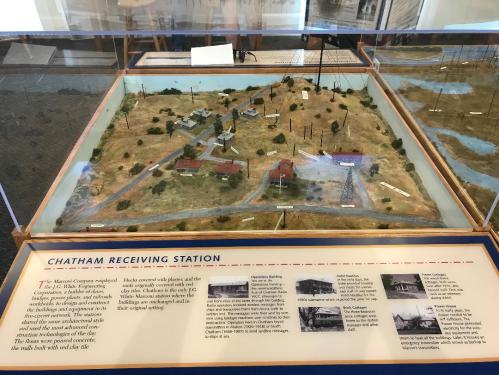
 Following World War I, America saw a future in long-distance wireless telegraphy using high-power radio stations. In the United States, British owned Marconi Wireless Telegraph Company of America ruled the airwaves, but in order to stay competitive, it needed the new equipment for broadcast, manufactured by General Electric Company.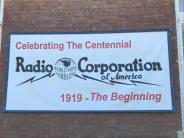

 Radio is a business.
 When World War I ended, it didn’t go unnoticed what a powerful role radio communication had played in the outcome. Led by the General Electric Company, the Radio Corporation of America (RCA) was formed in October of 1919. With guidance from the federal government, RCA brought together GE, Westinghouse, and AT&T to develop the radio broadcasting industry in the United States.
 A recent news item caught my attention. The English Cricket Board says “There are 200 million players of Fortnite…that is who we are competing against.” Welcome to the 21st Century and the attention economy, where everyone – yes, EVERYONE – is competing against everyone else. This blog competes for attention against not just other blogs, but everything else in our over mediated, world. It is our
  Fact: the number of people working in the advertising industry is in decline. What makes this noteworthy is that America has been in an economic expansion.
 The other evening, I watched the Netflix documentary “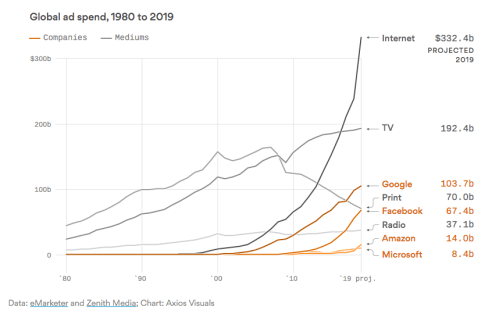
 OK, that’s not exactly new news. The latest New York City PPM Ratings show that WPLJ, now airing EMF’s Christian Contemporary K-Love format, went from a 3.1 (6+ Mon-Sun, 6a-12mid) before the format change to a 1.5 rating.
 in the 1950s and simulcast 770AM-WABC. In the late 1960s it became one of the early album-oriented rock radio stations in America. On February 14, 1971 it was renamed WPLJ to clearly separate it, and its programming, from its Top 40 sister, Music Radio 77 – WABC, at that point in time the most listened to radio station in the world.

 The only constant in life is change.
 DickTaylorBlog