
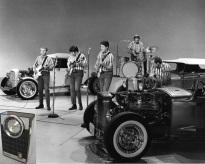
Transistor Radio, Cars & Rock ‘n Roll
I’ve written before how history never repeats itself, but usually rhymes. So when I was reading an article in the NY Times about “Tech’s ‘Frightful 5’ Will Dominate Digital Life for Foreseeable Future” it hit me. Here was how history was rhyming when it came to communications. Fasten your seat-belt, this will get bumpy.
What this article’s author Farhad Manjoo wrote was how Amazon, Apple, Facebook, Google and Microsoft (others include Netflix in this mix) came along at a perfect time to roll up their user base. They were in the right place, at the right time in other words.
Geoffrey G. Parker, a business professor at Tulane University has co-authored a book called “Platform Revolution” where he explains how these tech companies were able to ride the perfect wave of technology change – that being a decrease in the cost of IT, an increase in connectivity and the introduction/fast adoption of mobile phones.
And when it comes to advertising, these companies are in the right place to leverage digital marketing and enjoy most of the benefits of this growth area as well. In fact, since there is a sense that these major digital companies will receive most of the online advertising monies, traditional media – like radio & TV – could see advertising monies return to them. Let’s hope that happens.
So, where’s the rhyme in this story? Well consider this other time in communications history when television burst onto the scene after the end of World War Two in the 1950s. Radio, a lot of people thought, would cease to exist. Radio’s stars, programs and advertisers, to a large measure, jumped into television. Radio had to find a new act.
Radio was in the right place, at the right time for the birth of three things when TV came along; the transistor radio and the car radio. Both of these technology advancements would be the savior of radio along with one other important development; rock ‘n roll.
Radio was in the perfect place to ride the baby boomer youth wave of rock music, cars and transistor radios. Television grew in large measure by scarcity, only two or three television networks and few TV stations.
When broadband came along, that scarcity factor went poof. Radio now sees its dominance in the car being challenged by a digital dashboard.
The newest radio format to have come into existence – all sports/talk – is now 29 years old. Clearly, innovation in the radio world has stalled.
The good news is radio in America has more reach than any other form of mass media. The bad news is it sees annual erosion of its TSL (time spent listening). This can be fixed. To do this, radio needs to address the very factors that are causing its TSL to erode.
The thing most often heard from consumers about what they dislike about radio are its commercials. Yet, commercials don’t have to be a tune-out factor. No one tunes out the Super Bowl when it’s a blowout because they want to see what other clever commercials might still be coming on their television.
Most radio stations long ago did away with their copywriters. These masters of the spoken word who can craft a story about businesses need to be enticed back into the radio business at every radio station.
The number of commercials in a break needs to be reassessed by the radio industry as well. You can’t kill the goose that lays your gold revenue egg and expect it to continue to lay you golden eggs.
Bring back personalities. They not only sell the music (the record companies need you!); they sell your station and through live reads, your advertisers’ products and services.
Those who remember Paul Harvey News & Commentary will tell you that page two (his first live read commercial) was always something you turned up the radio for. I remember reading Paul Harvey brought in more money for the ABC Radio Network than everything else they did. And everyone loved Paul Harvey’s commercials and bought the products he talked about.
I think retired CBS Radio President Dan Mason said it best when he said this about radio:
“Without community and companionship, we have nothing.”
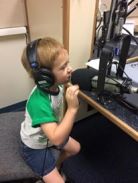 The Broadcast Education Association (BEA) meets every year in Las Vegas concurrently with the National Association of Broadcasters (NAB) annual convention. In forty-plus years of being a professional broadcaster I never attended an NAB convention. In six years of being a university professor, I’ve attended six conventions. I know, like that’s insane, right?
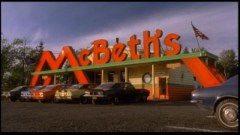 Lady Macbeth says this line in Act 5, scene 1. The line has made for ironic jokes and marketing schemes. The Bard’s lady, where the blood spot becomes dyed into her conscience and where the king and queen persist in imagining that physical actions can root out psychological demons, Shakespeare’s Macbeth is an exposition of how wrong they are.
 You remember HAL? The HAL 9000 is a fictional character from Arthur C. Clarke’s Space Odyssey series. HAL’s name stood for Heuristically programmed Algorithmic computer. HAL was the future of artificial intelligence. HAL always spoke in a soft, calm voice and in a conversational manner. HAL was born in the 90s according to Clarke.
 I remember the first radio station I worked for doing an experiment with one of their best clients, a men’s clothing store, to prove the power of radio advertising. Back in the 60s the dominant advertising vehicle in my hometown was the newspaper. This clothing store used both radio and newspaper, but felt it was the paper that drove their sales.
 I’ve been reading all the opinions about the FCC’s proposal to change the rules regarding America’s 77 Class A (formerly known as clear channel) licensed radio stations. Supposedly, all being done to “revitalize” the AM broadcast band. Like giving AM radio stations an FM translator does nothing to revitalize AM radio listening, neither – in my honest opinion – does this bright idea either.
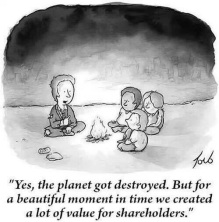 Last week I wrote about
 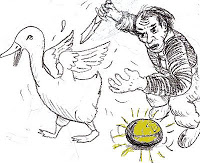 Do you remember Aesop’s fable of the goose that laid the gold eggs? Let me refresh your memory of this tale. It’s about a farmer that was poor. One day he makes a startling discovery when he finds a golden egg in the nest of his pet goose. Skeptical at first, he has the egg tested and finds that it is indeed made of pure gold. Even more amazing, each day this farmer awakes to find that his goose has laid another golden egg. In very short order, this poor farmer becomes fabulously wealthy. But then his wealth brings greed and impatience. No longer satisfied with just one golden egg per day, the farmer cuts open his goose to harvest all of its golden eggs at once only to find the goose is empty inside. With a now dead goose, there will be no more golden eggs laid.
 In two months, the world’s largest radio meeting will once again be taking place in Las Vegas; the 2016 NAB Show. Ironically, since leaving the radio industry and entering academia at Western Kentucky University, I attended my very first NAB show in 2011 and have every year since. So as visions of massive crowds and very sore feet dance in my head, I thought I’d look back over those past years and see how the theme of these meetings has evolved.
 I’m sure the title of this week’s post caught your attention. If you’ve ever been a manager, quite possibly this thought has crossed your mind on more than one occasion. Unfortunately, technology has provided many a radio company the opportunity to give this concept a whirl.
 DickTaylorBlog