
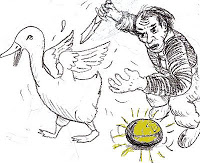
 Do you remember Aesop’s fable of the goose that laid the gold eggs? Let me refresh your memory of this tale. It’s about a farmer that was poor. One day he makes a startling discovery when he finds a golden egg in the nest of his pet goose. Skeptical at first, he has the egg tested and finds that it is indeed made of pure gold. Even more amazing, each day this farmer awakes to find that his goose has laid another golden egg. In very short order, this poor farmer becomes fabulously wealthy. But then his wealth brings greed and impatience. No longer satisfied with just one golden egg per day, the farmer cuts open his goose to harvest all of its golden eggs at once only to find the goose is empty inside. With a now dead goose, there will be no more golden eggs laid.
In remembering this fable, it sounded so familiar to the world of radio broadcasting. A radio station was like a wonderful “goose” that laid daily “golden eggs” for many an owner. It was an industry joke that having an FCC broadcast license was like having a license to print money. It was “golden.”
But broadcasters not wishing to wait for each day’s golden egg, cut open their goose with the Telcom Act of 1996. Twenty years ago, this act deregulated radio and now owners, like the farmer cutting open his goose to get all the eggs at once, now could own as many radio stations as they basically wished.
And how did that work out? Not much better than what the farmer discovered.
The moral of Aesop’s fable is if you focus only on the golden eggs and neglect the goose that lays them, you will soon be without the very asset that produces the golden eggs.
The radio industry’s quest for short-term returns, or results, took their free FCC licenses and ruined them by not maintaining the balance between the production of desired results and the production capacity of the asset.
Aesop’s fable is the very principle of effectiveness. It’s a natural law. Like gravity, you don’t have to believe in it or understand its principles, but you can never escape its effects.
Radio broadcasters probably saw the moral of the fable being the more geese you own, the more spots you add to the hour, the more effective your R.O.I. (Return On Investment) will be. But ironically, it was the principle of “Less Is More” that in the end rules the day.
To be truly effective, you need to maintain the balance of what is produced (golden eggs/revenue) and the producing asset (your goose/radio station).
Stephen Covey wrote extensively about all of this in his book “The Seven Habits of Highly Effective People.”
“When people fail to respect the P/PC Balance in their use of physical assets in organizations, they decrease organizational effectiveness and often leave others with dying geese.”
-Stephen Covey
One could certainly make that case for two of America’s largest radio broadcasters today. They are reaping the results of those who’ve gone before them who’ve in essence liquidated the asset, before they took over and now the accounting system appears to show that they are not performing at the level of their predecessors. But is that really the case? Did they in reality inherit a very sick goose when they took over? The debt problem say many who are more schooled in this area of high finance than I, will probably be addressed with a re-set. And once that happens, it will come back to the people of radio.
Covey says to “always treat your employees exactly the way you want them to treat your best customers.” Herb Kelleher at Southwest Airlines built his company on this very Covey principle.
Covey puts it this way: “You can buy a person’s hand, but you can’t buy his heart. His heart is where his enthusiasm, his loyalty is. You can buy his back, but you can buy his brain. That’s where his creativity is, his ingenuity, his resourcefulness.”
The bottom line is the future of radio will be determined by the vision of the people leading the radio industry. It will also be determined by the hiring decisions they make going forward.
“If you hire people just because they can do a job,
they’ll work for your money.
But if you hire people who believe what you believe,
they’ll work for you with blood and sweat and tears.”
-Simon Sinek
 In two months, the world’s largest radio meeting will once again be taking place in Las Vegas; the 2016 NAB Show. Ironically, since leaving the radio industry and entering academia at Western Kentucky University, I attended my very first NAB show in 2011 and have every year since. So as visions of massive crowds and very sore feet dance in my head, I thought I’d look back over those past years and see how the theme of these meetings has evolved.
 I’m sure the title of this week’s post caught your attention. If you’ve ever been a manager, quite possibly this thought has crossed your mind on more than one occasion. Unfortunately, technology has provided many a radio company the opportunity to give this concept a whirl.
 Fred and Paul Jacobs are prolific bloggers; they blog five days a week. Recently, their blog asked four questions about the future of radio. I found them interesting and thought I’d give you my answers to their questions. I’ve provided a link to their original blog post
 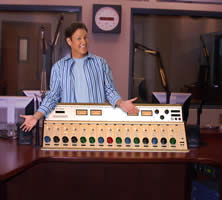 Crank it up means turning a knob. Radio people are going to have to make sure their car dealers demonstrate, or even set-up for their new car customers, how to find and lock in their local radio stations on these new digital dashboards. If the radio listener can easily find their favorite hometown companion, then they will default to what they know and love best. The reason radio has retained over 92% of its listeners is because all those new media devices mostly took out the new media device that came before it. Free over-the-air radio is unique and special. Let’s all work to keep it that way.
 There’s an old saying “Nothing lasts forever.” Do you remember flying on TWA or Pam Am? How about shopping at Woolworths? Broadcasters will remember names like Group W Westinghouse Broadcasting, or Taft Broadcasting, or Nationwide, or RKO General that would put the successful Bill Drake Top 40 format (with the non-stop innovations & promotions of 93-KHJ’s Ron Jacobs) in major cities across North America. They’re all now a memory.
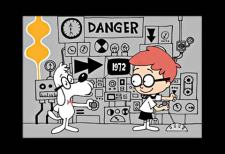 Led for Lunch (an hour of Led Zeppelin music) pre-dates a lot of things, not the least of which is my iPhone. But this radio programming staple along with “Two-fer Tuesdays” and “Million Dollar Weekends” (in a billion dollar world) remain on so many radio stations. It’s like Mr. Peabody’s Way-Back Machine broke down in 1972.
 As the clock was approaching midnight and people were anxiously waiting to ring in the New Year, many others were just anxious over the future of their streaming radio stations. Live365 put out a press release titled “Live365, Internet Streaming Leader, Downsizes and Looks to New Options in 2016.”
 Hard to believe I started this blog one year ago. It seems like only yesterday. Ironically, it was Sunday, January 3rd – the same date as today’s date.
 This was certainly true in the first golden age of radio, that period of time from its birth in 1920 through the mass takeover of television in the 1950s. Once TV came along, radio had to reinvent itself.
 I recently wrote an article for Radio World about the impact of colleges that sold their student radio station’s FCC license had on the pedagogical program at those institutions. You can read that article in Radio World
  DickTaylorBlog