Category Archives: Sales

What’s Your BHAG?

The past couple of weeks have featured some pretty intense webinars on where the media industry is headed and my mind is still spinning from all that was shared.

Let’s start with the meaning of BHAG (pronounced Bee-Hag); which means to have a Big Hairy Audacious Goal, a term coined from the book Built to Last: Successful Habits of Visionary Companies by Jim Collins and Jerry Poras. President Kennedy presented America with a BHAG when he said the United States would put a man on the moon.

“We choose to go to the moon in this decade and do the other things, not because they are easy, but because they are hard, because that goal will serve to organize and measure the best of our energies and skills, because that challenge is one that we are willing to accept, one we are unwilling to postpone, and one which we intend to win.”


-John F. Kennedy, President

The Elements of a BHAG

All companies have goals; probably too many actually, causing employees to have a lack of collective focus on what’s really important. So, what are the elements of a BHAG?

  • A BHAG is a compelling, long-term goal that brings employees together and inspires them to take action.
  • BHAGs should pull employees out of a slump and give them a reason to tackle a big-picture-type plan.
  • BHAGs should cause an organization to focus on a common enemy, and on a defined target, while bringing about an internal transformation.

From what I’m hearing in these webinars,

the radio industry needs a BHAG for digital.

Gordon Borrell

In a Radio Advertising Bureau (RAB) webinar “Digital Sales Approach $2 Billion” Gordon stressed the importance of have a long-term revenue BHAG for digital sales. He said radio stations should consider hiring digital-only sales reps.

Larry Rosin

Edison Research President Larry Rosin co-hosted the 25th Anniversary of Edison’s “The Infinite Dial Study.” It was truly eye-opening to realize how much audio media access has changed over the last quarter century.

  • Internet access 1998 (31%) versus 2023 (95%)
  • Households with computers 1998 (~50%) versus 2023 (91%) where computers have become smartphones we carry with us
  • Streaming digital audio listening 1998 (6%) versus 2023 (70%)

Why I Stream ALL My Radio Listening

On January 9, 2022, I began my 8th year of blogging with an article on why I stream all of my radio listening and how it’s so easy for anyone to do what I do. In our home, we effortlessly connect to the internet and streaming digital audio using Amazon’s Echo. I can’t remember the last time I played a record, cassette tape, reel-to-reel tape, CD or thumb drive; anything I want to hear can be heard on demand by voice command.

As a family, we don’t’ have the latest cars, Sue has a 2006 Subaru Forester and I have a 2009 Honda Accord, but both vehicles seamlessly connect to our iPhones when we enter the car and allow us to stream any digital audio content through our car’s audio systems.

Comscore Year-in-Review

As of December 2022, 91% of America’s population over the age of 18 are digital users. The Comscore webinar was especially eye-opening, when they told the audience that the “digital population grew relatively 2x more than the total population in the last 3 years with increasing emphasis on mobile usage.”

An average adult internet user will spend almost 4.5 hours a day

accessing the internet via desktop or mobile.

-Comscore Media Metrix Multi-Platform United States 18+ Total Digital Population

Willie Sutton when asked why he robbed banks, responded “because that’s where the money is.” Now you know why all media entities are racing to win with their digital media offering.

The interconnectedness of audiences

is where the wins will be found in measurement.

-Jason Clough, Senior Director, Partnerships & Insights, Comscore

I think Jason Clough perfectly summed up what radio’s BHAG should be in the above slide from his presentation: if media wants to stay relevant to its audience and win with any audience measurement metric, it must interconnect with them.

But, instead of “interconnectedness”…

Think “EXPERIENCES.”

Is your radio station delivering the best listener experience, wherever and however they access your programming?

16 Comments

Filed under Education, Mentor, Radio, Sales

Take This Job & Shove It

Forty-six years ago, Johnny Paycheck released a song titled “Take This Job And Shove it.” It was his biggest hit, and as it usually happens with a song like this, it stands out to even non-fans for a reason. Specifically, in this case, it was because it hit home with many dissatisfied workers all across America.

This #1 song was written by David Allan Coe, and in 1981 it became the genesis for a movie of the same name. So, what was the song about?

The Song’s Backstory

It’s appropriate that David Allan Coe was born the day after Labor Day, on September 6, 1939, in that his biggest song is known as “The Working Man’s Anthem.”

The song tells the story of a man who’s grown tired of being underappreciated and overworked at his job and fantasizes what it would be like to tell his boss to “take this job and shove it.”

Coe is fabled to have penned the song in about five minutes. He pitched the song to George Jones who turned it down. As word of the song spread, Coe one day received a phone call from Johnny Paycheck (a country artist unknown to Coe) who asked for permission to record it. He  agreed and the song became a massive hit as well as Paycheck’s signature song. In fact, it was the only #1 record Johnny Paycheck ever had, spending a total of 18 weeks on the charts.

Even recently, the song has been heard on the Hannah Montana and Simpsons television shows.

Why Is Everyone Quitting?

As American workers quit their jobs in record numbers in 2021, the year is now known as the “Great Resignation.” Return To Office (RTO) directives post-pandemic is when it started, as many who found they could do their jobs just as well from home and were not interested in returning to the office. By the end of 2021, 47 million hospitality workers, the industry with the highest rate of quitters, would in essence tell their employers to “take this job and shove it.”

In 2022, American business owners were confronted with a new kind of quitting by their employees; quiet quitting. Quiet quitting is defined as people who do the minimum required and are psychologically detached from their job.

That reminds me of what we used to call “not my job” people, who had the attitude of doing the least they could get away with and still get a paycheck.

Quiet quitters are estimated to make up 50% of today’s workforce and that should be alarming to all employers.

Higher Education

College professors, who must have terminal college degrees (like a PhD), are finding their work environment very unsatisfying and 500,000 of them headed for the exits in 2022. Radio’s unhappy employees have a lot in common with people employed in higher education.

I will tell you why, in a moment.

Broadcasting

If you go to the website Careercast.com and look up the “Top Ten Worst Jobs in America,” you will find that #1 is being a Reporter, #6 is being a Broadcaster and #8 is being an Advertising Salesperson.

Back in 2019, Fred Jacobs wrote a blog article “Take This (Radio) Job And Shove It,” in which he cited Careercast.com data showing that broadcaster, DJ and ad sales rep held down the #7, #8, and #9 positions on the top ten worst jobs in America and apparently conditions are not improving for our industry. Poor pay would be bad enough, but a lack of job growth exacerbates attracting new talent.

            Job                   Growth Forecast

            Reporter                      -11%

            Broadcaster                -11%

            Ad Sales Rep               -6%

Why Are People Quitting Their Jobs?

We can’t begin to fix the problem, if we don’t clearly understand what the problem is, and you might be surprised to learn that no matter the job or industry, the reasons are strikingly similar.

  • Feeling uncared for by their manager
  • Tense relationships with colleagues and stress
  • Poor compensation
  • Lack of career advancement

The Solution

If you’ve worked in the radio business, you’ve no doubt heard something like “DJs are like spark plugs, if one doesn’t work, pull it out and replace it with a new one.” I’ve heard this sentiment attributed to many big box broadcast leaders over the years.

It might surprise you to learn that I found much the same attitude among higher education administrators when it came to their faculty.

College faculty and radio personalities are both instrumental when it comes to making a connection. For faculty, it’s between the student and the college, for the radio personality, it’s between the radio station and the listener.

Colleges like to stress the importance of student recruitment and retention. The radio industry  calls this building Cume (total radio station listening audience) and maintaining a high Time Spent Listening (TSL). Sadly, both miss the most important element in growing both of these metrics.

Colleges have been quick to “replace and replenish workers,” while radio stations have opted for voice tracking and syndication.

If you think this stuff doesn’t matter, think back to when the National Football League (NFL) discounted the issues their referees were complaining about, let them go out on strike while replacing them with less experienced refs. The NFL quickly learned that they had made a very bad decision as blown calls proliferated; players and fans expressed their outrage about how this bad decision hurt the game.

What all workers are seeking, is a place of work that gives them a sense of belonging, appreciation, and fulfillment, as well as insuring their success, productivity and growth. The Harvard Business Review (HBR) says that your employees are more productive and engaged when their four basic needs are met:

  1. Renewal (physical)
  2. Value (emotional)
  3. Focus (mental)
  4. Purpose (spiritual)

HBR says that “when employees at a company perceive that anyone of their four needs has been met, they report a 30% higher capacity to focus, a nearly 50% higher level of engagement, and a 63% greater likelihood to stay at the company.”

People don’t care how much you know,

Until they know how much you care.

-Theodore Roosevelt, President of the United States

10 Comments

Filed under Education, Mentor, Radio, Sales

The Hiring Challenge

Over one-third of American companies have eliminated college degree requirements and the reason they did is simple, to increase the number of applicants.

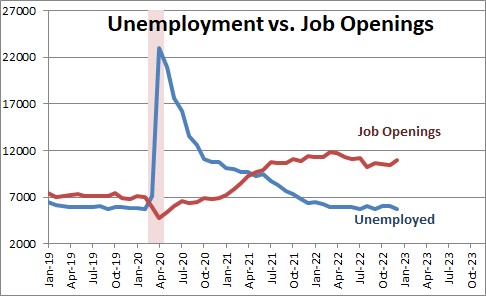
Here’s the reality, there are 1.9 jobs available for every unemployed worker.

Last year I wrote about how the radio industry needs to remove the college degree requirement from their Help Wanted Ads, and since that time, the ability to attract the best talent has become even more challenging.

The Latest Survey of Hiring Mangers

The website, Intelligent.com surveyed 1,000 hiring managers at the beginning of 2023 and released these key findings:

  • 53% of hiring managers say their companies eliminated the requirement for a bachelor’s degree for roles where a bachelor’s degree in not essential
    • 60% eliminated the college degree requirement for entry-level roles
    • 57%  eliminated the requirement for mid-level positions
    • 33% eliminated it for senior level jobs
  • 64% say the reason for removing the requirement was to increase the number of applicants
  • 76% say they are likely to favor experience over education
  • The majority of hiring managers say their company doesn’t see value in certificate programs, associate degrees, online degrees, or boot camps
  • 77% of companies are currently offering apprenticeships, or plan to, by the end of the year
  • 46% say attrition is a problem

Famous Radio Broadcasters Without A College Degree

Oprah Winfrey didn’t need to have a college degree to become one of the most successful women in broadcasting. She dropped out of college after only one semester to pursue a career in broadcasting.

In 2015, Forbes published the salaries of the top five radio broadcasters in America.

  • Glenn Beck earned $16.5 Million in 2015. Not bad for a Sehome High School graduate with no college experience.
  • Sean Hannity earned $29 Million, and never obtained a college degree, even though he attended four different colleges.
  • Ryan Seacrest earned $65 Million. He started his radio career at 16 while still in high school and would drop out of college to devote all of his energies to broadcasting.
  • Rush Limbaugh earned $77 Million and dropped out of college after only two semesters. His mother said at the time that Rush “flunked everything…he just didn’t seem interested in anything except radio.”

The BIG Exception

The top earning radio personality is Howard Stern. Howard graduated with a 3.8 Grade Point Average (GPA) from Boston University. In fact, Stern was named by Forbes as the world’s highest-paid media personality and the fifth highest-earning worldwide. As of February 2023, Howard Stern’s net worth is $650 Million.

I Love College

Please don’t think I’m dissing the college experience, I’m not. What I am taking issue with is the hiring practices of the radio industry that make having a college degree preferred. Radio is better positioned as a trade, one best learned by doing.

The radio industry should be presenting a broadcast career as an opportunity for students graduating from high school.

I treasure my five decade radio broadcasting career, but having my Bachelor of Arts and Master of Science college degrees never played a role.

It wasn’t until I pursued my second career in life, that of a college broadcast professor, that I would need those two pieces of paper to be hired at The School of Broadcasting and Journalism at Western Kentucky University.

Colleges sell pieces of paper representing knowledge learned. You can’t be part of the faculty unless you have also earned these benchmarks in higher education.

Finally, I am adamant about the radio industry starting its outreach at the high school level.

Radio Talent Institute

When I was at Western Kentucky University, I worked with Dan Vallie and his Radio Talent Institute. It’s an excellent program, now owned and operated by the Radio Advertising Bureau (RAB). Sadly, it’s offered as a summer program to students in a handful of colleges across America. I contend that the RAB should be offering this program in the high schools, especially those schools that have vibrant student run radio stations.

The Radio Talent Institute puts professional broadcasters into a mentorship role with the radio’s industry’s future leaders and we can’t start the recruitment effort early enough.

“A mentor is someone who

allows you to see the hope inside yourself.”

— Oprah Winfrey

22 Comments

Filed under Education, Mentor, Radio, Sales

It’s SUPER BOWL SUNDAY 2023

(NFL.com)

Super Bowl Sunday is a big event for broadcasting.

In the year 1983 the television’s series finale of M*A*S*H on CBS was the most watched program on TV and it held that record until it was beat by a Super Bowl broadcast in 1985. By 2015, M*A*S*H was being surrounded by football, as this graph from Wikipedia shows, and in 2022, the National Football League (NFL) had 82 of the top 100 programs on television in America.

M*A*S*H still is television’s #1 for most viewed scripted broadcast.

Football & Radio

While it’s estimated that over 100 million Americans will watch Super Bowl LVII (57) on television Sunday night, the best estimate for audio only listeners are a vaguer “millions.”

The big game will be broadcast on approximately 600 terrestrial radio stations as well as on-line and on streaming platforms. Westwood One, the radio network of record, will also provide its broadcast to the American Forces Radio Network and America’s Military troops around the world.

As I’ve written here before, I listen to all of my radio via streaming on a smart speaker or my iPhone using the TuneIn Radio App.

Home team fans have been known to watch the television network broadcast while having the sound turned down to hear their local radio broadcasters call the game.

The First Super Bowl Broadcast

The very first Super Bowl between the Green Bay Packers and the Kansas City Chiefs was broadcast by both NBC and CBS. NBC was the official television network of the AFL, and CBS was the same for the NFL; it remains the only Super Bowl to have been broadcast live in the United States by two different television networks.

Radio & Baseball

Baseball was meant to be listened to on the radio.

Growing up in New England hearing the Boston Red Sox baseball games coming out of everyone’s radio was commonplace. I remember sneaking my portable transistor radio into elementary school to listen to a Red Sox game.

Since the birth of radio, baseball has been broadcast live on this medium, originating on August 5, 1921 over Westinghouse’s KDKA in Pittsburgh. 25 year old Harold Arlin, a foreman for Westinghouse Electric Company, became the first person to ever broadcast a Major League Baseball game, using a converted telephone as a microphone.

Sadly, no recording exists of that first baseball broadcast. Radio stations at that time preferred their announcers to be anonymous voices, not wishing them to become popular and harder to manage.

The first television baseball broadcast didn’t occur until August 26, 1939, 18 years after the first radio broadcast.

Today, with every baseball game available to watch on TV, on your computer, smartphone or tablet, does radio matter anymore? Yes, it does, but in generationally different ways. Young baseball fans can’t imagine how us oldsters consumed sports back in the “dark ages.”

You’re either a baseball fan that likes listening to baseball on the radio or the kind that doesn’t.

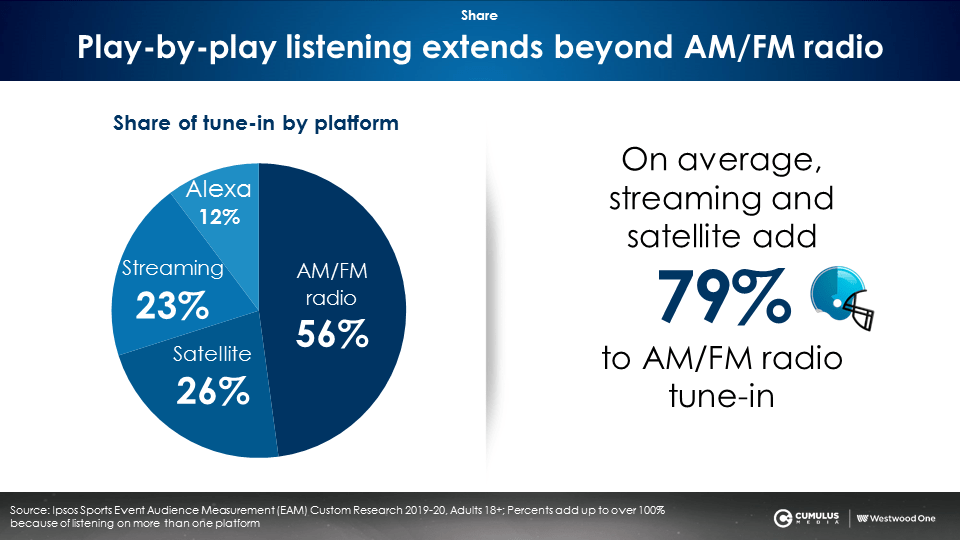
The radio broadcasting network for Super Bowl 57, Westwood One, says that people who do love to listen to sports on the radio are:

  • People who attend sports events
  • Seek sports information on a phone
  • Friends/Family ask their advice on sports
  • Are considered to be a sports category influential consumer
  • Play fantasy sports

GfK MRI reports that radio’s play-by-play audience is more engaged with and passionate about sports than those who watch sports on TV.

Super Bowl Parties

We’re hosting a Super Bowl Party for our family this year. For Sue and I, it’s a wonderful opportunity to spend time with family, much like Thanksgiving or Christmas. There will be lots of food and beverages while the TV will be tuned to the big game.

Our party will number ten people, and one rather large and lovable dog.

If you might be wondering how your Super Bowl party compares to others:

  • The average Super Bowl party will number 14 people
  • 103.5 million people plan on having or attending a home-based Super Bowl party
  • 17.8 million people will watch the big game at a bar or restaurant
  • 8,083 calories will be consumed at the average football party feast
  • Favorite football foods: 28% say its pizza, 24% say its wings & 18% say chips & dips
  • 16.1 million people will be calling in “sick” on Monday

Eagles vs. Chiefs

Whether you watch the Super Bowl on TV or listen to it on the radio, whether you’re rooting for the Philadelphia Eagles or the Kansas City Chiefs, or whether, like me, are just coming  for the calories and the camaraderie…

Enjoy Yourself

Leave a comment

Filed under Education, Mentor, Radio, Sales

Option A or Option B

Over the years as I’ve been writing this blog, some of my critics have accused me of being negative on the future of radio broadcasting, comparing me to a “radio chicken little” that each week proclaims the sky is falling.

It’s hard to read something that makes you feel uncomfortable.

Predictably Irrational

I’ve been a fan of Dan Ariely, with his Predictably Irrational  books and his column “Ask Ariely,” which was published in the Wall Street Journal for just over ten years. If you don’t know, Dan Ariely is an Israeli-American professor and author, serving as a James B. Duke Professor of psychology and behavioral economics at Duke University.

On September 26, 2022, he announced that he was ending “Ask Ariely”, a weekly column that he has been writing since June 2012.

At that time, the reasons he gave were “our society now confronts some big, important, collective problems. We haven’t yet made up our minds as to how we will treat our planet, confront fake news, cope with a post-COVID workforce or mitigate the effects of inequality, hatred and political fragmentation.”

WOW, it kind of makes anything I write about concerning radio seem trite, doesn’t it?

Then, in December, Dan emailed his subscribers a letter called “End-of-Year Alternative Ask Ariely”, with thoughts that I’ve been mentally marinating.

Stay or Change

In life we are often faced with Stay or Change decisions.

  • Stay in our current job or Change to a new one
  • Stay married or Change to go our separate ways
  • Stay on the couch watching TV or Change to a more active lifestyle
  • Stay in the radio format we’ve done for the past 10 years or Change to something new

“In general, when we look at the decisions we make each day, most of them are not an outcome of active deliberation,” says Ariely.

The Future is Digital

One of the tough facts facing the radio industry is the move to an all-digital world. Inside Radio started off the new year with the headline story “Digital Audio Listeners Expected to Top 225 Million This Year.”

The facts they presented in the story were:

  • 74% of American internet users listened to digital audio in 2022
  • Time spent listening (TSL) to digital audio is increasing by its users
  • Digital audio consumption is nearly even with the TSL of broadcast TV daily
  • Digital TSL beats streaming video, using social media or playing video games
  • Digital adoption remains most common among younger generations
    • 91.1% among people aged 16-24
    (Smartphones are the dominant way young people listen to digital audio)

Last year saw the majority of Americans listening to digital audio on their smartphones while at home, and this number is expected to grow to 55.8% of the U.S. population by 2026 according to eMarketer.

eMarketer also points out that more than six in ten digital audio listeners in America were  paying for a streaming audio subscription in 2022. (Full disclosure, I pay for two different streaming audio services that began in 2022.)

The latest from Dave Van Dyke at Bridge Ratings research shows that digital media was the big winner in 2022, with 95% of consumers using websites or apps and 88% interacting with social media.

Then there was this headline from Edison Research, “Mobile’s Share of At-Home Audio Listening Leads AM/FM Receivers.” Edison has found that Americans over the age 13 now spend 35% of their daily audio listening time with digital audio via their mobile device while in their home. In contrast, Americans who are still listening on an AM/FM radio receiver is down to 26%. This probably shouldn’t come as a surprise, since the most recent Infinite Dial research found 39% of American households have zero radios.

BBC Without Broadcast

BBC Director-General Tim Davie was recently reported saying: “A switch-off of broadcast will and should happen over time, and we should be active in planning for it.” Davie went on to say: “consumers are awash with choices from traditional broadcast and new streaming services [and that] a change to [the BBC’s] traditional model is necessary.”

The internet has removed

the historical distribution advantage

of broadcast media.

Changing Your Perspective

Most of the people who read this blog, have grown up with broadcast media, but a person born just 10 to 15 years ago is presented with two options for listening to audio content, broadcast or digital. For these young people, these two options have always existed.

Think of it as buying a new car with or without air conditioning. People buying cars in the mid-90s didn’t even consider buying a car without it, as it was offered as standard equipment by virtually all manufacturers on new cars.

Broadcasters weighing whether they should “stay” with what they’ve always done versus “change”, should reframe this question by labeling the choices as “Option A” or “Option B”.

  • Option A: Broadcast Media
  • Option B: Digital Media

As Dan Ariely explains, when you change the framing of this decision from one that considers “stay” versus “change” to one that considers Option A versus Option B, you put each choice on a more equal footing.

“The problem is that the natural framing of “stay” versus “change” gives an unfair advantage to the “stay” decision because it is simpler, it require less change, less work, and does not make us feel that we are making a decision. It also doesn’t make us think much about what we would risk if we made the wrong decision. Of course, staying might feel like we are not making a decision, but by staying we are making a decision. By reframing the decision as “Option A” versus “Option B”, some of the advantages of the stay options are reduced and it becomes clearer what we really want to do.”

So, what say you? “Option A” or “Option B”?

I’m all ears.

12 Comments

Filed under Education, Mentor, Radio, Sales

Listeners Don’t Care

If you think listeners hang on our every word – surprise – the reality is quite different.

Listening is a Habit

Radio listening, like many things in our lives, is on auto-pilot. When someone makes listening to your radio station part of their daily habit, you’ve struck gold.

However, two years of a global pandemic changed everyone’s routines and replaced them with new ones.

People who study people’s habits, usually say that it takes at least three weeks for a person to form a new routine and COVID forced changes on all of us that lasted for two years.

Award Winning

Go ahead and pound your chest that your radio station has won awards for its news coverage, its public service and its ability to break new hit songs, but appreciate that listeners don’t care. What is important to them is having your radio station deliver what they’re looking for, when they’re looking for it, and on the media platform they want it delivered on.

The Best Ads

It’s interesting that the ads listeners remember most are usually for products or services that have been around for decades and used the power of repetition to burn their ear worm into your brain.

Let me give you some examples of what I mean:

  • I don’t want to grow up, I’m a Toys R Us kid.
  • The best part of waking up, is Folgers in your cup. (Oddly, the brand actually sold the rights to this 38-year old jingle for $90,000.00.)
  • Plop, plop…Fizz, fizz…Oh, what a relief it is. This Alka-Seltzer ear worm was penned in 1976 and was so popular that Sammy Davis, Jr. actually recorded a version.
  • I’d like to teach the world to sing in perfect harmony, and I’d like to buy the world a Coke and keep it company, it’s the real thing.
    • I actually still play on my radio show, “I’d Like to Teach the World to Sing,” a song by Hillside Singers and it still makes me crave having a Coke, even though the hit record version never mentions Coca-Cola.

I could go on, but I think you get the idea.

Your Brand Messaging

You will never be all things to all people.

If your radio station uses multiple positioning statements, I’m willing to bet that your listeners, at best, can remember only one.

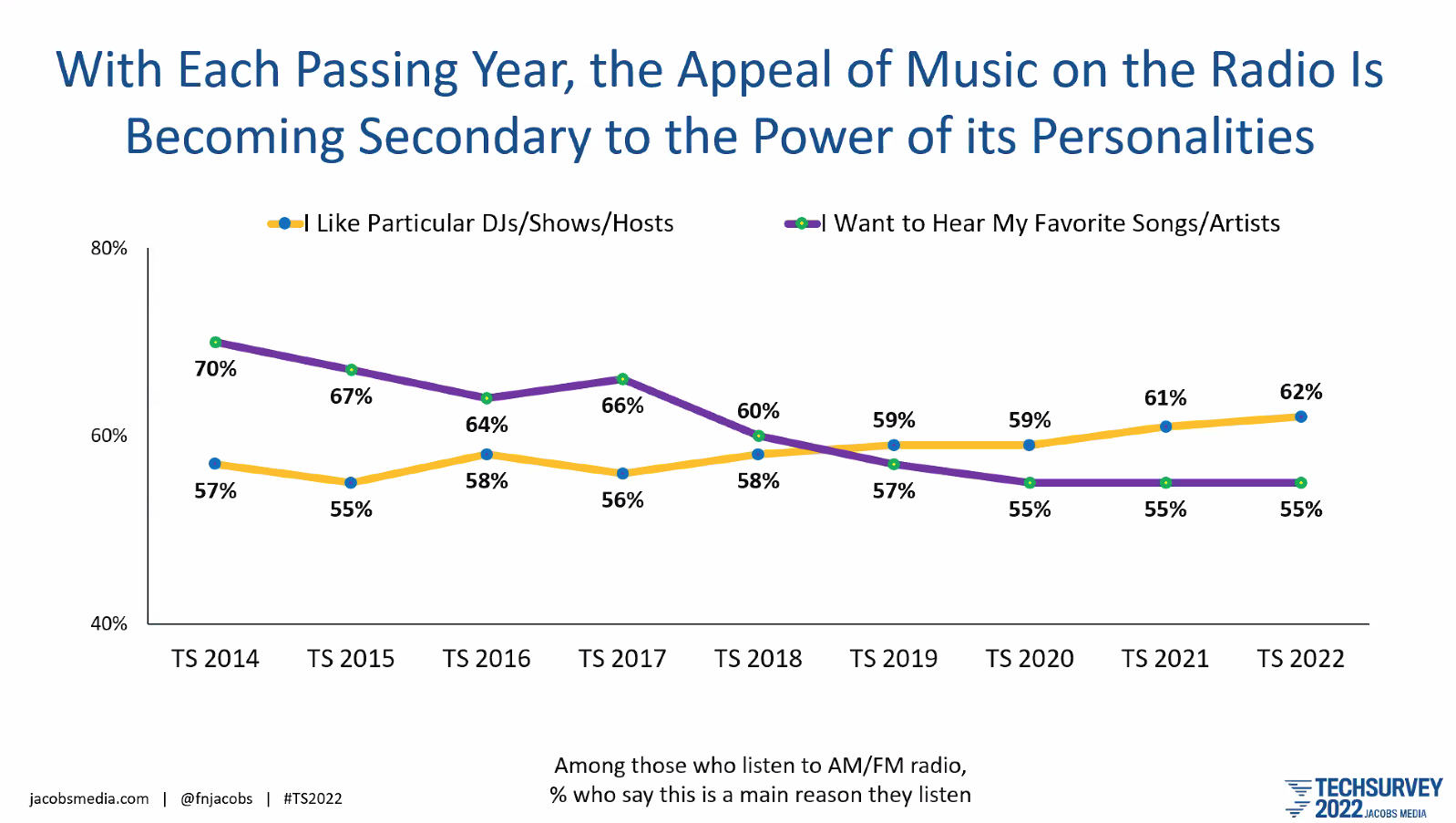
Back when I started in the broadcast business, radio stations spent a lot of money promoting their air personalities; they were the draw then, and they are the draw still, maybe even more so as Fred Jacobs TechSurvey 2022 so vividly points out.

Your personalities are your brand, and unique to your radio station; coach them, grow them and promote them.

If you don’t understand the listener’s needs, from the listener’s point of view, then you’re just spinning your wheels.

Your goal is to be the radio station a listener thinks of first,

and makes a daily habit.

8 Comments

Filed under Education, Mentor, Radio, Sales

Great Radio Takes A Team Effort

Looking back on my radio career that’s spanned over five decades, one thing is crystal clear, the success of each of the radio properties I worked at, was due to a team of people.

It Takes A Team

Whether we’re talking about your education, working in an office, performing on a stage, participating in a sport or being on the radio, nothing would happen if it wasn’t for a team of people, all working together, to make the magic happen.

Great radio takes dedicated professionals in all areas, including engineering, news/information, promotions, on-air personalities, programming, sales, billing and management.

Successful teams are the ones that have learned how to work together to meet and beat their goals.

Your First Team

The first team you were on was “Team Family.” Your mom and dad, along with maybe brothers and/or sisters, offered you love, support and guidance. As you grew older school introduced you to learning and sports teams.

Each of these experiences prepared you for entering the workforce where you learned that personal limitations could be balanced by others who were strong in areas you were not; no one has all the answers.

We Need Each Other

Successful radio stations are filled with people who excel in different skills and caringly collaborate; much like the human body needs all of its parts working in harmony to produce a healthy person.

To carry this a bit further, for a radio station to truly be successful, it needs to become part of another team; “Team Community.”

Radio stations that are active participants in the area they are licensed to serve become interwoven into the fabric of their community. They bring people together and create a positive energy for the betterment of everyone.

If you’re a radio listener, can you name a radio station that does this for you?

If you’re an owner/operator of a radio station, can you honestly say your property is fulfilling this mission?

“If everyone is moving forward together,

then success takes care of itself.”

-Henry Ford

5 Comments

Filed under Education, Mentor, Radio, Sales

Let’s Say Goodbye to Non-Compete Agreements

The Federal Trade Commission (FTC) just proposed a new rule that would ban employers from imposing non-compete agreements on their employees. Having spent the majority of my working life in the radio industry, I can’t remember a broadcasting company I worked for that didn’t have me sign one of these agreements, and I’m willing to bet that like me, you were never a fan of them.

What an FTC Ban on Non-Compete Would Mean

The proposed new rule eliminating non-competes would mean that employers could no longer make signing such an agreement a condition of hiring and that all existing non-competes would sunset within six months of the rule’s adoption. It would also require that employers give notice to their employees that the non-compete clause is no longer in effect and will not be enforced.

Should radio owner/operators be afraid? No, and let me tell you why.

The Day I Tore Up My Employee Non-Competes

Back when I was a general manager in Atlantic City, I had a sales employee walk across the street to my biggest radio competitor. I wanted to pursue this employee in court because I had them under a non-compete contract. However, the new owners of my radio stations said that if a person didn’t want to work for our broadcast company, to just let them leave.

Puzzled by this new operating philosophy, I asked the new owners, if they didn’t intend to enforce employee non-compete agreements, why did they keep them in place when they bought the radio stations from the previous owner. The company president’s response to me was, “darn if I know.” I said then, I’m going to tear them all up, and he said, “go ahead.”

Life Without Non-Competes

I have to tell you, as a young manager, the realization that every employee of my radio stations could walk across the street to my competitors, was scary.

However, something wonderful happened.

People who now worked for me knew they no longer were working under non-competes, and they now worked for me because they wanted to. It also made me realize that I too needed to provide a style of management that made people want to stay with me more than going someplace else. That, I would learn, is the best way to run a business.

Even better, having this type of work environment saw many talented people waiting in line to come work at our stations.

The FTC says the evidence to date suggests that non-competes suppress wages, reduce competition and keep innovative ideas from being birthed.

The rule making on this ban has just begun and the FTC is currently collecting comments from both supporters and opponents, and no timetable has been established for rendering a final decision on this proposal.

You can add your comments to the Federal Trade Commission decision making process by writing “Non-Compete Clause Rulemaking, Matter No. P201200” on your comment, and filing your comment online at https://www.regulations.gov

Today’s Media Environment

Radio today, unlike in 1920, operates in a marketplace that is over-served, and when that happens the basis of competition changes, opening the door for a new type of competitor.

Sadly, while this new media world was being born, the radio industry was focused on consolidation and increasing shareholder value, by replacing its radio personalities with technology and creating a radio medium that would play-it-safe to become predictable and boring.

“Never be boring.”

-Valerie Geller

Programming consultant, John Frost, recently asked this question in his weekly Frost Advisory,  “What does your radio station value?” Winning companies value encouragement and teamwork, according to Ken Blanchard, author of books like “The One Minute Manager.”

“Our greatest fear should not be of failure,

but of succeeding at things in life that don’t really matter.’

-Francis Chan

Radio can only win the future by attracting the most talented people to work in our industry, and giving them permission to fail.

9 Comments

Filed under Education, Mentor, Radio, Sales

Best of the Blog 2022

It’s been my tradition since I began this blog eight years ago to look back on the year just past and share with you the Top 5 Most Read articles over the last 52-weeks.

To date, 400 articles have been published and have been viewed over 273,800-times from folks around the world; maybe you missed them or perhaps you’d like to read them again.

Most Read Article of 2022

Radio’s most important assets are its broadcast radio personalities, yet the big radio owners continue to eliminate that very advantage. Worse, our industry has no plan to create a farm team of new broadcasters that will replace personalities who are retiring or have retired.

It’s this critical fact that prompted me to write Radio’s Leaking Listeners.” Apparently this article struck a nerve with thousands of readers when it was published in May 2022.

Second Most Read Article of 2022

I started off 2022 with a bang in my first new article of the year titled “Why I Stream ALL My Radio Listening.” Since my wife Sue (who edits this weekly missive) bought me an Amazon Echo in 2017, streaming has been my preferred way to listen to all thing’s audio and Alexa now inhabits four Echo devices and three televisions. Simple voice commands control what station I listen to and at what volume. In 2021, all of what was happening in our home was added to both of our cars using the Nulazy KM18 Blue Tooth receiver that immediately pairs with both Sue’s and my iPhones and our car radios have become nothing more than audio amplifiers.

Since I wrote that article, my good radio friend Gary James gifted me a C Crane Internet Radio that I’m thoroughly enjoying.

Third Most Read Article of 2022

Once upon a time in a land far away, a radio station had a team of people fully focused and dedicated to a single radio signal. Think of the incredible radio stations you listened to in your youth: WABC, WKBW, WRKO, WLS, WPRO, WDRC, KHJ, KFRC, CKLW etc. These were standalone radio stations with dedicated staffs that numbered ten or more times larger than today’s radio clusters, which are made up of 4 or more stations.

John Frost says that “Culture always changes in the hallways, before it changes out the speakers.” It’s a philosophy I’ve lived all my radio life, and was the genesis of “Great Radio Starts in the Station’s Hallways.”

Fourth Most Read Article of 2022

I often think about how much radio has changed since I began my career as a professional broadcaster in February 1968, 54 years ago. Local radio at that time told us who was born, who died, whether school was open or closed, what happened at the city council of school board meetings, what was going on in the world, our nation and our community. We depended on our hometown radio station for news, weather, sports and entertainment.

With so many of these needs now filled by other means, “What Purpose Does Radio Serve in 2022?

Fifth Most Read Article of 2022

Everywhere you turn you see “Help Wanted” signs, yet we see a radio industry that continues to eliminate people. In the article “Where Have All the People Gone”, I tackled the logic behind radio owners eliminating the very element that not only differentiates it from pureplay streamers, but is the attraction for most listeners – it’s radio personalities.

Most Read Article The Day It Was Published

Back on September 6, 2015, an article I wrote in the early days of this blog continues to hold the record for the most readers and comments the day it was published. Looking back, I see that it dealt with the same issue eight years ago that has only gotten worse, that being the elimination of the very thing that makes radio great – it’s radio personalities.

We Never Called It Content is the story of how a radio industry inspired me to make this my life’s career. It’s an article that’s now had over 5,000 views.

 Radio is an art form.

When you remove the artists, there’s not much left.

Why I Blog

I blog for broadcasters, educators and students, I blog to provide media mentorship and to pay-it-forward to the broadcasting industry that I have been a part of for over 50-years. I’m grateful for the more than 204,400-people from all over the world who have visited this blog (https://DickTaylorBlog.com) and have read an article that caught their interest.

Thank You for reading, next week I will begin my ninth year of blogging with all new articles.

Together we can all learn from one another by sharing our experiences, knowledge and wisdom. Feel free to contribute your thoughts to the discussion in the comments section. I read every one of them.

Happy New Year!

Dick & Sue

FREE SUBSCRIPTIONS

You can subscribe/follow this blog for FREE and get a copy of each week’s article delivered to your email IN BOX every Sunday morning. To subscribe, simply go to the bottom right-hand corner of your screen and click on the FOLLOW button. (If you’re accessing this blog via mobile phone or tablet, that button might not be visible, so be sure to do this on a computer or laptop.)

UPDATE 1-7-2023: Both Sue & I found ourselves testing COVID+ as we started 2023 and are now focusing on our health to try and put this behind us.

The good news is that we’re both vaccinated and boosted and on medication that should have us back on the road to recovery.

While we were both very careful to always mask up when shopping and when we did dine out, we would go at off hours to avoid crowded restaurants, the new strains of COVID appear to be as reported, very contagious.

I will resume writing this blog soon.

Stay tuned.

5 Comments

Filed under Education, Mentor, Radio, Sales

Community & Companionship Isn’t Built on Efficiency

The 1979 hit record by Charlie Dore called Pilot of the Airwaves perfectly captured a listener’s sentiment in the lyric:

“I’ve been listening to your show on the radio

and you seem like a friend to me.”

The two most important features radio broadcasting can provide for its listeners are a sense of community, and companionship.

While the pandemic exacerbated the situation, it’s been decades in the making.

Bowling Alone

In 1995, Robert D. Putnam wrote an essay entitled “Bowling Alone: America’s Declining Social Capital”; the essay chronicled the decline in all forms of in-person social interchange. What Putnam saw in his research was that the very foundation Americans had used to establish, educate and enrich the fabric of their social lives was eroding. People were now less likely to participate in their community, social organizations, churches, and even their democracy.

This trend has only been accelerated by social media and the internet with the unintended consequences of the internet being, that it has isolated each of us to a web of one. Algorithms have taken what Putnam saw happening in the last century and put it on steroids in this century, all in the name of driving more efficiency.

Efficiency Bubble

The term “efficiency bubble” means that efficiency is valued over effectiveness in today’s world, it was coined by Will Lion of BBH advertising.

Rory Sutherland, Vice Chairman of Ogilvy in the UK, shared this personal experience that demonstrated the efficiency bubble.

“The absurdity of the efficiency bubble was brought home to me in a recent meeting with an online travel company. The conversation repeatedly included the mantra ‘the need to maximize online conversion.’ Everyone nodded along. Clearly, it is much more efficient for people to book travel through the website than over the telephone, since it reduces transaction costs. But then someone – not me, I’m ashamed to say – said something revelatory: ‘Ah, but here’s the thing. Online visitors to the site convert at about 0.3%. People who telephone convert at 33%. Maybe the website should have a phone number on every page.”

“Perhaps the most efficient way to sell travel is not the most effective way to sell travel. What, in short, is the opportunity cost of being efficient?”

“Nobody ever asks this question. Opportunity costs are invisible; short-term savings earn you a bonus. That’s the efficiency bubble at work again.”

Consolidation is Just Another Word for “Efficiency”

During radio’s massive consolidation, Excel spreadsheets produced by new minted MBAs screamed a multitude of ways to have radio stations become more efficient. Unfortunately, the fast-lane involved the elimination of tens of thousands of radio jobs.

And this is still going on as I write this article; not just in radio, but in television and social media as well.

I don’t ever remember anyone asking about “opportunity costs” being sacrificed in the process.

In the last radio property, I managed, my days would be spent going to corporate meetings about Reductions In Force (RIFs) and coming home with a thumb drive that had dates to open new pages in an Excel spreadsheet, that listed what people and departments were to be eliminated next.

Efficient radio chases away listeners,

effective radio creates them.

Blame It on Competition

When all radio companies chase the same efficiency metrics, they all end up sounding the same, their websites end up looking the same, and in essence, they’ve turned the creative medium of radio into a commodity.

As I wrote about in the article The Birth of Radio in America, deregulation of broadcast now has virtually all of the radio stations in a radio market owned by one or two companies.

Radio always stole great ideas from other radio stations around the country, but most often those stolen ideas were massaged and improved upon in the process. Everyone was upping the game through their own creativity lens, and each radio station had its own unique sound.

Unfortunately, along with corporation radio came the concept of “Best Practices”. This would be yet another contributor to the end of personal creativity at radio stations, all in the name of more efficiency.

Emotions

The pursuit of efficiency is a rational answer to an emotional problem.

The radio business was never built on Excel spreadsheets and doing what was most efficient, it was built by creative people who touched others emotionally. Be it station imaging, air personalities, promotions, contests, community events, advertising or marketing, radio always went for people’s hearts.

I was reminded all of this when I was listening to Music & Jingles LIVE with Jon Wolfert on Rewound Radio. The show featured the creators of the famous 1974 Nine Tape created by Howard Hoffman, Randy West, Russ DiBello and Pete Salant. Listen to this five minute and thirty-seven seconds of audio HERE and you will understand…

“9”

7 Comments

Filed under Education, Mentor, Radio, Sales