
Category Archives: Uncategorized

Words Matter

74The words you use can make all the difference in the outcome of whatever you’re trying to do. Visual mediums can get lazy with wordcraft thinking the visuals will carry the message. Radio can’t.

Writing Persuasively

Colleges teach two kinds of writing: creative and journalistic. One is made of whimsy and the other is fact-based. Effective radio ads are written to persuade. Few do.

Cliché Town

In my sales class we spend time exploring how to write messages that cause the listener to see themselves doing what it is we want them to do. People must first envision something in their mind before they will ever actually do it.

Walt Disney said:

“If you can dream it, you can do it.”

So you’d think that when my students produce their radio ads in their sales presentation during finals week they would be filled with persuasive wizardry. They’re not. They’re filled with all of the tired old clichés that comprise most radio ads. Why, because they’ve been brainwashed with them without even realizing it. Even though they have no impact, rating a big zero on the persuasive scale, they are still filling their brains.

Clichés Have No Father

While we’ve all heard them – like “plenty of free parking,” “committed to excellence,” “fast friendly service,” “these prices won’t last long,” “in business since 19–,” – and know them, we have long stopped connecting them to anyone or any business. They are in a sense orphan phrases that fill-up an advertisement but don’t deliver the goods. And they usually are what cause an advertiser to say “radio doesn’t work.”

You don’t listen to clichés and neither will anyone else.  Stop using them.

Google It

George Johns is a famous programming consultant and he puts it this way:

“He who controls the language controls the budget.

We don’t Bing or Yahoo things we Google them.”

Google means search. It’s why the parent company re-branded itself from Google to Alphabet.

What’s Your Point?

Whether you’re selling advertising for your radio station(s) or you’re writing radio copy for one of your clients, you should distill your message into a single compelling sentence.

The last presidential election had two candidates. One candidate made a consistent, compelling point and the other had a “basket of deplorables.”

Long after people have forgotten all the dry details of the race, they will never forget those red ball caps and that single compelling sentence.

Final Point

It’s a New Year and time to stop using worn-out words and tired old clichés. To quote the great advertising man David Ogilvy:

“You cannot bore someone into buying your product.”

21 Comments

Filed under Education, Mentor, Radio, Sales, Uncategorized

Best of the Blog 2016

73Before I begin my 3rd year of blogging next week, I thought I’d take a look back of the Top 5 blog posts from 2016 and share with you the posts that received the highest readership and sharing from the year just past.

My Most Read Article in 2016

My most ever shared post received 3,725 views in a single day. It was published on February 28th and was “The Day the ‘Dumbest Idea’ Invaded the Radio Industry.” It told the story of a change in the way we measure business success. Before this new idea was born, Peter Drucker’s measure was the rule. The purpose of a business, said Drucker, was to create a customer. But that went out with leisure suits, the new crop of business wizards would proclaim. What replaced it was something that even GE’s Jack Welch has called “the dumbest idea in the world.” You can read that post here.

This post beat my beat my previous single day record of 1,816 set on September 6, 2015 with an article called “We Never Called It Content.” For my new readers, you  can go back and read that one here.

Second Most Read Article of 2016

Radio Would Be a Great Business…If It Weren’t for the Employees” said radio is a people business. Take away the people and do you really have radio anymore? You can read it here.

Third Most Read Article of 2016

SiriusXM Radio is Now Free” was an article that wondered what would happen if this satellite radio service offered some or most of its channels for free. What would that do to the revenues of the AM/FM radio industry? Even if they only turned on the top five music formats, it would mean drivers could listen to them wherever they drove across America, plus SiriusXM would have the ability to pop in promos for their other channels that remained behind a paywall. It’s almost too scary to consider the possibility. You can read that article here.

Fourth Most Read Article of 2016

Don’t Let Radio End Up Like Yahoo” told the story of how radio could learn from Yahoo’s mistakes. Yahoo went from being a company worth $120 Billion to its sale to Verizon for $4.8 Billion. The article shared the Top 5 Lessons of Yahoo for radio. You can read it here.

Fifth Most Read Article of 2016

Millennials Love Radio” shared how today’s Millennial generation nearly equal Boomers in listening to AM/FM radio. 91.3% of Millennials are reached by radio every week. 94% of GenX’ers are reached by radio and us Boomers come in at 93.5% reached by radio every week according to Nielsen. Radio continues to be the advertising medium that gets results when used correctly. Read the full article here.

Over 52,000 Readers

I’m happy to report that as I ended 2016, my second year of blogging saw over 52,000 readers come to this blog from all over the world. Broadcasters, educators and students have all stopped by to read an article or more that caught their interest.

This blog in media mentorship was created to pay-it-forward to the broadcasting industry that I will have been a part of for 50-years in 2017.

FREE SUBSCRIPTIONS

You can subscribe to this blog for FREE and get a copy delivered to your email IN box every week by going to the bottom right-hand part of the screen and clicking on the FOLLOW button. (If you’re accessing this blog via a mobile phone or tablet, that button may not be visible I’ve been told.)

Next week, I will begin year three of blogging with all new articles.

Thank You for reading.

Feel free to contribute your thoughts to the discussion in the comments. Together we can all learn by sharing our experience, knowledge and wisdom.

Happy New Year!


4 Comments

Filed under Education, Mentor, Radio, Sales, Uncategorized

Grateful for Your Readership

72

1 Comment

December 25, 2016 · 4:00 am

Your Most Important Sale

71What is selling?

Simply stated it’s the transference of confidence.

Selling is 90% attitude and 10% aptitude.

Self-confidence is having a ‘can do’ attitude.

What Successful Business School Grads Have in Common

Stanford’s Graduate School of Business conducted a study that looked at their most successful graduates over a twenty-year period of time to try and learn what the school did that provided their grads with skills to be successful.

The study boiled it all down to two things:

  • All their most successful grads were in the bottom-half of their class and
  • All of them were popular

Emotional Intelligence (EQ)                   

Schools put a heavy emphasis on grades, standardized tests and trying to measure a person’s IQ (Intelligence Quotient). The irony is that being smart won’t make you successful. Relationship skills are more important in the game of life.

The ability to collaborate will be important in our 21st Century world. Collaboration requires a high EQ.

How’s Your ‘tude?

Another element in success is optimism, your attitude and it’s completely in your control.

“No one can make you feel inferior without your consent.”

–Eleanor Roosevelt

Self-Esteem

Part and parcel with being self-confident is having a belief in yourself; feeling a sense of pride in your gut.

Great salespeople have developed a golden gut.

Ziglarism

One of my favorite concepts comes from Zig Ziglar.

“You are who you are, you are what you are,

by what has gone into your mind.

You can change who you are, you can change what you are,

by changing what goes into your mind.”

Just as important as what kind of food you put into your body, what you feed your mind will also have a huge impact on how your think.

You have to have conviction. You will bring to life that which you believe.

Develop a winning attitude and you will become a winner.

Winners find a way to win. Losers find excuses.

Your Attitude Determines Your Altitude

Your future is in your hands. Believe you are in control of your destiny.

Everything in your life you cause to happen first appeared in your mind.

Your thoughts shape your future.

So the most important sale you need to make to change your life is to yourself.

2 Comments

Filed under Education, Mentor, Radio, Sales, Uncategorized

I’ll Just Leave My Literature

70Be it just a one sheet with your latest sales promotion or a full color brochure, if you haven’t met with a person, why would you ever leave your company’s literature behind? Worse, most sales people will enter this hit and run as a “sales call.” It’s not.

Selling is Personal

The sales process is personal. You can’t phone it in or email it in. You have to get in front of the person you want to tell your story to. And if after you’re finished, if the person would like some more information, you can give them one of your brochures.

Circular File

I remember the time I returned from a sales call with one of my radio reps. When I entered the building, my receptionist said there had been a copier salesman who wanted to see me stop in. She said, “I told him you were out of the building.” Then she said “he left you his literature.”

I looked at this very expensive full color brochure on copiers and sadly tossed it into the trash can; the “circular file.”

What a waste of money I thought. Only the previous week, we had just signed a new long-term lease on a copier and we were now out of the market for several years.

I wonder how many calls like the one he made on me would be written down on his sales call sheet. That’s not selling.

Words Matter

When you do get in front of a person the words you use matter. David Letterman once asked long-time White House reporter Helen Thomas who she liked in the upcoming election and she replied “I don’t like any of them.”

David was really asking who she thought would be elected president but Helen thought she was being asked who she personally liked.

In Atlantic City, the program director on my music radio station asked if he could ask one question on our survey being sent out by the sales department to our listeners. The question seemed straightforward: “What’s your favorite song?” The program director of this music station was hoping that listeners would give him songs he might consider programming on our beautiful music station. The sales department was seeking qualitative future purchasing information from our listeners.

What my program director got back was a list of songs that could never be programmed on the same radio station, let alone our beautiful music station. The problem was the question didn’t ask what songs you would like hear on our station, but merely what your favorite song was. Taken out of context, the songs people wrote down were quite diverse.

What Are You Really Selling?

If you’re in radio sales and you think you’re selling advertising, you might be wrong.

What do lawyers, doctors and accountants sell? Legal advice, medical care and financial expertise? And how do you know if it’s any good? Most of us can’t answer that question. But what we can tell you is if we feel comfortable in the presence of one of these people. We can sense if the relationship feels good if our questions are answered honestly, our phone calls or emails are returned quickly and if we leave with a feeling that we are valued.

Radio sales are a professional service that is built on relationships.

People don’t care how much you know, until they know how much your care.

And you will never build a relationship with anyone by leaving your literature.


11 Comments

Filed under Education, Mentor, Radio, Sales, Uncategorized

Radio’s Non-Compete Contracts

69Have you ever thought about how Silicon Valley became such a powerhouse in the world of technology?  Back in the 80s, my home state of Massachusetts was home to world class research with institutions such as MIT, Harvard and the Route 128 corridor. So how did Boston cede its leadership to California and Silicon Valley? Employee non-compete contracts that held employees bound to these vertically integrated firms.

Meanwhile, taking a different approach companies such as Hewlett Packard and Sun Microsystems were embracing their people to job hop. They encouraged open technologies and building alliances.

Cross-Pollination of Ideas

In her book Regional Advantage AnnaLee Saxenian writes that these same phenomena took place in all kinds of industries all over the world; that being that these companies in California allowed cross-pollination of ideas to occur by the movement of people between them.

Ironically, radio enjoyed this same kind of cross-pollination up until 1996.

The Telecommunications Act of 1996

President Clinton signed sweeping communications reform in America with the Telecommunications Act of 1996. The radio industry consolidated almost overnight with a handful of major companies owning virtually all of the best “beachfront” radio properties.

The radio business, is not about just having a license to broadcast, but is about transmitted power and – like the real estate business – location, location, location. Unfortunately, that’s not how the FCC looks at license assignments.

Federal Radio Commission

The first regulatory body for communications in the United States was the FRC (Federal Radio Commission) and it divided the country into five equal regions and assigned the same number of radio services to each region. Why was this a bad idea? Because most of the people all lived in one or two regions of the country at that point in time and so more radio service was needed in them than in regions where it was mainly wildlife.

History Rhymes Again

I fond of saying that history doesn’t repeat but usually rhymes and in the case of radio’s number of AM or FM licenses a single company can own in a metro area we are repeating the same mistakes made by the FRC.

It’s not about number of signals but the power of those signals and location.

Cross-pollination of People

Part and parcel with the Telcom Act of ’96 was the loss of cross-pollination of people. If a person was RIF’d (Reduction In Force) by his company, he was under a non-compete to walk across the street or maybe some place else in the country as the same companies were now competing against one another all across this great land.

Before the Telcom Act, a single radio company could only own 12AM-12FM-12TV stations in the entire USA.  After the act, pretty much as much as they could afford to buy (with certain limitations).

BEST PRACTICES

Worse, these huge new radio companies would introduce across their footprint the concept of “Best Practices.” This is a code word for putting a knife in the heart of innovation.

Innovation requires risk.

Wall Street investors are basically risk adverse.

Playing it safe becomes the rule of the day and anyone that can’t play by the new rules is quickly shown to the exit doors.

Innovation requires three things according to the author of The Rise of the Creative Class, Richard Florida. Those are talent, technology and tolerance.

Consolidation and the new goal of “increasing shareholder value” would chop the talent pool while replacing people with technology. And the tolerance for anything new was likewise reduced to nil. Welcome to “playing it safe” radio; sterile, predictable and boring.

The Day I Tore Up My Employee’s Non-Competes

Back when I was in Atlantic City, I had an employee walk across the street to a radio competitor of mine. I wanted to pursue this employee because I had them under a non-compete contract. My new owners said that if a person didn’t want to work for them, to just let them go. I said then if they didn’t intend to enforce my employee’s non-compete contracts why did they keep them in place when they bought my stations from the previous owner. The president’s response to me was, “darn if I know.” I said then I’m going to tear them all up and he said, “go ahead.”

Life Without Non-Competes

I have to tell you, as a young manager, the realization that everyone at my radio stations could walk across the street to competitors was scary.

However, something wonderful happened.

People who now worked for me knew they no longer were working under non-competes and they now worked for me because they wanted to. It also made me realize that I too needed to provide a style of management that made people want to stay with me more than going someplace else. That, I would learn, is the best way to run a business.

Even better, having this type of work environment saw lots of talented people waiting in line to come work at my stations.

Make Radio Great Again

Radio became the force in America it is by being open to risk, new ideas and innovation. It kept the things that worked and jettisoned the ones that didn’t.

In other words, before radio was encumbered with huge debt brought on by consolidators, it invested in its future.

Radio can only win the future by investing in it.

8 Comments

Filed under Education, Mentor, Radio, Sales, Uncategorized

The Post-Fact Society

68P.T. Barnum, among many others, is credited with saying: “I don’t care what they say about me, just make sure they spell my name right!”
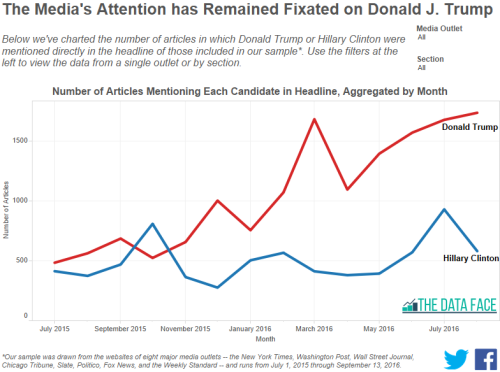
Barnum knew it wasn’t important what people said about him as long as they were talking about him. Only the noise level about Barnum mattered.

When I saw this chart from The DataFace measuring the newspaper media coverage of the two presidential candidates, it was eye opening.  68a It mattered little that most of that coverage was negative. What mattered was they spelled “Trump” correctly.

Fake News

Once upon a time, news came from journalists who worked for newspapers, radio and television stations.

Then along came the iPhone and social media.

Now the same device that could receive text, voice, pictures and video could produce it too.

Social media platforms provided mass distribution without a filter (aka an editor).

This provided the perfect storm for the production of fake news. A cottage industry in some parts of the world, some American citizens soon learned that producing internet stories that would get lots of clicks could be profitable.

Radio & Fake News

Even syndicated radio host Sean Hannity got snared in the volume of fake news being generated and had to apologize for using fake news stories to attack Obama.

Ad Supported Media Fight for Survival

In an effort to make a little coin, trusted media sources began accepting advertising that would lead their readers, listeners, viewers to unaffiliated sources that would serve up this fake news. In so doing, they inadvertently now wore the stink of the fake news creators. The public quickly could not discern the researched and sourced news from the made-up variety.

One PM Central Standard Time

Radio and television journalism didn’t always operate this way. PBS produced an excellent documentary about the coverage of the assassination of President John F. Kennedy. The program was called “One PM Central Standard Time” and it covered how “the most trusted man in America” Walter Cronkite waited until Kennedy’s death was confirmed by  multiple sources before going live with the news to the nation over the CBS radio and television networks.

The Being First Obsession

Things changed when things started being published digitally. In this world, advertising paid based on clicks. Quantity beat quality. Sensational beat facts. Going viral meant big money to these new media folks. Plus the concept of “native advertising” means that advertising copy is presented to look like editorial.

All of these little changes contributed to consumers becoming less and less able to tell real news from what was fake news. Which has led to many not believing anything today’s media tells them.

And that’s a very sad state of affairs for journalism.

“Were it left to me to decide whether we should have a government without newspapers, or newspapers without a government, I should not hesitate a moment to prefer the latter.”
–Thomas Jefferson

21st Century Business Model Challenge

Starting with newspapers, then radio, then TV then digital, the business model has been one of ad supported media. The model is broken.

Disruption first destroys the old ways of doing things before the new ways are discovered and take root. We are living in that destruction period of disruption.

Our challenge lies in building a business model that will support solid journalism, quality entertainment and community service.

What others have shown us is that in a 21st Century world it will take a collaborative effort from people from all over the world to help build the new way.

11 Comments

Filed under Education, Mentor, Radio, Sales, Uncategorized

The Magic Hat

67aI’m not going to get into the weeds about the presidential election. But I do want to weigh in about marketing and promotion.

I read that Donald Trump spent more on those “Make America Great Again” red ball caps than he did on any other part of his campaign. I also know that in the fly-over states his lawn signs were also prolific.

I bring this up because I remember when radio stations promoted themselves prolifically as well.

Do you?

It’s About Touching People Emotionally, Stupid

Roy H. Williams taught me long ago in writing persuasive radio commericials that if you win a person’s heart, their mind and pocketbook will follow. People first are hooked by their emotions and then justify their actions logically.

Go Team Go

Pick any sports team, in any sport, and you will see team fans proudly wearing their favorite team’s hats, shirts, colors.

Colleges also understand the importance of school spirit through the display of all kinds of wearables.

Bumper Stickers

Radio used to own the bumper sticker market. One radio station I especially remember was WOBM in Toms River, New Jersey. 67 This simple white on blue bumper sticker was seen on virtually every car at the Jersey Shore when I moved to Atlantic City in 1984.

But many of these station branded items seem to have been eliminated as budget cuts forced a leaner, meaner operating style.

Ratings vs. Station Wear

These days one of a radio station’s biggest expenses is audience ratings. The expense line for station branded items I’m sure pales by comparison.

The Federal Election Commission filings show that Donald Trump’s presidential campaign spent around $1.8 million on polling from June 2015 through September 2016, but spent $3.2 million on hats. Polling like audience ratings don’t touch anyone on an emotional level (except maybe the manager when the bill comes due).

Is there a lesson for radio here?

8 Comments

Filed under Education, Mentor, Radio, Sales, Uncategorized

Just In Time Learning

66In a post I wrote about “Where You Should Be Recruiting Radio Talent” I mentioned a concept of “Just In Time Learning” that struck a chord with many readers. Commenter’s said they found the idea interesting and something they had never heard or thought of before. So I thought I’d expand on that thought with a little more detail and why it’s time has come.

Toyota’s Better Idea

Manufacturers used to stock everything they would need to build a product in warehouses. It was expensive and often wasteful. Then the idea of having parts shipped just-in-time to be assembled into a finished product was introduced.

Originally called “just-in-time production,” it builds on the approach created by the founder of Toyota, Sakichi Toyoda, his son Kiichiro Toyoda, and the engineer Taiichi Ohno. The principles underlying the TPS are embodied in The Toyota Way.

College Degree Credential Creep

Once upon a time, college was an optional final stage of learning in the United States. Today even a Starbucks barista probably has a college degree. So what’s causing this college degree credential creep? In many cases the reason is that employers feel that by requiring candidates to have a bachelor’s degree they will see a higher quality group of candidates. It has nothing to do with what job skills are actually required. It’s used mainly as a screening tool. Unfortunately, two-thirds of the workforce in America gets screened out when a B.A. degree requirement is inserted into the advertisement. Burning Glass researched how the demand for a bachelor’s degree is reshaping the workforce and you can read more about all of this here.

The 20th Century College Education

When the 20th Century began, America had about a thousand colleges and those colleges had less than 200,000 students enrolled in them. By mid-century the number of colleges exploded and colleges that once had about a thousand students expanded to universities with enrollments of tens of thousands of students.

Unfortunately our 20th Century higher education system simply wasn’t designed to deliver what’s needed in a 21st Century world.

Your Teacher, Your Doctor and Your Barber

In our high tech world, things can quickly scale. Productivity grows quickly. But a teacher still teaches at the same pace. Your doctor can only see patients at the same pace.  And your barber can only cut hair at the same pace as each of these professions did in the 20th Century.

When something can’t scale, the price to provide the service goes up.

In the case of higher education, this price problem has been compounded by states reducing funding to their colleges and universities, resulting in public colleges being funded more and more by student tuition and lots of fees. This has resulted in a trillion dollar student loan crisis in America.

Certifications vs. Degrees

For the radio industry, the answer may be professional certifications versus bachelor’s degrees. Students simply can’t afford to go to college for four to six years and come out with tens of thousands of dollars in student loan debt to take an entry level radio job that will pay them fifteen to eighteen thousand dollars a year. Even worse, most likely the job you’re most looking to fill – sales – a college grad won’t have received any course work in learning about. Broadcasting in college is focused on teaching all of the low demand jobs in radio and the classes in the high demand jobs are either non-existent or being eliminated.

The Radio Advertising Bureau offers professional certifications in selling starting with their Radio Marketing Professional (RMP) certification. Burning Glass says that jobs in fields with strong certification and licensure standards have avoided the problem of “upcredentially.” They write: “This suggests that developing certifications that better reflect industry needs, together with industry acceptance of these alternative credentials, could reduce pressure on job seekers to pursue a bachelor’s degree and ensure that middle-skill Americans continue to have opportunities for rewarding careers, while continuing to provide employers with access to the talent they need.”

Radio’s Recruitment Mission

The National Association of Broadcasters (NAB) and the Radio Advertising Bureau (RAB) need to spearhead the radio industry in creating bonafide certification programs for all job classifications that will be accepted by the radio industry as the equivalent (or better) than a bachelor’s degree. These programs need to be offered to high school aged students and recent high school graduates.

Certification programs can be designed to provide the kind of just-in-time learning needed for each radio position. When a person shows they’re ready to advance additional certification training can be taken to prepare them for the next higher position.

Done in this way, the training will be up-to-date, cutting edge instruction to insure the student is learning exactly the skills needed for the position they will be moving into.

Time for Radio to Think Different

The radio industry will need to attract new talent in order to stay viable and continue growing. Embracing a better form of training for the skills needed and making this a requirement versus a college bachelor’s degree is 21st Century thinking.

Many of these programs are already in place, but industry recognition and acceptance of them lags in comparison to requiring a college degree.

It’s time to think differently about how we find, train and grow the radio talent of tomorrow.

-0-

Note to weekly readers of my blog: I publish every Sunday morning. If you would like to receive my articles by email, simply sign-up by clicking on the “Follow” button at the bottom right hand corner of your screen.


19 Comments

Filed under Education, Mentor, Radio, Sales, Uncategorized

It Was the Best of Times & the Worst of Times

65Radio broadcasting began in the “Roaring 20s.” A time in America that saw the first tabloid newspaper appear. Reader’s Digest, New Yorker Magazine, Time Magazine would also be born right along with radio. It was a time of unprecedented economic prosperity and social change. It was a time of a strong backlash of racism, fear of immigration and morality.

The 1920s and the world we are living in today are not all that dissimilar. Today, the wealth inequality is greater than it was in the early 1920s.

And just like those times, almost a hundred years ago, that gave birth to radio we are living in times that are giving birth to the “Internet of Things.”

Immigration: Then & Now

After World War One ended, America got tough on immigration. The most stringent set of immigration restrictions in American history was enacted with “The National Origins Act of 1924.” It restricted the flow of immigrants from Europe (and elsewhere) to less than 200,000 per year. This fear of immigrants reignited the Ku Klux Klan. The KKK membership saw its membership rise to a new high in 1928. Reformers advocated for a more militant, less conciliatory stance.

Today the battle rages on over building a wall between Mexico and the United States and over immigration of Muslims.

Women’s Rights

While women had won the right to vote, they still couldn’t go to college and most professions still excluded women. While women could now own property, they couldn’t establish credit with a bank or get backing for a business venture.

Many felt that the only thing that changed in America when women were given the power to vote was prohibition; the 18th Amendment to the Constitution.

War on Illegal Substances

So while the United States tried to control alcohol in the 20s and failed, today we find America battling another illegal substance battle, marijuana, with much the same results.

People will find a way to do something they really want to do.

Modern Mass Media

The 20s ushered in the first decade of modern mass media. American-made films not only captured the attention of American audiences, but the whole world. Every city would have at least one movie house by the end of the decade.

Because the movies were silent, musicians were in high demand for the movies. And because radio was all live, it too needed musicians to perform during each broadcast day.

Radio Jingles

The 20s also saw advertising agencies now develop departments devoted to the creation of radio advertising and soon the commercial radio jingle was born.

The Worst of Times

The Roaring 20s would end with Black Tuesday, October 29, 1929, the stock market crash and the beginning of the Great Depression.

While this decade created favorable conditions for big business to prosper, the alliance of government and industry left labor unions out in the cold.

It was these times that radio was born.

The Great Recession of 2008 would be the environment that would see the Internet of Things born.

Today’s Big Regulatory Difference

The big difference I see today for radio versus its toddler years is how it is regulated. The Radio Act of 1927  provided the foundation for all broadcast regulation right up until today. While more Acts were passed and made law over the years, the basics remain much the same as when they were first made law.

Some of the key provisions in the original Act that we’ve deviated from today are:

  • Limiting the number of broadcasters to foster higher quality radio broadcasts versus having more stations of poor or mediocre qualities
  • Radio broadcasters would operate in the “public interest, convenience and necessity”
  • Radio would be a regulated medium to assure high quality and operating in the public interest
  • Radio would be commercial and privately owned (a condition that made radio broadcasting in the USA different from every other country in the world)

Those who complain that radio isn’t like it used to be only need look at how broadcast regulations have been changed over the past century; the biggest change being the Telcom Act of 1996.

Utopian Hopes, Dystopian Fears

When commercial radio was born in 1920, it was hoped that it would bring about national unity. Those utopian hopes and dystopian fears would fall basically into four different areas.

  1. Radio would create a physical unity in the country bringing people together as one
  2. Radio would bring about a new cultural unity as Americans
  3. Radio would make America a one language nation providing linguistic unity
  4. Radio would bring about institutional unity where everyone wanted the same things and held the same vision

I will let you draw your own conclusions on the success or failure of these goals for radio.

Internet of Things

Broadcasting in America started out as a government-assisted oligopoly. The internet did too. Both, I would argue, now fall into the unlimited category. While I realize this is definitely true for the internet, I know others would quickly point out the limited amount of spectrum for AM and FM radio broadcasting. However, with the growth of FM translators and LPFM stations, it feels like it’s unlimited.

The original system of a government preferred broadcasting system is being challenged today by the Internet of Things.

And covered in dust, is the original fundamental principle of operating in the public interest, convenience and necessity and not merely for maximum profits.

12 Comments

Filed under Education, Mentor, Radio, Sales, Uncategorized