

I was reading about how HD Radio was celebrating its 15th birthday recently and that had me scratching my head as HD Radio is older than that. In checking the records, I saw that the Federal Communications Commission selected HD Radio as America’s digital standard in 2002. By comparison, Steve Jobs introduced Apple’s iPod in October 2001, XM Satellite Radio began service in 2001 and Sirius Satellite Radio in 2002.
Radios Go High-Definition
This was the headline that appeared in the Baltimore Sun on January 7, 2004. Unfortunately, unlike HDTV (High Definition Television) HD Radio never stood for “High Definition.” And possibly that was the first mistake. HD Radio was simply a name they chose for the digital radio technology, but even today, many people still think it means “High Definition” or “Hybrid Digital.”
Sadly, by 2004, America’s digital radio was late to the party and if the industry is now marking the date of 2006 as its moment of birth, it was really late!
Remembering 2006
In 2006, Facebook opened up its social network to everyone in the world. The original requirement that you be a college student enrolled at a specific university was eliminated and the only requirement now was that you were over the age of 13 and had a valid email address.
In just 15-years, Facebook has grown to over 2.85 billion active monthly users.
Let’s look at what else was born in 2006 that competes for our attention:
- Twitter was launched in 2006 and today enjoys 199 million monetizable daily active users.
- Wii game system was introduced with its handheld motion controller that got families off the couch and in motion doing all kinds of sports in front of the TV.
- PlayStation 3 came online to provide strong competition to XBOX 360. (Video gamers spent about eight hours and 27 minutes each week playing games, which is an increase of 14% over 2020. The video gaming industry predicts revenues of $100.56 billion by 2024)
- Google bought YouTube in 2006 and now has over 2 billion users, the channel grosses over $19.7 billion in revenue and users are uploading videos at the rate of 500 videos per minute with over a billion hours/day spent watching videos on the platform.
- The one billionth song was purchased from Apple’s iTunes, the dominate source for music lovers in 2006. (Two years later Spotify would arrive and not only disrupt how music was sold but how it was listened to in general.)
When we look at 2006, it becomes easier to understand why HD Radio wasn’t such a big deal to the average media consumer.
Solving a Problem That Didn’t Exist
What HD Radio did for FM radio stations was solve a problem that listeners to FM didn’t feel existed. No one who listened to FM radio was complaining about the quality of the sound, they were complaining about other things, like too many commercials. And for AM radio stations, it meant people buying radios for a service that didn’t offer anything they really wanted to hear or couldn’t get elsewhere. AM radio was now the service of senior citizens who already owned AM radios, who grew up with AM radio’s characteristics and whose hearing was not the best now anyway. So, HD Radio for AM wasn’t anything they were asking for and worse, AM radio stations that put on the new digital signal found it lacked the benefits of skywave and often interfered with other company AM radio stations as the industry quickly consolidated radio ownership.
Industries Most Disrupted By Digital
In March 2016, an article published by Rhys Grossman in the Harvard Business Review listed “Media” as the most disrupted by the growing digital economy. Turns out, if you’re a business-to-consumer business, you’re first being most disrupted by digital. The barriers to be a media company used to be huge, but in a digital world they are not, meaning that the business model that media companies depend on has not adapted well to the digital economy.
Elephant in the Room
But the elephant in the room remains the broken media business model. Newspapers, magazines, radio, and television – any media that is ad supported – will be challenged to find a way to capture revenue to continue operating.
Walt Disney famously said “We don’t make movies to make money, we make money to make movies.”
Broadcasters of my generation had that same attitude about creating great radio.
Do the people owning and operating today’s radio stations still embrace that concept?
 The other evening, I watched the Netflix documentary “
 I read a recent article in

 Jeff Bezos’
  I’ve been reading the trades, trying to grasp what is happening, and it is all so very confusing. Have you felt that way too? That’s what a period of disruption looks like. Black is white. Up is down. It’s enough to give you an Excedrin headache.
 at a time when AM/FM radio is no longer the entertainment focus of the vehicle dashboard, replaced by the entertainment center that resembles the touch screen on your smartphone.
 The other night I watched Jim Gaffigan’s 5th Netflix special called “CINCO.” In his standup comedy routine, he hit the nail on the head about why Netflix is more popular than cable TV. Here’s what Jim said:
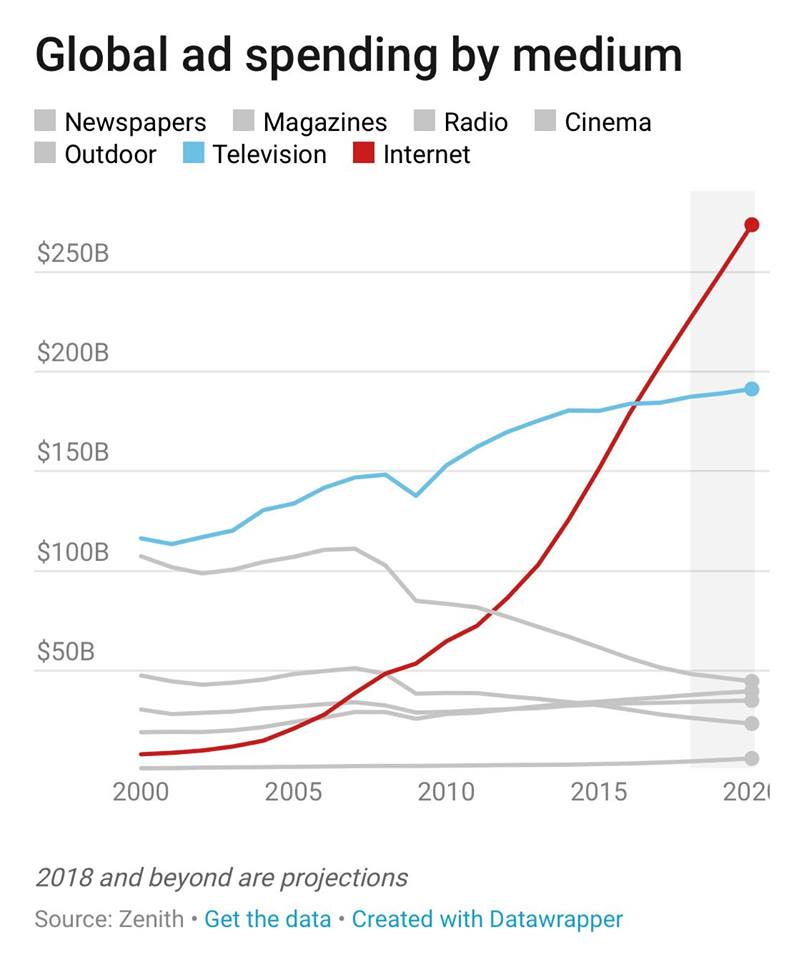 In the year 2020, commercial radio will celebrate its 100th birthday. Hopefully, by then, America’s two largest broadcasters will be out of bankruptcy. But before we light the candles and begin the celebration we need to face reality. Global ad spending, according to Zenith (see graph) will see newspapers, magazines, radio, cinema and outdoor all fighting to be the tallest ad-supported midget. TV will be marginally growing, but the internet will be the big winner; raking in more advertising revenue than, print, radio, cinema and outdoor combined. That’s sobering news.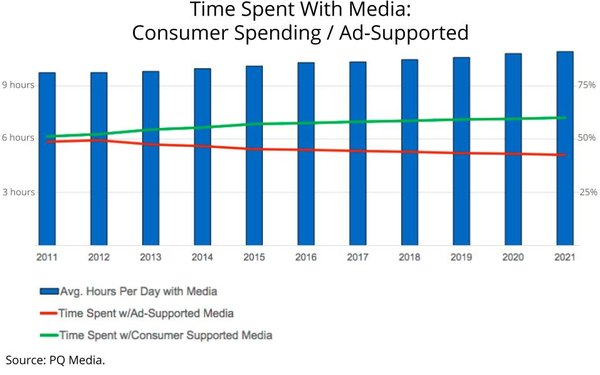
 This week produced some conflicting economic data. The stock market was setting new records and the
  Jack Nicholson famously said in the movie A Few Good Men “You want the truth? You can’t handle the truth!”
 It seems like no matter what line of work you’re in, someone is finding a way to take your job away. If you’re in coal mining, you think the EPA is doing it to you. If you’re in manufacturing, you think its Mexico or China or some other country that pays their workers less and offers no benefits. But is that really what’s happening to jobs?
 P.T. Barnum, among many others, is credited with saying: “
 It mattered little that most of that coverage was negative. What mattered was they spelled “Trump” correctly.
 Last week I wrote about
  DickTaylorBlog