Tag Archives: WABC

How You Say It, Makes All the Difference

A few of weeks ago, my wife Sue & I went to two different churches for Easter Sunday services; our new church, where we just became members and our old church where we exchanged our vows of commitment to each other.

Here’s what I learned…

Talking versus Preaching

One of the pastors delivered the service as if he was talking to us. He engaged us with his message, as if he were having a conversation, and even posed questions to the congregation. The religious meaning of Easter Sunday was delivered in a relatable way, bringing meaning and perspective to the world we are living in today.

The other pastor, at our second Easter service, preached…or what I might characterize as “talking at and not to” me. It didn’t really relate to the world outside the church doors, in tone or message. The sermon made no effort to tie a religious message to our current reality.

WABC – “The Last Aircheck”

On Saturday, May 10th, Rewound Radio aired, what’s become known as “The Last Aircheck,” the day that WABC Music Radio 77 would switch their format to Talk Radio 77. That happened 43 years ago on May 10, 1982.

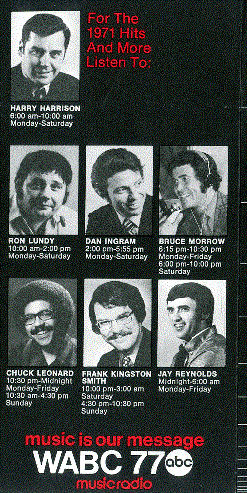
Those final hours were hosted by Ron Lundy and Dan Ingram, and as I listened to the replay of that broadcast, I got goosebumps. The sound of their voices took me back in time, when listening to the radio was like a religious experience for me.

Techsurvey 2025

Fred Jacobs has been tracking the power of personalities in his annual Techsuveys, the most recent one which came out in the first quarter of this year. Here’s the trendline:
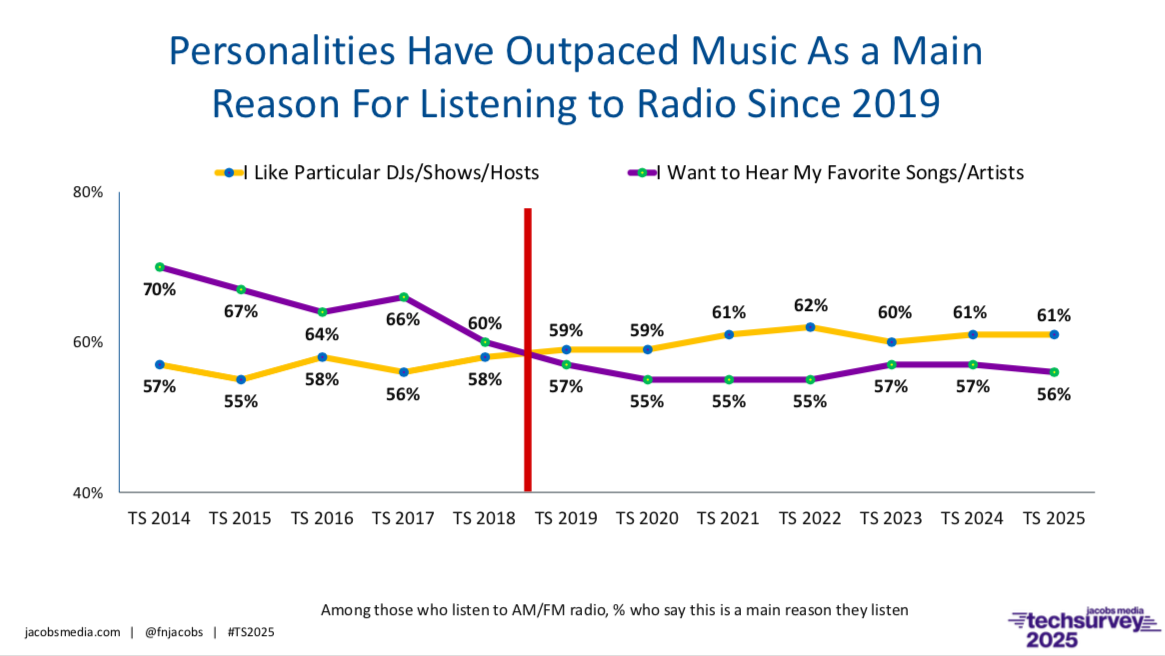
Fred’s graph only goes back to 2014, but radio captured my heart in the 60s. It was a time when great radio personalities ruled the airwaves on virtually every broadcast signal.

Radio owners would covet, promote and value their air personalities and so did the radio audience. For the radio listener, meeting their favorite air personality was a heart pounding experience.

The Human Voice
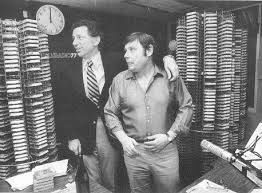
I never had the opportunity to meet Ron Lundy or Dan Ingram, but their voices owned real estate in my brain. As it was broadcast over Rewound Radio, hearing them talking on “The Last Aircheck” made the same impact as it did when I heard them LIVE 43 years ago.

That’s the power of the human voice.

Church Attendance & Radio Listenership

In today’s world, both entities are challenged to build and hold an audience. Our new church saw its lead pastor of 12 years promoted and a new pastor was named to replace him.

Like a radio station that loses a popular personality, and causes listeners to seek out other listening possibilities, a church changing its pastor is monumental change, often causing people to try other churches.

One saving grace in our church’s situation was having an assistant pastor that provided continuity to the congregation during this time of change.

The good news is that when the new pastor arrived, he would be as dynamic as the pastor who had left; maybe even more so. Our congregation has grown under his leadership, at a time when other churches have not. He talks, not preaches; and he listens.

Every Hour in Radio is Front Page

Radio, unlike print publications, doesn’t have a back page. Every minute of the broadcast day is like being on the front page. Every minute counts and a radio station is either building an audience, keeping an audience or losing an audience.

Radio’s reduction in force (RIF) of its air personalities has created two problems:

1) many hours of the broadcast day are now sterile and

2) those sterile hours aren’t just driving away radio listeners to other venues, but they also aren’t attracting a new generation of broadcasters who’ve been inspired by what they hear coming through their radio speaker.

BOTTOM LINE

Today’s radio lacks personality and FOMO.*

*FOMO is Fear Of Missing Out

18 Comments

Filed under Education, Mentor, Radio

What’s the Future of Radio, AM or Digital?

Reading the RAB’s “Radio Matters” blog, I couldn’t help but notice the picture of the radio used for the article, “What’s on the Horizon for Radio?” was an AM/FM radio set that couldn’t receive HD Radio broadcasts. (Picture of that radio is on the left.)

Radio Digital Growing

The article did cite that in 2025 radio digital* presented the radio industry in America with growth potential, stating:

“The Finance/Insurance category will be the spending leader for Radio Digital with $586 million in local ad spend, with other categories that will be significantly increasing their spend in Radio Digital being QSRs (Quick Service Restaurants), Supermarkets & Other Grocery Stores and Tier 3 – New Car Dealers.”

HD Radio

What I found most curious about the blog article was the total absence of anything regarding America’s digital radio standard, HD Radio.

We just acquired a new car that has an HD Radio, and I am finding great difficulty in navigating radio stations and their HD 1, 2, 3 & 4 subchannels. Hopefully, the FCC’s  (Federal Communications Commission) “Modifying Rules for FM Terrestrial Digital Audio Broadcasting Systems, First Report and Order” will improve this digital radio service.

Ironically, when we enter our new car, it automatically and seamlessly connects to Apple CarPlay and allows us to play our personal music library or favorite streaming App. It’s so easy, because it operates just like our iPhones and accepts voice commands.

AM Radio

James Cridland wrote in this week’s newsletter:

“In the US, the House of Representatives is reviewing “the AM Radio For Every Vehicle Act”, a piece of legislation aimed at ensuring that AM radio is not removed from car radio receivers, “because emergencies”.”

“John “Cats” Catsimatidis, “a true self-made billionaire, philanthropist, and former NYC mayoral candidate“, has been buying full-page ads in the New York Post – like the one below – raising awareness of the issue. He’s the owner of 77 WABC, an AM radio station in New York, so he’s got considerable skin in the game.”

“I’ve written much about AM’s decline; but it should be noted that in Europe, a piece of legislation aimed at ensuring that DAB was put into all cars, “because emergencies”, was passed – and is a good reason for the success of DAB on the continent.”

Sadly, it appears that the American broadcast industry is investing its money and political capital in trying the preserve the past rather than lead the charge into the future.

Alaska

Before COVID-19 and a global pandemic closed down the world, Sue and I had planned a trip to our 49th state, Alaska. Now, four years later, that trip was finally taken.

We traveled through Anchorage, Seward, Juneau, Skagway, Haines, Hoonah and Ketchikan. Music was playing in just about every business we entered, not on a radio, but on a digital speaker that was apparently connected to a streaming music service or personal library.

Also, not one of our hotel rooms had a radio in them, unlike in 1922 when having a radio in your hotel room was a big deal. I wrote about that in a blog titled “Once It Was Radio.”

We found local cell service to be prolific everywhere we went and often available on our cruise ship while cruising the inland passages, allowing us to avoid purchasing the cruise lines internet/cellphone package.

Our smartphones are portable and allow us to tune into the world for music, entertainment and information. So, the possibility arises that the “horizon for radio” is delivery of its programming primarily via smartphones, as in our household, they represent the portable “transistor radio” of our youth.

In today’s connected world, relevant content rules.

Relevant is the new local.

* Radio Digital means digital radio advertising including local advertising sold by local stations (streaming, email advertising, O&O banners, SEM (not SEO), website advertisements) and pure play streaming services except CTV/OTT.  that utilizes digital formats. Includes the share retained by local radio stations after reselling other online platforms (e.g., Google AdWords). -BIA Advisory Services

4 Comments

Filed under Education, Mentor, Radio

Best of the Blog 2022

It’s been my tradition since I began this blog eight years ago to look back on the year just past and share with you the Top 5 Most Read articles over the last 52-weeks.

To date, 400 articles have been published and have been viewed over 273,800-times from folks around the world; maybe you missed them or perhaps you’d like to read them again.

Most Read Article of 2022

Radio’s most important assets are its broadcast radio personalities, yet the big radio owners continue to eliminate that very advantage. Worse, our industry has no plan to create a farm team of new broadcasters that will replace personalities who are retiring or have retired.

It’s this critical fact that prompted me to write Radio’s Leaking Listeners.” Apparently this article struck a nerve with thousands of readers when it was published in May 2022.

Second Most Read Article of 2022

I started off 2022 with a bang in my first new article of the year titled “Why I Stream ALL My Radio Listening.” Since my wife Sue (who edits this weekly missive) bought me an Amazon Echo in 2017, streaming has been my preferred way to listen to all thing’s audio and Alexa now inhabits four Echo devices and three televisions. Simple voice commands control what station I listen to and at what volume. In 2021, all of what was happening in our home was added to both of our cars using the Nulazy KM18 Blue Tooth receiver that immediately pairs with both Sue’s and my iPhones and our car radios have become nothing more than audio amplifiers.

Since I wrote that article, my good radio friend Gary James gifted me a C Crane Internet Radio that I’m thoroughly enjoying.

Third Most Read Article of 2022

Once upon a time in a land far away, a radio station had a team of people fully focused and dedicated to a single radio signal. Think of the incredible radio stations you listened to in your youth: WABC, WKBW, WRKO, WLS, WPRO, WDRC, KHJ, KFRC, CKLW etc. These were standalone radio stations with dedicated staffs that numbered ten or more times larger than today’s radio clusters, which are made up of 4 or more stations.

John Frost says that “Culture always changes in the hallways, before it changes out the speakers.” It’s a philosophy I’ve lived all my radio life, and was the genesis of “Great Radio Starts in the Station’s Hallways.”

Fourth Most Read Article of 2022

I often think about how much radio has changed since I began my career as a professional broadcaster in February 1968, 54 years ago. Local radio at that time told us who was born, who died, whether school was open or closed, what happened at the city council of school board meetings, what was going on in the world, our nation and our community. We depended on our hometown radio station for news, weather, sports and entertainment.

With so many of these needs now filled by other means, “What Purpose Does Radio Serve in 2022?

Fifth Most Read Article of 2022

Everywhere you turn you see “Help Wanted” signs, yet we see a radio industry that continues to eliminate people. In the article “Where Have All the People Gone”, I tackled the logic behind radio owners eliminating the very element that not only differentiates it from pureplay streamers, but is the attraction for most listeners – it’s radio personalities.

Most Read Article The Day It Was Published

Back on September 6, 2015, an article I wrote in the early days of this blog continues to hold the record for the most readers and comments the day it was published. Looking back, I see that it dealt with the same issue eight years ago that has only gotten worse, that being the elimination of the very thing that makes radio great – it’s radio personalities.

We Never Called It Content is the story of how a radio industry inspired me to make this my life’s career. It’s an article that’s now had over 5,000 views.

 Radio is an art form.

When you remove the artists, there’s not much left.

Why I Blog

I blog for broadcasters, educators and students, I blog to provide media mentorship and to pay-it-forward to the broadcasting industry that I have been a part of for over 50-years. I’m grateful for the more than 204,400-people from all over the world who have visited this blog (https://DickTaylorBlog.com) and have read an article that caught their interest.

Thank You for reading, next week I will begin my ninth year of blogging with all new articles.

Together we can all learn from one another by sharing our experiences, knowledge and wisdom. Feel free to contribute your thoughts to the discussion in the comments section. I read every one of them.

Happy New Year!

Dick & Sue

FREE SUBSCRIPTIONS

You can subscribe/follow this blog for FREE and get a copy of each week’s article delivered to your email IN BOX every Sunday morning. To subscribe, simply go to the bottom right-hand corner of your screen and click on the FOLLOW button. (If you’re accessing this blog via mobile phone or tablet, that button might not be visible, so be sure to do this on a computer or laptop.)

UPDATE 1-7-2023: Both Sue & I found ourselves testing COVID+ as we started 2023 and are now focusing on our health to try and put this behind us.

The good news is that we’re both vaccinated and boosted and on medication that should have us back on the road to recovery.

While we were both very careful to always mask up when shopping and when we did dine out, we would go at off hours to avoid crowded restaurants, the new strains of COVID appear to be as reported, very contagious.

I will resume writing this blog soon.

Stay tuned.

5 Comments

Filed under Education, Mentor, Radio, Sales

Great Radio Starts in the Station’s Hallways

Once upon a time, a radio station had a team of people fully focused and dedicated to a single radio signal. Think of the incredible radio stations you listened to in your youth: WABC, WKBW, WRKO, WLS, WPRO, WDRC, KHJ, KFRC, CKLW, etc. These were standalone radio stations with dedicated staffs that numbered ten or more times larger than today’s radio clusters, which are made up of 4 or more stations.

WBEC

When I was on-the-air and in programming/operations for AM1420-WBEC, it was the only radio station I was concerned about. When the owner added an FM signal to our operation, he hired a dedicated air staff and programmer to oversee this new signal.

In my car, in my home, in my office, you could here WBEC playing. I remember the programmer of our new FM station grousing that his station was not being heard anywhere in the building but his own radio studio.

WUPE/WUHN

When I moved into sales at Whoopee Radio, our programming was simulcast on both our AM and FM signals. When ownership decided to split the AM and FM into separate formats, I was promoted to general manager of the AM station and went about hiring air personalities and a sales staff for our new Radio One – WUHN. Only our broadcast engineer and office staff would be shared by both operations.

On my side of the building all you heard playing was WUHN and on the other side it was WUPE.

KOEL AM/FM, KCRR & KKCV

When I got to Iowa as Market Manager of a four station cluster, the sound of any one of the radio stations playing was hit and miss in the common areas, but each station had its own dedicated staff, completely focused on their operation. Again, only office and engineering staff were shared.

Radio Clusters in 2022

People wonder why Christian Radio and Public Radio stations are often the most successful radio operations in markets across America. I don’t wonder. What I see are radio operations that hearken back to the way I started in radio, an entire staff, 100% focused on a single radio station.

In these radio stations, the programming can be heard in the hallways, bathrooms and coming out of every office.

In my Capstone Class at the university, I would take my students to see how different radio and TV stations operated in the area. The differences in equipment, staffing, and facilities were always enlightening. Everyone in these stations could be seen jumping from one station to another, many had programs they hosted on more than one signal.

What never ceased to amaze me however, was when you went into our local public radio station or our local Christian radio station, the energy was palpable. Everyone in these radio stations were dedicated to the mission of the station. They didn’t just broadcast their formats, they lived and breathed them.

Culture always changes in the hallways,

before it changes out the speakers.

-John Frost

When John Frost asked in his weekly blog, “if your radio station went off the air, would anyone care,” it got me to thinking about what makes for a successful operation. Be it a business, sports team, or even a radio station, if you don’t have that spirit of a shared mission with a defined goal that everyone’s working towards, you won’t ever be a success.

Radio broadcasting is an emotional art form. If you don’t feel that emotion in the hallways of your operation, you’ve entered a radio station that is dying.

Radio is not dead, but many radio stations are on life support.

16 Comments

Filed under Education, Mentor, Radio, Sales

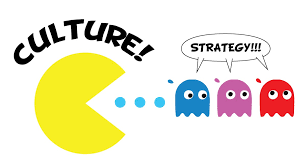
Culture Eats Strategy for Breakfast

It’s always been my belief that unless you first build a positive culture in the workplace, nothing else you try to accomplish will ever come to fruition.

So, when I read this famous quote that business guru Peter Drucker was alleged to have coined, “culture eats strategy for breakfast,” it came as no surprise that the foundation of any successful enterprise is built on its culture.

In fact, most people don’t quit companies or leaders, they quit organizational cultures.

“The best way to improve the team is to improve yourself.”

-John Wooden

The Learning Never Stops

In my capstone classes, students learned that their time at the university should be considered a launch pad to a lifetime of learning. Leaders never stop learning.

“When I am through learning, I am through.”

-John Wooden

Your Attitude Determines Your Altitude

Your own personal culture is your attitude. Whether it is positive or negative, it’s yours to control.

As a hiring manager, I always hired people on their attitude; everything else can be trained.

In life, more than any other factor, your attitude pretty much determines where you will go –  and how far you will go.

Ron Lundy

One of my favorite radio personalities was Ron Lundy. I first heard Ron on Music Radio 77 – WABC and immediately fell in love with the contagious, upbeat, positive attitude he presented on his radio show.

When WABC switched formats from music to talk, Ron Lundy found himself out of work, but would eventually be hired by Joe McCoy at WCBS-FM.

Every air shift on CBS-FM was already filled, so in order to create a time period for Ron, Joe McCoy would need to shorten everyone’s air shift, and convince his general manager why this hire would be beneficial to the radio station.

As I heard the story, Joe’s pitch to his GM was that Ron wasn’t just a powerful personality that would attract more listeners to CBS-FM, but that Ron was the type of guy that provided a positive culture inside the radio station, inspiring everyone to do their jobs better.

Attitude in Managing

One of my radio mentors was Phil Weiner (WBEC/WQRB/WUHN/WUPE). When I departed for my first solo general manager position in Atlantic City, he shared with me the most important thing he learned as a general manager, “Whatever your attitude is, when you enter the radio station each day, that will become the attitude of your fellow employees. Keep your problems to yourself and always maintain a positive, upbeat, enthusiastic attitude.”

It may have been the most important advice of my forty-year radio management career.

In my second career as a college professor, knowing that one’s attitude is contagious, I brought that same positive attitude and energy into the classroom.

“Attitudes aren’t taught, they’re caught.”

-Margaret McFarland

Everyone You Meet Can Teach You Something

No matter how far in life you’ve gone, or how many degrees, medals or trophies you’ve earned, stay humble. Every person you meet carries knowledge about life that you can benefit from. Stay curious and be willing to soak up the wisdom from everyone you come in contact with.

“It’s what you learn after you know it all that counts.”

-John Wooden

Radio is a People Business

All of my life, I’ve invested my energies in the development of people. Many of them today are owners and managers of their own broadcast operations. As a general manager, I was proud to work with some great and talented individuals.

“You handle things. You work with people.”

-John Wooden

When it comes to managing people, one size does not fit all. I treated each member of my team for the unique personality they were, valuing their talents, and skills, as well as understanding that we all come with our own issues, problems and demons.

Great radio stations, full of talented people, can be an exceptionally exciting workplace.

“The worst things you can do for those you love

is the things they could and should do for themselves.”

-Abraham Lincoln

It’s important to have a culture that allows people to fail. Often the greatest wisdom comes from things that go wrong. As long as you have given your best effort, you are never a failure.

Great managers and teachers are great coaches of people.

The Big Four

Consider these four things when creating culture in your organization:

  1. Culture is created by the behaviors you tolerate.
  2. Change starts with YOU. You can’t expect your people to change if you won’t.
  3. Leadership gives you a voice at the table, not the voice.
  4. Listen to everyone and take their opinions into account when you make the final decision for moving forward.

“Much can be accomplished by teamwork

when no one is concerned about who gets the credit.”

-John Wooden

8 Comments

Filed under Education, Mentor, Radio, Sales

You Can’t Make an Elephant into a Giraffe

Let’s face it, somethings in life are what they are. Giraffe’s have long necks and elephants have big ears, big feet and trunks. Just as pickup trucks were designed for a different purpose than speed boats. So, why do we think that radio can somehow defy the natural order and become something that it was never designed to be?

Work on Your Strengths, Not Your Weaknesses

One of the lessons I learned in classes at Clear Channel University* was how people often focus on their weaknesses and try to improve them. However, studies have shown that when we focus on our strengths, we grow faster than when we try to improve our weaknesses. Added benefits to focusing on our strengths are that we become happier, less stressed and more confident.

The cure for constantly falling short of your goals is to work on improving where you’re already strong, rather than on areas where you are weak.

Why Doesn’t Radio Focus on Its Strengths?

Entercom changed its name to Audacy, saying:

“We have transformed into a fundamentally different and dramatically enhanced organization and so it is time to embrace a new name and brand identity which better reflects who we have become and our vision for the future. Audacy captures our dynamic creativity, outstanding content and innovative spirit as we aspire to build the country’s best audio content and entertainment platform.”

-David Field, CEO

Audacy is the fourth largest radio company in America (based on the number of radio stations owned) and just like the top three radio operators ahead of them, none use the word “radio” in their name.

It was in 2010, that National Public Radio announced that it would be using “NPR” as its brand name, even though its legal name remains the same. NPR celebrated its 50th birthday in 2020, the same year that American commercial radio turned 100.

What is it about the name “radio” that has radio station owners and operators distancing themselves from this word?

Finding Your Strengths

If you want to grow your strengths, first you need to identify them. This week, Pierre Bouvard, Chief Insights Officer at Cumulus Media/Westwood One, did a pretty good job of that in his blog. While Pierre was trying to correct some misperceptions about broadcast radio, he also gave us a good place to start with identifying some of its strengths. Here are five Pierre cites:

  1. Radio reaches 88% of persons 18 years of age and older each week in America.
  2. Radio reaches the 60% of Americans who are back in their cars commuting to work every day. (The Radio Advertising Bureau says radio’s reach in the car is 83% in 2021, making it the dominate form of media on-the-road.)
  3. Radio’s audience shares are twenty-one times larger than ad-supported Pandora and ten times that of ad-supported Spotify, according to Edison Research.
  4. Radio delivers an impressive Return On Investment (ROI). Pierre says “for example, for every $1 invested in an auto aftermarket AM/FM radio campaign, there is a $21 sales return.”
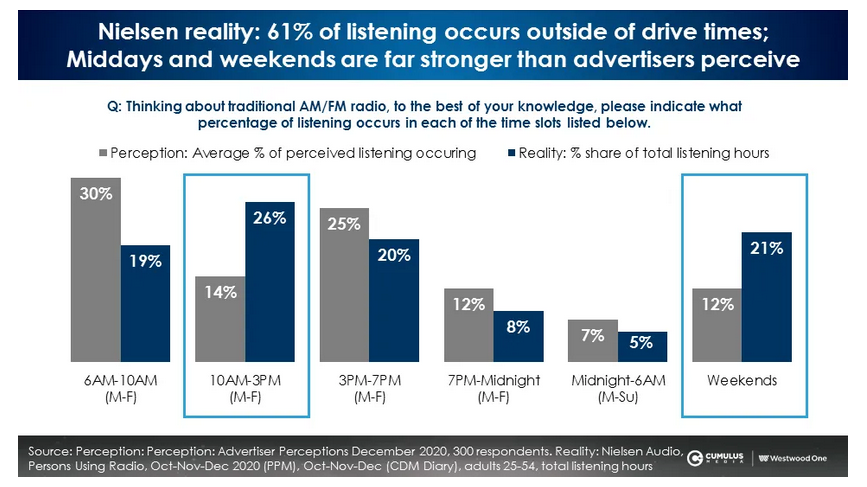
5. Radio delivers listeners at all hours of the day, seven days a week.

Radio’s Analog Audience

Lee Abrams posted a short YouTube video back in August 2020 that you might have missed explaining his “PSYCHOGRAPHIC CHART.” If you’re in radio, you should watch it now.   

View the full twelve-minute presentation HERE What I’d like to focus on is the two quadrants that Lee has labeled as “Analog Generation/Culturally Sophisticated & Culturally Unsophisticated.” These people are radio listeners. They were born with and are comfortable with analog media.

Lee makes clear that you can’t satisfy more than one quadrant. Pick one and super serve those people to the point of making what you do appalling to people in the other three quadrants.

The bottom line is that you can’t be all things to all people, but you can be everything to some people. This is really Marketing 101.

But the Future is Digital

Yes, the future of media is digital and it can’t be ignored. But you can’t make radio into something it’s not and never will be. It’s a powerful one-to-many media entity; leverage that.

The Australian Radio Network’s Neuro Lab is doing some interesting research into how a listener’s brain responds to audio, whether it’s coming from the radio, a podcast or streamed.

What should make all radio owner/operators sit-up and take notice is the fact that “radio showed the strongest ability to engage listeners and for extended periods of time, racking up 60% more neural engagement than any other audio format.” Podcasts showed higher levels of memory encoding and streaming was noted for promoting positive attitudes towards brands. You can read the full report HERE

All Audio is Not Created Equal (in the Brain)

Dr. Shannon Bosshard, the neuroscience specialist who conducted this groundbreaking research said, “This is the first time that anyone has demonstrated, from the perspective of the brain, that radio, podcasting and music streaming are processed differently and should be treated differently, in the same manner that audio and audio-visual mediums have been.”

Radio Financed TV

It was the incredible revenue streams produced by broadcast radio that were used to build out the medium of commercial television. TV also stole radio’s stars and programs, leaving the radio industry to reinvent itself and compete with television for advertising.

Today, radio is once again finding itself the “money mule” charged with funding the buildout of digital initiatives, having to sacrifice the very thing that makes radio unique in the process; its personalities. And then, just like with TV, radio has to compete with digital for advertising.

Fred Jacobs in his TechSurvey 2021 revealed how important the Radio Personality is to today’s radio listener.

But this shouldn’t come as a surprise. For generations, the radio personality has been the primary attraction drawing audiences to one radio station over another. At his peak, Dan Ingram on WABC in New York was said to be more popular to the station’s listeners than The Beatles.

Great Radio

In the end, great radio isn’t any one element, it’s all of them – personalities, jingles, promotions, station imaging, community involvement and companionship – that makes a radio station part of a listener’s family. People have favorite movies, but not a favorite movie theater; they have favorite television programs, but not a favorite television station; however, people DO HAVE favorite radio stations.

Remember that. Leverage that. Make money knowing that.

*Clear Channel University was closed in 2009

2 Comments

Filed under Education, Mentor, Radio, Sales

Radio & Urban Contemporary, Is the End Nigh?

35Once upon a time, radio was pretty much like the TV show The Voice. We only knew what we heard coming through the speaker on our radio.
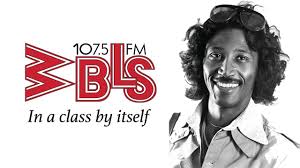
Those pilots of the airwaves were magical.

We may not have had a clue as to what they looked like, but we created a persona in our minds as if we did. It was never even close to the real person.

Who’s the Black Guy?

I got my best friend hooked on radio and each day at school we’d compare notes of who we listened to the night before, how far away the stations we picked up were, and where on the dial they were located.

Music Radio 77 – WABC out of New York City threw a pretty consistent signal over Western Massachusetts at night and so that got a lot of my after dark listening time. My friend listened to WABC often as well, so you can imagine our surprise the first time we saw a picture of the WABC All Americans (that’s what they called their air personalities back in the 70s). We looked at one another and said simultaneously, “Who’s the Black Guy?”

That personality was Chuck Leonard. His cool factor just went up in our eyes. Chuck Leonard was not only heard over WABC late at night but on one of our local ABC network affiliated radio stations doing the feature show “Sneak Preview.” Chuck was famous for one-liners like “The best that ever did it, and got away with it.” Yes, we heard a lot from Chuck Leonard and loved everything he did. But in our minds, we had never thought of him as being Black. Once we found out, we didn’t care.

Urban Contemporary Radio

What does that name mean to you and what does it mean to your listeners?

Has the term “urban contemporary” migrated over the last several decades as to its meaning?

The answer in two words: Most Likely.

At the beginning of June 2020, Republic Records announced it would “remove ‘urban’ from the label’s verbiage in describing departments, employee titles and music genres,” explaining that “over time the meaning and connotations of ‘urban’ have shifted and developed into a generalization of Black people in many sectors of the music industry, including employees and music by Black artists.”

A few days later, the Grammy Awards announced it would be renaming its “Best Urban Contemporary Album” — category now being — “Best Progressive R&B Album.”

Motown Sound

Once upon a time, “kid’s music” was just called contemporary or Top40. Everything that wasn’t your parent’s music was embraced. It was the silent rebellion for many of us.

My favorite artists were The Four Tops, The Supremes, Stevie Wonder, Marvin Gaye, The Temptations, The Spinners, Smokey Robinson & the Miracles, Al Green, Martha Reeves, Gladys Knight, Michael Jackson as well as many others. Berry Gordy’s Motown Records out of Detroit would craft the sound that quickly integrated America’s contemporary radio stations.

But it was DJ Alan Freed at WINS, who coined the term “rock & roll,” that would be the first to break down the color barrier and integrate the music he played over the radio. It’s almost hard to believe that people in his day considered Freed a threat to society because he was playing “race music,” also known as music by Black artists.

WBLS

In 1974, legendary disc jockey and program director Frankie Crocker, coined the term “urban contemporary.” Crocker said his format on WBLS was a broad mix of R&B, hip-hop, disco, rap, and everything from James Brown to Dinah Shore.Frankie Crocker

In essence, it was the best music featuring the songs his radio station’s listeners wanted to hear most.

Black music stations, while popular with listeners, had trouble attracting advertising back then. So, the brilliance of calling WBLS “urban contemporary” enabled Crocker to evade being branded with the Black label. The urban contemporary imaging helped make white advertising executives more comfortable with placing advertising for their clients on that radio station.

Format wise, Crocker brought the concept of ‘playing the hits’ that made radio stations like WABC so loved, from AM to FM radio.

It’s hard to find any radio station nowadays that plays the wide variety of artists, styles and music that one could hear over a single radio station back in the 70s, as this 1970 Top 100 Songs from WABC demonstrates.

iHeart Phasing Out the Word ‘Urban’

Most recently, Rolling Stone magazine wrote an article about how iHeart, and the radio analytics company Media Base owned by iHeart, were working to remove the word ‘urban’ due to the word being controversial in industry-wide discussions around systemic racism.

The use of the word ‘urban’ will be removed from not just the way formats or playlists are described but from job titles too. A representative for iHeart says the term is “definitely outdated.”

Black & White

Unfortunately, this issue may not be as black & white as it might first appear. Not all organizations or individual Black executives are willing to give up the ‘urban’ descriptor, believing that it’s more of a distraction than action for change, saying the “problem lies in the infrastructure, in the system – not in the word.”

Real Change

This issue is not just an American one, but a global one. The student newspaper, The Boar, from Warwick University in the United Kingdom wrote about the “Institutionalized Racism in the Music Industry.”

The article, written by Bailey Agbai, perfectly summed up the current situation:

“As more people start to actively recognize just how deeply racism infests our society, it is no surprise that it plagues the music industry too. It’s important that we continue to speak up and advocate change so that the institutions within the industry amend their ways and finally reflect the music that they unfairly exploit. The industry is a pool of wealth and it is important that those with influence use not only their words to combat racism, but also their resources to impact real change.”


4 Comments

Filed under Education, Mentor, Radio

Efficiency vs. Resilience

Rick SklarOn November 9, 1965, around 5:21pm in the afternoon, WABC listeners heard something unusual coming through the speakers on their battery powered transistor radios. WABC was playing Jonathan King’s “Everyone’s Gone to the Moon,” but it sounded different. It sounded like it needed a shot of Geritol, as the recording turned slower and slower. Even WABC’s famous chime was off key, and popular afternoon personality Dan Ingram tried to make fun of what was happening. You can hear that moment by clicking HERE.

The 1965 Northeast Blackout

As it was happening what no one knew, was that the power grid was collapsing. Inside Dan Ingram’s studio, the lights were flickering, the music cartridges were playing at slower and slower speeds and the journalists in the WABC newsroom were beginning to see the wire services report that city after city along the Eastern seaboard were going dark.dan ingram 1965

From Maine to New Jersey, America was experiencing a regional power grid failure. Many radio stations without emergency generators were silenced, but WABC was still on the air due to the station’s transmitter facility being located in Lodi, New Jersey. New Jersey was on a different power grid than New York City.

WABC would rush Dan Ingram to Lodi with a stack of records and have him continue his show from there.

Rick Sklar & Building Resilience

Rocking AmericaRick Sklar wrote in his book “Rocking America” that the blackout helped him to focus his attention on technical reliability. “A station can have the best mix of music and the top jingles, but if the tapes break, the cartridges jam, or the music fidelity is off, the ratings (aka audience) begin to evaporate,” Sklar wrote.
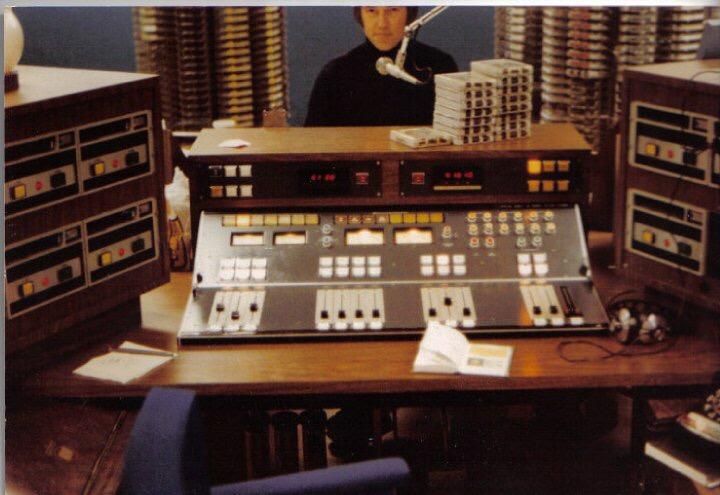
Early in his tenure as the program director at WABC, Sklar would be frustrated by the technical obstacles that got in the way of his building Music Radio 77 into the #1 radio station in The Big Apple.

Lessons Learned at NASA

When America was ready to put a man on the moon, Sklar decided he wanted to be there for that significant moment in history.

He was fascinated by the confidence of NASA that they would land men on the moon and bring them back home safely. He was envious of their certainty and of their equipment and systems to get the job done. He wanted to attain that same kind of certainty for WABC when he returned home to New York.

In drilling down mission control’s engineering confidence, he learned that NASA used triple measurement and triple backup on everything. Sklar would learn from Walter Häusermann, the man who designed the guidance systems for the V-2 rockets, and those of the Apollo command module, “If two of the three readings on any measurement agree, we assume that it is the third meter and not our readout that is at fault.”

WABC Builds Resilience

When Rick Sklar got back home, he began to implement what he had learned at NASA, in the operations at WABC. He built two identical main control rooms and made sure a production studio could act as an air studio if needed. He built the studios with eight cart machines, instead of the previous five, three being ready in case of a failure of any of the primary five machines. He had every one of the two thousand-odd cartridges that made up the WABC sound, duplicated for each studio. The studio to transmitter broadcast land lines were broken into a northern and southern route from the main studios to the transmitter site in Lodi, with a microwave link as the third method for delivering programming to the transmitter.

George Michael WABC in NASA inspired studio

George Michael at WABC in NASA inspired air studio (photo by Frank D’Elia)

Rick Sklar had thoroughly reviewed every element of the operation and implemented ample redundancy to insure a consistent and reliable delivery system for his programming.

Resiliency in People

There’s only so much repetition in equipment that can protect you from disruptions, in order to truly have a “fail-safe” operation, you must have good backup people.

And there’s the real rub in today’s radio world. Where are the people?

As I wrote in last week’s blog, Good Money After Bad, the need to build efficiency in my Sussex, New Jersey radio property saw the elimination of not only full-time employees but the backup people so critical in providing the over-the-air and online services so necessary during times of winter storms.

Global Pandemic

COVID19 is revealing the tradeoffs between building operating systems for efficiency, versus resiliency. These tradeoffs have been occurring in all areas of corporate America, not just broadcasting. This pandemic presents us all with opportunities to rethink of how prepared we are to handle a Black Swan Event. It also has shown us ,simply doing things the way they’ve always been done, isn’t necessarily how they can be done or should be done going forward.

Resiliency and efficiency are polar opposites and every business needs to mind its bottom line and deliver a profit to stay in business. The leaders will learn to invest in resilience efficiently.

Look for that to be the in demand skill in all companies as we digest the lessons of this global event.


12 Comments

Filed under Education, Mentor, Radio

What’s the Purpose of a Radio Station?

WSM Tower SiteRadio is a business.

Peter Drucker said the purpose of a business is to create a customer.

For radio, that means creating two types of customers: 1) a listener and 2) an advertiser and when done correctly, a radio station makes a profit.

Making Money

For most of my radio career, radio enjoyed a revenue expansion that rivaled the infamous “internet bubble.” Owning a radio station was considered a license to print money. Bottom lines often delivered a profit of 25 to 50% or more, so, while those profits were noticed by Wall Street investors the ownership limits on radio stations kept them away. Investors were frustrated that there was no way to scale up the size of a radio broadcast company.

Telcom Act of 1996

Then President Bill Clinton signed the Telecommunications Act of 1996. It relaxed radio’s ownership rules making it possible for one company to own multiple radio stations in a single market.

Wall Street loved the change! The money poured in from eager investors, and companies like Clear Channel, Citadel, and Cumulus quickly bought as many stations as they could using other people’s money. Mom & Pop radio operations had multiple companies vying for their properties and radio station values soared.

Ownership Limits

In 1953, the Federal Communications Commission (FCC) adopted its so-called 7-7-7 rule to encourage diversity of broadcast ownership. In essence, no single owner could own more than 7 AM radio stations, 7 FM radio stations, and 7 television stations in the entire United States of America.

By July of 1984, the FCC said they sought to encourage media competition and increased the number of radio and television stations a single owner could control to 12-12-12. The FCC Chairman was Mark S. Fowler. The President of the United States was Ronald Reagan. The five member FCC was 3 Republican appointees and 2 Democratic appointees. The vote to expand the ownership limits was 4 to 1 in favor.

“Bigness is not necessarily badness,” Chairman Fowler is reported saying. “Sometimes it is goodness.”

The New York Times reported reaction on Capitol Hill to the expansion of ownership limits this way:

On Capitol Hill, there was mixed reaction to the plan to abandon all limits on broadcasting ownership in 1990, although sentiment has grown in recent years for raising the ownership maximum somewhat.

Representative Timothy E. Wirth, the Colorado Democrat who is chairman of the House telecommunications subcommittee, said, ”The 12-12- 12 rule is just as arbitrary as the 7-7-7 rule.”

Mr. Wirth said a broad bipartisan consensus in Congress favors adoption of ”objective, long-term rules that assure diversity and competition.” He said such rules would provide for increased broadcast ownership but would not completely deregulate it.”

He went to say “If they deregulate in 1990, we could end up with a handful of companies owning every broadcasting outlet in the country.”

President Ronald Reagan

Reagan loved two things, cutting taxes and eliminating regulation. Remember Reagan famously said that “Government isn’t the solution to our problems, government is the problem.” Reagan’s pick for FCC Chairman, Mark Fowler, fully embraced this vision and actively applied it to the FCC.

However, the prediction of Congressman Timothy Wirth wouldn’t come into existence until President Bill Clinton signed the Telecommunications Act of 1996. It would be the first significant overhaul of the 1934 Act in more than sixty years.

Radio station ownership in the first five years under this new act went from 5,100 owners to 3,800.

Instead of opening up ownership to new and more diverse ownership, it created an opportunity for media monopoly. The Wall Street funded radio companies could now buy out the Mom & Pops and the temptation to sell at never-before-seen-multiples was too good to pass up.

Operating in the Public Interest, Convenience and Necessity

When no one really knew what radio broadcasting would become, they did know they wanted radio to be a communications business that would serve its community of license for convenience in good times and of necessity in times of trouble. The airwaves were considered to be owned by the public, so operating in their best interests was a requirement to being an FCC broadcast licensee.

Changing Competitive Landscape

Historically, radio stations competed against one another. Most markets had such battles as, WLS vs. WCFL, WMEX vs. WRKO, WPTR vs. WTRY, KHJ vs. KRLA etc. When FM radio began to take over from AM, a station such as WABC no longer had just WMCA to beat, but now WTKU-FM too, which offered better fidelity and stereo. This new radio competition replicated in every radio market in America.

Then came Satellite Radio, followed by Pandora along with other pureplay streamers, and podcasts so that today, the radio competition landscape lines are blurred beyond recognition.

Mission vs. Platform

Today’s communications company needs to clearly define its mission and needs to earn the trust of all of its stakeholders. That means building trust between its employees, advertisers and listeners.

We need to stop thinking of “radio” as AM or FM.

We need to think of radio as being the audio leader for creating an environment for convening and supporting groups. We need to be preparing for a future that is still coming into focus.


26 Comments

Filed under Education, Mentor, Radio, Sales

Great Expectations

OR FMI read with great interest the five part series by Matt Bailey on “The Alexa Effect.” In the 5th and final installment Matt shared what he called the “radio weapon Spotify will never have.” What is it? The radio personality. He wrote:


  • “A radio personality can tell you the backstory of a breakthrough artist that makes you want to hear her work.”

  • “A radio personality can point out that crazy line in the second verse to stay tuned to hear.”

  • “A radio personality can engage you to smash or trash a song on the station’s social media.”

  • “A radio personality can give you the chance to be among the very first to hear a new song by a star artist.”

“A radio personality can add context that will make listeners excited to hear a song that otherwise would simply be weird and unfamiliar. It’s a deeply personal and emotionally engaging weapon no algorithm can match. When we stifle their voices and their role in introducing new music simply to avoid potential tune-out, we might win a few tenths of a point in the PPM battle, but we will lose the new music war to Spotify.”

Consolidation & Voice Tracking

I don’t disagree with Matt, but I lived through the ramifications of the Telcom Act of 1996 and the consolidation of radio stations, along with the rollout of voice tracking.

Clear Channel called it “Premium Choice,” and we were told it would replace our local personalities with big market talent.

I watched in market after market as radio personalities, who were like members of the radio listener’s family, were sent to the unemployment lines. Relationships that took years, even decades to establish, wiped out in an instant.

Early Media Expectations

I grew up at a time when the family television set received a signal from a couple of antennas on the roof. We had two channels, which meant we received two television networks, CBS and NBC. If you wanted to change the channel, you had to get off the couch and change it. There was no remote control.

Our radios had both the AM and FM bands, but I remember wondering why. I often scanned the entire FM band to hear nothing at all with only the AM band picking up radio signals.

My early media expectations were two TV channels and AM radio stations. The radio provided a lot more variety, plus I had a radio in my room and our family had a single TV located in the living room. I controlled my radio, my parents controlled the family TV.

Media Expectations Change

In time, I would come to expect television to be in color, to be connected to a cable and have a remote control to easily change the multitude of channels I could now receive, from the comfort of my couch.

Radio would expand to the FM band and a whole new type and style of radio was born. The one thing that connected AM and FM radio was the radio personality. Every station had them and the decision to listen to one station over another was because of the radio personality.

In fact, I wrote an article on the power of the radio personality back in 2015 entitled “We Never Called It Content.”

I wrote this article after reading about the latest round of “forced retirements” in the radio industry.

And if you thought this type of downsizing was only occurring in large radio metros, the movie “Corporate FM” told the story of how in the 80s, ninety percent of mass media in America was owned and controlled by about fifty different companies, but after the Telcom Act of 1996 it was down to just six corporations.

New Media Brings New Expectations

Let’s fast-forward to today. I cut the cord on cable TV two years ago and all of my television viewing is streamed. Netflix, Amazon Prime, Sling TV and YouTube provide me with more hours of television entertainment and information than I could ever have time to watch, and I’m retired.

Amazon Echo provides me with all of my audio entertainment and I do mix it up between stations via TuneIn and the pureplays like Pandora and Amazon Music.

I also read a lot and subscribe to several online newsletters that all link to the original source of the material.

Which leads me to this conclusion, my calendar age did not cement my media habits. They’ve been fluid all of my life.

My 21st Century Great Expectations

  • I expect NPR to open up my world to things I should be aware of, that I might not have been. I expect them to also provide me with more depth to the stories in the news. I expect them to have all of this posted online for almost immediate access. They don’t disappoint.
  • I expect my television viewing to be On Demand and commercial free.
  • I expect my music listening to match my mood and be there by simply asking Alexa to play my favorite channels when I want to hear them.
  • Finally, I expect I’m not alone in these “21st Century Great Expectations.”

Rewound Radio DJ Hall of Fame

On Saturdays, I enjoy asking Alexa to play Rewound Radio so I can hear another fabulous radio personality featured in the weekly “DJ Hall of Fame.” The other weekend they featured WOR-FM out of New York City and the air personality was Johnny Donovan. OR-FM air checks are all in stereo and the music mix has plenty of variety. It was a time when Music Radio 77 – WABC dominated the world’s airwaves on the AM band. But the one thing I notice in these weekly trips down memory lane is how integral the radio personality was in the total program. They were a constant companion. They really were radio’s “secret weapon” to attracting faithful listeners.

The question I ponder often is, was this period of radio history akin to the vaudeville period of theater. It filled the right hole at the right time but won’t ever be coming back again.

I welcome your thoughts.

17 Comments

Filed under Education, Mentor, Radio, Sales